Project-1: Powertrain for aircraft in runways
EV BATCH-17
>> Part A:
1. Search and list out the total weight of various types of aircrafts.
2. Is there any difference between ground speed and air speed?
3. Why is it not recommended to use aircraft engine power to move it on the ground at Airport?
4. How an aircraft is pushed to runway when its ready to take off?
5. Learn about take off power, tyre design, rolling resistance, tyre pressure, brake forces when landing.
>> Part B:
6. A. With necessary assumptions, calculate the force and power required to push / pull an aircraft by a towing vehicle.
B. Develop the model for the calculated force and power using Simulink.
7. A. Design an electric powertrain with type of motor, it’s power rating, and energy requirement to fulfill aircraft towing application in Simulink. Estimate the duty cycle range to control the aircraft speed from zero to highest. Make all required assumptions. Prepare a table of assumed parameters. Draw a block diagram of powertrain.
(Hint :DC7 Block)
B. Also, Design the parameters in excel sheet.
Objective:
1. Search and list out the total weight of various types of aircrafts.
2. Is there any difference between ground speed and air speed?
3. Why is it not recommended to use aircraft engine power to move it on the ground at Airport?
4. How an aircraft is pushed to runway when its ready to take off?
5. Learn about take off power, tyre design, rolling resistance, tyre pressure, brake forces when landing.
6. A. With necessary assumptions, calculate the force and power required to push / pull an aircraft by a towing vehicle.
B. Develop the model for the calculated force and power using Simulink.
7. A. Design an electric powertrain with type of motor, it’s power rating, and energy requirement to fulfill aircraft towing application in Simulink. Estimate the duty cycle range to control the aircraft speed from zero to highest. Make all required assumptions. Prepare a table of assumed parameters. Draw a block diagram of powertrain.
(Hint :DC7 Block)
B. Also, Design the parameters in excel sheet.
Explanation:
1. Search and list out the total weight of various types of aircrafts.
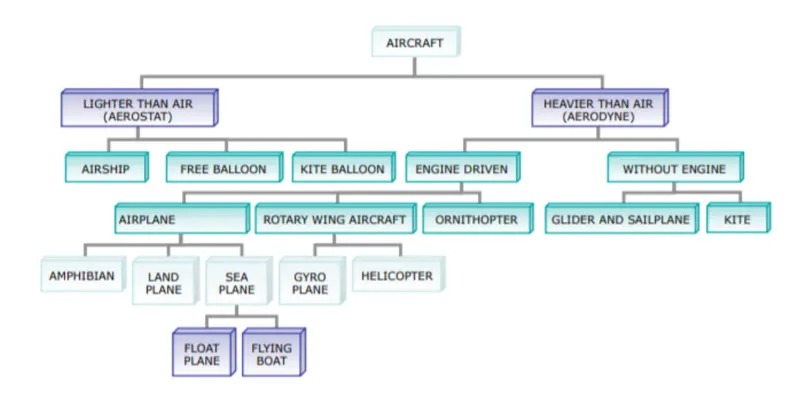
Here is the various types of aircrafts. According to total weight
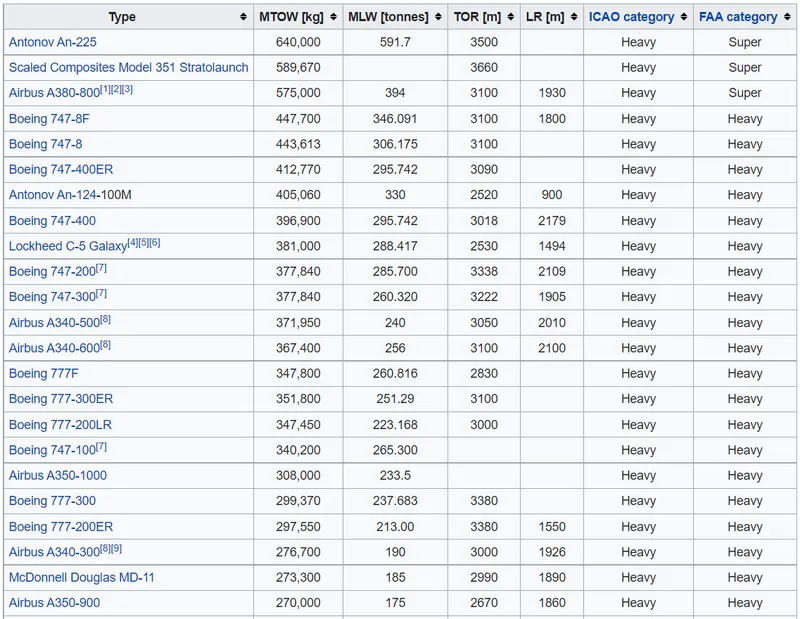
Here some Examples of aircrafts weights are given below
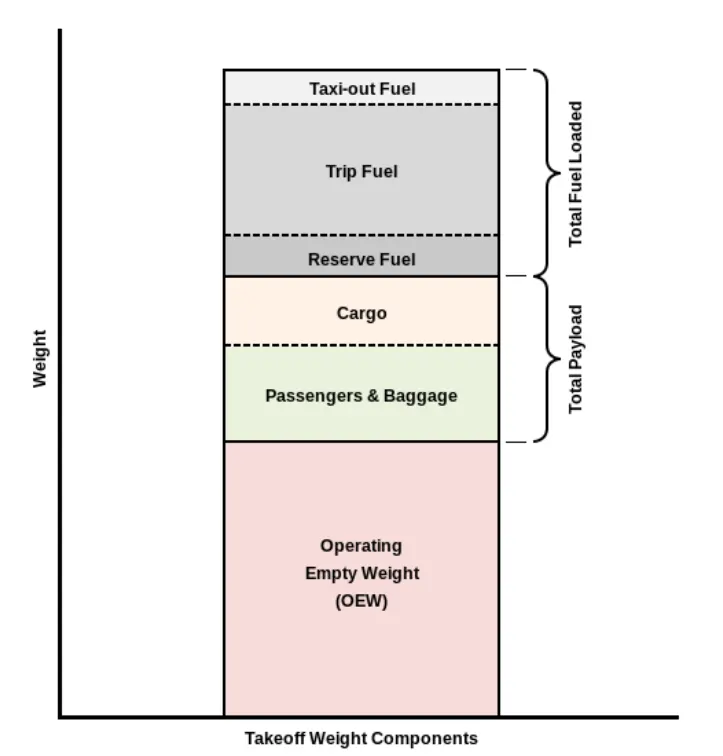
Here is the Types of aircraft weights
- Manufacturer's empty weight (MEW)
- Zero-fuel weight (ZFW)
- Operating empty weight (OEW) (Roughly equivalent to basic empty weight on light aircraft)
- Payload
- Maximum takeoff weight (MTOW)
- Regulated takeoff weight (RTOW)
- Maximum landing weight (MLW)
- Maximum ramp weight (MRW)
- Aircraft gross weight
2. Is there any difference between ground speed and air speed?
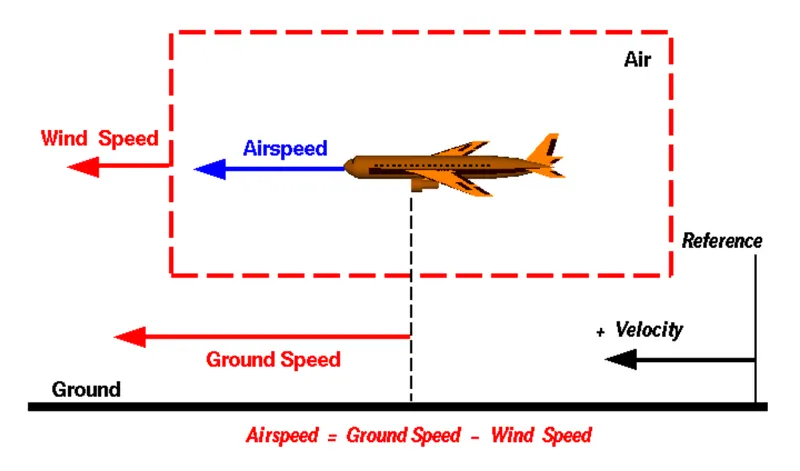
Ground speed:
It is when you are measuring the horizontal velocity of the plane relative to the ground. ground speed is the velocity of the plane relative to a reference point on the ground.
Air speed:
Air speed is the velocity of the plane relative to the winds around it. It is defined as the vector difference between the ground speed and the wind speed.
Airspeed = Ground Speed - Wind Speed
difference between ground speed and air speed?
On a perfectly says that the airspeed is equal to the ground speed. But if the wind is blowing in the same direction that the aircraft is moving, the airspeed will be less than the ground speed.
3. Why is it not recommended to use aircraft engine power to move it on the ground at Airport?
Although most aircraft are capable of moving themselves on the ground, it is not typically done due to the following reasons,
- The jet blast from the engines can damage the terminal building and nearby equipment. It can even throw away people standing nearby.
- Engines can blow sand and debris.
- Engines can suck in sand and debris which can cause serious damage to the engine. • It is easier for the truck driver to see the surroundings better than the pilot sitting in the cockpit with limited windows.
- The pushback truck driver knows the airport better than the pilot.
- The plane engines are very loud. This noise can add up substantially when multiple planes are moving around the airport.
- It won't be a pleasant experience for people sitting inside the terminal, as most people don't even like the sound of powerful motor-bikes. It saves fuel.
- Modern planes are huge. It is difficult to navigate such gigantic structures through limited space. An A380 is eight stories high.
- The pilots won't be able to see anything directly in-front of them or anything behind the wings.
4. How an aircraft is pushed to runway when its ready to take off?
Aircrafts are usually 'pushed' by ground vehicles known as tow vehicles such as tow trucks. It is used mainly to reverse an airplane from the terminal area, until it is in a position to move by itself. These tow trucks will only help move the aircraft to an area where the pilots can safely switch on the engines, not the runway! (Ground vehicles are rarely allowed to move on a runway (save for emergencies and inspection), and the aircraft is supposed to move to the runway by itself.
- Aircrafts don't have powered wheels, and hence cannot move in reverse (let alone forward by themselves). Imagine a tiny jet strapped to one of your toy cars; that's essentially how airplanes work on the ground!
- They go where the engines push them towards. (Note: There is a mechanism known as reverse thrusters, which allow the engine air flow to be pushed towards the front, but that is highly risky maneuver, and is only used to reduce speed immediately after landing.)
- Another reason to push back an aircraft to a safe area, is for safety reasons. The engines produce tremendous thrust from the exit, and an immense vacuum from the front; enough to suck in people, small vehicles, ground equipment etc.
- Hence it is a common procedure to start the engines once it is cleared away from the terminal area and lined up on a taxiway (roads that lead to the runway)
5. Learn about take off power, tyre design, rolling resistance, tyre pressure, brake forces when landing.
>> Take off power:
Take off power can be predicted using a simple measure of the acceleration of the aircraft along the runway based on force equilibrium.
The forces involved will be.
T is Thrust of propulsion system pushing aircraft along the runway.
D is Aerodynamic Drag of vehicle resisting the aircraft motion.
F is Rolling resistance friction due to the contact of wheels or skids on the ground.
During the take-off run, the imbalance in these forces will produce an acceleration along the runway.
m (dv/dt)=T-D-F
where, dv/dt is the acceleration along the runway and m is the mass of the vehicle.
This length will typically be considerably longer than the distance required to achieve rotation (flying) speed. A rough approximation is that runway total length is around 2. S₁
Therefore, Takeoff power = force displacement = dv dt 2-S1 (T-D-F). Si
>> Tyre design:
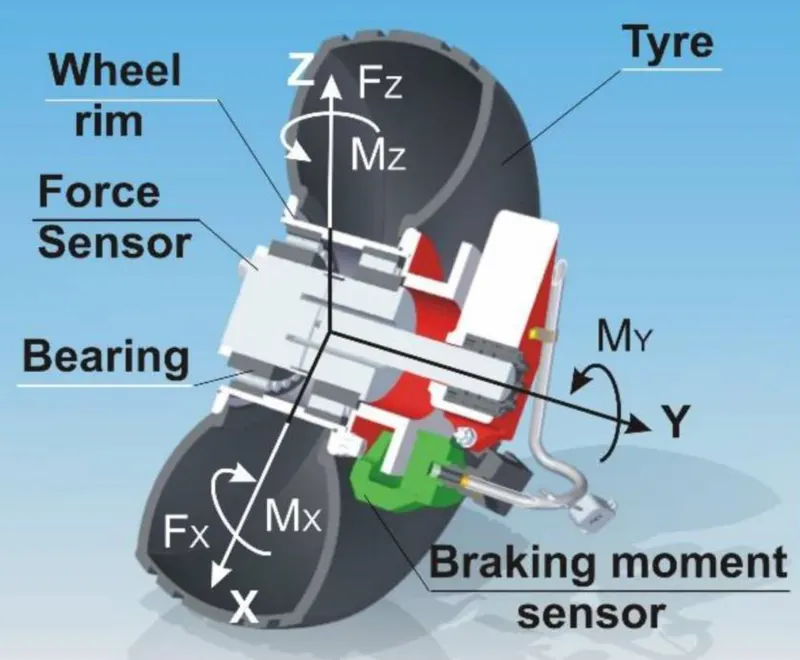
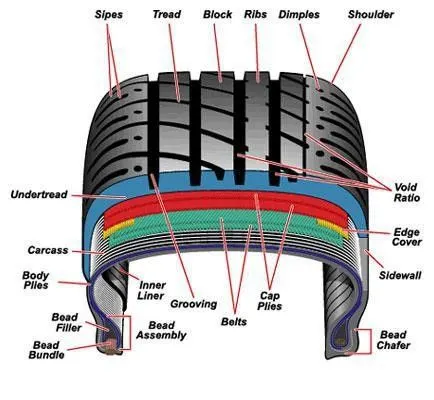
- Designing aircraft tires is a very intense undertaking The tyre is designed to withstand heavy loads while landing, take off, taxing, and parking.
- The number of wheels required for aircraft increases with the weight of the aircraft, as the weight of the aeroplane needs to be distributed more evenly.
- Aircraft tyre generates more heat during landing Aircraft drags the wheel until they match the rotational velocity of wheels. Due to this heat generates.
- Aircraft's tread pattern is designed to facilitate stability in high crosswind conditions, to channel water away to prevent hydroplaning and for braking effect.
>> Rolling resistance:
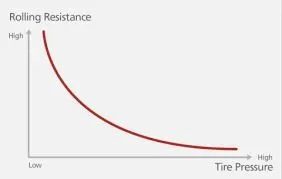
The friction between aircraft and runway will be proportional to the normal force exerted by the aircraft on the runway.
F= μ(W-L)
The normal force will be the difference between Weight of aircraft and Lift, the friction coefficient will be typically of a magnitude of 0.02 for a standard runway
>> Tyre pressure:
Aircraft tires generally operate at high pressures, up to 200 psi (14 bar or 1,400 kPa) for airliners, and even higher for business jets. The main landing gear was typically inflated to 232 psi (16.0 bar), whilst its tail bumper gear tires were as high as 294 psi (20.3 bar). The high pressure and weight load tyres were a significant factor.
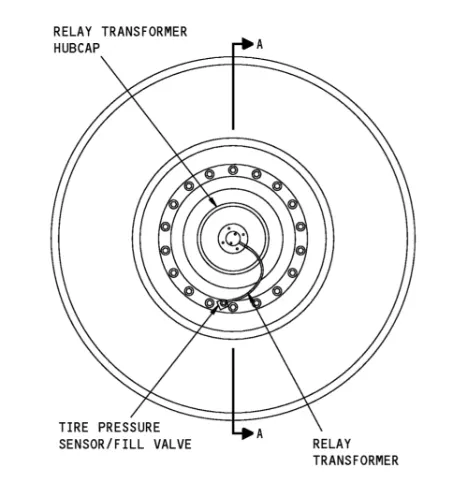
- Tests of airliner aircraft tires have shown that they are able to sustain pressures of maximum 800 psi (55 bar; 5,500 kPa) before bursting.
- During the tests the tires have to be filled with water, to prevent the test room being blown apart by the energy that would be released by a gas when the tire bursts.
- Aircraft tires are usually inflated with nitrogen to minimize expansion and contraction from extreme changes in ambient temperature and pressure experienced during flight.
- Dry nitrogen expands at the same rate as other dry atmospheric gases (normal air is about 80% nitrogen), but common compressed air sources may contain moisture, which increases the expansion rate with temperature.
- The requirement that an inert gas, such as nitrogen, be used instead of air for inflation of tires on certain transport category airplanes was prompted by at least three cases in which the oxygen in air-filled tires had combined with volatile gases given off by a severely overheated tire and exploded upon reaching autoignition temperature.
- The use of an inert gas for tire inflation eliminates the possibility of tire explosion
>> Brake forces when landing:
The landing run can be calculated in a similar fashion to the take off distance. The aim is again to minimise the distance.
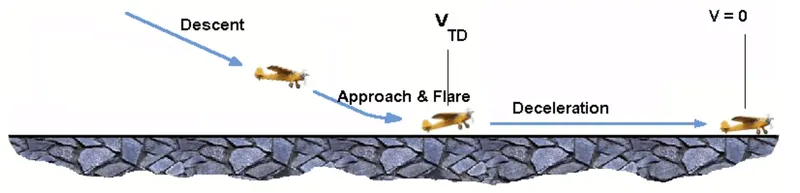
The touch down velocity should be approximately the stall speed of the aircraft in landing configuration. This will be achieved by a pitch manoeuvre during the flare portion of the approach which which increase drag an decelerate the aircraft to minimum flying speed. The deceleration on the landing roll from VTD to Vo will be accomplished by braking and reverse thrust. This can be solved by the average acceleration approach that was used to estimate the take-off roll.
m*(dv/dt) = -T-D-F
The negative acceleration or deceleration value will be based on friction coefficient for maximum braking and the value of reverse thrust (if available).
6. A. With necessary assumptions, calculate the force and power required to push / pull an aircraft by a towing vehicle.
Considering:Total mass of ther aircraft (including payload) for airbus a380=575,000kg.
Mass of the push back: 1000kg (assumed)
Rolling Resistance (Frr):
Coefficient of rolling resistance (Crr) = 0.002 (on tarmac)
Rolling resistance force is given by F, Cm-g
For the aircraft:
F= 0.002-575000*9.81
F, = 11281.5N
F,, = 11.2815kN
For the Towing Vehicle:
F= 0.002 1000-9.81
F = 19.62N
As the towing vehicle resistance is so less compared to the Aircraft because this is a heavy aircraft these can be neglected
Aerodynamic resistnace (Far):
Drag coeffcient(Cd): 0.025
Air Density (p) = 1.125kg/m^3
Frontal Area (A): 150m^2.
Velocity (v) = 14.5kmph or 4m/s
Far=1/2*Cd*ρ*A*V^2
Far= 1/2*0.025*1.125*150*4^2
Far= 1/2*0.025*1.125*150*16
Far=33.75N
As the vehicle and plane is moving at very low speed aerodynamic resistance can be neglected
Hill climbing Resistance :
Runways are constructed flat so Gradient resistance/hill climb force is neglected.
Total Resistance :
Ft = 11.2815kN
Power Required :
P=Ft*v
P=11.2815*4
P=45.26KW
The min power required by the tow vehicle is 45.26kw to taxi a heavy aircraft at 4m/s.
B. Develop the model for the calculated force and power using Simulink.
>> Simulink Block:
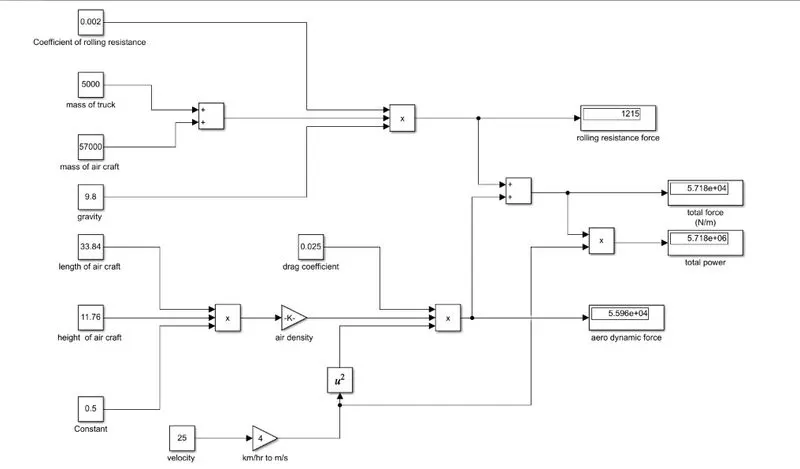
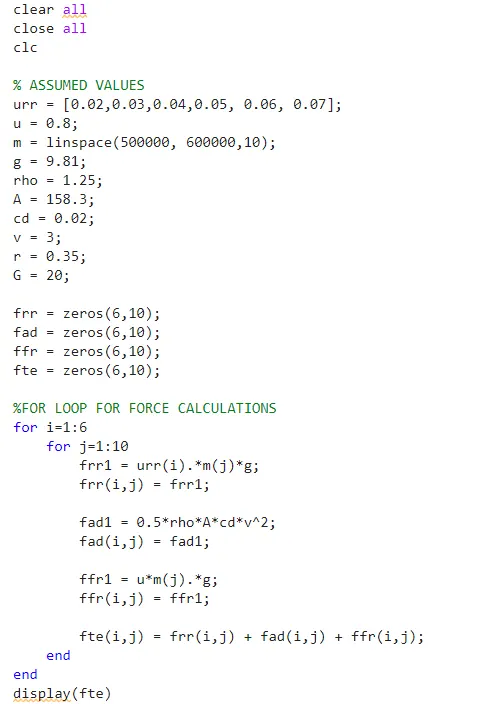
MATLAB code:
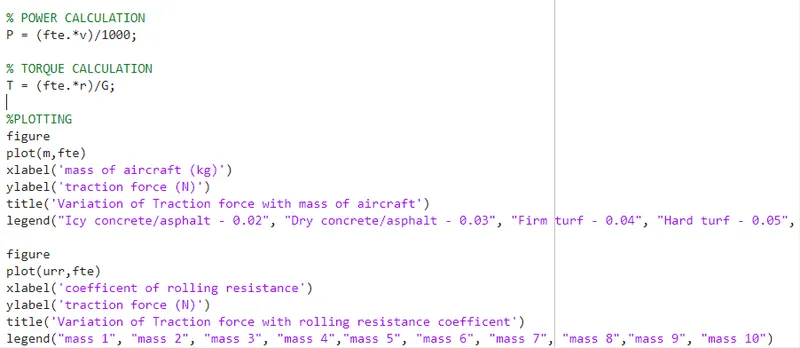
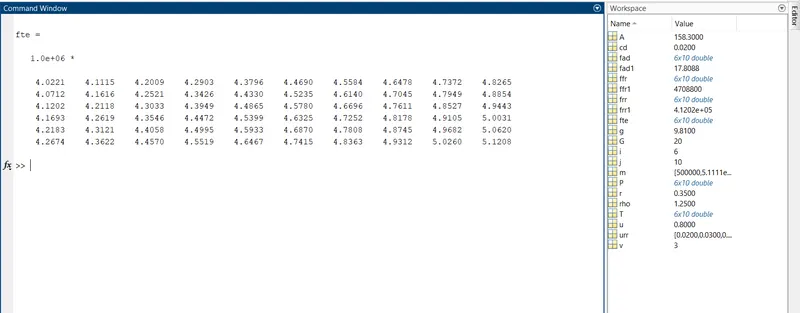
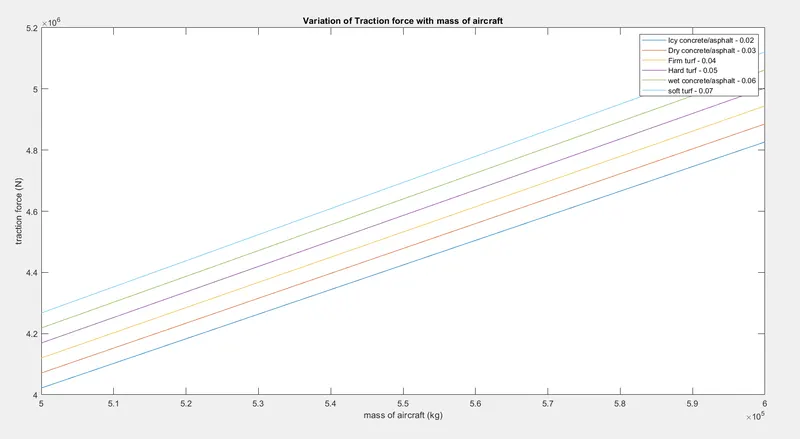
- If Traction force(N) will increase with increasing mass of aircraft (kg) in above graph
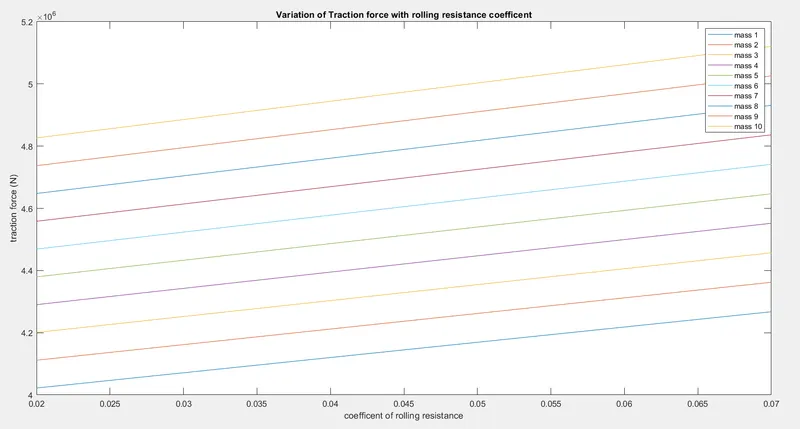
- In variation of traction force with rolling resistance coefficent there is increase in coefficient of rolling resistance when increases traction (N)
7. A. Design an electric powertrain with type of motor, it’s power rating, and energy requirement to fulfill aircraft towing application in Simulink. Estimate the duty cycle range to control the aircraft speed from zero to highest. Make all required assumptions. Prepare a table of assumed parameters. Draw a block diagram of powertrain.
Design an electric powertrain with the type of motor, it's power rating, and energy requirement to fulfill aircraft towing application. Estimate the duty cycle range to control the aircraft speed from zero to highest. Make all required assumptions. Prepare a table of assumed parameters. Draw a block diagram of the powertrain.
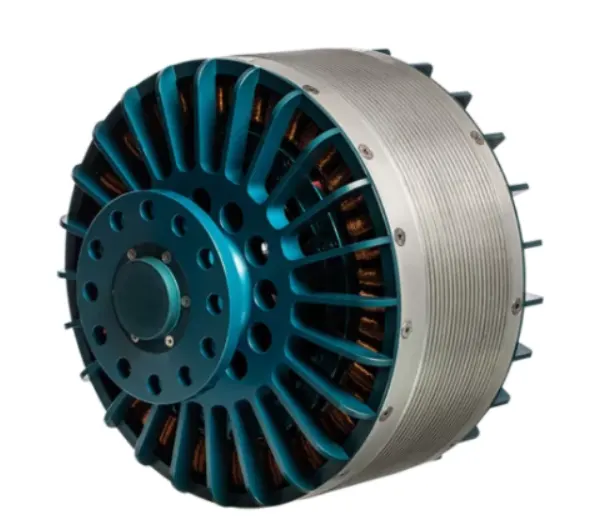
Technical Date:

Estimation of Duty Cycle:
Based on the calculation done in study 6
The Power Required for towing of the aircraft is 45.26kW.
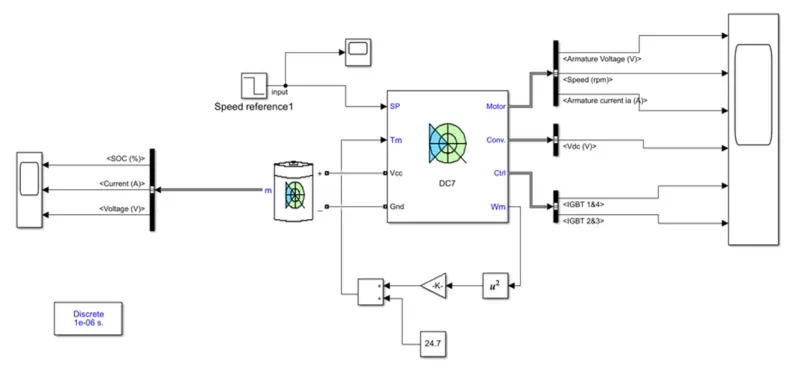
Motor Considred for the drive train is REB 90
Considering 60kW as continuous power, so the voltage will be 400V
Battery power is considred to be 550v .
Duty cycle is given by Vo/Vb
where Vo is motor required voltage
Vb is battery voltage.
d= 400 550 ⇒ 0.7272
As there will be losses due to the
resistance of FET and Inductance.
Correction factor is considred to be 90%
As there is 10% loss, the voltafge demanded by the motor should be 10% more than required d 0.7272 (1+0.1) 0.799≈ 0.8
so the voltage demand should be around 440V from the battery.
Assumed parameters:
Mass of aircraft = 575000 kg
Mass of the push back track = 1000 kg
coefficient of rolling resistance = 0.002
Drag coefficient = 0.025
Air density = 1.125 kg/m^3
Frontal Area =150 m^2
Velocity = 4 m/s
uphill gradient = 0 deg
Battery voltage = 550 v
correction Factor = 0.8
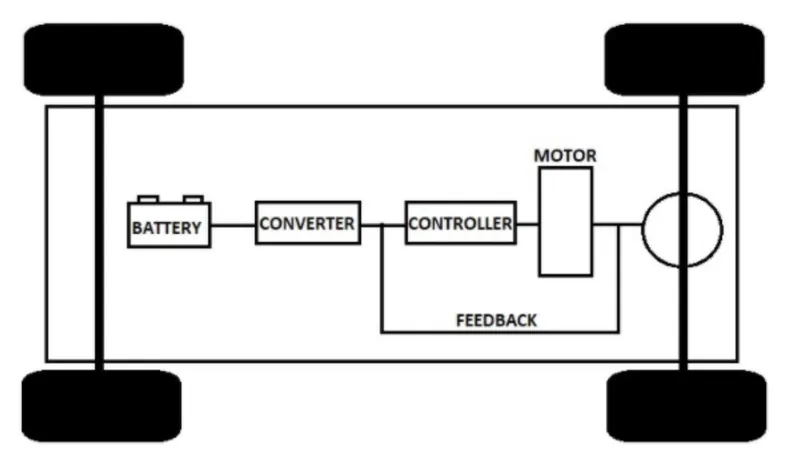
Block diagram of electric power train :
Simulation Block:
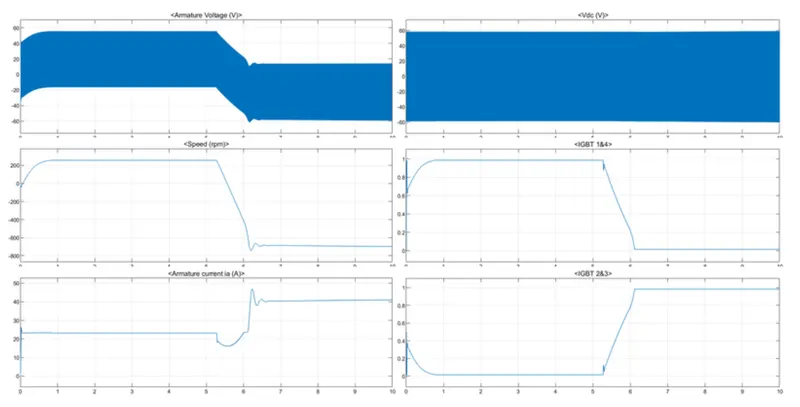
Results:
>> For motor Output:
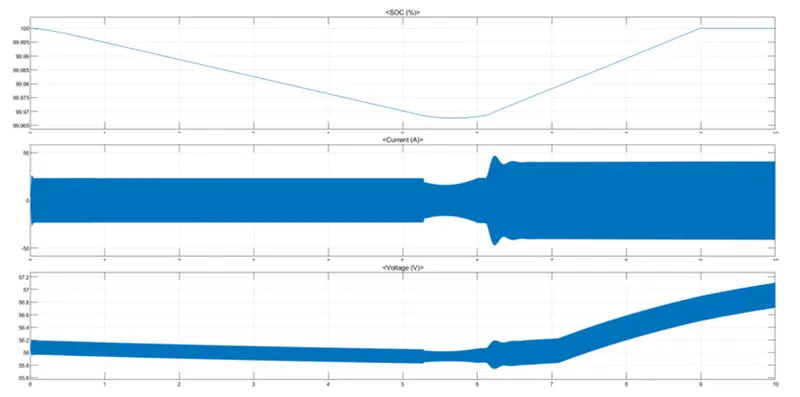
>> For Battery output:
B. Also, Design the parameters in excel sheet:
The Excel sheet will attached in the below files