Project-1: Powertrain for aircraft in runways
I AN A STUDENT OF LIVE BATCH -16
Part A:
1. Search and list out the total weight of various types of aircrafts.
SOLUTION:
the total weight of various types of aircrafts are
| Type | Maximum take-off weight [kg] | Maximum landing weight [tonnes] | Take-off run [m] | Landing run [m] | ||
|---|---|---|---|---|---|---|
| Antonov An-225 | 640,000 | 591.7 | 3500 | |||
| Scaled Composites Model 351 Stratolaunch | 589,670 | 3660 | ||||
| Airbus A380-800[1][2][3] | 575,000 | 394 | 3100 | 1930 | ||
| Boeing 747-8F | 447,700 | 346.091 | 3100 | 1800 | ||
| Boeing 747-8 | 443,613 | 306.175 | 3100 | |||
| Boeing 747-400ER | 412,770 | 295.742 | 3090 | |||
| Antonov An-124-100M | 405,060 | 330 | 2520 | 900 | ||
| Boeing 747-400 | 396,900 | 295.742 | 3018 | 2179 | ||
| Lockheed C-5 Galaxy[4][5][6] | 381,000 | 288.417 | 2530 | 1494 | ||
| Boeing 747-200[7] | 377,840 | 285.700 | 3338 | 2109 | ||
| Boeing 747-300[7] | 377,840 | 260.320 | 3222 | 1905 | ||
| Airbus A340-500[8] | 371,950 | 240 | 3050 | 2010 | ||
| Airbus A340-600[8] | 367,400 | 256 | 3100 | 2100 | ||
| Boeing 777F | 347,800 | 260.816 | 2830 | |||
| Boeing 777-300ER | 351,800 | 251.29 | 3100 | |||
| Boeing 777-200LR | 347,450 | 223.168 | 3000 | |||
| Boeing 747-100[7] | 340,200 | 265.300 | ||||
| Airbus A350-1000 | 308,000 | 233.5 | ||||
| Boeing 777-300 | 299,370 | 237.683 | 3380 | |||
| Boeing 777-200ER | 297,550 | 213.00 | 3380 | 1550 | ||
| Airbus A340-300[8][9] | 276,700 | 190 | 3000 | 1926 | ||
| McDonnell Douglas MD-11 | 273,300 | 185 | 2990 | 1890 | ||
| Airbus A350-900 | 270,000 | 175 | 2670 | 1860 | ||
| Ilyushin Il-96M | 270,000 | 195.04 | 3115 | 2118 | ||
| McDonnell Douglas DC-10 | 256,280 | 183 | 2990 | 1890 | ||
| Boeing 787-9[10] | 254,000 | 192.777 | 2900 | |||
| Boeing 787-10[10] | 254,000 | 201.849 | ||||
| Airbus A340-200[8][11] | 253,500 | 181 | 2990 | |||
| Airbus A330-900 | 251,000 | 191 | 3100 | |||
| Ilyushin IL-96-300 | 250,000 | 175 | 2600 | 1980 | ||
| Airbus A330-300[12][13] | 242,000 | 185 | 2500 | 1750 | ||
| Airbus A330-200[12][13] | 242,000 | 180 | 2220 | 1750 | ||
| Lockheed L-1011-500 | 231,300 | 166.92 | 2636 | |||
| Boeing 787-8[10] | 228,000 | 172.365 | 3300 | 1695 | ||
| Lockheed L-1011-200 | 211,400 | |||||
| Ilyushin IL-86 | 208,000 | 175 | ||||
| Boeing 767-400ER | 204,000 | 158.758 | 3414 | |||
| Airbus A300-600R[14] | 192,000 | 140 | 2385 | 1555 | ||
| Boeing 767-300ER | 187,000 | 136.08 | 2713 | 1676 | ||
| Concorde | 185,000 | 111.1 | 3440 | 2220 | ||
| Airbus A300-600[14] | 163,000 | 138 | 2324 | 1536 | ||
| Boeing 767-300 | 159,000 | 136.078 | 2713 | 1676 | ||
| Airbus A310-300[14] | 157,000 | 124 | 2290 | 1490 | ||
| Vickers VC10 | 152,000 | 151.9 | ||||
| Boeing 707-320B[15] | 151,000 | 97.5 | ||||
| Boeing 707-320C[15] | 151,000 | 112.1 | ||||
| Douglas DC-8-61 | 147,000 | |||||
| Airbus A310-200[14] | 142,000 | 123 | 1860 | 1480 | ||
| Airbus A400M | 141,000 | 122 | 980 | 770 | ||
| Douglas DC-8-32 | 140,000 | |||||
| Douglas DC-8-51 | 125,000 | |||||
| Boeing 757-300 | 124,000 | 101.6 | 2550 | 1750 | ||
| Boeing 707-120B[15] | 117,000 | 86.3 | ||||
| Boeing 757-200 | 116,000 | 89.9 | 2347 | 1555 | ||
| Boeing 720B[16] | 106,000 | 79.5 | ||||
| Boeing 720[16] | 104,000 | 79.5 | ||||
| Tupolev Tu-154M | 104,000 | 80 | ||||
| Tupolev Tu-204SM | 104,000 | 87.5 | 2250 | |||
| Convair 880 | 87,500 | |||||
| Boeing 737-900 | 85,000 | 66.36 | 2500 | 1704 | ||
| Boeing 737-900ER | 85,000 | 71.35 | 2804 | 1829 | ||
| Boeing 727-200 Advanced[17] | 84,000 | 70.1 | ||||
| Airbus A321-100[18] | 83,000 | 77.8 | 2200 | 1540 | ||
| Boeing 737-800 | 79,000 | 65.32 | 2308 | 1634 | ||
| Boeing 727-200[17] | 78,000 | 68.1 | ||||
| McDonnell-Douglas MD-83 | 73,000 | 63.28 | ||||
| Boeing 727-100[17] | 72,500 | 62.4 | ||||
| Boeing 727-100C[17] | 72,500 | 62.4 | ||||
| McDonnell-Douglas MD-90-30 | 71,000 | 64.41 | 2165 | 1520 | ||
| de Havilland Comet 4 | 70,700 | |||||
| Boeing 737-700 | 70,000 | 58.06 | 1921 | 1415 | ||
| Airbus A320-100[18] | 68,000 | 66 | 1955 | 1490 | ||
| Boeing 737-400 | 68,000 | 54.9 | 2540 | 1540 | ||
| de Havilland Comet 3 | 68,000 | |||||
| Boeing 377 | 67,000 | |||||
| Boeing 737-600 | 66,000 | 54.66 | 1796 | 1340 | ||
| Airbus A220-300 | 65,000 | 57.61 | 1890 | 1494 | ||
| Hawker Siddeley Trident 2E | 65,000 | |||||
| Airbus A319[18] | 64,000 | 62.5 | 1850 | 1470 | ||
| Boeing 737-300 | 63,000 | 51.7 | 1939 | 1396 | ||
| Boeing 737-500 | 60,000 | 49.9 | 1832 | 1360 | ||
| Airbus A220-100 | 59,000 | 50.80 | 1463 | 1356 | ||
| Airbus A318[18] | 59,000 | 57.5 | 1375 | 1340 | ||
| Boeing 717-200HGW | 55,000 | 47.174 | 1950 | |||
| Douglas DC-7 | 55,000 | |||||
| de Havilland Comet 2 | 54,000 | |||||
| Boeing 717-200BGW | 50,000 | 46.265 | 1950 | |||
| de Havilland Comet 1 | 50,000 | |||||
| Douglas DC-6A | 48,600 | |||||
| Douglas DC-6B | 48,500 | |||||
| Embraer 190[19] | 48,000 | 43 | 2056 | 1323 | ||
| Caravelle III | 46,000 | |||||
| Fokker 100 | 46,000 | 39.95 | 1621 | 1350 | ||
| Douglas DC-6 | 44,000 | |||||
| Avro RJ-85 | 42,000 | 36.74 | ||||
| Handley Page Hermes | 39,000 | |||||
| Embraer 175[20] | 37,500 | 32.8 | 2244 | 1304 | ||
| Bombardier CRJ900[21] | 36,500 | 33.345 | 1778 | 1596 | ||
| Embraer 170[22] | 36,000 | 32.8 | 1644 | 1274 | ||
| Bombardier CRJ700 | 33,000 | 30.39 | 1564 | 1478 | ||
| Douglas DC-4 | 33,000 | |||||
| Vickers Viscount 800 | 30,400 | |||||
| Bombardier Q400 | 28,000 | 28.01 | 1219 | 1295 | ||
| Bombardier CRJ200 | 23,000 | 21.319 | 1918 | 1479 | ||
| ATR 72-600 | 22,800 | 22.35 | 1333 | 914 | ||
| Saab 2000 | 22,800 | 21.5 | 1300 | |||
| Embraer ERJ 145 | 22,000 | 19.3 | 2270 | 1380 | ||
| ATR 42-500 | 18,600 | 18.3 | 1165 | 1126 | ||
| Saab 340 | 13,150 | 12.930 | 1300 | 1030 | ||
| Embraer 120 Brasilia | 11,500 | 11.25 | 1560 | 1380 | ||
| BAe Jetstream 41 | 10,890 | 10.570 | 1493 | 826 | ||
| Learjet 75[23] | 9,752 | 8.709 | 1353 | 811 | ||
| Pilatus PC-24[24] | 8,300 | 7.665 | 893 | 724 | ||
| Embraer Phenom 300[25] | 8,150 | 7.65 | 956 | 677 | ||
| Beechcraft 1900D | 7,765 | 7.605 | 1036 | 853 | ||
| Cessna Citation CJ4[26] | 7,761 | 7.103 | 1039 | 896 | ||
| de Havilland Hercules | 7,000 | |||||
| Embraer Phenom 100 | 4,800 | 4.43 | 975 | 741 |
2. Is there any difference between ground speed and air speed?
SOLUTION:
ground speed
- Ground speed is the horizontal speed of an aircraft relative to the Earth’s surface.
- It is vital for accurate navigation that the pilot has an estimate of the ground speed that will be achieved during each leg of a flight.
- An aircraft diving vertically would have a ground speed of zero.
- Information displayed to passengers through the entertainment system of airline aircraft usually gives the aircraft ground speed rather than airspeed.
- Ground speed can be determined by the vector sum of the aircraft's true airspeed and the current wind speed and direction;
groundspeed= airspeed+windspeed
air speed
- airspeed is also the speed at which air is flowing around the aircraft's wings
- An airspeed indicator indicates the aircraft's speed relative to the air mass.
- The air mass may be moving over the ground due to wind, and therefore some additional means to provide position over the ground is required.
airspeed = groundspeed-windspeed
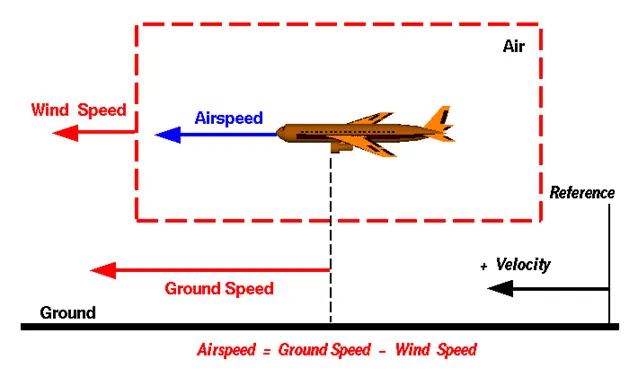
hence,Ground speed is quite different from airspeed. When an aircraft is airborne the ground speed does not determine when the aircraft will stall, and it doesn't influence the aircraft performance such as rate of climb.
3. Why is it not recommended to use aircraft engine power to move it on the ground at Airport?
SOLUTION:
The term Aircraft Ground Running is usually used to describe the operation of some or all of the engines of an aircraft, whilst on the ground, for the purpose of functionally checking the operation of either engines or aircraft systems.
Although many aircrafts are capable of moving in backward using reverse thrust, as result the jet blast or prop wash might cause damage to the terminal building or equipment. Engine close to ground may also blow sand and debris forward and then suck them into the engine, causing damage to the engine.
4. How an aircraft is pushed to runway when its ready to take off?
SOLUTION:
aircraft is pushed to runway by two methods taxing and towing
- Taxiing is the movement of an aircraft on the ground, under its own power, in contrast to towing or pushback where the aircraft is moved by a tug. The aircraft usually moves on wheels, but the term also includes aircraft with skis or floats (for water-based travel).
An airplane uses taxiways to taxi from one place on an airport to another; for example, when moving from a hangar to the runway.
There are different ways that airplanes can be taxied. Taxiing is most commonly performed using an airplane’s own propulsion system.
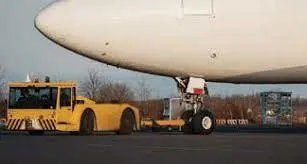
2. Towing: Movement of most aircraft around the airport and hangars is usually accomplished by towing with a towing vehicle or 'tug'.
The aircraft is attached it to the tow vehicle by the use of a towbar or other specialized methods that connect to or raise the nose or landing gear off the ground.
Towing aircraft can be dangerous and damage to the aircraft, other objects, or injuries to towing team members is possible if the proper procedures are not followed.
Most towing accidents are preventable by the proper handling of the aircraft, maintaining situational awareness, and practicing patience. Towing accidents cannot only result in aircraft damage but can also delay or cancel flights or lead to other airport disruptions.
Towing of aircraft
5. Learn about take off power, tyre design, rolling resistance, tyre pressure, brake forces when landing.
SOLUTION:
Take off power:
- The amount of power that an engine is allowed to produce for a limited period of time for takeoff.
- The use of takeoff power is usually limited to 5 min for reciprocating engines and up to 2½ min for gas turbine engines. This may not always be the case. Specifically, with respect to reciprocating engines, it is the brake horsepower developed under standard, sea-level conditions and under the maximum conditions of the crankshaft rotational speed and the engine manifold pressure approved for the normal take-off.
- It is limited in continuous use to the period of time shown in the approved engine specifications.
- With respect to gas turbine engines, it is the thrust developed under static conditions at a specified altitude and atmospheric conditions of the rotor shaft rotational speed and gas temperature approved for the normal takeoff.
- It is limited in continuous use to the period of time shown in the approved engine specifications.
Tyre design:
Carcass plies are used to form the tire. They are sometimes called casing plies. An aircraft tyre is constructed for the purpose it serves.
- They support the weight of an aircraft while it is on the ground.
- It also provides the necessary traction for braking and stopping of an aeroplane.
- Tyre also helps to absorb the shock of landing and provide cushioning the roughness of takeoff, roll-out, and taxi operations.
Unlike an automobile or truck tyre, it does not have to carry a load for a long period of continuous operation. However, an aircraft tyre absorbs the high impact loads of landing, and also it’s operating at high speeds for a short time when required.
Some technical aspects of the tyre are:
1. Retreading – Retreading is methods of restoring a worn tyre by renewing the tread area or by renewing the tread area plus one or both sidewalls. Repairs are included in the tyre retreading process.
2. Load Rating – Load rating is the maximum permissible load at a specified inflation pressure.
3. Ply Rating – Ply Rating is used to identify the maximum recommended load rating and inflation pressure for a specified tyre. It is an index of tyre strength.
4. Speed Rating – The speed rating is the maximum takeoff speed to which the tyre has been tested.
5. Skid Depth – Skid depth is the distance between the tread surface and the deepest groove as measured in the mould.
Aircraft tyres may be Tube-type or Tubeless:
Tubeless tyres are more advantageous over tube-type. There is no longer the use of tube-type tyre in recent aviation. Nowadays all airliners are using tubeless tyres. Tubeless that are meant to be used without a tube has the word TUBELESS on the sidewall of the tyre.Aircraft tyres may be Radial or Bias
Almost all airliners are using Radial tyre. Bias is an older design, and it’s mainly used for road vehicles. Radial tyres have the word RADIAL on the sidewall. Radial tires are more expensive than bias-ply tyres. Radial tires are in demand because of their lower life cycle cost and long term value.
Aircraft Tyre Standards
Each tyre manufacturer produces their own designs of the tyre with different tread patterns, wear patterns, wear limits etc, and in some cases, different names for the same part of the tyre. But all tyres must meet the approved standards before being accepted by the FAA or CAA.
All commercial aircraft tyres approved under FAA Requirement Technical Standard Order (TSO) C62. A TSO is a minimum performance standard for specified materials, parts, and appliances used on civil aircraft.
Rolling resistance:
Rolling Resistance Coefficient (μr) is defined by μr = F/G,
where F is the force necessary to pull the axle of a tire horizontally in the direction of travel, and
G is the vertical load on the tire which is assumed to roll on a flat horizontal surface.
the rolling friction of airplane wheels and tires due to various conditions of wheel loading, tire inflation pressure, and ground surface
Tyre pressure :
- Aircraft tires generally operate at high pressures, up to 200 psi (14 bar; 1,400 kPa) for airliners, and even higher for business jets.
- The main landing gear on the Concorde was typically inflated to 232 psi (16.0 bar), whilst its tail bumper gear tires were as high as 294 psi (20.3 bar).The high pressure and weight load on the Concorde tyres were a significant factor in the loss of Air France Flight 4590.
- Aircraft tires are usually inflated with nitrogen to minimize expansion and contraction from extreme changes in ambient temperature and pressure experienced during flight.
- Dry nitrogen expands at the same rate as other dry atmospheric gases (normal air is about 80% nitrogen), but common compressed air sources may contain moisture, which increases the expansion rate with temperature.
- The requirement that an inert gas, such as nitrogen, be used instead of air for inflation of tires on certain transport category airplanes was prompted by at least three cases in which the oxygen in air-filled tires had combined with volatile gases given off by a severely overheated tire and exploded upon reaching autoignition temperature.
- The use of an inert gas for tire inflation eliminates the possibility of tire explosion.
Brake forces when landing:
Airplanes rely on a braking system to safely land on runways. At cruising altitude, most commercial airplanes fly at a speed of roughly 500 to 600 mph. When landing, however, they must reduce their speed. A typical 747, for instance, has a landing speed of about 160 to 170 mph. And upon touching the runway, airplanes must quickly brake until they come to a complete stop.
WING SPOILER: Many airplanes use wing spoilers to assist with braking when landing. Not to be confused with ailerons, spoilers are extendable flaps on the ends of an airplane’s wings. Pilots can raise the spoilers to decelerate the airplane as it approaches the runway. And even while on the runway, pilots will typically leave the wing spoilers raised. Raised wing spoilers create drag, which essentially slows down the airplane so that it’s able to brake more quickly.
DISC BRAKES: In addition to wing spoilers, airplanes use disc brakes. Airplane disc brakes are similar to the braking system in automobiles. They consist of a pair of calipers that, when engaged, squeeze pads against the rotors of an airplane’s landing gear.Disc brakes are designed to remain static at all times. In other words, they don’t rotate with the wheels of an airplane’s landing gear. As the wheels turn, the disc brakes will remain static and stationary. They are a vital component of an airplane’s braking system because they are designed to apply pressure to the airplane’s wheels. Disc brakes will squeeze the wheels, thereby slowing down the speed at which they spin. In turn, this reduces the speed of the airplane so that it can come to a complete stop on the runway.
REVERSE THRUST: Finally, many jet airplanes use reverse thrust to assist with braking during landings. Reverse thrust is a feature in jet engine airplanes that, as the name suggests, involves the reversal of the engines’ thrust. When flying, the thrust is projected out the rear of an airplane’s engines. When landing, however, pilots may use the reverse thrust feature. Reverse thrust changes the direction of the engines’ thrust. Rather than projecting out the rear, the thrust will be projected out the front. This reversal of thrust provides deceleration that allows airplanes to slow down more quickly when landing.
Part B:
6. A. With necessary assumptions, calculate the force and power required to push / pull an aircraft by a towing vehicle.
SOLUTION:
The given data is taken from the towing truck TMX-150-9 & Aircraft Airbus A319
towing truck TMX-150-9 Aircraft Airbus A319
The data is from towing truck TMX-150-9 and Aircraft Airbus A319.
Data given :
Mass of the truck — 8300kg
Mass of the aircraft — 75500kg
Length of the aircraft — 33.84m
Velocity of the truck — 25kmph
Height of the aircraft — 11.76m
Air density (rho) = 1.225kg/m^3
Drag coefficient(Cd) = 0.75
Rolling resistance coefficient = 0.013
Gravitational constant — 9.8Nm
CALCULATION:
Rolling Resistance force
(Frr)=μrr*m*g
m= mass of the truck + mass of the aircraft
m= 8300+75500 =83800kg
`Frr = 0.013*83800*9.8 =
Frr= 10678.12 N
Aerodynamic drag force (Fad)
`Fad =0.5*rho*Cd*A*V^2`
V = velocity of the truck(m/s) = 6.95m/s
Area(A) = Length of the aircraft*Height of the aircraft
A= 33.84*11.76
A= 397.95m
Fad=0.5*1225*0.75*397.95*6.95^2
Fad= 8830 N
Total force required to push or pull an aircraft by towing vehicle is
Ftotal = Frr+Fad
Ftotal= 10678.12+8830
Ftotal= 19508.12N
Total power = Ftotal*Velocity
Total power=219508.12*6.95
Total power= 135.581kW.
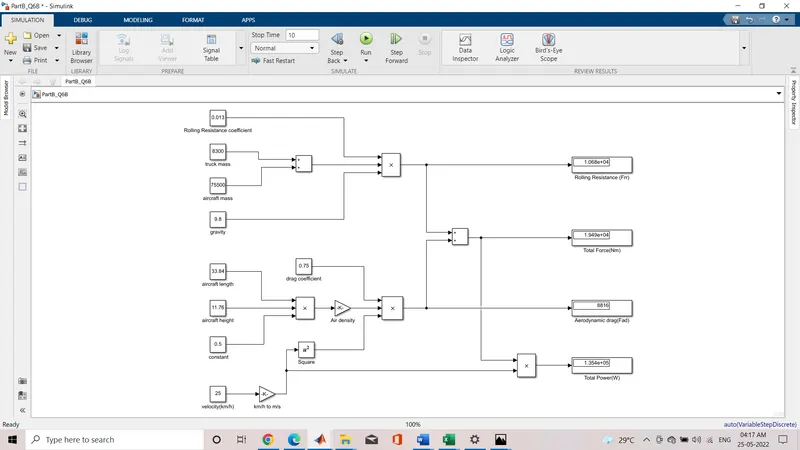
B. Develop the model for the calculated force and power using Simulink.
SOLUTION:
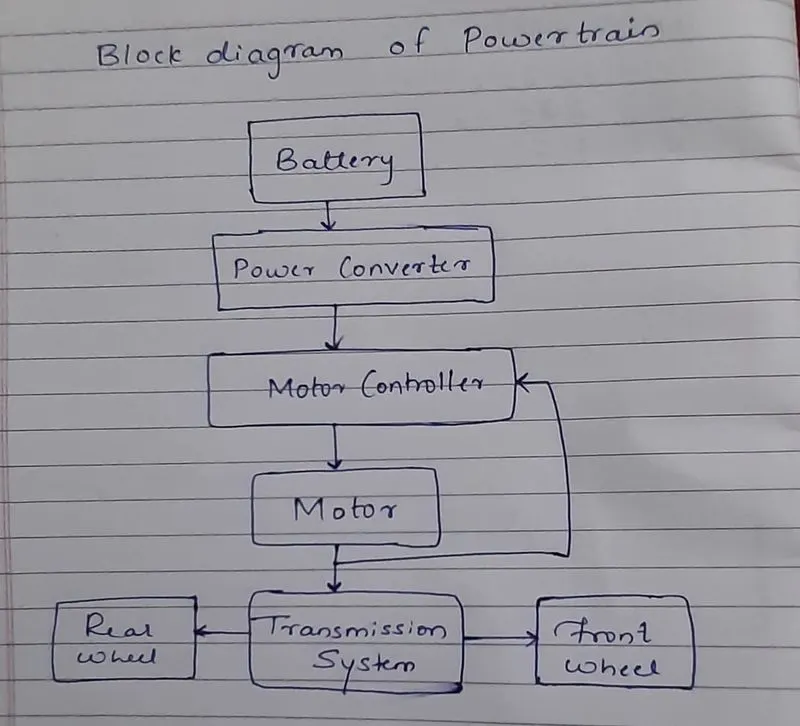
7. A. Design an electric powertrain with type of motor, it’s power rating, and energy requirement to fulfill aircraft towing application in Simulink. Estimate the duty cycle range to control the aircraft speed from zero to highest. Make all required assumptions. Prepare a table of assumed parameters. Draw a block diagram of powertrain.
SOLUTION:
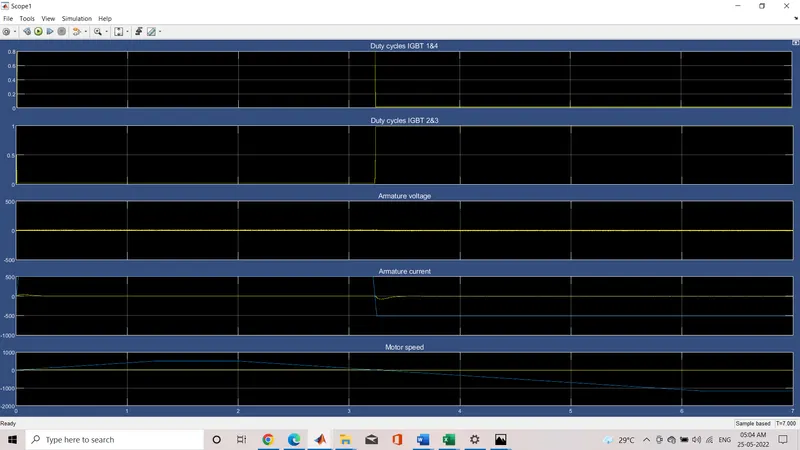
Simulink model of electric powertrain of aircraft towing truck
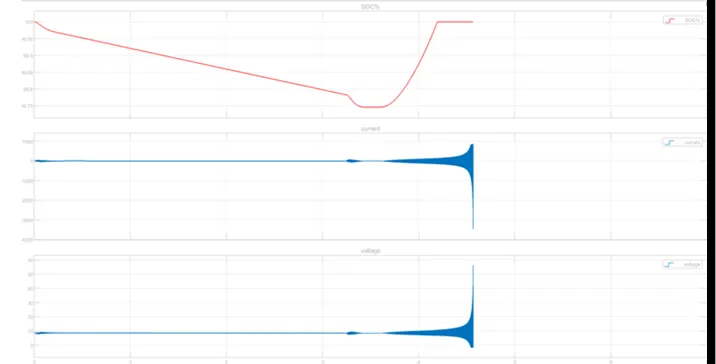
replaced AC input supply by DC battery source in DC7-Four-Quadrant chopper 200HP Dc Drive and SOC current and voltage is ovserved here
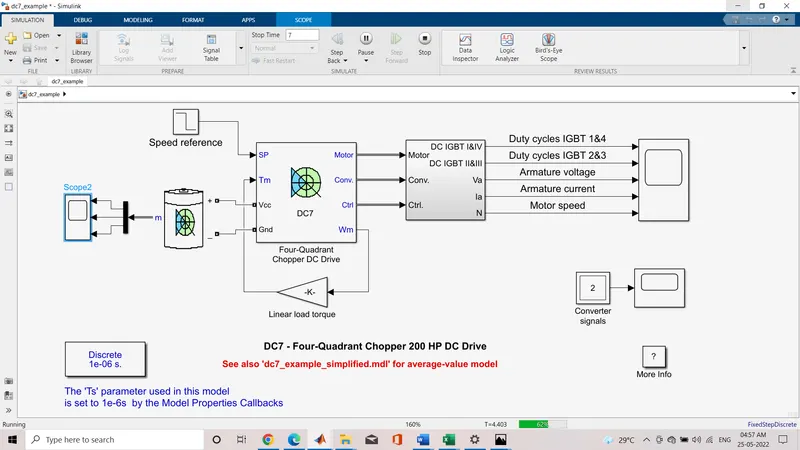
plots:
Designing of an electric power train aircraft towing
The tyre specification of TMX-150-9 is 315/70 R15
Data:
Force required to tow the aircraft = 19508.12 N
Power required for towing the aircraft = 135.581kW
Tyre radius for the towing truck = Aspect ratio x section width + (Rim diameter/2) = 0.411m
Gear ratio= 7
Transmission efficiency(ηt) = 80%
Motor efficiency (ηm) — 92%
Calculations
- Torque required at the wheels (Tw)
Tw = Total force tire radius = 19508.12*0.411
Tw = 8017.83Nm
- Actual power required (Pac)
Pac = Power required/ (η t* η m)
Pac =35.581/ (0.8*0.92)
Pac= 184.21kW
- Motor Torque (Tm)
Tm=Tw/ (gear ratio* η t)
Tm=3017.83/ (0.8*7)
Tm=1431.75 Nm
- Actual motor torque (Tmac)
Tmac = Tm/ η m
Tmac= 1.431/0.92
Tmac=1.555kNm
- Battery capacity
Towing tractor takes 15 min for taxing
15 mins = 0.25hours
Battery capacity =Pac*hours = 184.21*.25 =
Battery capacity= 46.05 kWh
The battery must deliver the power output of 46.05 kWh
If we use 210kW battery we can run the tow truck easily.
- Duty Cycle
Duty Cycle= power required/power rated= (Pac/input power)
Duty Cycle = 184.21/210
Duty Cycle = 0.87
Block diagram of powertrain:
B. Also, Design the parameters in excel sheet.
SOLUTION: