Week-4 Challenge WOT Condition Part-2
I’m student of live batch-16
- What is the difference between mapped and dynamic model of engine, motor and generator? How can you change model type?
Solution:
Mapped model-
- The map model is one type where the data points are pre assigned into look up tables
- Mapped module are useful for understanding the behaviour of the system using empirical data.
- The engine or motor torque required is sensed and the motor or engine block generates the required torque output just as required simply without considering the real time motor or engine parameters
- The output values are sorted for the corresponding given input values of the engine motor and generator
- The accuracy of this type is not that high
- The simulation will be done in much less time as it does not run by real time parameters
- In mapped Model The behaviour of the macro motor or generator can be represented as a set of lookup tables of efficiency, torque curve, rpm, power curve, Temp. etc.
Dynamic model-
- The dynamic model in other hand uses the combination of the output from various subsystems to generate the output
- Dynamic models are suitable for designing control, estimator, and diagnostic algorithms that depend on dynamic subsystem states, like in closed-loop AFR control algorithm development.
- It runs by real time simulation where the required input from the drive cycle is taken and for that individual real time simulation gets performed and summing all the results of the subsystem use the output for the simulation
- As per the dry cycle requirements the initial bus voltage, current is given along with the vehicle feedback so that it runs the actual simulation at that particular moment through the drive cycle.
- The accuracy of this model is very high as it considered the real outputs from all the subsystem to generate the output
- The simulation will take very long time to complete as it has so many individual simulations running by the subsystem of the engine motor or generator.
- Dynamic Model of a motor or generator performs a real-time simulation of components that actually takes place in an original system to generate an output and also the dynamic model of a motor/generator decomposes motor behaviour into individual component models.
Steps to change module type:
- Open powertrain blockset module in Matlab documentation for the required vehicle.
- Then open passenger car or vehicle block and select electric plant subsystem.
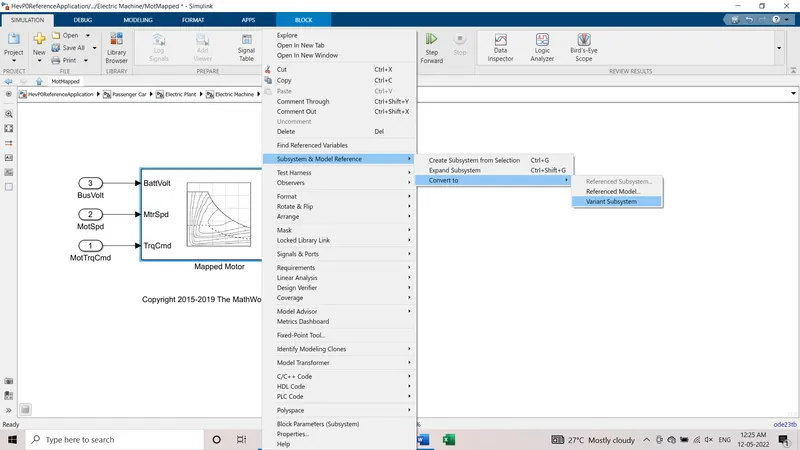
- now Right-click on Engine/motor/generator on the vehicle model we need to change the model type.
- Then select subsystem & model reference then click on convert to then on variant subsystem.
2. How does the model calculate miles per gallon? Which factors are considered to model fuel flow?
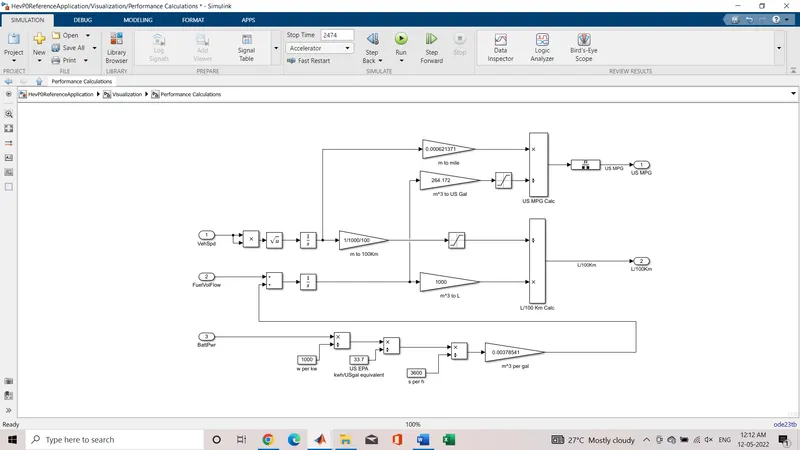
"Performance calculation subsystem" under visualization calculates the miles per gallon
The below model is for HEV which takes the input of the vehicle speed, Fuel Flow, and Battery power to calculate the fuel consumption and the equivalent battery consumption and calculates the miles per gallon.
Vehicle Speed and Fuel Flow:
- To determine the fuel consumption throughout the drive cycle the vehicle speed is an important factor while considering the fuel consumption at that particular time.
- To convert speed to Distance we can integrate speed with time and also, we are doing the same of converting the velocity to get the distance covered by integrating.
- Then the fuel flow is expressed as the mass flow rate i.e., the amount of fuel at each moment in kg/Sec. Now integrating this will result in the mass of the fuel and by dividing the mass with the fuel density we can convert it to the volume and by multiplying 1000 we can get it in litres.
- By comparing the results, we can get the amount of the consumed to Run for 100 km
Battery Power:
- The amount of energy of battery power equivalent to that of the Engine is calculated here.
- Then the battery power is converted to kW by dividing it by 1000.
- Battery power is then converted into energy kWh by multiplying it with time.
- Then converting the Energy from kWh to equivalent energy in US gallons of automotive gasoline by dividing with 33.7. Since we get the energy in US Gallons equal in kWh, to get the energy of equivalent US Gallons per second we have to divide with 3600 and have to convert the hour to seconds.
- Then US Gallon per second is multiplied by 0.00378541 to get the volume of fuel flow in `m^3`/s.And also it is multiplied with 739(density of gasoline) to get the mass flow rate in kg/s.
- Then finally the Battery energy equivalent in kg/s is given as an input for the fuel flow to find the equivalent US gallons of energy and estimate the Miles per Gallon.
Calculating Miles per Gallon:
- The inputs from the vehicle speed i.e the distance we found (in meters) are taken into the calculation and it is converted to the miles by multiplying with 0.000621371.
- Then the inputs from fuel flow (Battery energy + Fuel energy) which is in `m^3` are converted into equivalent US Gallons by multiplying with 264.172.
- Then the two inputs Miles covered and equivalent US Gallon are further divided and the final result is got in Miles/Gallon.
- To convert speed to Distance we can integrate speed with time and also, we are doing the same of converting the velocity to get the distance covered by integrating.
- Then the fuel flow is expressed as the mass flow rate i.e., the amount of fuel at each moment in kg/Sec. Now integrating this will result in the mass of the fuel and by dividing the mass with the fuel density we can convert it to the volume and by multiplying 1000 we can get it in litres.
Factors considered in the model fuel flow are Fuel Economy and Fuel Consumption.
- Fuel Economy: The fuel economy of an automobile relates to distance by a vehicle and the amount of fuel consumed. Consumption can be expressed in terms of the volume of fuel to travel a distance, or the distance travelled per unit volume of fuel consumed. Different methods are used to approximate the actual performance of the vehicle. The energy in the fuel is required to overcome various losses (like wind resistance, tire drag, and others parameters) encountered while propelling the vehicle, and in providing power to vehicle systems such as ignition or air conditioning. Driver's behaviour can affect fuel economy such as sudden acceleration and heavy braking waste energy.
The Major factors that are considered in the Fuel Economy:
- Vehicle Speed
- Engine Speed
- Motor Torque
- Fuel Consumption: Fuel Consumption is the inverse of fuel economy. It is the amount of fuel consumed in driving with a given distance.