Project-1: Powertrain for aircraft in runways
I am online batch student from batch EV - 16
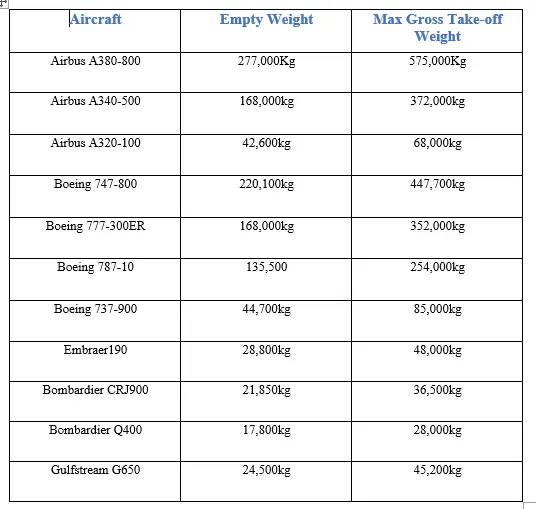
1. Search and list out the total weight of various types of aircrafts.
There are different kinds of weights in aeroplanes.
1- manufacturers' empty weight(MEW)
In this weight, it includes the aeroplane structure, power plant, furnishing, installation, system and equipment that are considered as an integral part of the aircraft.
2- Zero fuel weight(ZFW)
This is the total weight of the aeroplane and all its contents excluding the total weight of usable fuel on board. Maximum zero fuel weight (MZFW) is the maximum weight allowed before usable fuel and other specified
usable agents (engine injection fluid, and other consumable propulsion agents) are loaded.
3 - Operating empty weight (OEW)
It is the aircraft's basic weight, including the crew, all fluids necessary for operation such as engine oil, engine coolant, water, unusable fuel, and all operator items and equipment required for flight but excluding usable fuel and the payload.
4 - Payload
It is the carrying capacity of an aircraft. It includes cargo, people, and extra fuel. In the case of a commercial airliner, it may refer only to revenue-generating cargo or paying passengers.
5 - Maximum takeoff Weight(MTOW)
This is the maximum weight at which the aircraft pilot is allowed to attempt to take off.
6 - Regulated takeoff weight(RTOW)
Depending on different factors (e.g. flap setting, altitude, air temperature, length of runway), RTOW or maximum permissible takeoff weight varies for each takeoff. It can never be higher than MTOW.
7 - Maximum landing weight(MLW)
This is the maximum weight at which an aircraft is permitted to land.
8 - Maximum ramp weight(MRW)
It is the maximum weight authorized for manoeuvring (taxiing or towing) an aircraft on the ground.
9 - Aircraft gross weight
It is the total aircraft weight at any moment during the flight or ground operation. This decreases during the flight due to fuel and oil consumption.
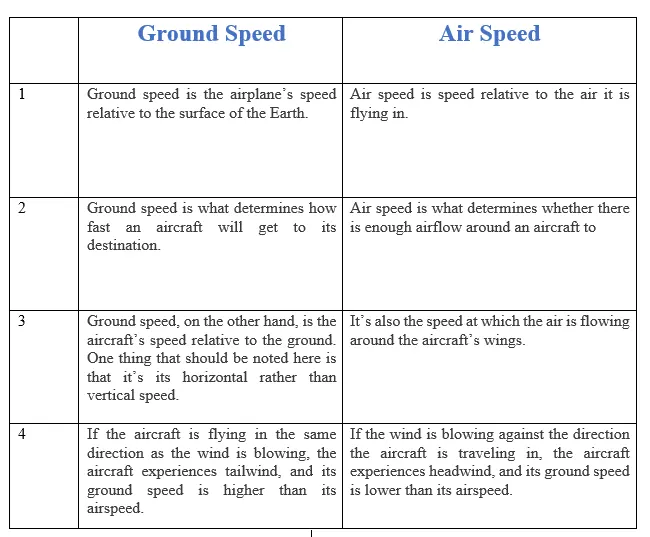
2. Is there any difference between ground speed and air speed?
3. Why is it not recommended to use aircraft engine power to move it on the ground at Airport?
Ans - It is not recommended to use aircraft engine power because:-
- Aircraft don't have reverse gear. so to get to the runway from the airport gates it needs assistance from a pushback vehicle. and when aeroplanes start using reverse thrust it will consume a lot of fuel as well as cause lot of noise and hazardous for the people working nearby.
- Applying thrust can create a blast behind each engine. Anything else in the way can be injured or damaged by the jet blast.
- Aircraft burn too much fuel and are responsible for a huge amount of pollution. The fuel is not cheap hence to save cost and fuel engine power not use.
- On the moving aircraft pilot sitting in the cockpit has his eye level at some distance. which creates a blindspot. so for moving on the ground planes do not use engine power and rely on o towing crew.
4. How an aircraft is pushed to runway when its ready to take off?
- when the aircraft is on the ground it moves on wheels. it uses taxiways to taxi from one place to another place at an airport.
- power of taxiing comes from engines. If the aircraft contains a propeller then it provides thrust and pulls the aircraft. If it contains a jet engine then it exhausts air that out and creates forward force.
- On the take of roll, the aeroplane gains sufficient speed. enough air flows over the rudders, pilots go back to using the rudder pedals to maintain the centre line.
- when the aircraft is ready with passengers and luggage airport procedure is to push the aircraft backwards from the airport gate by an external power.
- It moves on the ground following yellow lines to avoid a collision. taxiing motion has a speed limit and before a turn pilot reduces the speed
to prevent tire skids. - pushbacks are carried out by special, low profile vehicles called pushback tractors or tugs.
5. Learn about take off power, tyre design, rolling resistance, tyre pressure, brake forces when landing.
Take off power
- The amount of power that an engine is allowed to produce for a limited period for take-off.
Take off power with respect to reciprocating engines which means the brake horsepower that is developed under standard sea-level conditions. - Take off is the phase of flight in which an aerospace vehicle leaves the ground and becomes airborne.
- Take off speed varies with air density, aircraft gross weight and aircraft configuration. the power from the engine of the aircraft used to achieve the flight is called take-off power.
tyre Design
- The aircraft tires are designed to withstand extremely heavy loads while landing, takeoff, taxing and parking. when the weight of the aeroplane increased number of tires evenly distributes the weight.
- Tires from carcass piles. sometimes they are called casing piles. they support the weight of an aircraft while it is on the ground.
- It also provides the necessary traction for braking and stopping the aeroplane.
- Tyre absorbs the shock of landing and provides cushioning for the roughness of take-off, roll-out and taxi operations.
Rolling resistance
- Rolling resistance is a force that resists the motion of a body when it rolls on a surface. it is caused by non-elastic effects. Not all energy needed for the deformation of the wheel is recovered when the pressure is removed.
`Frr = murr*mg`
Tyre pressure
- Aircraft tires usually operate at high pressure up to 200psi for airlines, when it is high for jets, the main landing gear on the Concorde was inflated while its tail bumper gear tires were inflated at high
pressure. - aircraft tires are usually inflated at high pressure to sustain the heavy loads during take-off, landing and taxing.
- They are typically made of nylon and more recently a variety is known as aramid.
Brake force when loading
- When aircraft are landing at over 150mph speed is a difficult take. Aircraft rely on braking systems for safe landing n runways.
- Most aircraft use their wing spoilers to assist braking while landing. the spoilers are extendable flaps at the ends of wings.
- Pilots raise the spoilers to decelerate upon reaching the runway and kept raising till the plan comes to halt. the raised spoiler increases drag that slows down the plan.
Part B:
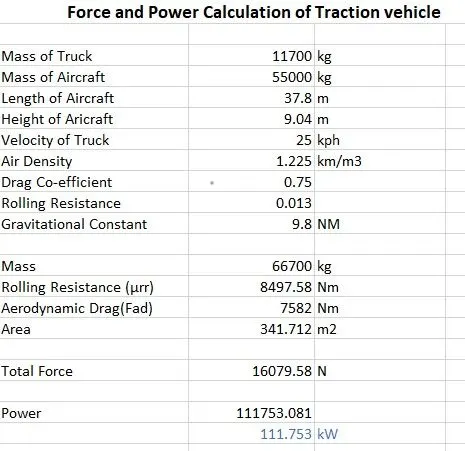
6. A. With necessary assumptions, calculate the force and power required to push / pull an aircraft by a towing vehicle.
Data were taken from towing truck TMX-150-12 and boring 717-200
Specifications:-
Mass of truck = 11,700kg
Mass of aircraft = 55,000kg
Length of aircraft = 37.80m
Velocity of truck = 25 kmph
Height of aircraft = 9.04m
Air density = 1.225kg/m^3
Drag coefficient = 0.75
Rolling Resistance = 0.013
Gravitational constant = 9.8NM
Calculation for Rolling Resistance
`Frr = murr*mg`
m = mass of truck + mass of aircraft
m = 11,700 + 55,000
m = 66,700kg
`Frr = 0.013*66700*9.8`
`Frr = 8497.58NM`
Aerodynamic Drag
`Fad = 0.5*rho*Cd*A*V^2`
velocity of truck = 25/3.6 =6.94m/s
Area = length of aircraft * height of aircraft
Area = 37.80*9.04
`A = 341.71m^2`
`Fad = 0.5*1.225*0.75*(6.95)^2*341.41`
`Fad = 1090NM`
Total force required to Puah/pull by towing vehicle
`Ft = Frr+Fad`
Ft = 7582 + 8497.58
Ft = 16079.58N
Power = Ft*velocity
`P= 16079.58*6.9`
`P= 111753.0`
P = 111.753kW
B) Develop the model for the calculated force and power using Simulink.
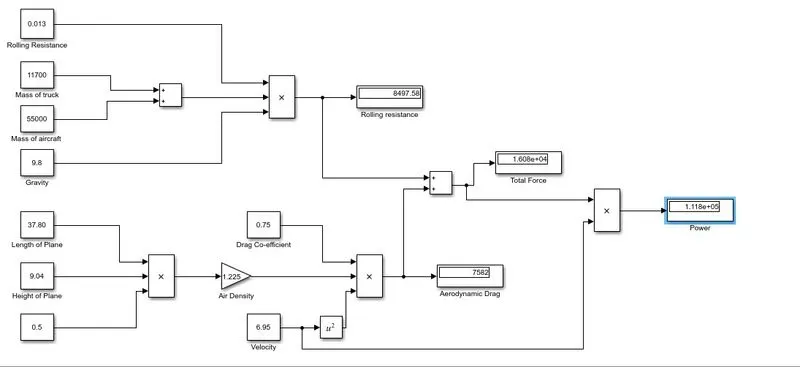
https://drive.google.com/file/d/1yEVmy-EZLCJj6kpj5yPR0-0QOK2H9s6B/view?usp=sharing
7. A. Design an electric powertrain with type of motor, it’s power rating, and energy requirement to fulfill aircraft towing application in Simulink. Estimate the duty cycle range to control the aircraft speed from zero to highest. Make all required assumptions. Prepare a table of assumed parameters. Draw a block diagram of powertrain.
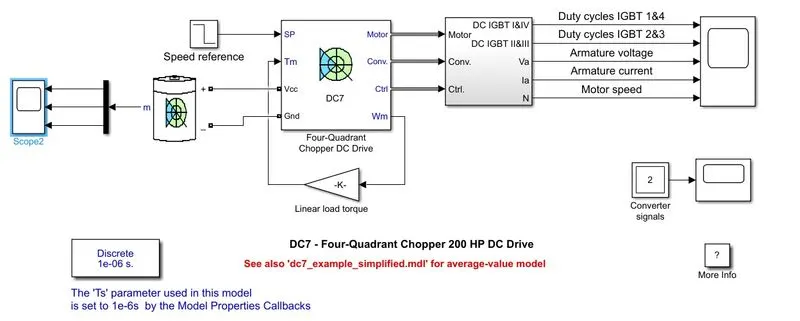
Output of converter
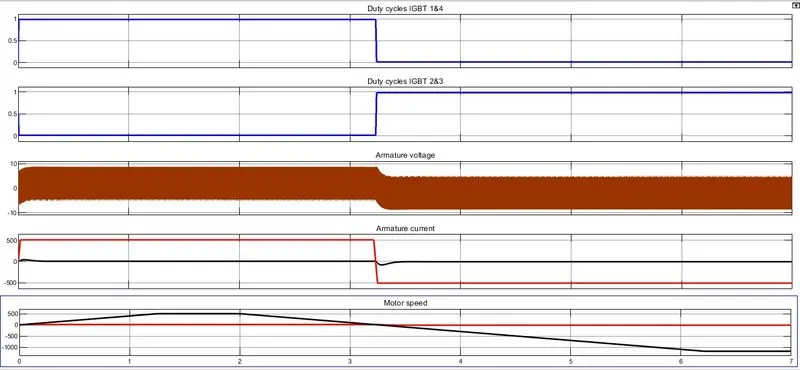
here, two switches get on at once and another two off simultaneously other switches work as same. hence pulses are generated.
motor armature voltage, a current is shown it goes till 50A. motor speed is 500 rpm when the current is drawn. when it brakes or the motor stops current flows negatively.
https://drive.google.com/file/d/1TO06m-cqC7vGFRB3Q2yWa0Vs9CtmQo9C/view?usp=sharing
B. Also, Design the parameters in excel sheet.