Project-1: Powertrain for aircraft in runways
PART A
1. The total weight of various types of aircrafts:
| Aircraft | Empty Weight | Max Fuel Weight | Max Cargo Weight | Max Gross Takeoff Weight |
|---|---|---|---|---|
| Antanov AN-225 | 628,000 lbs 285,000 kg |
661,400 lbs 300,000 kg |
417,000 lbs 190,000 kg |
1,411,000 lbs 640,000 kg |
| Airbus A380-800 | 611,000 lbs 277,000 kg |
560,000 lbs 254,000 kg |
185,000 lbs 84,000 kg |
1,268,000 lbs 575,000 kg |
| Boeing 747-800 | 485,300 lbs 220,100 kg |
427,400 lbs 194,000 kg |
295,000 lbs 134,000 kg |
987,000 lbs 447,700 kg |
| Airbus A340-500 | 370,000 lbs 168,000 kg |
386,300 lbs 175,000 kg |
119,000 lbs 54,000 kg |
820,000 lbs 372,000 kg |
| Boeing 777-300ER | 370,000 lbs 168,000 kg | 320,800 lbs 145,500 kg | 148,000 lbs 67,100 kg |
776,000 lbs 352,000 kg |
| Boeing 787-10 | 299,000 lbs 135,500 kg | 223,500 lbs 101,500 kg |
126,300 lbs 57,300 kg | 560,000 lbs 254,000 kg |
| Boeing 737-900 | 98,500 lbs 44,700 kg |
53,100 lbs 24,000 kg |
44,600 lbs 20,200 kg |
187,000 lbs 85,000 kg |
| Airbus A320-100 | 93,900 lbs 42,600 kg |
48,700 lbs 22,100 kg |
44,000 lbs 20,000 kg |
150,000 lbs 68,000 kg |
| Embraer 190 | 63,500 lbs 28,800 kg |
28,600 lbs 13,000 kg |
28,800 lbs 13,100 kg |
106,000 lbs 48,000 kg |
| Gulfstream G650 | 54,000 lbs 24,500 kg | 48,200 lbs 21,900 kg | 6,500 lbs 3,000 kg |
100,000 lbs 45,200 kg |
| Bombardier CRJ900 | 48,160 lbs 21,850 kg | 19,600 lbs 8,900 kg | 6,075 lbs 2,760 kg | 80,500 lbs 36,500 kg |
| Bombardier Q400 | 39,300 lbs 17,800 kg |
11,700 lbs 5,300 kg |
18,700 lbs 8,500 kg |
62,000 lbs 28,000 kg |
| Learjet 75 | 13,900 lbs 6,300 kg | 6,060 lbs 2,750 kg |
2,900 lbs 1,300 kg |
21,500 lbs 9,700 kg |
| Cessna Citation CJ4 | 10,300 lbs 4,700 kg | 5,800 lbs 2,650 kg |
2,200 lbs 1,000 kg | 17,200 lbs 7,800 kg |
| Beechcraft King Air B100 | 7,100 lbs 3,200 kg | 3,200 lbs 1,450 kg |
4,150 lbs 1,900 kg |
12,000 lbs 5,400 kg |
| Diamond DA50 RG | 3,200 lbs 1,450 kg |
340 lbs 155 lbs |
1,250 lbs 560 kg |
4,400 lbs 2,000 kg |
| Beechcraft Bonanza G36 | 2,500 lbs 1,150 kg | 450 lbs 200 kg |
850 lbs 385 kg |
3,660 lbs 1,660 kg |
| Cessna 206H | 2,200 lbs 990 kg |
520 lbs 235 kg |
1,150 lbs 520 kg |
3,600 lbs 1,630 kg |
| Sirrus SR22 | 2,250 lbs 1,000 kg | 485 lbs 220 kg |
950 lbs 430 kg |
3,600 lbs 1,630 kg |
| Cessna 172R | 1,700 lbs 770 kg |
380 lbs 170 kg |
560 lbs 255 kg |
2,425 lbs 1,100 kg |
2. Difference between ground speed and air speed:
Ground speed is how fast an airplane is traveling, relative to a fixed point on the ground. Ground speed is how fast an airplane's shadow would move across the land. If there's a strong wind pushing an aircraft, that's reflected in the ground speed. For a reference point picked on the ground, the aircraft moves relative to the reference point at the ground speed. Ground speed is also a vector quantity so a comparison of the ground speed to the wind speed must be done according to rules for vector comparisons.
Airspeed, in contrast, is how fast an airplane is really flying strictly under its own power, which is calculated by subtracting the wind speed from the ground speed. Airspeed cannot be directly measured from a ground position, but must be computed from the ground speed and the wind speed. Airspeed is the vector difference between the ground speed and the wind speed.
Airspeed = Ground Speed - Wind Speed
On a perfectly still day, the airspeed is equal to the ground speed. But if the wind is blowing in the same direction that the aircraft is moving, the airspeed will be less than the ground speed.
Examples
Suppose we had an airplane that could take off on a windless day at 100 mph (liftoff airspeed is 100 mph). We are at an airport with an east-west runway that is 1 mile long. The wind is blowing 20 mph towards the west and the airplane takes off going east. The wind is blowing towards the aircraft which we call a headwind. Since we have defined a positive velocity to be in the direction of the aircraft's motion, a headwind is a negative velocity. While the plane is sitting still on the runway, it has a ground speed of 0 and an airspeed of 20 mph:
Airspeed = Ground Speed (0) - Wind Speed (-20) = 20 mph
The airplane starts its take off roll and has a constant acceleration a. From Newton's second law of motion, the ground speed V at any time t is:
V = a * t
and the distance d down the runway at any time is:
d = 1/2 * a * t^2
For a fixed length runway, this specifies the time to be used in the velocity equation. Let's assume that at 5000 feet down the runway, the velocity is 80 mph. Then the airspeed is given by
Airspeed = Ground Speed (80) - Wind Speed (-20) = 100 mph
and the airplane begins to fly. Now another pilot, with exactly the same airplane decides to take off to the west. The wind is now in the same direction as the motion and this is called a tailwind. The sign on the wind speed is now positive, not negative as with the headwind. The acceleration along the ground is the same, so at 5000 feet down the runway, the ground speed is again 80 mph. The airspeed is then given by:
Airspeed = Ground Speed (80) - Wind Speed (20) = 60 mph
This airplane doesn't have enough airspeed to fly. It runs off the end of the runway.
3. The movement of the aircraft on the ground under its own power is termed as Taxiing. But it is not recommended to taxiing on the ground in the airport because if the taxiing speed is 30 -35 kmph then at such low speeds the aircraft engine operate at very low efficiency and consume a higher amount of fuel. Hence towing is prefered where the aircraft is moved by a tug and is known as towing.
Moving airplanes by towing will prevent any damage or hazard to nearby buildings, ground crew or other aircraft and ground handling equipment from the jetblast of the aircraft engines or propwash from their propellers.
4. Large airplanes required a lot of force to get moving from a dead stop. There are two ways to get a plane moving:
- Use the engines to provide reverse thrust
- Use a tow vehicle to push the aiplane back
Using the engines to create reverse thrust is accomplished by using deflector scoops on each engine to channel the thrust airflow sidewards and slightly forwards. This is mainly used to aid in slowing the aircraft down during landing but can allow the aircraft to reverse, but it has implications.
Older aircraft that had their engines mounted high up on the rear of the aircraft could use reverse thrust to back out from the gate but with most modern airplanes the engines are mounted under the wing placing them close to the ground.
When an airplane uses reverse thrust it takes a high power setting to get the aircraft moving initially. This creates a high-speed wind that can easily damage the airport terminal, jetway, surrounding ground vehicles, baggage, and ground personnel and cause debris to be ingested by the engine which is not good.
For propellor-based aircraft like the Bombardier Dash 8 they can reverse the pitch of the propellor blades forcing the thrust forwards and propelling the airplane backward. Again this creates high-speed debris and airflow that can cause problems on a busy airport apron.
By far the most common option is to use a tow vehicle to hook up to that airplane and propel it backward without the airplane’s engines running.
By doing this it allows for:
- Far greater safety because the tow truck operator has a much better view of the entire area surrounding and under the aircraft
- The vehicle driver is in communication with the pilots to ensure aircraft braking can be applied if needed in an emergency
- With the aid of ground personnel who walk under the wingtips, the tow truck driver can precisely position the aircraft and ensure it does not contact any structure,vehicle, person or aircraft
- It allows the airports ground controllers to get aircraft moved with much greater time constraints thus improving the flow around the apron and gate areas
5.
Take off power:
Take off is the phase of flight in which an aerospace vehicle leaves the ground and becomes airborne. The amount of power that an engine is allowed to produce for a limited period of time for takeoff is termed as Takeoff power. The use of takeoff power is usually limited to 5 min for reciprocating engines and up to 2½ min for gas turbine engines.
Tyre Design:
When it comes to safety, tyres are one of the most important components of aircraft. They help to absorb the shock of landing and provide cushioning. It also provides the necessary traction for braking and stopping of an aircraft.
An aircraft tyre is designed to withstand extremely heavy loads while landing, take off, taxing, and parking. The number of wheels required for aircraft increases with the weight of the aircraft, as the weight of the aeroplane needs to be distributed more evenly.
Carcass plies are used to form the tire. They are sometimes called casing plies. An aircraft tyre is constructed for the purpose it serves.
- They support the weight of an aircraft while it is on the ground.
- It also provides the necessary traction for braking and stopping of an aeroplane.
- Tyre also helps to absorb the shock of landing and provide cushioning the roughness of takeoff, roll-out, and taxi operations.
Unlike an automobile or truck tyre, it does not have to carry a load for a long period of continuous operation. However, an aircraft tyre absorbs the high impact loads of landing, and also it’s operating at high speeds for a short time when required.
Rolling resistance:
The force that resists the motion of a body rolling on a surface is called the rolling resistance or the rolling friction
Tyre Pressure:
Of all the things that operators can do to improve the life of the aviation tire, maintaining good pressure maintenance is right at the top of every list. Like all things aviation, the tire is one part of an assembly which can only work as intended when the parts are used as defined by the airframe and component manufacturers.
Under-inflating the tire or allowing the tire to operate when it is under-inflated will prevent the parts working together as intended. And it will be the tire that will take the strain. It will deflect more and it will wear more. Harsh operating environments will only make it worse. Some of the wear will be visible – on the tread and some of the wear will be invisible – inside the structure of the aviation tire.
- Visible Wear
Under-inflation will increase the footprint of the aviation tire as it rolls on the ground and will increase the build-up of heat. Heat is no friend to tires on airplanes and the tread will wear out more quickly than it should. On multi-tire landing gear the under-inflated tire will force the other, maybe correctly inflated tires, to take a little bit more of the strain. This will wear those other tires a little more.
- Invisible Wear
As extra heat caused by under-inflation builds up in the airplane tire the internal components of the tire might start to separate from each other. A catastrophic failure might result. Component separation in the casing of the tyre will prevent retreading and will increase operating costs. All for a bit of pressure maintenance!
- 24 Hour Pressure Checks
A carefully thought out pressure maintenance routine will increase the life of the tyre and will reduce the number of wheel changes required. As all tires can allow a small pressure decrease during normal operations (due to the intense nature of their service life) airplane operators should check tire pressure every 24 hours. Because putting the right pressure in the tires will always take pressure off the airplane operation.
Brake Forces:
Aircraft braking systems include:
- Aircraft disc brakes in the landing gear, used to brake the wheels while touching the ground. These brakes are operated hydraulically or pneumatically. In most modern aircraft they are activated by the top section of the rudder pedals ("toe brakes"). In some older aircraft the bottom section is used instead ("heel brakes"). Levers are used in a few aircraft. Most aircraft are capable of differential braking
- Thrust reversers, that allow thrust from the engines to be used to slow the aircraft.
- Air brakes, dedicated flight control surfaces that work by increasing drag.
- Large drogue parachutes, used by several former and current military and civilian aircraft
PART B
6A) Force and Power required to push/pull an aircraft by a towing vehicle:
The Rolling resistance force = `Frr = murr*m*g`
The Aerodynamic Drag Force = `Fad = (1/2)*rho*A*Cd*v^2`
Hill climbing force = `Fhc = m*g*sin theta`
Acceleration force = `Fla = m*a`
Total Traction force = Fte = Frr+Fad+Fhc+Fla
Total power required= Pte = Fte*v
Performing the above calculations in an excel sheet the total power required to push or pull an aircraft by a towing vehicle can be found :
| Power calculation | |
| Rolling Resistance calculation | |
| Aircraft weight | 41000 |
| Co-efficient of rolling resistance | 0.01 |
| Rolling resistance force (N) of aircraft | 4018 |
| Towing vehicle weight | 10000 |
| Co-efficient of rolling resistance | 0.02 |
| Rolling resistance force (N) of tow | 1960 |
| Air drag force calculation | |
| Air density (kg/m3) | 1.25 |
| Width (m) | 2.375 |
| Height (m) | 2.1 |
| Frontal area (m2) | 4.9875 |
| Drag Co-efficient of aircraft | 0.3 |
| Drag Co-efficient of towing vehicle | 0.23 |
| Speed (kmph) | 30 |
| Speed (m/s) | 8.333333 |
| Air drag force (N) | 114.7298 |
| Hill climbing force calculation | |
| Angle (degrees) | 0 |
| Hill climbing Force (N) | 0 |
| Acceleration Force | |
| Acceleration Time (s) | 600 |
| Acceleration (m/s2) | 0.013889 |
| Acceleration Force (N) | 708.3333 |
| Total force (N) - | 6801.063 |
| Total power (kW) - | 56.67553 |
6)B)Force and Power required to push/pull an aircraft by a towing vehicle in simulink
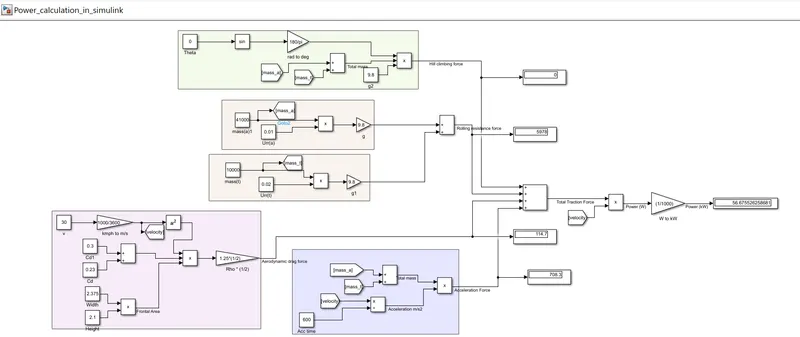
The power required to push/pull an aircraft by a towing vehicle has been calculated in simulink and the results are found to be the same
7)A)
From the previous question
Total power is 56.67 kW and total force is 6801.063 N
Assuming
Radius of the tyre, r = 0.75 m
Gear ratio = 8
Transmission efficiency = 90%
Motor efficiency = 93%
Operating hour = 0.75 hr
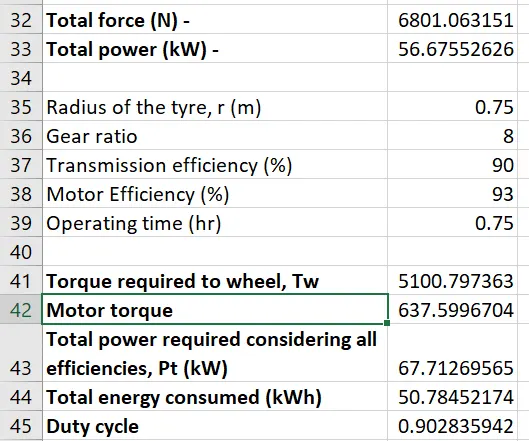
The torque required to the wheel, Tw = F*r = 6801.063 * 0.75 = 5100.79 Nm
Motor torque = Tw / gear ratio = 637.59 Nm
Total power required considering all the efficiencies,
Pt = Total power/(transmission efficiency*motor efficiency)
= 56.67kW/(0.90*0.93)
= 67.71 kW
Total Energy consumed = Pt*Operating hr = 67.71 * 0.75 = 50.78 kWh
If the battery capacity is 70 kW
Then the duty ratio = Pt/70 = 0.96
So the duty cycle range will be 0 to 96%
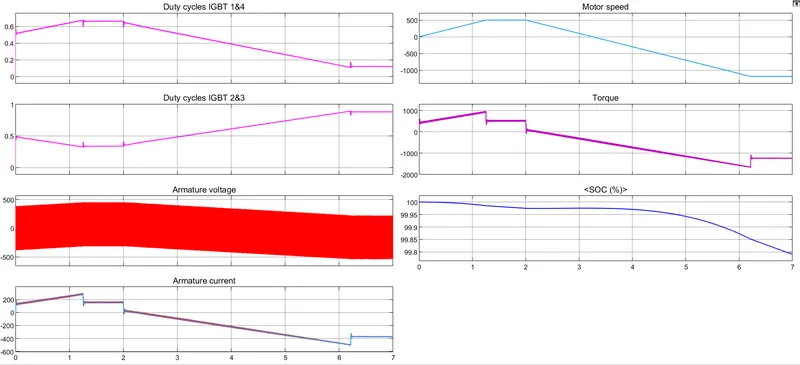
Results
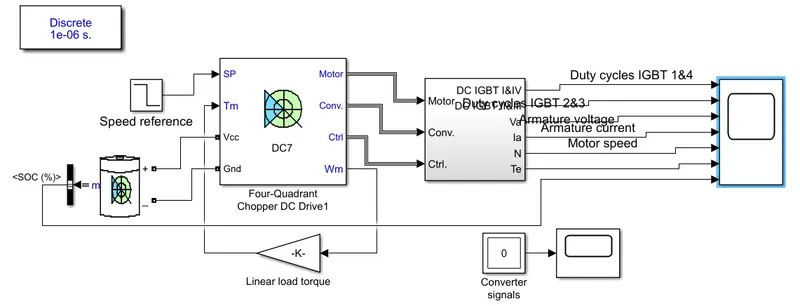
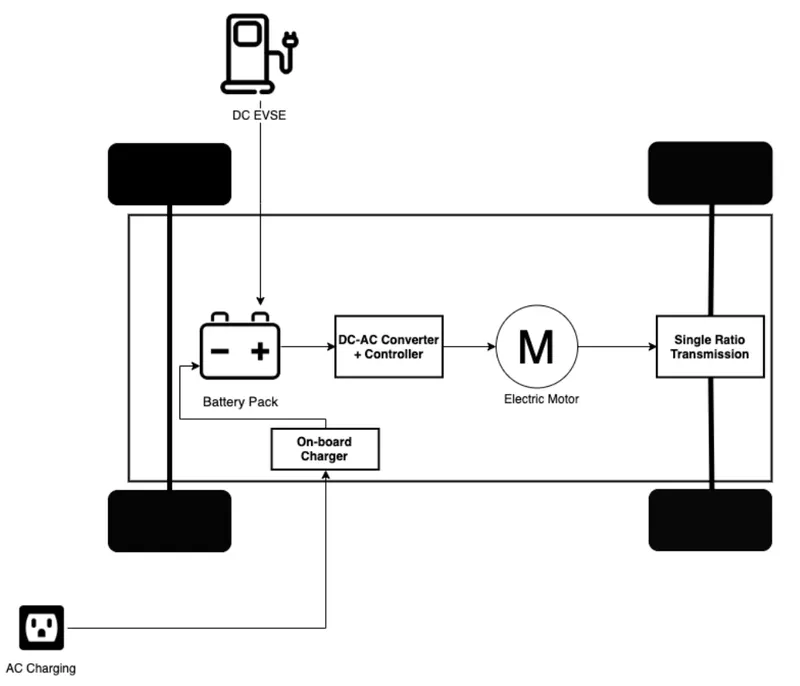
BLOCK DIAGRAM OF POWERTRAIN:
7)B) Parameters in Excel sheet: