Project-1: Powertrain for aircraft in runways
Part - A
Ans 1:
Total weights of various types of Aircrafts
An aircraft is a vehicle or machine that is able to fly by gaining support from the air. It counters the force of gravity by using either static lift or by using the dynamic lift of an airfoil, or in a few cases the downward thrust from jet engines.
An aircraft is any machine that can fly. Airplanes, hot air balloons, helicopters, or even flying platforms are considered aircraft! An airplane is a specific type of aircraft that has fixed wings and is heavier than air that is capable of sustained, powered, and controlled flight.
- Airplane – Single-engine land or sea or multi-engine land or sea.
- Rotorcraft – helicopter or gyroplane.
- Lighter-Than-Air – balloons or airships.
- Powered Parachutes – land or sea.
- Weight-Shift-Control – land or sea.
Weight class is based are assigned by APO130 based on the TFMS observed aircraft codes. There are 6 categories -- (A) Heavy, (B) B757, (C) Large Jet, (D) Large Commuter, (E) Medium, (F) Small.
(A) Heavy: Any aircraft weighing more than 255,000 lb such as the Boeing 747 or the Airbus A340;
(B) B757: Boeing 757 all series; (57,840 kg (127,520 lb)
(C) Large Jet: Large jet aircraft weighing more than 41,000 and up to 255,000 lbs such as the Boeing 737 or the Airbus A320;(41,410 kg)
(D) Large Commuter: Large non-jet aircraft (such as the Aerospatiale/Alenia ATR-42 and the Saab SF 340), and small regional jets (such as the Bombardier Canadair Regional Jet), weighing more than 41,000 and up to 255,000 lbs;
(E) Medium: Small commuter aircraft including business jets weighing more than 12,500 up to 41,000 lbs such as the Embraer 120 or the Learjet 35; and
(F) Small: Small, single, or twin engine aircraft weighing 12,500 lbs or less such as the Beech 90 or the Cessna Caravan.
| Type | Maximum take-off weight [kg] | Maximum landing weight [tonnes] | Take-off run (SL, ISA+15°, MTOW) [m] | Landing run (SL, ISA+15°, MLW)[m] |
|---|---|---|---|---|
| Antonov An-225 | 640,000 | 591.7 | 3500 | |
| Scaled Composites Model 351 Stratolaunch | 589,670 | 3660 | ||
| Airbus A380-800[1][2][3] | 575,000 | 394 | 3100 | 1930 |
| Boeing 747-8F | 447,700 | 346.091 | 3100 | 1800 |
| Boeing 747-8 | 443,613 | 306.175 | 3100 | |
| Boeing 747-400ER | 412,770 | 295.742 | 3090 | |
| Antonov An-124-100M | 405,060 | 330 | 2520 | 900 |
| Boeing 747-400 | 396,900 | 295.742 | 3018 | 2179 |
| Lockheed C-5 Galaxy[4][5][6] | 381,000 | 288.417 | 2530 | 1494 |
| Boeing 747-200[7] | 377,840 | 285.700 | 3338 | 2109 |
| Boeing 747-300[7] | 377,840 | 260.320 | 3222 | 1905 |
| Airbus A340-500[8] | 371,950 | 240 | 3050 | 2010 |
| Airbus A340-600[8] | 367,400 | 256 | 3100 | 2100 |
| Boeing 777F | 347,800 | 260.816 | 2830 | |
| Boeing 777-300ER | 351,800 | 251.29 | 3100 | |
| Boeing 777-200LR | 347,450 | 223.168 | 3000 | |
| Boeing 747-100[7] | 340,200 | 265.300 | ||
| Airbus A350-1000 | 308,000 | 233.5 | ||
| Boeing 777-300 | 299,370 | 237.683 | 3380 | |
| Boeing 777-200ER | 297,550 | 213.00 | 3380 | 1550 |
| Airbus A340-300[8][9] | 276,700 | 190 | 3000 | 1926 |
| McDonnell Douglas MD-11 | 273,300 | 185 | 2990 | 1890 |
| Airbus A350-900 | 270,000 | 175 | 2670 | 1860 |
| Ilyushin Il-96M | 270,000 | 195.04 | 3115 | 2118 |
| McDonnell Douglas DC-10 | 256,280 | 183 | 2990 | 1890 |
| Boeing 787-9[10] | 254,000 | 192.777 | 2900 | |
| Boeing 787-10[10] | 254,000 | 201.849 | ||
| Airbus A340-200[8][11] | 253,500 | 181 | 2990 | |
| Airbus A330-900 | 251,000 | 191 | 3100 | |
| Ilyushin IL-96-300 | 250,000 | 175 | 2600 | 1980 |
| Airbus A330-300[12][13] | 242,000 | 185 | 2500 | 1750 |
| Airbus A330-200[12][13] | 242,000 | 180 | 2220 | 1750 |
| Lockheed L-1011-500 | 231,300 | 166.92 | 2636 | |
| Boeing 787-8[10] | 228,000 | 172.365 | 3300 | 1695 |
| Lockheed L-1011-200 | 211,400 | |||
| Ilyushin IL-86 | 208,000 | 175 | ||
| Boeing 767-400ER | 204,000 | 158.758 | 3414 | |
| Airbus A300-600R[14] | 192,000 | 140 | 2385 | 1555 |
| Boeing 767-300ER | 187,000 | 136.08 | 2713 | 1676 |
| Concorde | 185,000 | 111.1 | 3440 | 2220 |
| Airbus A300-600[14] | 163,000 | 138 | 2324 | 1536 |
| Boeing 767-300 | 159,000 | 136.078 | 2713 | 1676 |
| Airbus A310-300[14] | 157,000 | 124 | 2290 | 1490 |
| Vickers VC10 | 152,000 | 151.9 | ||
| Boeing 707-320B[15] | 151,000 | 97.5 | ||
| Boeing 707-320C[15] | 151,000 | 112.1 | ||
| Douglas DC-8-61 | 147,000 | |||
| Airbus A310-200[14] | 142,000 | 123 | 1860 | 1480 |
| Airbus A400M | 141,000 | 122 | 980 | 770 |
| Douglas DC-8-32 | 140,000 | |||
| Douglas DC-8-51 | 125,000 | |||
| Boeing 757-300 | 124,000 | 101.6 | 2550 | 1750 |
| Boeing 707-120B[15] | 117,000 | 86.3 | ||
| Boeing 757-200 | 116,000 | 89.9 | 2347 | 1555 |
| Boeing 720B[16] | 106,000 | 79.5 | ||
| Boeing 720[16] | 104,000 | 79.5 | ||
| Tupolev Tu-154M | 104,000 | 80 | ||
| Tupolev Tu-204SM | 104,000 | 87.5 | 2250 | |
| Convair 880 | 87,500 | |||
| Boeing 737-900 | 85,000 | 66.36 | 2500 | 1704 |
| Boeing 737-900ER | 85,000 | 71.35 | 2804 | 1829 |
| Boeing 727-200 Advanced[17] | 84,000 | 70.1 | ||
| Airbus A321-100[18] | 83,000 | 77.8 | 2200 | 1540 |
| Boeing 737-800 | 79,000 | 65.32 | 2308 | 1634 |
| Boeing 727-200[17] | 78,000 | 68.1 | ||
| McDonnell-Douglas MD-83 | 73,000 | 63.28 | ||
| Boeing 727-100[17] | 72,500 | 62.4 | ||
| Boeing 727-100C[17] | 72,500 | 62.4 | ||
| McDonnell-Douglas MD-90-30 | 71,000 | 64.41 | 2165 | 1520 |
| de Havilland Comet 4 | 70,700 | |||
| Boeing 737-700 | 70,000 | 58.06 | 1921 | 1415 |
| Airbus A320-100[18] | 68,000 | 66 | 1955 | 1490 |
| Boeing 737-400 | 68,000 | 54.9 | 2540 | 1540 |
| de Havilland Comet 3 | 68,000 | |||
| Boeing 377 | 67,000 | |||
| Boeing 737-600 | 66,000 | 54.66 | 1796 | 1340 |
| Airbus A220-300 | 65,000 | 57.61 | 1890 | 1494 |
| Hawker Siddeley Trident 2E | 65,000 | |||
| Airbus A319[18] | 64,000 | 62.5 | 1850 | 1470 |
| Boeing 737-300 | 63,000 | 51.7 | 1939 | 1396 |
| Boeing 737-500 | 60,000 | 49.9 | 1832 | 1360 |
| Airbus A220-100 | 59,000 | 50.80 | 1463 | 1356 |
| Airbus A318[18] | 59,000 | 57.5 | 1375 | 1340 |
| Boeing 717-200HGW | 55,000 | 47.174 | 1950 | |
| Douglas DC-7 | 55,000 | |||
| de Havilland Comet 2 | 54,000 | |||
| Boeing 717-200BGW | 50,000 | 46.265 | 1950 | |
| de Havilland Comet 1 | 50,000 | |||
| Douglas DC-6A | 48,600 | |||
| Douglas DC-6B | 48,500 | |||
| Embraer 190[19] | 48,000 | 43 | 2056 | 1323 |
| Caravelle III | 46,000 | |||
| Fokker 100 | 46,000 | 39.95 | 1621 | 1350 |
| Douglas DC-6 | 44,000 | |||
| Avro RJ-85 | 42,000 | 36.74 | ||
| Handley Page Hermes | 39,000 | |||
| Embraer 175[20] | 37,500 | 32.8 | 2244 | 1304 |
| Bombardier CRJ900[21] | 36,500 | 33.345 | 1778 | 1596 |
| Embraer 170[22] | 36,000 | 32.8 | 1644 | 1274 |
| Bombardier CRJ700 | 33,000 | 30.39 | 1564 | 1478 |
| Douglas DC-4 | 33,000 | |||
| Vickers Viscount 800 | 30,400 | |||
| Bombardier Q400 | 28,000 | 28.01 | 1219 | 1295 |
| Bombardier CRJ200 | 23,000 | 21.319 | 1918 | 1479 |
| ATR 72-600 | 22,800 | 22.35 | 1333 | 914 |
| Saab 2000 | 22,800 | 21.5 | 1300 | |
| Embraer ERJ 145 | 22,000 | 19.3 | 2270 | 1380 |
| ATR 42-500 | 18,600 | 18.3 | 1165 | 1126 |
| Saab 340 | 13,150 | 12.930 | 1300 | 1030 |
| Embraer 120 Brasilia | 11,500 | 11.25 | 1560 | 1380 |
| BAe Jetstream 41 | 10,890 | 10.570 | 1493 | 826 |
| Learjet 75[23] | 9,752 | 8.709 | 1353 | 811 |
| Pilatus PC-24[24] | 8,300 | 7.665 | 893 | 724 |
| Embraer Phenom 300[25] | 8,150 | 7.65 | 956 | 677 |
| Beechcraft 1900D | 7,765 | 7.605 | 1036 | 853 |
| Cessna Citation CJ4[26] | 7,761 | 7.103 | 1039 | 896 |
| de Havilland Hercules | 7,000 | |||
| Embraer Phenom 100 | 4,800 | 4.43 | 975 | 741 |
Ans : 2
Difference between ground speed and air speed
Air Speed:
True airspeed is simply the speed at which an aircraft is moving relative to the air it is flying in. As such, it's also the speed at which the air is flowing around the aircraft's wings.
Ground speed:
on the other hand, ground speed is the aircraft's speed relative to the ground.
Effect of wind speed:
If the aircraft is flying in the same direction as the wind is blowing, the aircraft experiences tailwind, and its ground speed is higher than its airspeed. On the other hand, if the wind is blowing against the direction the aircraft is traveling in, the aircraft experiences headwind, and its ground speed is lower than its airspeed.
Ans :3
Why aircraft engine power is not used to move the aircraft:
Reasons behind the use of pushback tractors:
- WARM UP: Engine failure on take off is one of the most dangerous scenarios for ANY flight. To minimize the risk of this happening, aircraft engines and components need to warm up slowly and smoothly BEFORE you push them to full power for the take off roll. The objective is to be fully warmed up and all interdependent systems checked prior to full power. If we consider all the risks and the potential monetary costs, this warm up process (and related checks) prove to be even more important since pushing a cold and unchecked engine to full power can dramatically increase wear and tear, shortening the operating life of the engine, increasing maintenance costs AND increasing the risk of an engine failure on take off. The fuel lost during taxiing is MINOR compared to the costs of each of these risks I just mentioned. Warm up time of at least 2-5 minutes is recommended. Even if you are searching for ways to save fuel, this is ONE area where cutting corners can bleed red for both airline and passengers.
2. BATTERY & POWER SOURCES: Although most aircraft CAN start their own engines, it is safer to start turbine aircraft using ‘ground power’ services at the gate (if that service is available) so that you are saving battery life and “cranking power” for emergency use in the air, especially any problems that could arise immediately after take off. Consider that if you start your engines with batteries, it could be as much as an hour before those batteries return to full charge - which means your cranking power is reduced until then.
3.AIRMANSHIP: Airports could make made Ground Power services available far away from the gate. But even then, starting engines (and the systems that rely on them) at or near the gate allows you to patiently observe the aircraft’s engines/systems performance for signs of potential problems BEFORE going out onto the taxiway to hold up traffic on the ground. You really want to be relaxed as practicable, and take your time doing systems checks and running through checklists…without the pressure of thinking that a bunch of other aircraft could get affected if you take a bit longer or if you find a problem and have to return to the gate. In multi-engine aircraft, its critical to start AT LEAST one engine before moving from the gate. This will allow you to do nearly all of your systems checks…and provide power to start all the other engines.
Ans : 4
Aircraft Movements Between Parking Bays
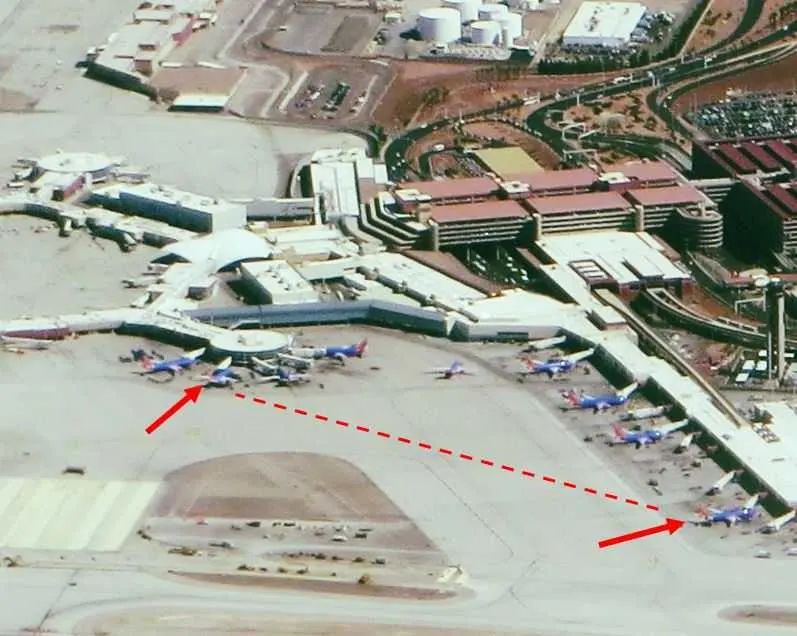
Pushback tractor is also used for repositioning the aircraft from one aircraft stand to another at an airport. Such a requirement arises when let’s say an aircraft brings international passengers to an airport gate, however, its departure flight is with domestic passengers.
Since airports have different gates for domestic and international passengers, after passenger deplaning is complete on international gate, the aircraft needs to be pushed back from international gate and taken to a domestic gate. A pushback tractor is used for such a movement because it is not economical to turn on jet engines for such a short movement.
Another example of such movement is when an aircraft brings passengers but there is no departure flight scheduled for the aircraft immediately. Under such a case, such an aircraft is repositioning from the gate at which it first parked to a remote aircraft stand. It frees up the occupied gate for other flights.
Repositioning on Aircraft Centerline
A pushback tractor is briefly required in instances when an aircraft parks incorrectly on an aircraft stand. Let us explain what incorrect parking means in this context.
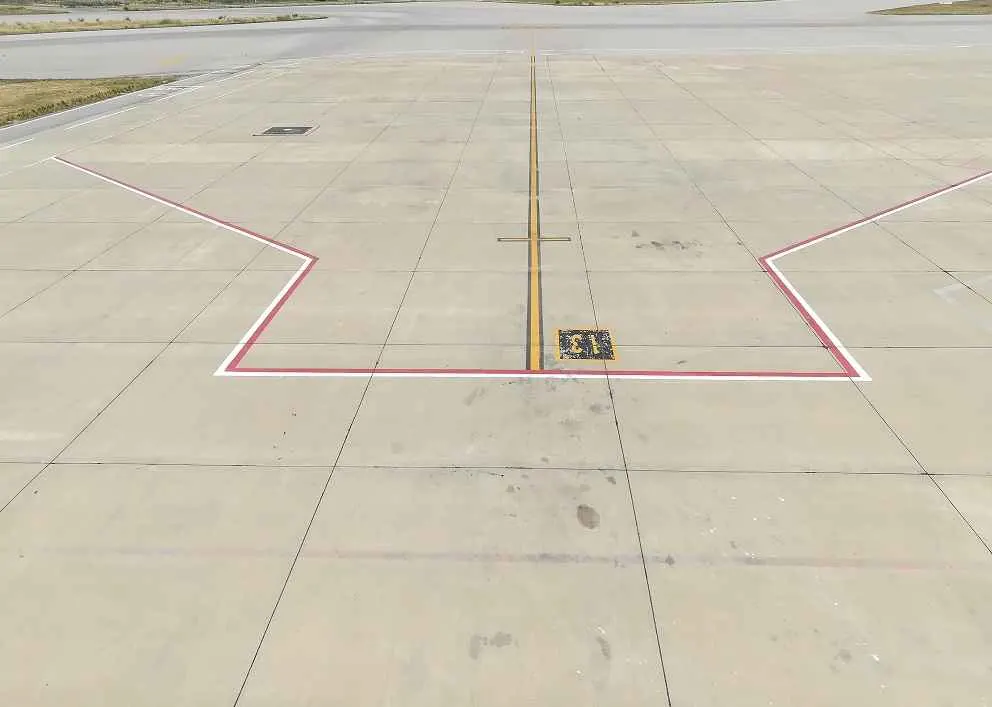
Every aircraft stand has a center line with reflective paint that is used for guiding the aircraft on an aircraft stand. When aircraft approaches for parking, its nose wheel must be kept on the referred centerline so that it doesn’t end up parked too much on the left or on the right.
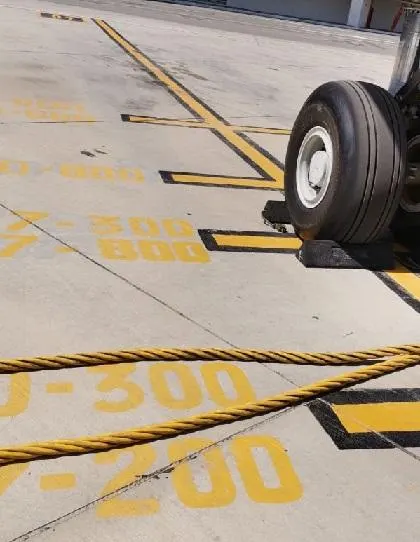
Since different aircrafts have different geometries, the aircraft centerline has stop positions, also known as stop bars, to indicate where nosewheel of each aircraft type must stop so that the aircraft neither parks too far behind nor too far ahead.
In this way, centerline and stop positions on an aircraft stand keep the aircraft horizontally and longitudinally centered.
The role of pushback tractor in all this:
Sometimes, the aircraft nose wheel crosses its stop position on the centerline and moves too far ahead its designated parking position.
It happens if the marshaller (the official who guides the aircraft with hand signals) makes a mistake and delays the stop signal causing the nosewheel to move past the stop bar or if there is a shortcoming in Pilot’s judgment to apply brakes or comprehend marshaller signals.
Whatever the reason, the aircraft cannot reverse itself to get back on its designated stop position. A pushback tractor is used to push the aircraft nosewheel back to its stop position.
Such a scenario creates quite a hassle on the ramp because it costs airlines time and money. It takes at least 5 minutes to engage pushback tractor and push the aircraft back to its stop position.
Ans 5:
Take off Power:
On take-off, in order to position the aircraft to a safe height away from terrain and obstacles (i.e. a flight path of maximum height and minimum ground distance desired), the engine thrust is set to a high ‘take-off power’ setting (although this is not necessarily full power) and the aircraft attitude is pitched up to maintain a specific speed (usually in the region of V2 + 15kts). Once the ‘safe height’ is reached the engine thrust can therefore be reduced to a more appropriate (i.e. efficient) setting and the aircraft flight path can be changed to a more appropriate (i.e. efficient) flight path.
In order to achieve that described above and also to provide minimum noise disturbance to the area surrounding the airport, regulatory procedures require aircraft to fly one of the two profiles given below during every departure. The aerodrome briefing pages will state which one of the two profiles is to be flown at each particular airport:
- At 1,500ft aal reduce thrust to climb power and accelerate the aircraft towards 250 knots, retracting flaps and slats.
- At 1,500ft aal reduce thrust to climb power maintaining V2 + 15kts. At 3,000ft accelerate the aircraft.
Tyre Design:
Design and Construction of Aircraft tyre
Carcass plies are used to form the tire. They are sometimes called casing plies. An aircraft tyre is constructed for the purpose it serves.
- They support the weight of an aircraft while it is on the ground.
- It also provides the necessary traction for braking and stopping of an aeroplane.
- Tyre also helps to absorb the shock of landing and provide cushioning the roughness of takeoff, roll-out, and taxi operations.
Unlike an automobile or truck tyre, it does not have to carry a load for a long period of continuous operation. However, an aircraft tyre absorbs the high impact loads of landing, and also it’s operating at high speeds for a short time when required.
Let’s go through some technical aspects of the tyre.
Retreading – Retreading is methods of restoring a worn tyre by renewing the tread area or by renewing the tread area plus one or both sidewalls. Repairs are included in the tyre retreading process.
Load Rating – Load rating is the maximum permissible load at a specified inflation pressure.
Ply Rating – Ply Rating is used to identify the maximum recommended load rating and inflation pressure for a specified tyre. It is an index of tyre strength.
Speed Rating – The speed rating is the maximum takeoff speed to which the tyre has been tested.
Skid Depth – Skid depth is the distance between the tread surface and the deepest groove as measured in the mould.
Aircraft tyres must have an approved speed and load rating and have sufficient clearance when retracted through landing gear to allow for tyre growth. Tyre growth is the increase in the size of the tyre due to centrifugal forces at high speed.
Aircraft tyres may be Tube-type or Tubeless
Tubeless tyres are more advantageous over tube-type. There is no longer the use of tube-type tyre in recent aviation. Nowadays all airliners are using tubeless tyres. Tubeless that are meant to be used without a tube has the word TUBELESS on the sidewall of the tyre.
Aircraft tyres may be Radial or Bias
Almost all airliners are using Radial tyre. Bias is an older design, and it’s mainly used for road vehicles. Radial tyres have the word RADIAL on the sidewall. Radial tires are more expensive than bias-ply tyres. Radial tires are in demand because of their lower life cycle cost and long term value.
Conductive Tyres
Today’s tyres are conductive. Aircraft tyres are manufactured with tread rubber with conducting compounds to permit earthing of static charges. Conductive Tyres
In early days when tyres were not sufficiently conductive, aircraft used to have a conductive strip hanging down from the axle of the landing gear. Upon landing, this strip would be the first part of the aircraft to touch the earth. This discharges any static electricity accumulated on the outer surfaces of the aircraft. Now you don’t see them anymore.
Rolling resistance:
The typical airliner tire can handle a 38-ton load. It can meet the ground 500 times before needing a re-tread, a refresh it can take on seven times in its life.
A Boeing 777 uses 14 tires, Airbus' A380 carries 22, and the enormous Antonov An-225 demands 32. The key to their remarkable durability is maximizing the air pressure, says Lee Bartholomew, lead test engineer for Michelin Aircraft Tires. The high-flying rubber is typically inflated to 200 psi, roughly six times what you put in an automobile tire, and the tires on an F-16 fighter are pumped to 320 psi. “It's really pressurized air that's so strong,” .
The tires themselves aren't terribly large--- a Boeing 737 rides on 27x7.75 R15 rubber. In English, that means it is 27 inches in diameter, 7.75 inches wide, and wrapped around a 15-inch wheel. The sidewalls aren't terribly thick, and the strength of the tire lies in the cords embedded below the tread, Bartholomew says. They're typically nylon, and more recently a variety known as aramid. Each layer of the casing contributes to its load bearing and air pressure resisting capabilities. Of course, tires can fail, especially when under-inflated or overloaded. Treads can come off and casings can blow out.
In the first moments after a plane touches down, the tires are skidding, not rolling. The airplane essentially drags them down the runway until their rotational velocity matches the velocity of the plane. That's why they smoke upon landing, and why Michelin uses grooves instead of the block patterns seen on your car's rubber---blocks would simply break off. (Most tire wear comes from this moment of contact---where the rubber meets the runway.) The stoutest tires are rated for speeds of up to 288 mph.
To develop a new sort of tire, or test a tweak, Michelin starts with computer simulation, followed by prototyping. Then it tests how the tires do when they're overloaded or pushed past their speed limit, on simulated takeoffs, landings, and taxiing. Like everything in aviation, tires must meet specific and demanding rules---for example, a tire must withstand four times its rated pressure for at least three seconds.
Tyre Pressure:
An aircraft tire or tyre is designed to withstand extremely heavy loads for short durations.[1] The number of tires required for aircraft increases with the weight of the aircraft, as the weight of the airplane needs to be distributed more evenly. Aircraft tire tread patterns are designed to facilitate stability in high crosswind conditions, to channel water away to prevent hydroplaning, and for braking effect.
Aircraft tires generally operate at high pressures, up to 200 psi (14 bar; 1,400 kPa) for airliners, and even higher for business jets. The main landing gear on the Concorde was typically inflated to 232 psi (16.0 bar), whilst its tail bumper gear tires were as high as 294 psi (20.3 bar).
Brake Force:
Emergency procedures at take-off weight will produce the biggest braking loads. I will calculate the highest possible braking loads for a Boeing 747-400 that weighs up to 400 tons on take-off. For this I need this plot of a polynominal for the braking coefficient, which is the ratio between vertical and horizontal forces before the tire skids. I do not know the source;
Shortly before the aircraft comes to a stop, the highest friction coefficient is reached, and then little lift is produced by the wings, so the vertical tire loads are those of the static case. The braked wheels are the 16 main wheels; that the unbraked noswheels carry 4% of the total weight. At 96% of 400 tons acting on those 16 wheels, this is 24 tons = 235,344 N = 52,907 lbs of downward force per wheel. Since the friction coefficient is 1 at low speed, the same load is transferred horizontally from each wheel to the ground and into the gear struts.
also, brakes will lock on a dry runway if the disk brakes are fully engaged.
PART - B
Ans 6A
Assumption for Towing vechile to pull back the aircraft:
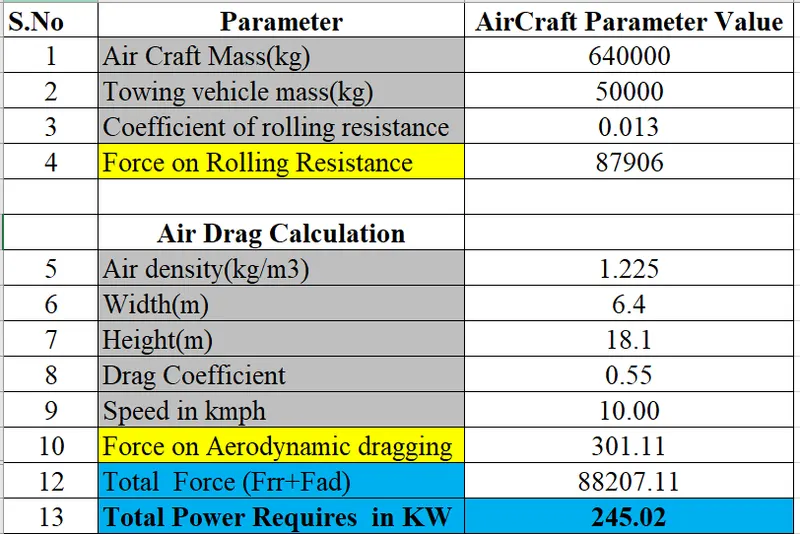
Due to Runway driving conditions, Hill climbing force is assumed as zero.
As per the assumed values, we required 245KW is required power. In addition with the suitability and the nearby value of standared HP rating, the machine (either PMDC,BLDC or IM) can be choosen to drive the Towing Vehicle.
Ans 6 B :
Simulink model:
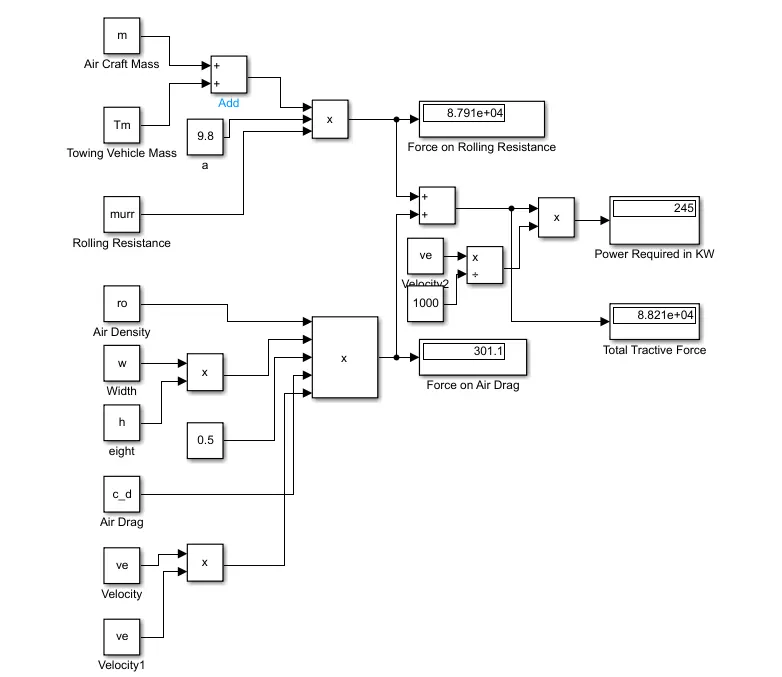
Aircraft Parameters:
m=640000;
Tm=50000;
murr=0.013;
ro=1.225
w=6.4;
h=18.1;
c_d=0.55
ve=10/3.6;
Ans :7
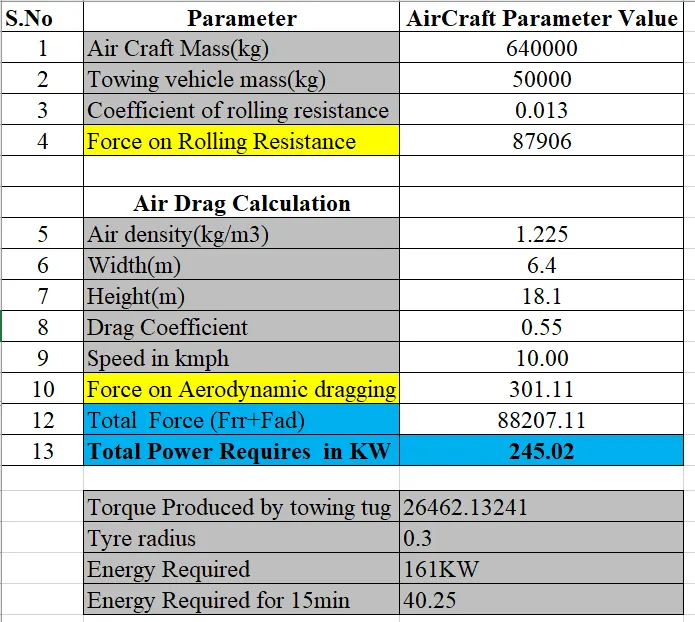
Energy Required:161KW
Enegy = P*t
=161*0.25 ( 15 min operating time)
=40KW
If the 200KW motor is selected for the application,
duty cycle = Pout/Pin
=161/200
=0.80 for smooth operation upto 15min
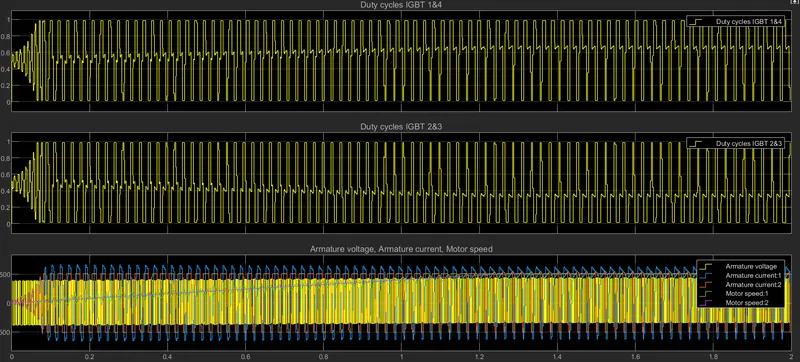
Simulink model:
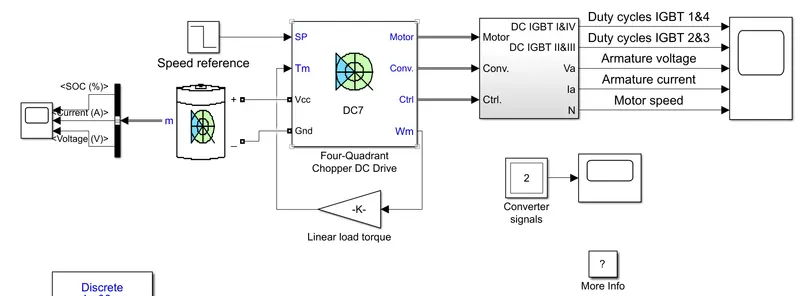
Output Voltage: