Project-1: Powertrain for aircraft in runways
1) AIM: Search and list out the total weight of various types of aircrafts.
aircraft:
An aircraft is a vehicle or machine that is able to fly by gaining support from the air. It counters the force of gravity by using either static lift or by using the dynamic lift of an airfoil or in a few cases the downward thrust from jet engines . Common examples of aircraft include airplanes,helicopters,airships including blimps,gliders paramotors and hot air balloons.
Different Types of Weights of an Aircraft:
Manufacturer's Empty Weight (MEW):
In aviation, manufacturer's empty weight (MEW) (also known as manufacturer's weight empty (MWE)) is the weight of the aircraft "as built" and includes the weight of the structure, power plant, furnishings, installations, systems, and other equipment that are considered an integral part of an aircraft before additional operator items are added for operation.
zero-fuel Weight (ZFW):
The zero-fuel weight (ZFW) of an aircraft is the total weight of the airplane and all its contents, minus the total weight of the usable fuel on board. Unusable fuel is included in ZFW.
Operating empty Weight(OEW): (Roughly equivalent to basic empty weight on light aircraft)
It is the basic weight of an aircraft including the crew, all fluids necessary for operation such as engine oil, engine coolant, water, unusable fuel and all operator items and equipment required for flight but excluding usable fuel and the payload.
Payload:
It is the carrying capacity of an aircraft. It includes cargo, people, extra fuel. In the case of a commercial airliner, it may refer only to revenue-generating cargo or paying passengers.
Maximum Takeoff Weight (MTOW):
This is the maximum weight at which the pilot of the aircraft is allowed to attempt to take off.
Regulated Takeoff Weight (RTOW):
Depending on different factors (e.g. flap setting, altitude, air temperature, length of runway), RTOW or maximum permissible takeoff weight varies for each takeoff.
Maximum Landing Weight (MLW):
This maximum weight at which an aircraft is permitted to land.
The following image depicts takeoff weight components.
Maximum Ramp Weight (MRW):
It is the maximum weight authorized for maneuvering (taxiing or towing) an aircraft on the ground.
Aircraft Gross Weight (AGW):
It is the total aircraft weight at any moment during the flight or ground operation. This decreases during flight due to fuel and oil consumption.
The aircraft has:
Basic Empty Weight (BEW):
is the weight of the aircraft "as built" and includes the weight of the structure, power plant, furnishings, installations, systems and other equipment that are considered an integral part of an aircraft before additional operator items are added for operation.
Dry Operating Wieght (DOW): BEW + Weight of Crew (Pilot + Cabin including their bags) + Pantry
Operating Weight (OW): DOW + Takeoff fuel (i.e. Ramp Fuel - Taxi fuel)
Maximum Zero Fuel Weight (MZFW): DOW + Payload (anything put on the aircraft that generates revenue to the company, e.g. passenger, baggage, cargo, mail and fret)
Maximum Taxi Weight (MTW): MZFW + Ramp fuel
Maximum Takeoff Weight (MTOW): MZFW + Takeoff fuel, or MTW - Taxi fuel
Maximum Landing Weight (MLW): MTOW - Trip Fuel
list out the total weight of various types of aircraft:
| Type | MTOW [kg] | MLW [tonnes] |
|---|---|---|
| Airbus A380-800 | 575,000 | 394 |
| Boeing 747-8F | 447,700 | 346.091 |
| Boeing 747-8 | 443,613 | 306.175 |
| Boeing 747-400ER | 412,770 | 295.742 |
2) AIM: Is there any difference between ground speed and air speed
It is important to understand the relationships of wind speed to ground speed and airspeed
Wind Speed:
For a reference point picked on the ground, the air moves relative to the reference point at the wind speed. Notice that the wind speed is a vector quantity and has both a magnitude and a direction. Direction is important. A 20 mph wind from the west is different from a 20 mph wind from the east. The wind has components in all three primary directions (north-south, east-west, and up-down).
In this figure, we are considering only velocities along the aircraft's flight path. A positive velocity is defined to be in the direction of the aircraft's motion. We are neglecting cross winds, which occur perpendicular to the flight path but parallel to the ground, and updrafts and downdrafts, which occur perpendicular to the ground.
Ground Speed:
For a reference point picked on the ground, the aircraft moves relative to the reference point at the ground speed. Ground speed is also a vector quantity so a comparison of the ground speed to the wind speed must be done according to rules for vector comparisons.
Airspeed:
The important quantity in the generation of lift is the relative velocity between the object and the air, which is called the airspeed. Airspeed cannot be directly measured from a ground position, but must be computed from the ground speed and the wind speed. Airspeed is the vector difference between the ground speed and the wind speed.
Airspeed = Ground Speed - Wind Speed
On a perfectly still day, the airspeed is equal to the ground speed. But if the wind is blowing in the same direction that the aircraft is moving, the airspeed will be less than the ground speed.
3) AIM: Why is it not recommended to use aircraft engine power to move it on the ground at Airport
Unless the aircraft is in a location where it is unwise to taxi under aircraft power and necessitating a tow by a large tractor, the aircrafts engine(s) is how the craft moves.
Obviously, it is prudent to use only the amount of power to get the airplane moving and then reduce the power for taxiing to avoid high volumes of air spreading debris or damaging other aircraft or ground vehicles.
whether jets or prop airplanes,there are use the aircrafts(engine) power to move on the airfield.
4) AIM: How an aircraft is pushed to runway when its ready to take off
Airplanes have engines, and they can use them to move forward along the ground. So they push themselves to the runway.
It is true that most of the time, a small vehicle is needed to push the larger commercial airplanes backwards away from the terminal building, because even if a plane can reverse it’s thrust, it’s not always safe to hit the buildings with that reverse thrust.
So the little trucks push the bigger planes back away from the buildings, but after that, the planes can apply a small amount of engine power to roll forward just as all airplanes can.
Aircraft push themselves to the runway.
5) AIM: Learn about take off power, tyre design, rolling resistance, tyre pressure, brake forces when landing.
Tyre Design:
When it comes to safety, tyres are one of the most important components of aircraft. They help to absorb the shock of landing and provide cushioning. It also provides the necessary traction for braking and stopping of an aircraft.
An aircraft tyre is designed to withstand extremely heavy loads while landing, take off, taxing, and parking. The number of wheels required for aircraft increases with the weight of the aircraft, as the weight of the aeroplane needs to be distributed more evenly.
Design and Construction of Aircraft Tyre:
Carcass plies are used to form the tire. They are sometimes called casing plies. An aircraft tyre is constructed for the purpose it serves.
- They support the weight of an aircraft while it is on the ground.
- It also provides the necessary traction for braking and stopping of an aeroplane.
- Tyre also helps to absorb the shock of landing and provide cushioning the roughness of takeoff, roll-out, and taxi operations.
Unlike an automobile or truck tyre, it does not have to carry a load for a long period of continuous operation. However, an aircraft tyre absorbs the high impact loads of landing, and also it’s operating at high speeds for a short time when required.
Retreading: Retreading is methods of restoring a worn tyre by renewing the tread area or by renewing the tread area plus one or both sidewalls. Repairs are included in the tyre retreading process.
Load Rating: Load rating is the maximum permissible load at a specified inflation pressure.
Ply Rating: Ply Rating is used to identify the maximum recommended load rating and inflation pressure for a specified tyre. It is an index of tyre strength.
Speed Rating: The speed rating is the maximum takeoff speed to which the tyre has been tested.
Skid Depth: Skid depth is the distance between the tread surface and the deepest groove as measured in the mould.
Aircraft tyres must have an approved speed and load rating and have sufficient clearance when retracted through landing gear to allow for tyre growth. Tyre growth is the increase in the size of the tyre due to centrifugal forces at high speed.
Tyre Types:
- Radial ply tires - these tyres feature a flexible casing which is constructed of rubber-coated ply cords which extend around the beads and are substantially at 90° to the centerline of the tread. The casing is stabilized by an essentially inextensible circumferential belt.
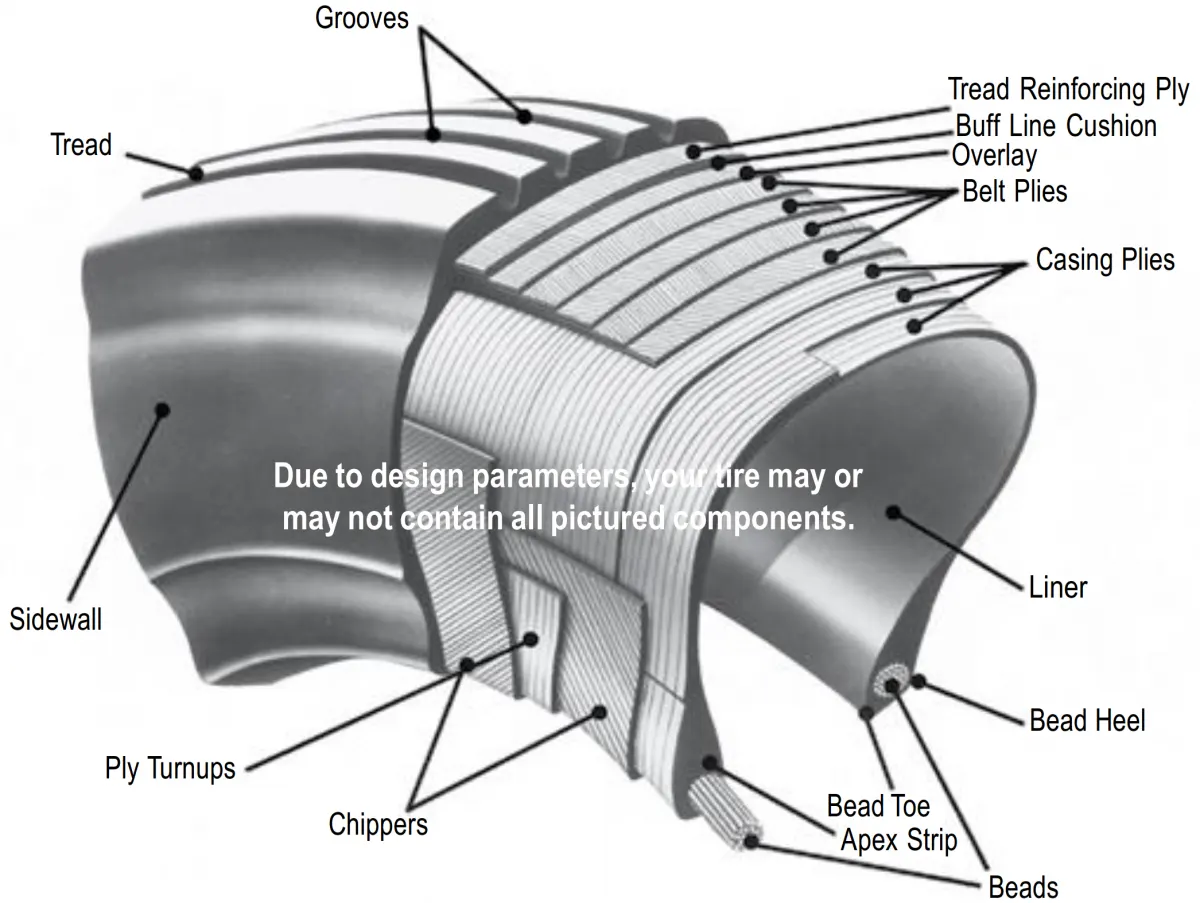
- Bias ply tires: these tyres feature a casing which is constructed of alternate layers of rubber-coated ply cords which extend around the beads and are at alternate angles substantially less than 90° to the center line of the tread.
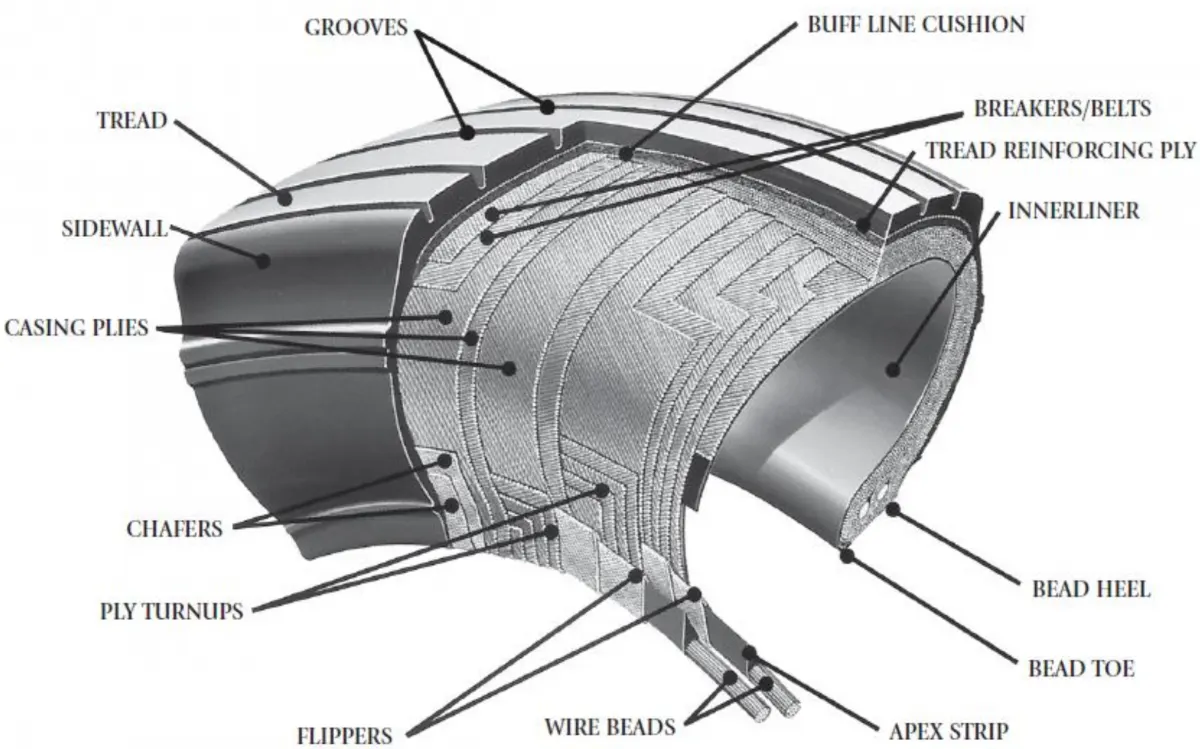
- Tube-type tyres: these require tubes for inflation retention.
- Tubeless tyres: these do not require tubes. They are constructed with an innerliner (integral rubber lining that is engineered to prevent the diffusion of the inflation gas into the casing.).
Rolling Resistance:
- The rolling resistance is primarily due to the hysteresis losses in the vehicle tyres. Friction
in bearings and the gearing system also play their part. The rolling resistance is approximately constant, and hardly depends on vehicle speed. It is proportional to vehicle weight.
The equation is
Frr = μrrmg - where μrr is the coefficient of rolling resistance. The main factors controlling μrr are the
type of tyre and the tyre pressure. Any cyclist will know this very well – the freewheeling
performance of a bicycle becomes much better if the tyres are pumped up to a high
pressure, though the ride may be less comfortable.
The value of μrr can reasonably readily be found by pulling a vehicle at a steady very
low speed, and measuring the force required.
Tyre Pressure:
Depends on the weight of the plane and number of tires it has, but generally the cold pressure is between 200 and 300+ psi.
Aircraft braking systems:
A disc brake: is a type of brake that uses the calipers to squeeze pairs of pads against a disc or a "rotor" to create friction.This action slows the rotation of a shaft, such as a vehicle , either to reduce its rotational speed or to hold it stationary. The energy of motion is converted into waste heat which must be dispersed.
Thrust reversal: also called reverse thrust, is the temporary diversion of an aircraft engines thrust for it to act against the forward travel of the aircraft, providing deceleration . Thrust reverser systems are featured on many jet aircraft to help slow down just after touch-down, reducing wear on the brakes and enabling shorter landing distances. Such devices affect the aircraft significantly and are considered important for safe operations by airlines .
There have been accidents involving thrust reversal systems, including fatal ones.
Air brakes dedicated flight control surfaces that work by increasing drag.
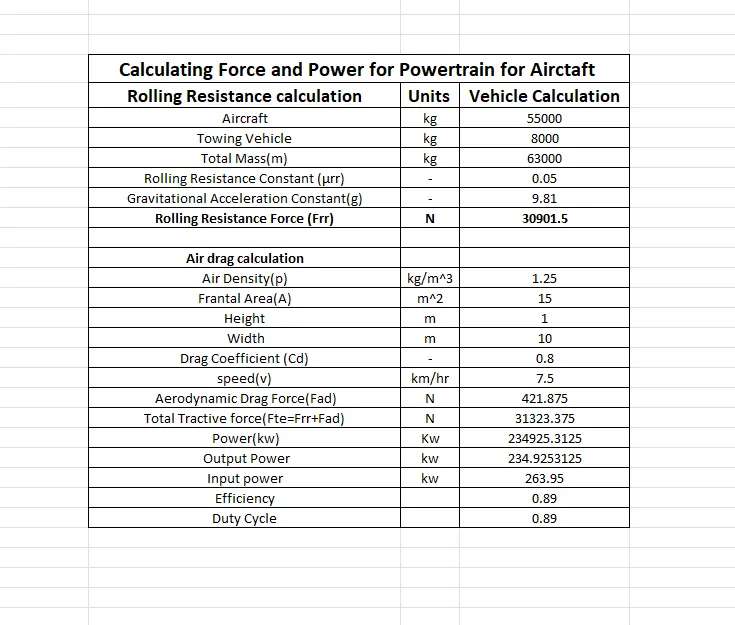
6. A. With necessary assumptions, calculate the force and power required to push / pull an aircraft by a towing vehicle.
calculation:
- Rolling Resistance Force(Frr)
Frr = μrrmg
- Aerodynamic Drag Force(Fad)
Fad =1/2*ρACdv^2
- Total Tractive Force (Fte) (Rolling resistance Force+Aerodynamic drag force)
Fte =G/r*T
- Total Power= Total Tractive Force*Velocity
P=Fte*V
where,
m=Mass of the vehicle
g=Gravitational Acceleration Constant
μrr=Rolling Resistance Constant
ρ=Air Density kg/m^2
A=Frantal Area m^2
Cd=Drag Coefficient
V=Velocity of the Vehicle m/s
T=Torque output
r=Radius of tire
G=Gear ratio
Let us Assume the Values:
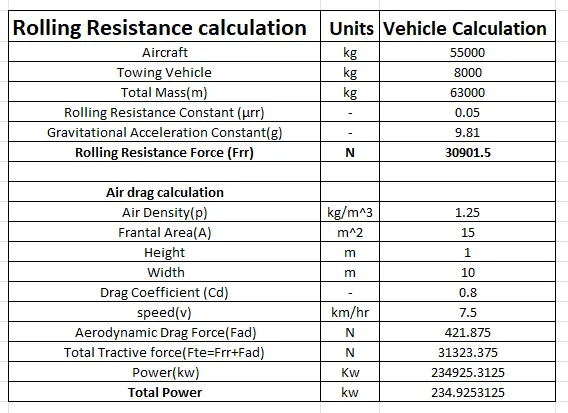
For a Towing Vehicle we assume,
G-10(For Delivering High Torque)
r-27 inches=27/39.73=0.685m
T=Fte*r/G
T=31323.375*0.685/10
T=2145.65
Fte =G/r*T
Fte=10/0.685*2145.65
Fte=31323.35
6.B. Develop the model for the calculated force and power using Simulink.
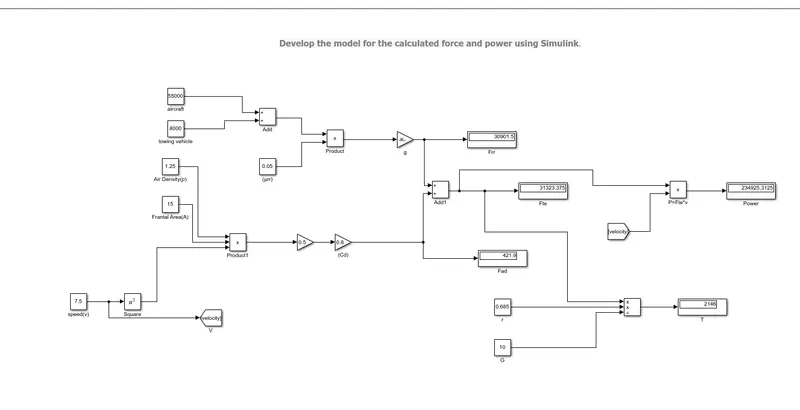
Constant Block:
This block is used to declare the diffrent input like
m=Mass of the vehicle
μrr=Rolling Resistance Constant
ρ=Air Density kg/m^2
A=Frantal Area m^2
V=Velocity of the Vehicle m/s
Gain Block:
This block is multiply the input with the gain value.
This block is used for
Cd=Drag Coefficient
g=Gravitational Acceleration Constant
Display:
which results the output of the equations.
Tags:
Used to tag the data between the blocks.(goto&from)
and used add block,product block,Divide block,square block etc..
7. A. Design an electric powertrain with type of motor, it’s power rating, and energy requirement to fulfill aircraft towing application in Simulink. Estimate the duty cycle range to control the aircraft speed from zero to highest. Make all required assumptions. Prepare a table of assumed parameters. Draw a block diagram of powertrain.
(Hint :DC7 Block)
Design an electric powertrain with type of motor, it’s power rating, and energy requirement to fulfill aircraft towing application in Simulink:
Here i assumed the aircraft
Motor selection for the power train
Based on some of the parameters i selected the dc machine for the power train
Power rating and energy requirement to fulfill airctaft towing application
we calculated the power required the vehicle.
The power required to propell the vehicle is 234.92kw.
This power is the output of the motor.
in order to select the power rating of the machine we need to consider the efficiency accepct.
Because the machine consists of different types of losses.
we know that
input power=outputpower+losses in machine
efficiency(η)=outputpower/inputpower
let assume the machine efficiency is 89%
then the input power is calculated as
inputpower=outputpower/efficiency(η)
=234.92kw/0.89
=263.95kw
we can select a 264kw dc motor is sufficient for the power train
consider the particular motor to operate for a 1hr then the energy for the machine is given by
energy=power*time
=264*3600
950400wh or 950.4kwh
Duty cycle Range to control the aircraft speed frome zero to highest block diagram of powertrain
duty cycle=outputpower/inputpower
=234.92/263.95
=0.89%
assumed paramerers:
| Aircraft | kg | 55000 |
| Towing Vehicle | kg | 8000 |
| Total Mass(m) | kg | 63000 |
| Rolling Resistance Constant (µrr) | - | 0.05 |
| Gravitational Acceleration Constant(g) | - | 9.81 |
| Air Density(p) | kg/m^3 | 1.25 |
| Frantal Area(A) | m^2 | 15 |
| Height | m | 1 |
| Width | m | 10 |
| Drag Coefficient (Cd) | - | 0.8 |
| speed(v) | km/hr | 7.5 |
Draw a block diagram of powertrain:
7.B. Also, Design the parameters in excel sheet.