Project-1: Powertrain for aircraft in runways
Part A:
1. Search and list out the total weight of various types of aircrafts.
The following study is obtained from an article "What are different types of weights of an aircraft? - Aviation Stack Exchange" and "Average Airplane Weight (With 9 Examples) (travelonthefly.com)"
Manufacturer's Design weight limitation
- The maximum allowable weight of an aircraft is determined by design considerations by the aircraft manufacturer
- The maximum operational weight can be less than the maimum allowable weight due to such consideration as high density altitude or high drag field conditions caused by wet grass or water on the runway.
Difference between usable fuel and unusable fuel
| USABLE FUEL | UNUSABLE FUEL |
| Is the fuel on board an aircraft that can actually be used by its engines. | The small amount of fuel that cannot be drained from the tanks is the unusable fuel. |
| For calculation of range, usable fuel is used. |
This restriction is due to structural, design or operational limitations.
Manufacturer's empty weight (MEW)
- Also called Manufacturer's Weight Empty (MWE) or Licensed Empty Weight.
- It is the weight of the aircraft "as built" and includes the weight of the structure, power plant, furnishings, installations, systems and other equipment that are considered an integral part of an aircraft.
- This excludes any baggage, passengers, or usable fuel.
Zero-fuel weight (ZFW)
- This is the total weight of the airplane and all its contents (including unusable fuel), but excluding the total weight of the usable fuel on board.
- As a flight progresses and fuel is consumed, the total weight of the airplane reduces, but the ZFW remains constant.
Maximum zero fuel weight (MZFW)
- Is the maximum weight allowed before usable fuel and other specified usable agents (engine injection fluid, and other consumable propulsion agents) are loaded.
Operating empty weight (OEW)
- Roughly equivalent to basic empty weight on light aircraft.
- It is the basic weight of an aircraft including the crew, all fluids necessary for operation such as engine oil, engine coolant, water, unusable fuel and all operator items and equipment required for flight but excluding usable fuel and the payload.
Payload
- It is the carrying capacity of an aircraft. It includes cargo, people, extra fuel.
- In the case of a commercial airliner, it may refer only to revenue-generating cargo or paying passengers.
Maximum takeoff weight (MTOW)
- This is the maximum weight at which the pilot of the aircraft is allowed to attempt to take off.
Regulated takeoff weight (RTOW)
- Depending on different factors (e.g. flap setting, altitude, air temperature, length of runway), RTOW or maximum permissible takeoff weight varies for each takeoff.
- It can never be higher than MTOW.
Maximum landing weight (MLW)
- This maximum weight at which an aircraft is permitted to land.
Maximum ramp weight (MRW)
- also called maximum taxi weight (MTW)
- It is the maximum weight authorized for maneuvering (taxiing or towing) an aircraft on the ground.
Aircraft gross weight
- It is the total aircraft weight at any moment during the flight or ground operation.
- This decreases during flight due to fuel and oil consumption.
Simplified method for load calculations
From the above figure we acn understand the weight calculations of the aircraft.
- Basic Empty Weight (BEW)
- Is the weight of the aircraft "as built" and includes the weight of the structure, power plant, furnishings, installations, systems and other equipment that are considered an integral part of an aircraft before additional operator items are added for operation.
- Dry Operating Wieght (DOW)
- BEW + Weight of Crew (Pilot + Cabin including their bags) + Pantry
- Operating Weight (OW)
- DOW + Takeoff fuel (i.e. Ramp Fuel - Taxi fuel)
- Maximum Zero Fuel Weight (MZFW)
- DOW + Payload (anything put on the aircraft that generates revenue to the company, e.g. passenger, baggage, cargo, mail and fret)
- Maximum Taxi Weight (MTW)
- MZFW + Ramp fuel
- Maximum Takeoff Weight (MTOW)
- MZFW + Takeoff fuel, or MTW - Taxi fuel
- Maximum Landing Weight (MLW)
- MTOW - Trip Fuel
Total weight of various types of aircrafts
| Aircraft | Long (Feet) | Empty Weight (Ton) | Max Weight (Ton) |
| Cessna 172 | 27 | 0.64 | 1.09 |
| Citation Jet M2 | 42 | 3.12 | 4.77 |
| Boeing 767-300 | 185 | 87.05 | 178.57 |
| Boeing 787-800 | 186 | 118.08 | 224.33 |
| Boeing 777-300 | 242 | 158.03 | 294.64 |
| Boeing 747-400 | 232 | 181.69 | 406.25 |
| Airbus A320 | 123 | 36.607 | 75.89 |
| Airbus A330 | 210 | 122.54 | 226.33 |
2.Is there any difference between ground speed and air speed?
The following study is obtained from an article "What Is the Difference Between Airspeed and Ground Speed? (knaviation.net)"
The above represented fig shows the difference between air speed and ground speed
Ground speed
- Ground speed is how fast an airplane's shadow would move across the land.
- If there's a strong wind pushing an aircraft, that's reflected in the ground speed.
- Ground speed is simply the sum of airspeed and wind speed.
- Ground speed = Airspeed + Wind speed
Air speed
- Airspeed, in contrast, is how fast an airplane is really flying strictly under its own power, which is calculated by subtracting the wind speed from the ground speed.
- On the other hand, if the wind is blowing against the direction the aircraft is traveling in, the aircraft experiences headwind, and its ground speed is lower than its airspeed.
- It is measured by using the pilot tube
- Airspeed = Airspeed - Wind speed
- Air speed is further classified into three types
- Indicated Airspeed
- It is calculated directly off an aircraft pilot static system.
- It is calculted off the aircraft dynamic pressure.
- The difference between its total pressure and static pressure.
- The dynamic pressure depends not only on the aircraft’s speed, but also on the density of the air it is flying in.
- As such, the higher the aircraft flies ,and the lower the air density as a result , the bigger the difference between indicated and true airspeed is.
- Calibrated airspeed
- It is indicated airspeed adjusted for a variety of errorsJust as an example, one of the things it’s adjusted for is the flap position.
- The reason for that is that at different flap positions, air flows differently around the pitot-static system and affects the indicated airspeed readings.
- Indicated Airspeed
True airspeed
- It is the actual speed at which an aircraft is moving relative to the air it is traveling in.
- It’s calibrated airspeed adjusted for the the exact conditions (altitude, air temperature, etc.) that the aircraft is flying in.
3.Why is it not recommended to use aircraft engine power to move it on the ground at Airport?
Due to the following reasons aircraft is not recommended to use engine power to move it on the ground at Airport.
- The thrust produced by the engine may cause damage to the surrounding building or the equipment.
- Engine close to the ground may also blow the sand and derbies into the engine which also damage the engine itself.
- Too much of noise is produced by the engine .
- To reduce the fuel consumption of the engine ,taxing is used.
4.How an aircraft is pushed to runway when its ready to take off?
The following study is obtained from an article "Why do airplanes have to move very fast on a runway before taking off? – JanetPanic.com" & "How is an aircraft pushed to the runway when it's ready to take off? - Quora"
- Airplanes have engines, and they can use them to move forward along the ground. So they push themselves to the runway.
- It is true that most of the time, a small vehicle is needed to push the larger commercial airplanes backwards away from the terminal building, because even if a plane can reverse it’s thrust, it’s not always safe to hit the buildings with that reverse thrust.
- A so-called pushback truck reverses the aircraft into taxiing position, pushing it with a towbar attached to the nose-wheel strut. Or, in the most modern versions, by actually lifting the wheel.
- So the little trucks push the bigger planes back away from the buildings, but after that, the planes can apply a small amount of engine power to roll forward just as all airplanes can.
- The aircraft taxis to the runway to depart at the agreed time.
5.Learn about take off power, tyre design, rolling resistance, tyre pressure, brake forces when landing.
- Take off Power
The following study is obtained from an article "Takeoff - Wikipedia"
The takeoff in any aircraft occurs when the airplane leaves the ground and becomes airborne.Which an aerospace vehicle leaves the ground and becomes airborne. For aircraft traveling vertically, this is known as liftoff.For aircraft that take off horizontally, this usually involves starting with a transition from moving along the ground on a runway
For light aircraft, usually full power is used during takeoff. Large transport category (airliner) aircraft may use a reduced power for takeoff, where less than full power is applied in order to prolong engine life, reduce maintenance costs and reduce noise emissions. In some emergency cases, the power used can then be increased to increase the aircraft's performance.power used can then be increased to increase the aircraft's performance. Before takeoff, the engines, particularly piston engines, are routinely run up at high power to check for engine-related problems.
Fixed-wing aircraft designed for high-speed operation (such as commercial jet aircraft) have difficulty generating enough lift at the low speeds encountered during takeoff. These are therefore fitted with high-lift devices, often including slats and usually flaps, which increase the camber and often area of the wing, making it more effective at low speed, thus creating more lift. These are deployed from the wing before takeoff, and retracted during the climb. They can also be deployed at other times, such as before landing.
W.K.T Power">Power = Mass x Acceleration x distance/time. The forces which are considered during the take off are Thrust , Drag , Weight & Lift
The following study is obtained from an article "NASA - The Four Forces of Flight"
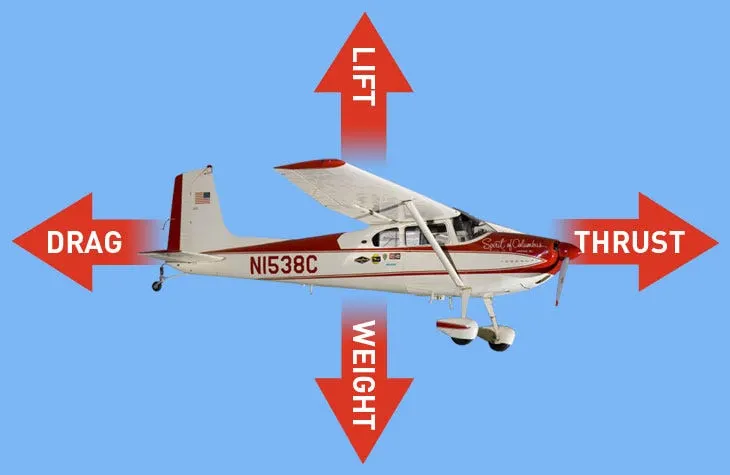
- Thrust (T)
- It is a force that moves an aircraft in the direction of the motion.
- It is created with a propeller, jet engine, or rocket.
- Air is pulled in and then pushed out in an opposite direction.
- One example is a household fan.
- T = (Pshaft *Efficiency/V )
- Pshaft -------> Output power of the shaft.
- V ------------> Velocity
- Drag (D)
- It is the force that acts opposite to the direction of motion.
- It tends to slow an object.
- Drag is caused by friction and differences in air pressure.
- An example is putting your hand out of a moving car window and feeling it pull back.
- D = Cd *0.5*ρ*V^2*A
- A ------------> Frontal Area
- Cd ----------> Drag coefficient
- V ------------> Velocity
- Weight (W)
- It is the force caused by gravity.
- It includes the Total weigght of the aircraft itself.
- W = m*g
- m-----------> Mass of the aircraft
- g -----------> Garvitational force
- Lift
- It is the force that holds an airplane in the air.
- The wings create most of the lift used by airplanes.
The way the four forces act on the airplane make the plane do different things. Each force has an opposite force that works against it.
- Lift works opposite of weight.
- Thrust works opposite of drag. When the forces are balanced, a plane flies in a level direction. The plane goes up if the forces of lift and thrust are more than gravity and drag.
- If gravity and drag are bigger than lift and thrust, the plane goes down. Just as drag holds something back as a response to wind flow, lift pushes something up.
- The air pressure is higher on the bottom side of a wing, so it is pushed upward.
2.Rolling Resistance
The following study is obtained from an article "ROLLING RESISTANCE OR ROLLING FRICTION: DEFINITION, EXPRESSION AND FACTORS CONTRIBUTING TO ROLLING RESISTANCE - UNDERSTANDING BUSINESS ANALYSIS AND ENGINEERING PRINCIPLES (hkdivedi.com)"
- Rolling resistance is basically defined as the force resisting the motion, when a body such as ball, wheel, automobile tyre rolls along the surface of another body.
- Deformation at the point of contact will develop the resistance to rolling.
- This resistance will be an entirely different phenomenon from that of dry friction.
- In analogy with sliding friction, rolling resistance will be expressed as a coefficient of rolling resistance multiply by the normal force.
- There will be no slipping or impending slipping in the interpretation of rolling resistance.
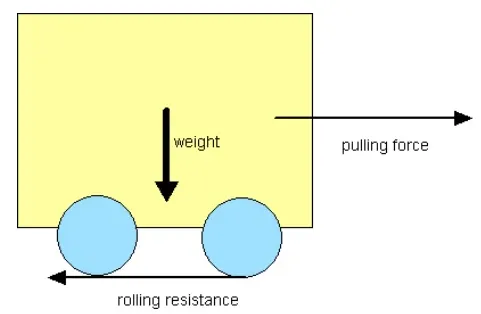
- The expression for rolling resistance could be written as mentioned below
- Fr = c x W
- Fr = Rolling resistance or Rolling friction (N)
- c = Rolling resistance co-efficient or co-efficient of rolling friction i.e. CRF
- W = Normal force (N)
- Rolling resistance co-efficient or co-efficient of rolling friction i.e. CRF is a dimensionless.
- For example,
- We can see that a rubber tyre such as automobile car will have higher rolling resistance on a paved road as compared with a steel railroad wheel such as a train wheel on a steel rail.
- Automobile car running on a road will have higher rolling resistance because its tyre wheel will be soft. On the other hand, train steel wheel running on rail track will have relatively lower rolling resistance as its wheel will be quite hard as compared with the tyre wheel.
3.Tyre design
The following study is obtained from an article "Aircraft Tyre | Design and Construction - AviationHunt"
Tyres are one of the most important components of aircraft. They help to absorb the shock of landing and provide cushioning. It also provides the necessary traction for braking and stopping of an aircraft.
An aircraft tyre is designed to withstand extremely heavy loads while landing, take off, taxing, and parking. The number of wheels required for aircraft increases with the weight of the aircraft, as the weight of the aeroplane needs to be distributed more evenly.
Aircraft tyres must have an approved speed and load rating and have sufficient clearance when retracted through landing gear to allow for tyre growth. Tyre growth is the increase in the size of the tyre due to centrifugal forces at high speed.
- They support the weight of an aircraft while it is on the ground.
- It also provides the necessary traction for braking and stopping of an aeroplane.
- Tyre also helps to absorb the shock of landing and provide cushioning the roughness of takeoff, roll-out, and taxi operations.
Unlike an automobile or truck tyre, it does not have to carry a load for a long period of continuous operation. However, an aircraft tyre absorbs the high impact loads of landing, and also it’s operating at high speeds for a short time when required.
- Retreading
- Retreading is methods of restoring a worn tyre by renewing the tread area or by renewing the tread area plus one or both sidewalls. Repairs are included in the tyre retreading process.
- Load Rating
- Load rating is the maximum permissible load at a specified inflation pressure.
- Speed Rating
- The speed rating is the maximum takeoff speed to which the tyre has been tested.
- Skid Depth
- Skid depth is the distance between the tread surface and the deepest groove as measured in the mould.
- Aircraft tyre may be tube or tubeless
- Tubeless tyres are more advantageous over tube-type.
- There is no longer the use of tube-type tyre in recent aviation.
- Nowadays all airliners are using tubeless tyres. T
- ubeless that are meant to be used without a tube has the word TUBELESS on the sidewall of the tyre.
- Aircraft tyre may be Radial or Bias
- Almost all airliners are using Radial tyre.
- Bias is an older design, and it’s mainly used for road vehicles.
- Radial tyres have the word RADIAL on the sidewall.
- Radial tires are more expensive than bias-ply tyres.
- Radial tires are in demand because of their lower life cycle cost and long term value.
4.Tyre pressure
- According to the size and weight of an aircraft the tyre pressure varries.
- Aircraft tyre operate at such high exteme of pressure,load,speed in a short period of time .
- So it must be undergo critical and periodical maintenance.
- The most important action of an operator is to prevent tyre relevant events is to maintain proper tire inflation pressure.
- Failure to keep aircarft tire properly inflated can lead to very serious consequences.
- The typical airline tyre can handle a 38 ton load.
- It can meet the ground 500 times in its lifebedfore needing a re-tread,a refresh it can take on seven times in its life.
- Aircarft tire generally operates upto 200psi .
-
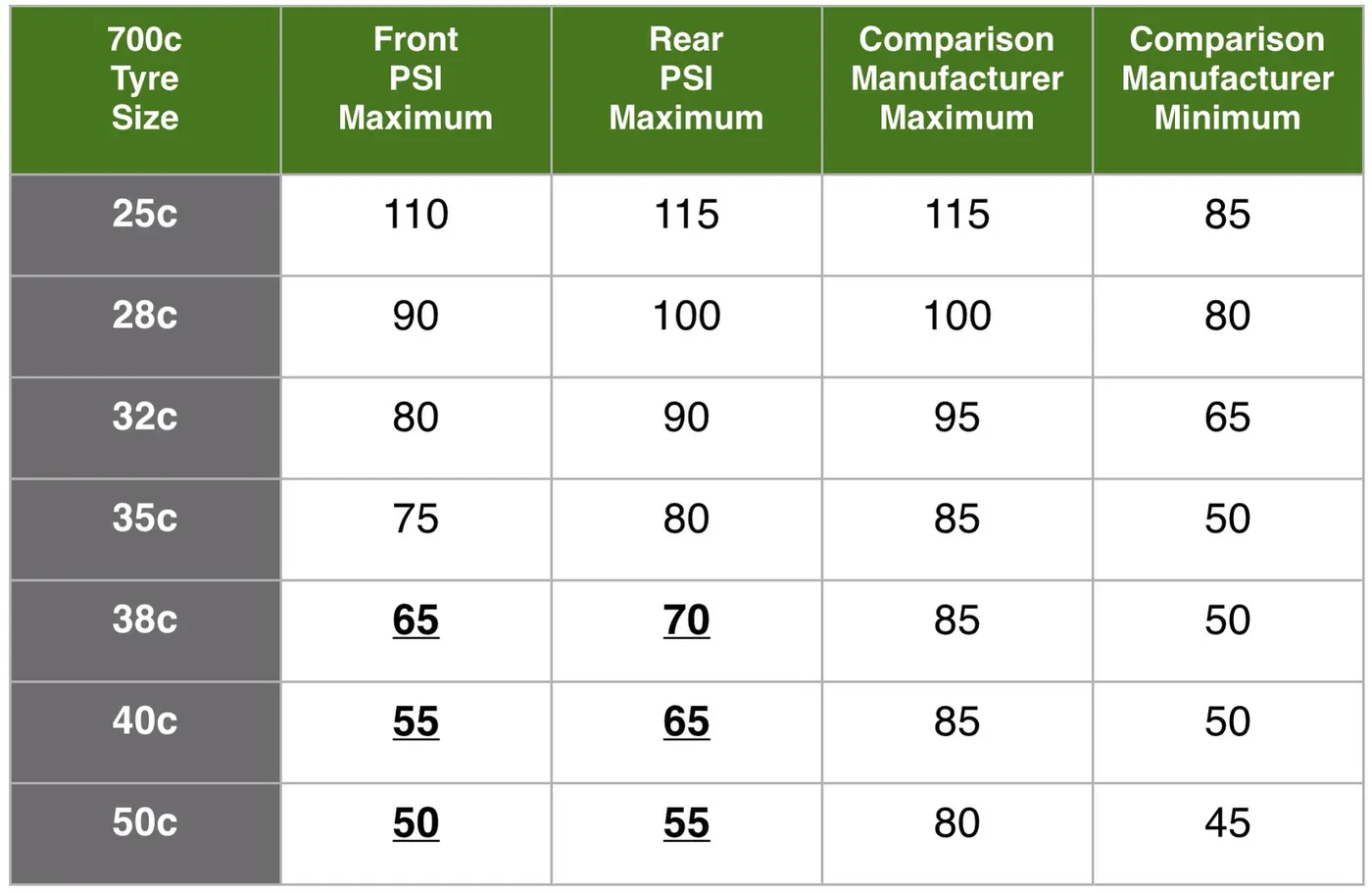
- The following actions are taken to operate the tyre at most optimistic performance.
- Perform daily pressure check with a calibarated guage.
- Target the highest pressure recommended in the AMM or POH (105 % of operating pressure).
- Componsate tfor the ambient temperature changes.
5.Brake forces when landing
The following study is obtained from an article " How do aircraft brakes work? | Engineering360 (globalspec.com)"
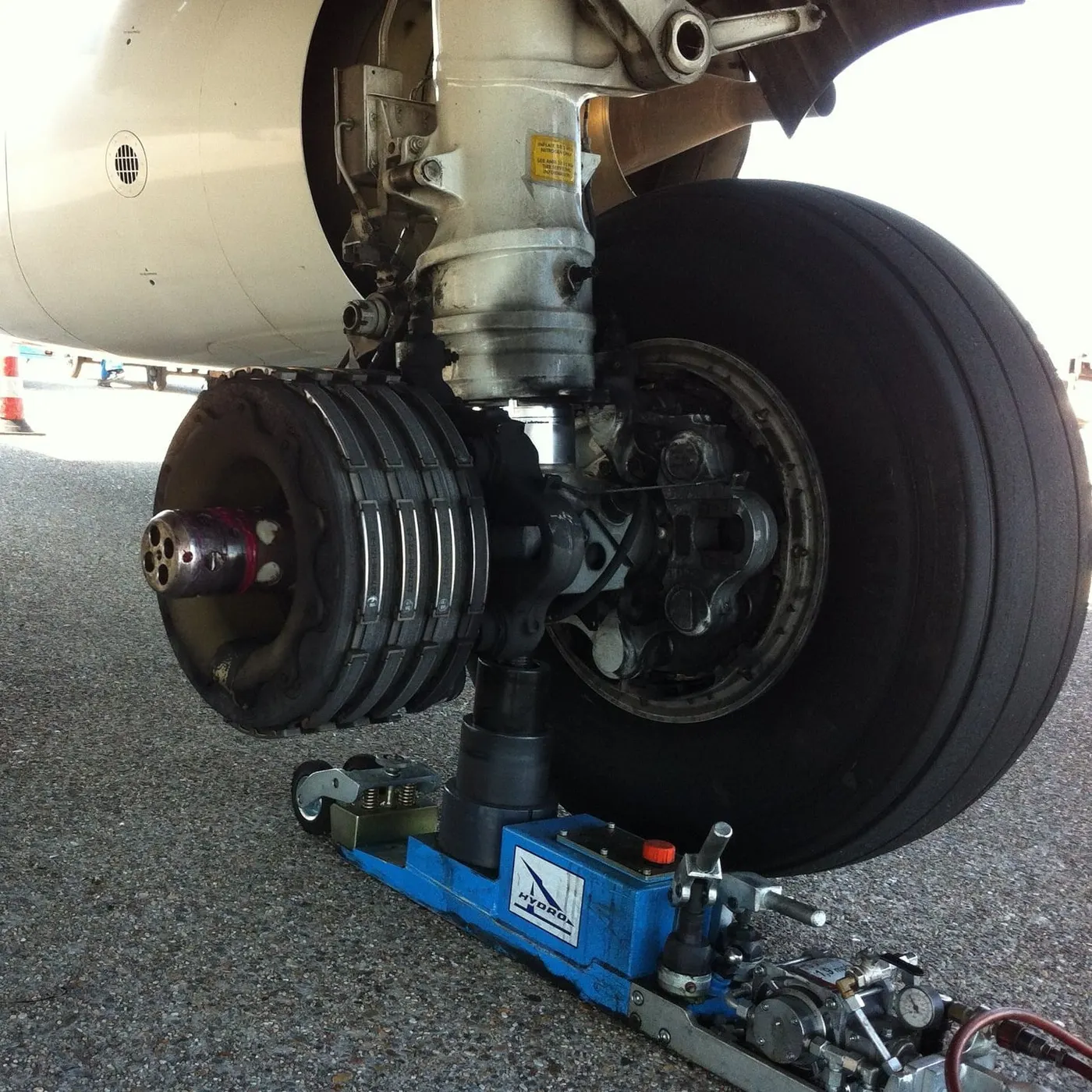
- Aircraft brakes also prevent motion of the aircraft when it is parked, limit its speed during taxiing and can even help steer the aircraft on the ground by applying different levels of braking force to the left- and right-side brakes.
- Aircraft brakes work in conjunction with other brake mechanisms such as thrust reversers, air brakes and spoilers.
- Thrust reversers are surfaces that are deployed into the path of the jet blast from the engines to redirect propulsive thrust in a direction that opposes the motion of the aircraft.
- Air brakes and spoilers are flight control surfaces that create additional aerodynamic drag when deployed into the path of air flowing around the aircraft.
- The most common type of brake used on aircraft is the disc brake. Disc brakes function by exploiting friction between rotating and stationary discs inside the brake.
- Upon receiving a command signal to brake — from the pilot depressing a foot pedal or from the autobrake system — actuators in the brake move a piston to squeeze the discs together, generating a frictional force that slows the rotation of the wheel.
- The friction between the discs generates heat as the aircraft’s kinetic energy is converted to heat energy.
- In this function, the brakes act as a heat sink, absorbing tremendous amounts of heat as the aircraft sheds kinetic energy.
- During RTO stops, the temperature of carbon disc brakes can exceed 1,800° C.
- W.K.T
- Kinetic Energy = 0.5 m*V^2
- m-----> mass of the airlpane.
- V -----> Velocity
- From that we derived that
- dv/dt = -(T+F+D)/m
- Reffer Take off power
- Here the dv/dt is the force required for Deacceleration
Part B
6. A. With necessary assumptions, calculate the force and power required to push / pull an aircraft by a towing vehicle.
The forces required to push / pull an aircraft by a towing vehicle are rolling resistance and aerodynamic drag force.
- We already discussed about the Rolling resistance and aerodynamic drag force in the previous part (5th question).
- The given data is taken from the towing truck TMX-150-9 & Aircraft Airbus A319
- DATA GIVEN
- Mass of the truck = 8,300 Kg
- Mass of the aircraft = 75,500 Kg
- Lenght of the aircraft = 33.84 m
- Velocity of the truck = 25kmph
- Height of the aircarft = 11.76 m
- Air density (ρ) = 1.225 Kg/m^3
- Drag coefficient (Cd) = 0.75
- Rolling resistance coefficient (μrr) = 0.013
- Gravitational constant (g) = 9.8 Nm
- DATA GIVEN
- Calculation for Rolling Ressistance (Frr)
- Frr = μrr * m * g
- m = Mass of the truck + Mass of the aircraft = 8300+75500
- m = 83800 kg
- Sub the values in the formulae
- Frr = 0.013 * 82800 * 9.8
- Frr = 10676.12 Nm
- Frr = μrr * m * g
- Calculation for Aerodynamic drag (Fad)
- Fad = 0.5 * ρ * Cd * A * V^2
- Velocity of the truck (m/sec) = 25 / 3.6 = 6.95 m/sec
- Area = Lenght of the aircraft * Height of the aircarft = 33.84 * 11.76
- Area = 392.544 m^2
- Fad = 0.5 * 1.225 * 0.75 * 392.544 * 6.95 ^2
- Fad = 8816 N
- Fad = 0.5 * ρ * Cd * A * V^2
- Total Force required to push / pull an aircraft by a towing vehicle is
- In Newton
- Ftotal = Frr + Fad = 10676.12 + 8816
- Ftotal = 19492.8 N
- In Power
- Power = Ftotal * Velocity = 18258.8 * 6.95
- Power = 135.363 kW
- In Newton
B. Develop the model for the calculated force and power using Simulink.
Model
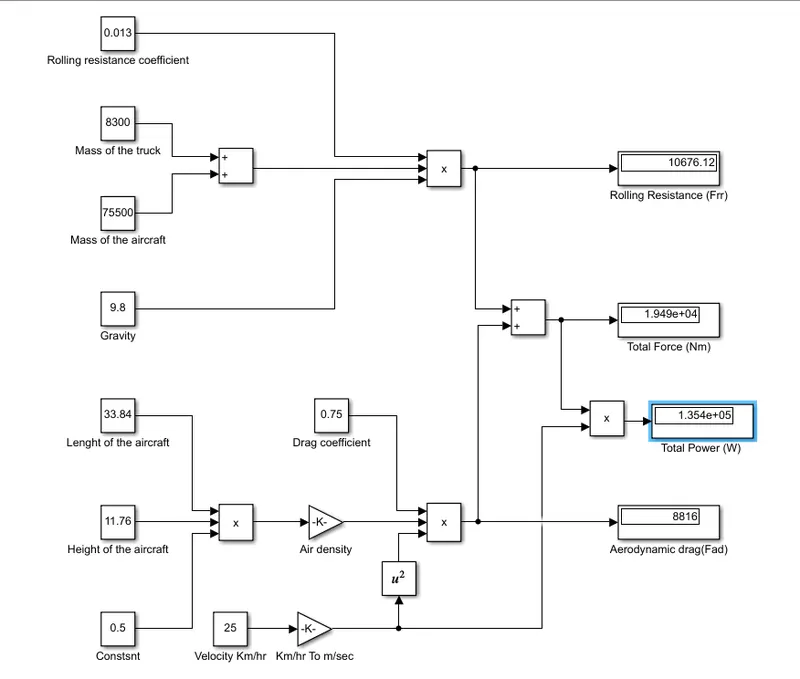
Explaination
- The Datas(Rolling resistance coefficient , Mass of the truck , Mass of the aircraft , Gravity , Lenght of the aircraft, Height of the aircraft , Drag coefficient , Air density , Velocity ) are given in the constant block .
- To find the Rolling resistance (Frr)
- The mass of the aircraft and mass of the truck are added using summer block .
- The total mass , rolling coefficient , gravity are multipiled using product block .
- The Rolling resistance (Frr) is shown by using the display block.
- To find the Aerodynamic drag (Far)
- The area of the aircraft is got from product of lenght and height of the aircraft by the product block.
- The air density is multiplied with the area with the help of gain block.
- The velocity (km/hr) is converted to Velocity (m/sec) by the help of gain block.
- The velocity is squared by the help of square block.
- The air density , velocity , drag coefficient are multiplied with the help of product block.
- The result of the product block will be the Aerodynamic drag (Fad).
- To find the Total Force
- The sum of the Rolling resistance (Frr) And Aerodynamic drag (Far) will the total force .
- It is done by using the summer block.
- To find the Total power required
- By multiplying the Total force and Velocity of the vechicle power required is obtained.
- It is done by using the product block.
7.A. Design an electric powertrain with type of motor, it’s power rating, and energy requirement to fulfill aircraft towing application in Simulink. Estimate the duty cycle range to control the aircraft speed from zero to highest. Make all required assumptions. Prepare a table of assumed parameters. Draw a block diagram of powertrain. (Hint :DC7 Block)
Block Diagram
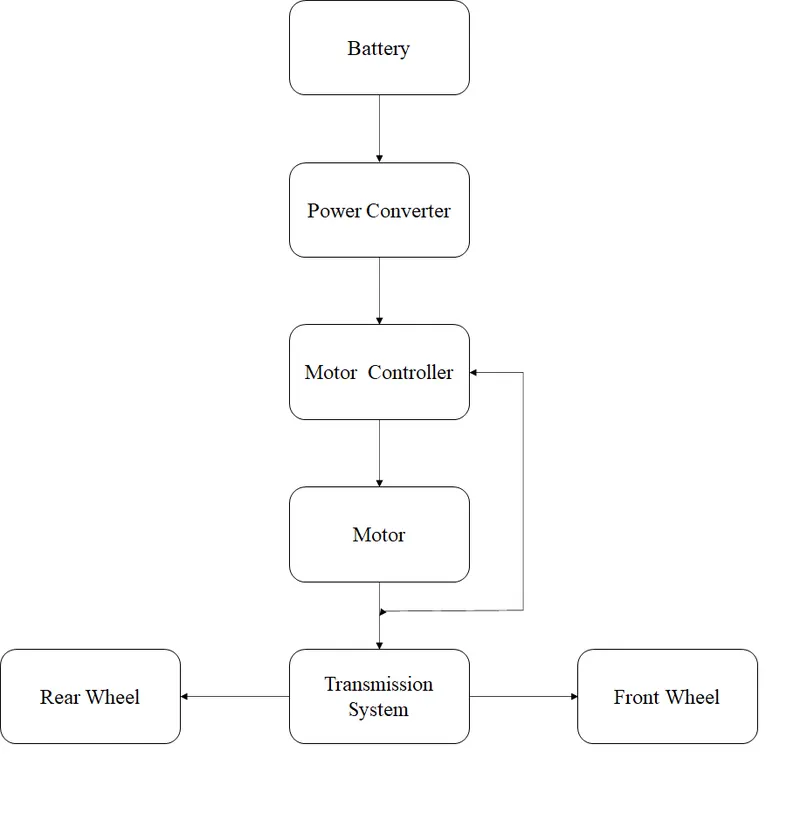
- It is the diagrammatic representation of the Electric powertrain
Designing a electric power train aircraft towing application in Simulink
- In 6th question we found the power required for towing a aircraft.
- We are going to design a power train for the 6th question.
- 315/70 R15 it is the Tyre specification for Towing truck TMX-150-9
- Data For designing
- Force required to tow the aircraft = 19492.8 N
- Power required for towing the aircraft = 135.363 kW
- Tyre radius for the towing truck = 0.411 m
- Gear ratio = 7
- Transmission Efficiency (ηt) = 80 %
- Motor Efficiency (ηm) = 92%
- Calculation
- Torque required at the wheels (Tw)
- Tw = Total force * Tyre radius = 19492 * 0.411
- Tw = 8011.212 Nm
- Actual power reqiured (Pac)
- Pac = (Power reqiured)/(ηt * ηm) = 135.363 k / (0.8*0.92)
- Pac = 183.917 kW
- It is the motor power rating should be around 190 kW.
- To calculate motor torque (Tm)
- Tm = (Tw)/(Gear ratio * ηt) = 8011.212 / (0.8 * 7)
- Tm = 1.430 kNm
- Actual motor torque (Tmac)
- Tmac = (Tm)/(ηm) = 5.6 / 0.92
- Tmac = 1.555 kNm
- To calculate battery capacity
- The Towing tractor takes 15 minutes for taxing.
- 15 minutes = 0.016667 hours
- Battery Capacity = Pac * hours =0.016667 * 183.917
- Battery Capacity = 3.067 kWh
- The battery must deliver the power output of 3.067 kWh
- If i use 210 kW battey i can run the towing tractor easily .
- Duty cycle calcultion
- Duty cycle = (Power required (Pac))/(Power rated(battery capacity))= 183.917/210
- Duty cycle = 0.875
- To run the towing tractor for 15 minutes with speed of 7 m/sec the duty cycle is varries between (0 - 0.875)
- At 0.875 the towing tractor reaches its maximum speed of 7m/sec.
- Torque required at the wheels (Tw)
- Parameters
| Parameter | Values |
| Mass of the truck | 8,300 Kg |
| Mass of the aircraft | 75,500 Kg |
| Area of the aircraft | 392.544 m^2 |
| Coefficient of rolling resistance | 0.013 |
| Speed of the truck | 25 Kmph |
| Drag Coefficient | 0.75 |
| Air density | 1.225 Kg/m^3 |
| Taxing time | 15 mins |
| Battery Voltage |
80 V (2 no's) |
| Motor Power | 6.086 kNm |
- Simulink Model
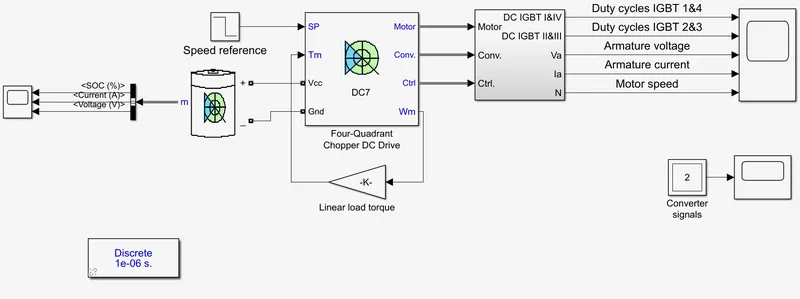
The above simulation is done by using the data obtained
The simulation stop time is 7 second
- Input
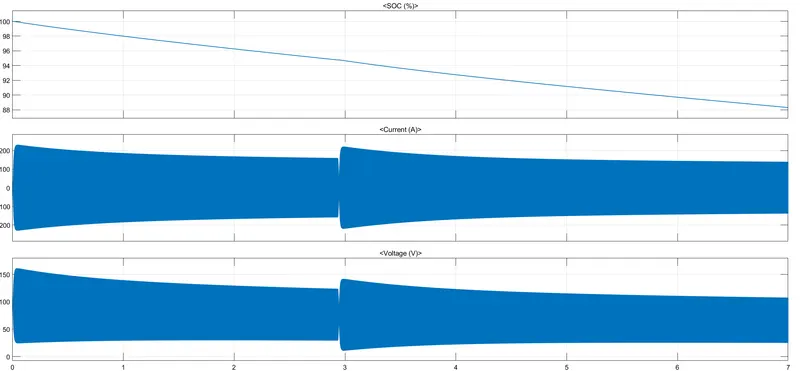
- From the above plot we can understand the battery SOC , Voltage , Current
- At the starting time we can see the sydden rush of starting current .
- The battery voltage is set be as 80 volts.
- Here the battery percentage is reduced to 88 percent in the short duration of time due to its heavy usage
- Output
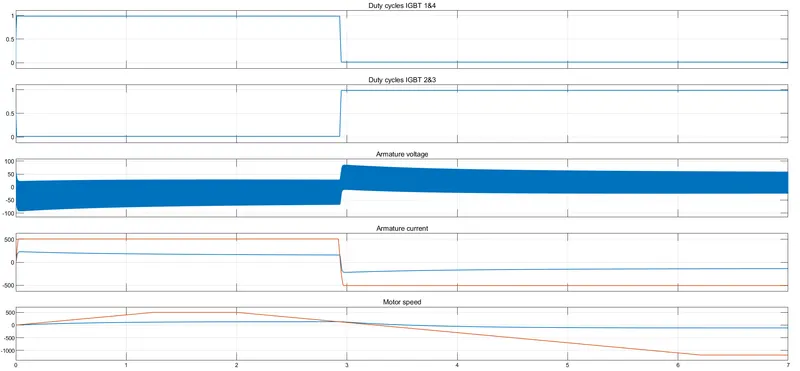
- From the above plot we can see the duty cycle of the power converter
- The duty cycle is setted as 87 % for the bettery usage of the battery power.
- By using the Dc 7 converter the motor is tested in both forward and reverse direction.
B. Also, Design the parameters in excel sheet.
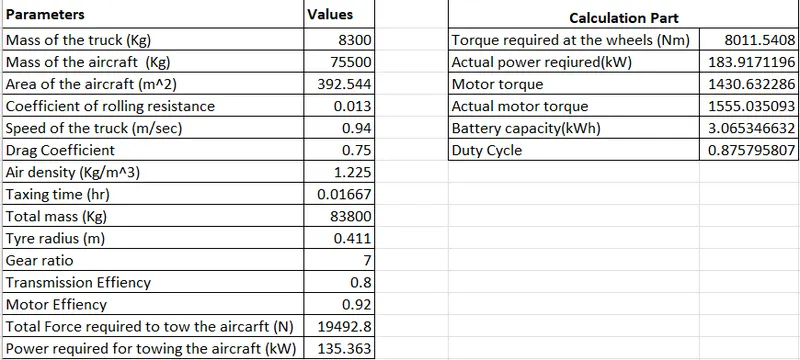
The given excel is attached .