Project-1: Powertrain for aircraft in runways
6A. The total tractive force acting on the towing vehicle depends on many forces such as
- rolling resistance force
- aerodynamic drag force
- hill-climbing force
For a towing vehicle moving at a very slow speed, the aerodynamic drag force is minimum as this force is directly proportional to the velocity of the vehicle.
The towing vehicle moves along a fat surface , hence the hill-climbing force is negligible.
The maximum tractive force depends on the rolling resistance force and aerodynamic force at max velocity.
Rolling resistance force
Frr = mgfrcos(alpha)
alpha =0 ; cos(alpha) =1
g =9.81 m/s^2
fr =0.01
m = 661.9 kg as per T80 datasheet
Frr = 661.9 *9.81*0.01*1= 64.86N
Aerodynamic force
Fad = 0.5 rho A cd v^2
rho = 1.2kg/m^2
height= 1.6m
width =2.75m
cd = 0.4
v = 25kmph
Fad = 0.5*1.2*(1.6*2.75)*0.4*25^2 = 660N
Total tractive force = 64.86 N + 660 N = 724.86 N
The maximum power required = Tractive force * velocity
= 724.86 * 25 = 18.121kW
6B. Matlab Model for calculation of force and power is given by
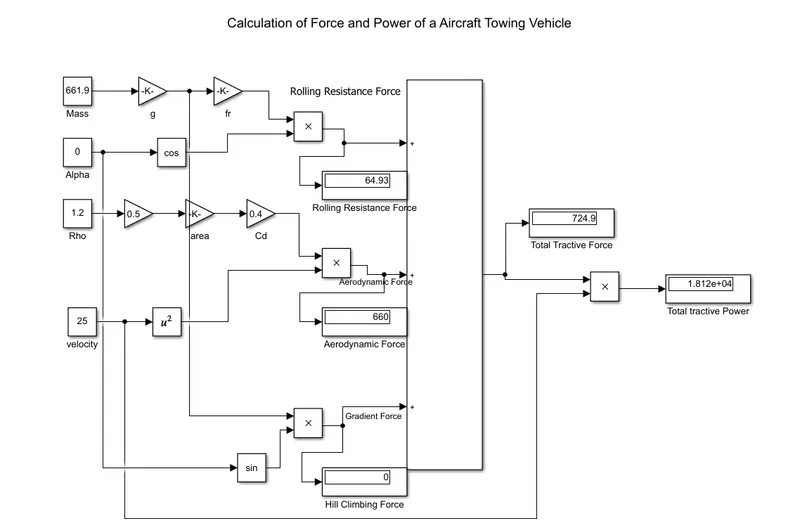
It can be seen from the figure that the model is done with basic blocks such as constant , gain ad math function blocks. Based on the formula for calculation of forces the prdoct and addition blocks are used. Display blocks is used to display the results of individual forces, total tractive force and total tractive power.
By applying the given data, it can be seen that the model holds good as per the theoretical Calculations.
7A. Design of electric power train with a type of motor, it's power rating, and energy requirement to fulfill the aircraft towing application
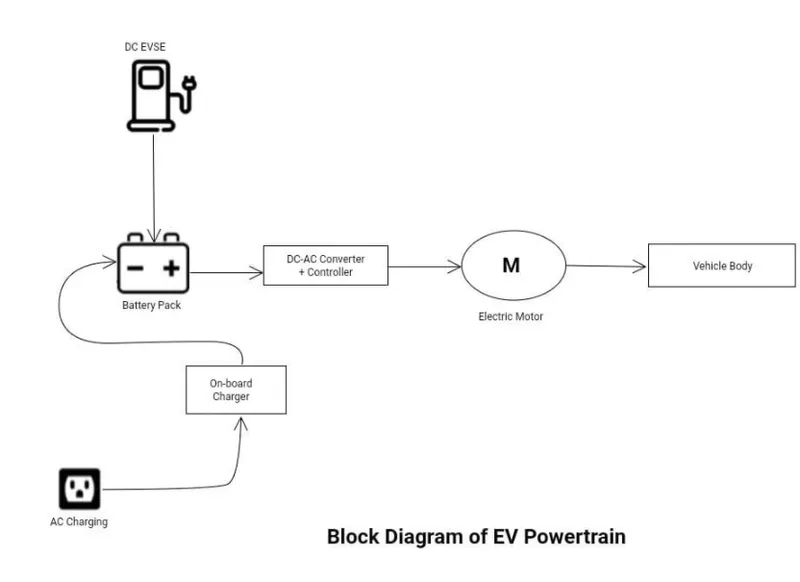
EV powertrain consists of 60% fewer components than IC engine. A power train is a combination of an Energy source and an energy converter that drive the motor to propel the vehicle forward.
Battery pack:
It is made of multiple lithium ion cells that stores energy needed to run the vehicle. It gives a DC current when connected across a load.
Power Converter:
An EV consists of various types of power converters such as
- AC - DC Converter: The supply from the grid is AC which has to be converted to DC to charge the battery.
- DC-DC converter: To control the vehicle in four quadrants a DC-Dc Converter is required. Converting Variable DC to a fixed DC or vice versa is also a necessity in case of EV.
- DC-AC Converter: In case of use of Induction motor for EV propulsion, DC has to be converted to AC to drive the vehicle. There is an necessity of the inverter in case of BLDC motor drive system as well.
Electric Motor:
Converts electrical energy to mechanical energy which is delivered to the transmission. This motor acts as a generator also for regenerative applications.
Motor Design:
Considering DC motor
Rated Power = 25kW
Peak Power = 50kW
speed = 3500rpm
rated torque = 80Nm
peak torque = 160Nm
efficiency => 80%
Assuming the input voltage of 350V
and input current of 70A
power input = voltage * current = 350*70 = 24.5kW
The energy requirement for an EV is similar to the towing vehicle of an aircraft which is calculated on the basis of time.
Assuming a time of 15 mins = 900secs
Energy = Power *time taken
= 24.5*900 =22050kJ
Therefore the power required by a single-vehicle = 6.125 kW
Duty Cycle
The output power = 19.94kW
input power = 24.5kW
duty cycle = 19.94/24.5 = 0.813
Therefore, the efficiency of the duty cycle for an electric power train is 0 to 81.3%.
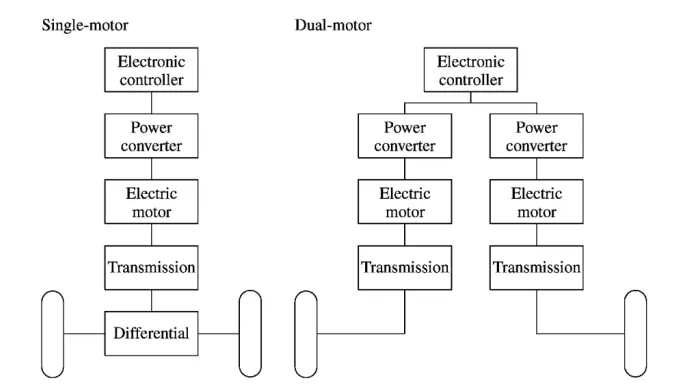
Block Diagram
7B. The excel sheet is attached with this document.