Project-1: Powertrain for aircraft in runways
PART A:
Study 1:-
Listing total weight of various kinds of Aircraft:-
Aircraft:-
An Aircraft is a vehicle or machine that is able to fly by gaining support from the air. It counters the force of gravity by using either static or by using the dynamic lift of an airfoil, or in a few cases the downward thrust from jet engines. Common examples of aircraft include airplanes, helicopters, airships, gliders, paramotors, and hot air ballons.
Methods to Lift:-
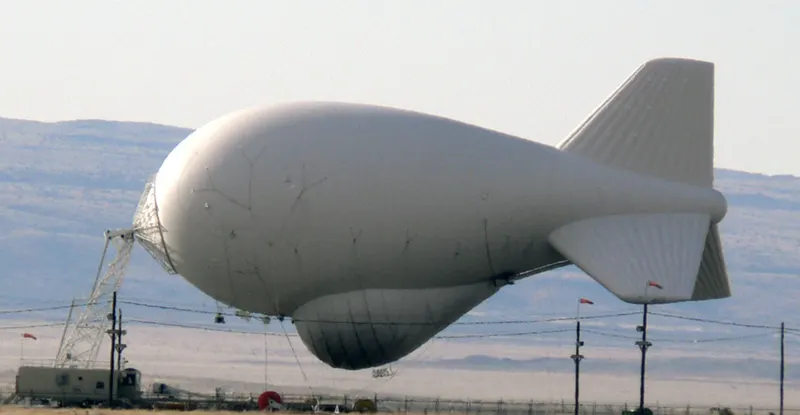
- Lighter than Air - Aerostats
Aerostat use upthrust to float in the air in much the same way that ships float on the water. They are characterized by one or more large cells or canopies, filled with a relatively low-density gas such as helium, hydrogen, or hot air, which is less dense than the surrounding air. When the weight of this is added to the weight of the aircraft structure, it adds up to the same weight as the air that the craft displaces.
- Heavier than Air - Aerodynes
Heavier-than-air aircraft, such as airplanes, must find some way to push air or gas downwards so that a reaction occurs to push the aircraft upwards. This dynamic movement through the air is the origin of the term. There are two ways to produce dynamic upthrust aerodynamic lift and powered lift in the form of engine thrust.
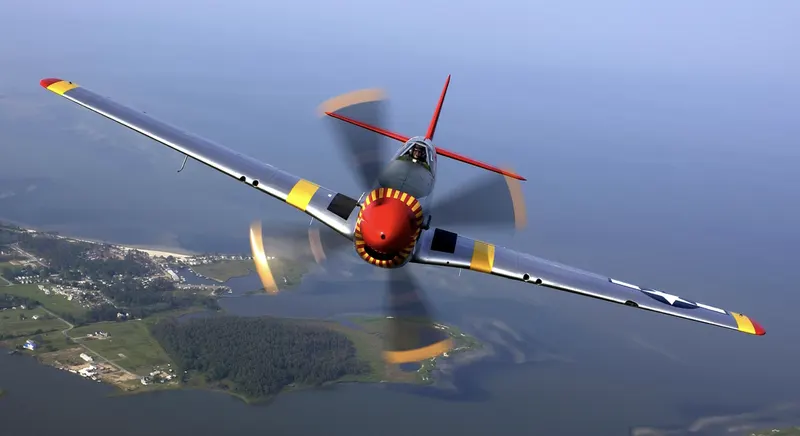
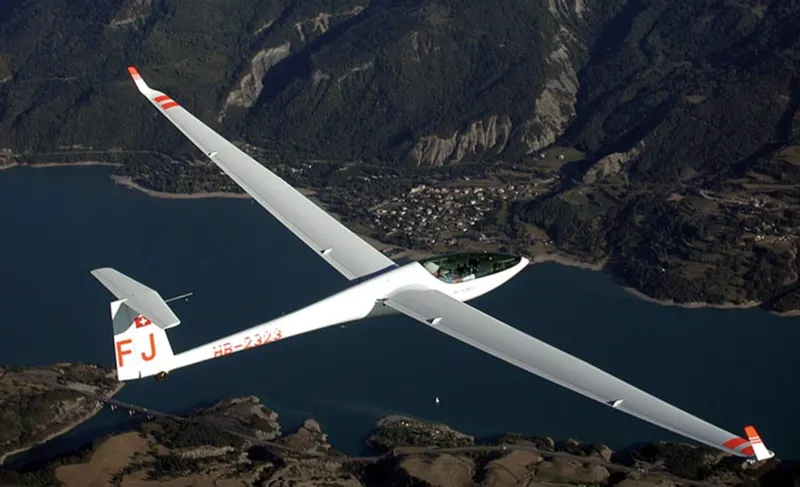
- Fixed Wing
The forerunner of the fixed-wing aircraft is the kite. Whereas a fixed-wing aircraft relies on its forward speed to create airflow over the wings, a kite is tethered to the ground and relies on the wind blowing over its wings to provide lift.
- Rotor Craft
Rotorcraft, or rotary-wing aircraft, use a spinning rotor with aerofoil section blades to provide lift. Types include Helicopters, Autogyros, and various hybrids such as gyrodynes and compound rotorcraft.
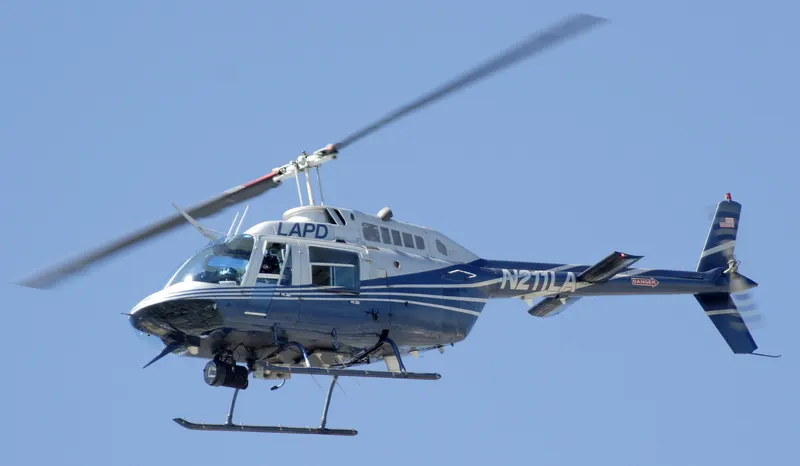
Weight of Various Kinds of Aircraft:-
Weight of Aircraft:-
Manufacturer’s Empty Weight (MEW): It is the weight of the aircraft as built and includes the weight of the structure, power plant (engines), furnishings, installations, systems and other equipment that are considered an integral part of an aircraft.
Zero Fuel Weight (ZFW): This is the total weight of the airplane and all its contents including unusable fuel (unusable fuel is the fuel which is required to maintain the structural stability of the aircraft, especially wings), but excluding the total weight of the usable fuel on board (usable fuel is the fuel necessary for the flight). Note: As a flight progresses and fuel is consumed, the total weight of the airplane reduces, but the Zero Fuel Weight remains constant.
Operational Empty Weight (OEM) or Dry Operating Weight (DOW): It is the basic weight of an aircraft including the crew, all fluids necessary for operation, (such as engine oil, engine coolant, water, unusable fuel) all operator items and equipment required for flight but excluding usable fuel and the payload.
Maximum Zero Fuel Weight (MZFW): Maximum zero fuel weight (MZFW) is the maximum weight allowed before usable fuel and other specified usable agents (engine injection fluid, and other consumable propulsion agents) are loaded. OR (OEM / DOW + Payload = MZFW)
Maximum Taxi Weight (MTW) or Maximum Ramp Weight (MRW): It is the maximum permitted weight of the aircraft at which it may be moved on the ground either with its own engine or towed by a tractor. It can also be defined as maximum weight for ground maneuvering including the weight of run-up and taxi fuel. (MZFE + Ramp Fuel = MRW)
Maximum Take-Off Weight (MTOW): It is the maximum permitted weight at the start of the take-off. While determining this limit, the manufacturer takes into consideration the strength of the material used for the manufacturing of the aircraft and standard performance variables such as runway temperature, altitude, atmospheric pressure, wind components, flaps, etc. (MZFW + Take-Off Fuel = MTOW)
Regulated Take-Off Weight (RTOW): As told in the above definition depending on different factors (e.g. flap setting, altitude, air temperature, length of runway), RTOW or maximum permissible takeoff weight varies for each takeoff. It can never be higher than MTOW.
All Up Weight (AUP): DOW + Payload + Fuel.
Maximum Landing Weight (MLW): When aircraft touches the ground it puts force of the runway as well as on the tyres and under carriage, so to ensure structural safety of the aircraft MLW is taken into consideration. Manufactures have calculate this force to be approximately “9” times the weight of the aircraft. Thus when the aircraft has to make an emergency landing or when the weight of the aircraft before landing exceeds the MLW defined by the manufacturer the pilots dump fuel to reduce the weight of the aircraft. (MTOW – Trip Fuel = MLW)
Various Types of Aircraft weights:-
(A) Heavy: Any aircraft weighing more than 255,000 lb such as the Boeing 747 or the Airbus A340;
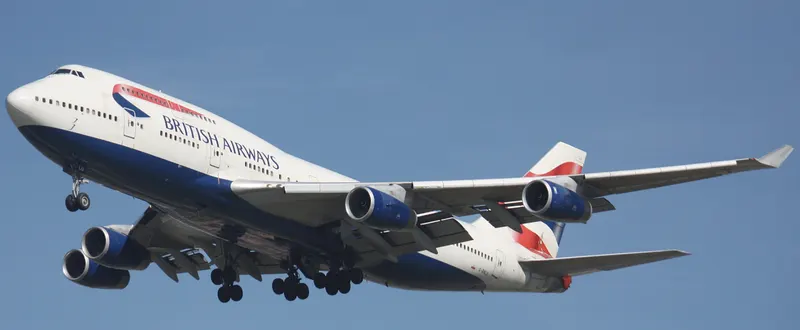
(B) B757: Boeing 757 all series;

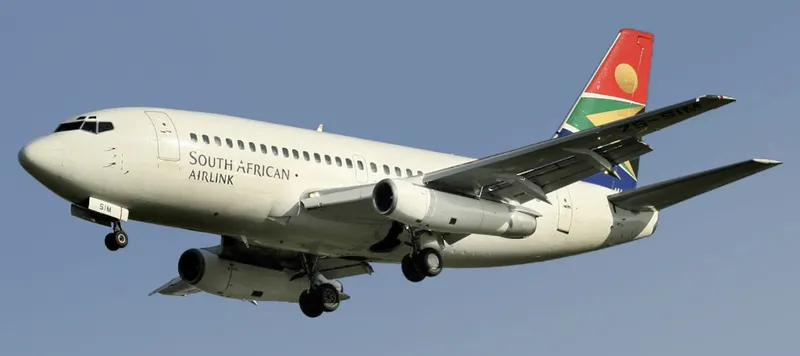
(C) Large Jet: Large jet aircraft weighing more than 41,000 and up to 255,000 lbs such as the Boeing 737 or the Airbus A320;
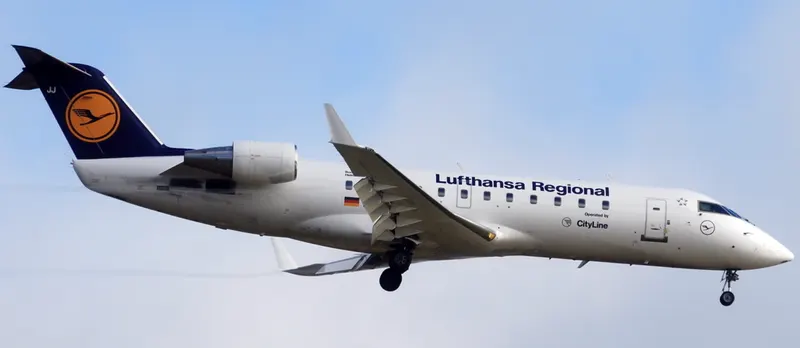
(D) Large Commuter: Large non-jet aircraft (such as the Aerospatiale/Alenia ATR-42 and the Saab SF 340), and small regional jets (such as the Bombardier Canadair Regional Jet), weighing more than 41,000 and up to 255,000 lbs;
(E) Medium: Small commuter aircraft including business jets weighing more than 12,500 up to 41,000 lbs such as the Embraer 120 or the Learjet 35; and
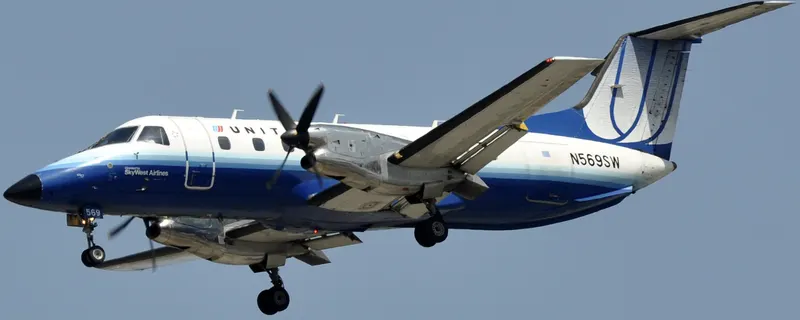
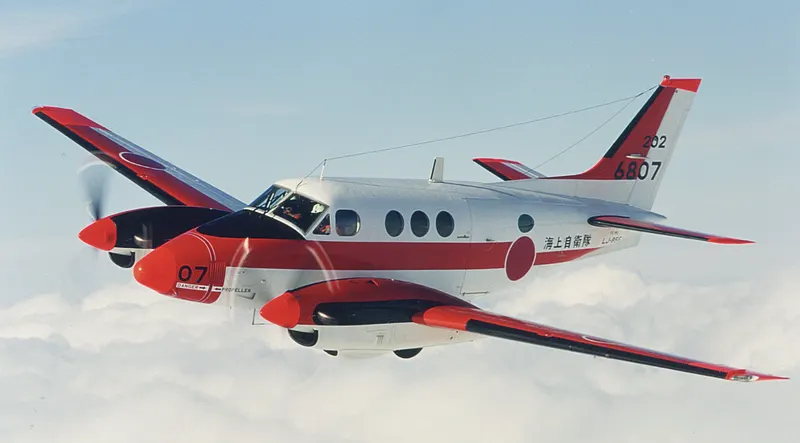
(F) Small: Small, single, or twin engine aircraft weighing 12,500 lbs or less such as the Beech 90 or the Cessna Caravan.
Study 2:-
Difference between Ground Speed and Air Speed:-
Ground Speed:-
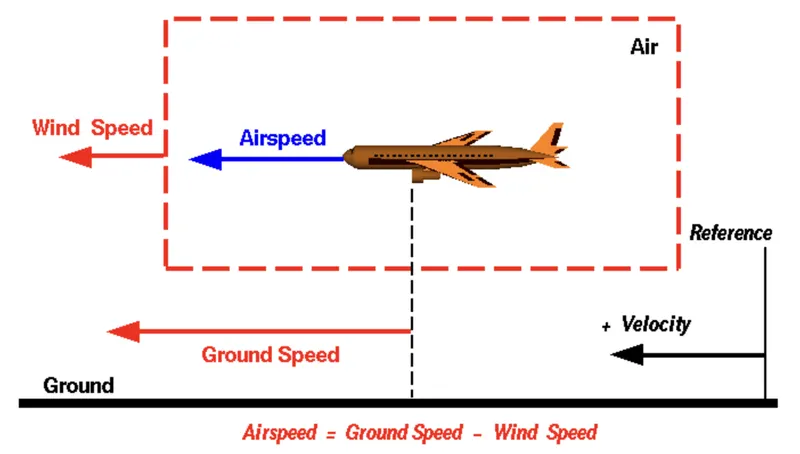
For a reference point picked on the ground, the aircraft moves relative to the reference point at the ground speed. Ground speed is also a vector quantity so a comparison of the ground speed to the wind speed must be done according to rules for vector comparisions.
Air Speed:-
The important quantity in the generation of lift is the relative velocity between the object and the air, which is called the airspeed. Airspeed cannot be directly measured from a ground position, but must be computed from the ground speed and the wind speed. Airspeed is the vector difference between the ground speed and the wind speed.
Airspeed = Ground Speed - Wind Speed
On a perfectly still day, the airspeed is equal to the ground speed. But if the wind is blowing in the same direction that the aircraft is moving, the airspeed will be less than the ground speed.
Difference :-
- Ground Speed is the speed relative to the surface of the earth whereas the Air speed is the speed relative to the air in which it is flying.
- Ground speed determines the how fast it can get to its destination whereas Air speed determines enough airflow around the aircraft to lift or make it fly.
- Ground speed is an vector comparision whereas the Air speed an vector difference.
Study 3:-
Not recommended using aircraft engine power to move it on the ground:-
It is not recommended using aircraft engine power to move it on the ground because of the risk of operation.
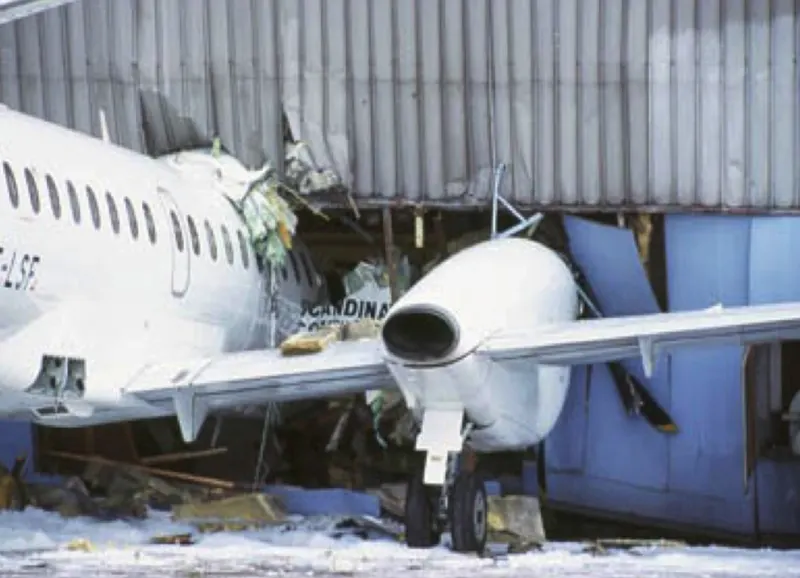
The risks which may arise from engine ground running relate to the potential for loss of control of the aircraft by those persons occupying the pilot seats in the flight deck. In most cases, such persons will be maintenance personnel holding specific company-issued approval for the required tasks. The consequences of loss of control during taxi or towing are the same as apply to these operations generally and this article is concerned only with the risks arising from the static running of one or more aircraft engines. Unwanted consequences from such static running are mainly related to those arising from the unintended movement of the aircraft during engine running - effectively a loss of control - especially during high power engine running. Damage can occur to the aircraft itself, other aircraft nearby or to airside structures. In addition, there is a risk of injury to ground support personnel who may be in relatively close proximity to the aircraft.
Study 4:-
Aircrafts pushed to runway when ready to take off:-
A so-called pushback truck reverses the aircraft into taxiing position, pushing it with a towbar attached to the nose-wheel strut. Or, in the most modern versions, by actually lifting the wheel. The aircraft taxis to the runway to depart at the agreed time
An airplane uses taxiways to taxi from one place on an airport to another; for example, when moving from a hanger to the runway. The term "taxiing" is not used for the accelerating run along a runway prior to takeoff, or the decelerating run immediately after landing, which are called the takeoff roll and landing rollout, respectively.
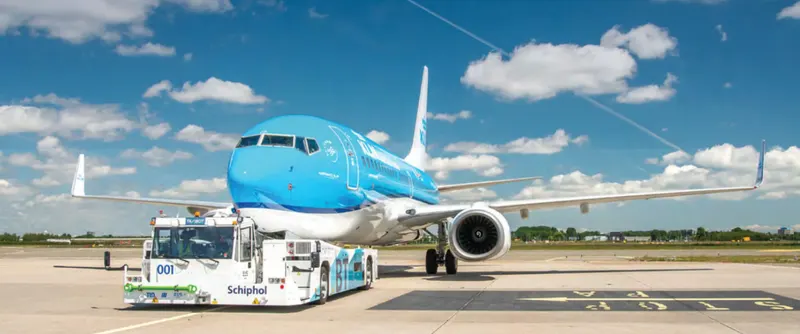
Mostly towing vehicle which is operated electrically is used in taxiing the aircraft.
Study 5:-
Take off Power:-
Take off power of an aircraft is stated as the distance from the ground run from zero ground speed to the point where the wheels leave the ground.
To analyse the take off power following parameters are to be considered
D = Drag force
F = Rolling Resistance
T = Thrust of the propulsion
During take off,
m * dv/dt = T-F-D
Considering displacement as 2S
Take off power = force * Displacement = (m*dv/dt)*2S.
Tyre Design:-
When it comes to safety, tyres are one of the most important components of aircraft. They help to absorb the shock of landing and provide cushioning. It also provides the necessary traction for braking and stopping of an aircraft.
An aircraft tyre is designed to withstand extremely heavy loads while landing, take off, taxing, and parking. The number of wheels required for aircraft increases with the weight of the aircraft, as the weight of the aeroplane needs to be distributed more evenly.
Carcass plies are used to form the tire. They are sometimes called casing plies. An aircraft tyre is constructed for the purpose it serves.Unlike an automobile or truck tyre, it does not have to carry a load for a long period of continuous operation. However, an aircraft tyre absorbs the high impact loads of landing, and also it’s operating at high speeds for a short time when required.
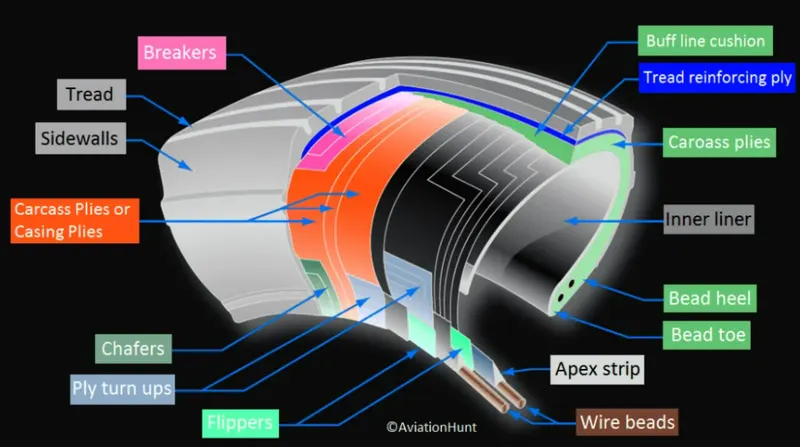
Load Rating – Load rating is the maximum permissible load at a specified inflation pressure.
Ply Rating – Ply Rating is used to identify the maximum recommended load rating and inflation pressure for a specified tyre. It is an index of tyre strength.
Speed Rating – The speed rating is the maximum takeoff speed to which the tyre has been tested.
Skid Depth – Skid depth is the distance between the tread surface and the deepest groove as measured in the mould.
Each tyre manufacturer produces their own designs of the tyre with different tread patterns, wear patterns, wear limits etc, and in some cases, different names for the same part of the tyre. But all tyres must meet the approved standards before being accepted by the FAA or CAA.
All commercial aircraft tyres approved under FAA Requirement Technical Standard Order (TSO) C62. A TSO is a minimum performance standard for specified materials, parts, and appliances used on civil aircraft
Rolling Resistance:-
The friction between aircraft and runway will be proportional to the normal force exerted by the aircraft on the runway.
The normal force will be the difference between Weight of aircraft and Lift, the friction coefficient will be typically of a magnitude of 0.02 for a standard tarmac runway.
Tyre pressure:-
Aircraft tires generally operate at high pressures, up to 200 psi (14 bar; 1,400 kPa) for airliners, and even higher for business jets. The main landing gear on the Concorde was typically inflated to 232 psi (16.0 bar), whilst its tail bumper gear tires were as high as 294 psi (20.3 bar)
Brake force when landing:-
Brakes are used not only to decelerate during a landing run, but also to hold the aircraft during an engine run-up, and in some cases to steer the aircraft through differential braking. Brakes are fitted to the main landing gear but not generally to the nose or tail wheel.
PART -B:-
Study 6:-
Calculate force and power required to push/pull the aircraft by a Towing Vehicle:-
For Calculating power and force , we are considering Airbus A321 Neo & tow Vehicle as Mototok spacer 8600 MA PB
Aircraft Specification:-
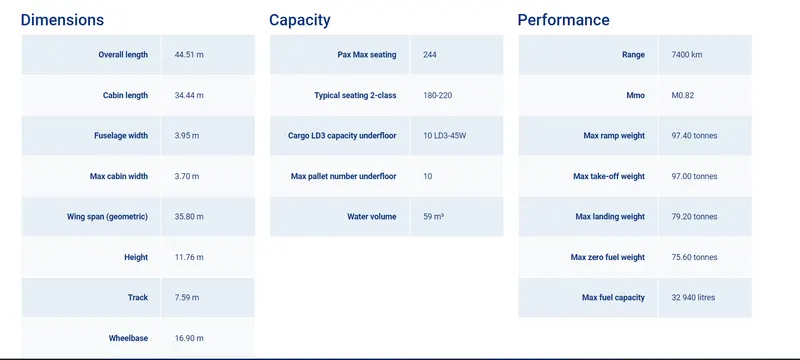
Ramp Weight = 97400 kg
Wingspan = 35.80 m
Assume,
Co-efficient of Rolling Resistance = 0.01
Air Density = 1.25 kg/m^3
Coefficient of Drag = 0.025
Towing Vechicle Specification:-
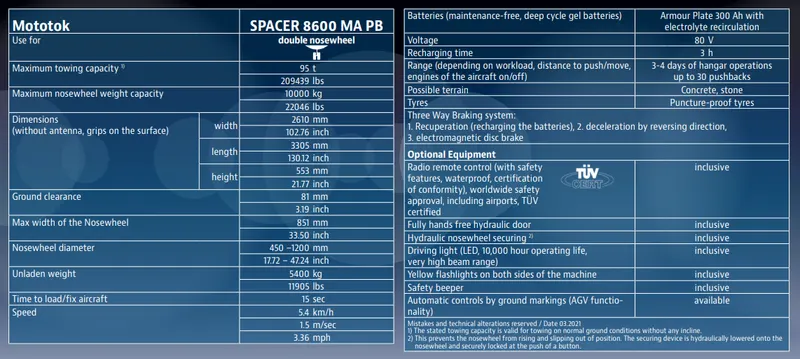
Weight = 5400 kg
Tow speed = 1.5 m/s
Assumptions,
Coefficient of rolling resistance = 0.01
Air Density = 1.25 kg/m^3
Coefficient of drag = 1.15
Formulas Used:-
Rolling Resistance, Frr = Crr*mr*g
Air Drag Force, Fd =`0.5*rho*Cd.A.v^2`
Total Force = Frr + Fd
Power = Force * Velocity
Calculation:-
Aircraft:-
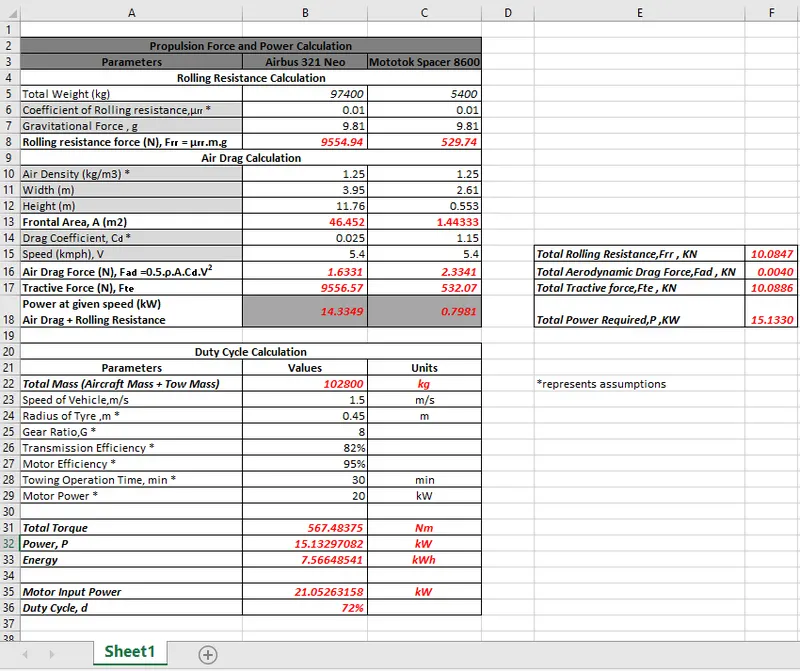
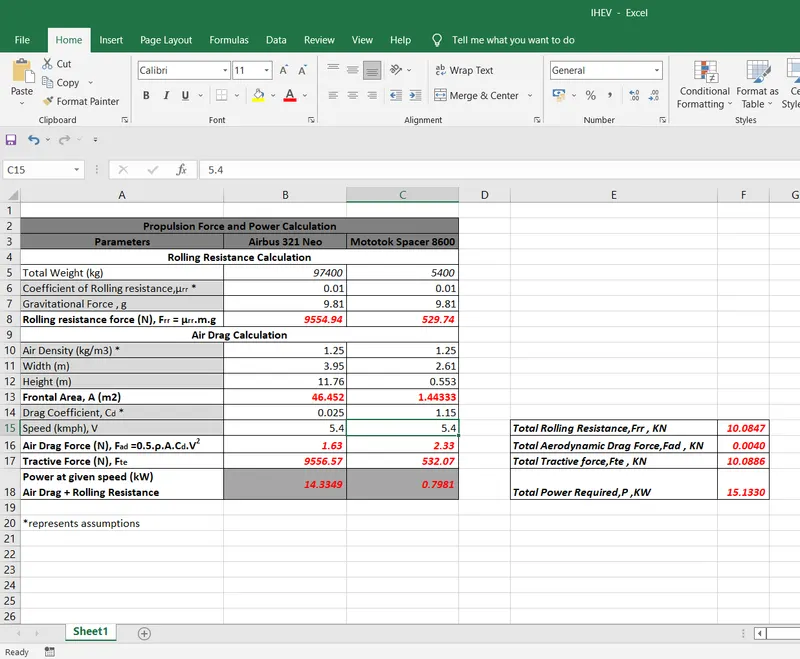
Rolling Ressistance = 0.01*97400*9.81 = 9554.94 N
Air Drag Force = 0.5*1.25*46.452*0.025*(5.4)^2 = 1.63 N
Tractive Force = Rolling Resistance + Air Drag Force = 9556.57 N
Power = 9556.57 * (5.4*(5/18)/1000) = 14.3349 kW
Tow Vehicle:-
Rolling Ressistance = 0.01*5400*9.81 = 529.74 N
Air Drag Force = 0.5*1.25*1.44333*1.15*(5.4)^2 = 2.33 N
Tractive Force = Rolling Resistance + Air Drag Force = 532.07 N
Power = 532.07 * (5.4*(5/18)/1000) = 0.7981 kW
Total Power Required to pull and Push Aircraft:-
Total Rolling Resistance,Frr = 10084.7 N = 10.0847 KN
Total Air Drag Force,Fad = 0.0040 KN
Total force,Fte = 10.0886 KN
Total Power,P = 15.1330 kW
Calulations are made using Excel Sheet:-
Simulink Model for the above Calculation:-
Simulink Model:-
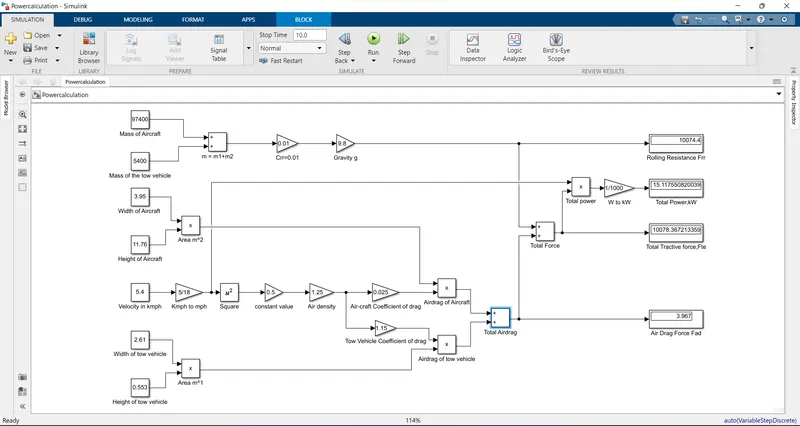
The simulink is made as per the formulas used in the power and force calculation.
Thus the model for above calculated force and power is developed using simlink.
Study 7:-
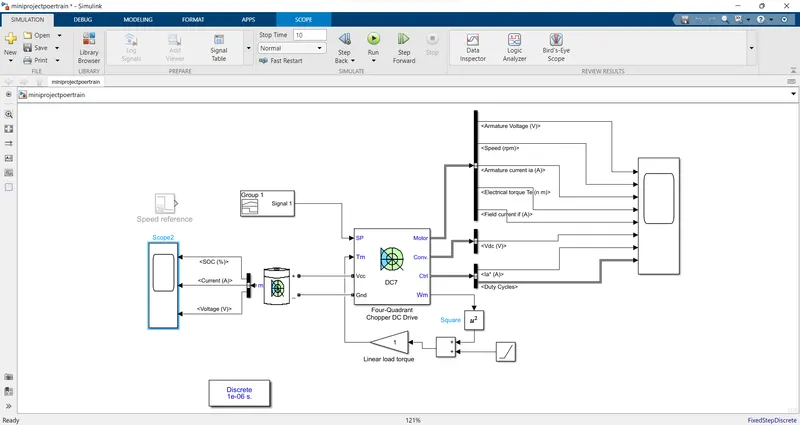
Simulink Model of powertrain of Towing Vehicle:-
As per the calculation made in above case,
Total Force Required to push and pull = 10.0886 kN
Total Power required = 15.1330 kW
Let us consider,
Radius of tire of Tow Vehichle = 0.450 m
Gear Ratio = 8
Transmission Efficiency = 82%
Motor Efficiency = 95%
Opertional time = 30 min
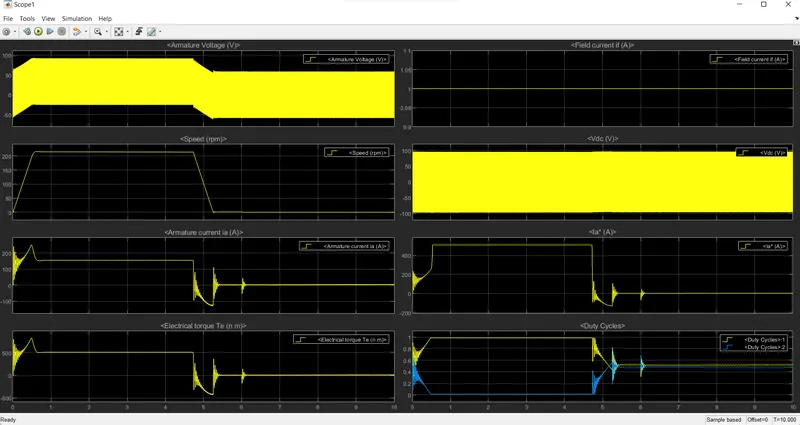
T = 10088.6*0.45/8 = 567.4837 Nm
Power, P = F *V = 10.0886*1.5 = 15.1329 kW
Energy = 15.1329 * 0.5 = 7.56645 kWh
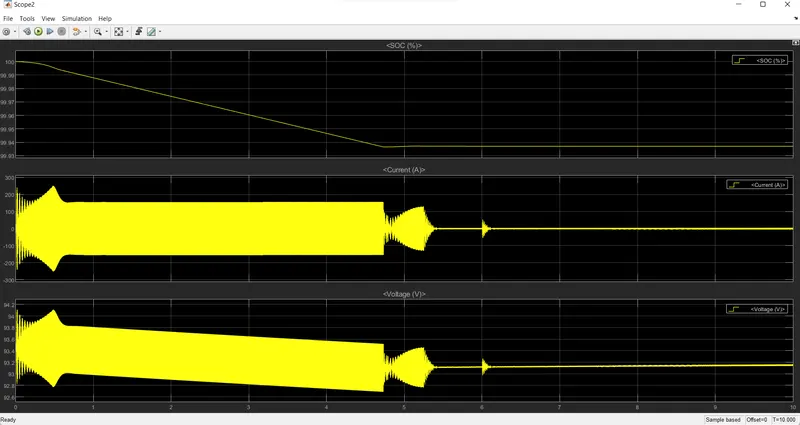
Therefore the battery should be able to store an energy of 7.56645 kWh for a 30 minute operation whereas for 24 hours operation the battery should be able to store the energy of 363.18 kWh and it should deliver the energy throughout the runtime in order for the motor to produce 567.4837 Nm of torque.
Motor we choose here is must deliver a power of 15.1329 kW is choosen here we take PMSM Motor with rated power and it should deliver a torque of 567.48Nm instantaneously
Rated Motor Power = 20 kW
Motor Input power = 20/0.95 = 21.0526 kW
Therefore ,
Duty cycle, d = (15.1329 / 21.0526) = 0.72 = 72%
Hence the speed from 0 to max is control using duty cycle range from 0 to 72%
Simulink Model:-
Input :-
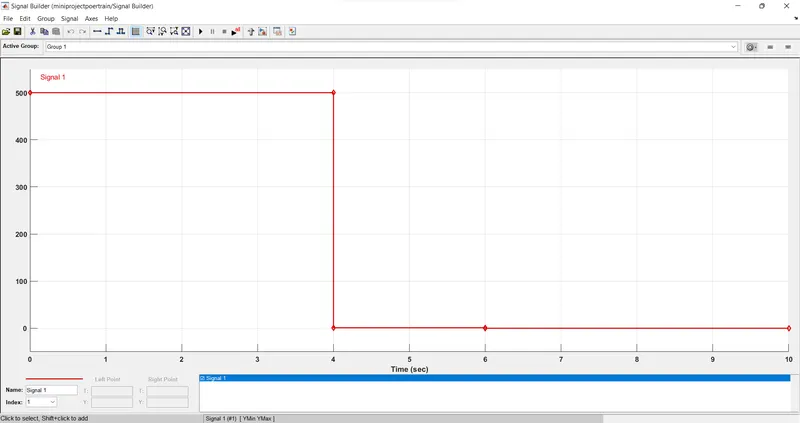
Signal Builder:-
Battery Data :-
Output:-
Parameters are Designed in Excel:-