Project-1: Powertrain for aircraft in runways
Part A:
1. Search and list out the total weight of various types of aircrafts.
An aircraft gross weight is designed by considering several weight restrictions in order to avoid overloading its structure and to avoid unacceptable performance or handling qualities while operating an aircraft.
Maximum design taxi weight
The maximum design taxi weight which is also known as the maximum design ramp weight is the certified maximum weight for aircraft on the ground according to the aircraft strength and airworthiness.
Maximum design takeoff weight
It is the maximum certified design weight when the brakes are released for takeoff of an aircraft.
It is the value Defined by aircraft manufacturers.
Maximum design landing weight
Maximum design landing weight is a fairly self-explanatory weight limitation.
It is the heaviest the aircraft can be to make a landing safely like most weight limitations.
Maximum landing weight will be driven by any of a number of different factors. For example, it might be set by the shock absorption characteristics of the lining gear on touch down.
If the maximum landing weight is far enough below the maximum takeoff weight, it might even drive requirements for fuel damping equipment so Pilots can make the airplane light enough to make the landing safely in the event of emergency right after takeoff.
Zero fuel weight
It is the maximum permissible weight of an aircraft with no disposable fuel or oil.
It it is a condition which states an aircraft which is loaded with passengers and cargo with no usable fuel or oil onboards.
Minimum flight weight
It refers to the minimum weight of a plane in its takeoff status which means it has enough fuel in the fuel tank, other Fuels like hydraulic and engine oils and other miscellaneous items to make a realistic flight.
Minimum flight weight doesn't include any cargo or flight crew.
The Total weight of various types of aircrafts.
|
Aircraft |
Empty Weight |
Max Fuel Weight |
Max Cargo Weight |
Max Gross Takeoff Weight |
|
628,000 lbs. |
661,400 lbs. |
417,000 lbs. |
1,411,000 lbs. |
|
|
611,000 lbs. |
560,000 lbs. |
185,000 lbs. |
1,268,000 lbs. |
|
|
485,300 lbs. |
427,400 lbs. |
295,000 lbs. |
987,000 lbs. |
|
|
370,000 lbs. |
386,300 lbs. |
119,000 lbs. |
820,000 lbs. |
|
|
370,000 lbs. 168,000 kg |
320,800 lbs. 145,500 kg |
148,000 lbs. |
776,000 lbs. |
|
|
299,000 lbs. 135,500 kg |
223,500 lbs. |
126,300 lbs. 57,300 kg |
560,000 lbs. |
|
|
98,500 lbs. |
53,100 lbs. |
44,600 lbs. |
187,000 lbs. |
|
|
93,900 lbs. |
48,700 lbs. |
44,000 lbs. |
150,000 lbs. |
|
|
63,500 lbs. |
28,600 lbs. |
28,800 lbs. |
106,000 lbs. |
|
|
54,000 lbs. 24,500 kg |
48,200 lbs. 21,900 kg |
6,500 lbs. |
100,000 lbs. |
|
|
48,160 lbs. 21,850 kg |
19,600 lbs. 8,900 kg |
6,075 lbs. 2,760 kg |
80,500 lbs. |
|
|
39,300 lbs. |
11,700 lbs. |
18,700 lbs. |
62,000 lbs. |
|
|
13,900 lbs. 6,300 kg |
6,060 lbs. |
2,900 lbs. |
21,500 lbs. |
|
|
10,300 lbs. 4,700 kg |
5,800 lbs. |
2,200 lbs. 1,000 kg |
17,200 lbs. |
|
|
7,100 lbs. 3,200 kg |
3,200 lbs. |
4,150 lbs. |
12,000 lbs. |
|
|
3,200 lbs. |
340 lbs. |
1,250 lbs. |
4,400 lbs. |
|
|
2,500 lbs. 1,150 kg |
450 lbs. |
850 lbs. |
3,660 lbs. |
|
|
2,200 lbs. |
520 lbs. |
1,150 lbs. |
3,600 lbs. |
|
|
2,250 lbs. 1,000 kg |
485 lbs. |
950 lbs. |
3,600 lbs. |
|
|
1,700 lbs. |
380 lbs. |
560 lbs. |
2,425 lbs. |
2. Is there any difference between ground speed and air speed?
Yes there is a difference between ground speed and airspeed.
Ground speed is the airplane speed relative to the surface of the earth
While Air speed is the speed at which an aircraft is moving relative to the air it is flying in.
Airspeed is all about enough air flow around an aircraft to make it fly whereas ground speed describes how fast and aircraft will get to its destination.
Actually airspeed is the vector difference between ground speed and air speed.
3. Why is it not recommended to use aircraft engine power to move it on the ground at Airport?
On the ground
There would be a Huge risk of controlling the airplane on ground due to Limited controllability and structure of a plane.
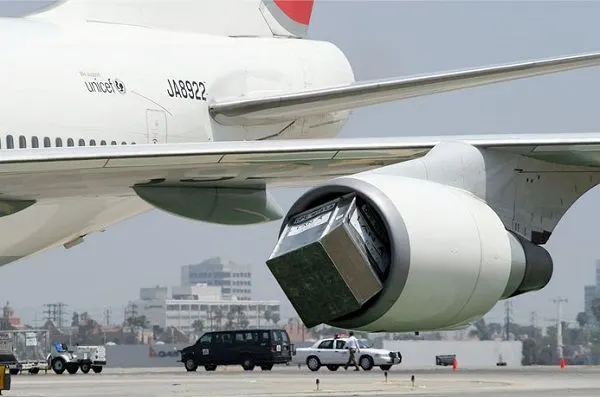
The risk involved accident search at crashing of Airplane with near by plane or hitting nearby structure or risk of injury to ground support personnel, who may be in relative close proximity to the aircraft, Jet Blast from engines which can damage the nearby structures , it can even through aaway people standing nearby.
The high power engines can suck in sand and Debris on ground which can cause serious damage to the engine.
And otherhand , engines can blow Sand and Debris.
And last factors are Noise and Fuel , because the plane engines are very loud and the cost of fuel.
Therefore it is not recommended to use aircraft engine power to move it on the ground of the airport.
4. How an aircraft is pushed to runway when its ready to take off?
Pushback is a procedure in which aircraft is a reversed or pushed backwards from an airport Gate.
Most of the commercial Jet aircraft are fitted with thrust reversers, they cannot use for reversing aircraft but they can be only used for reducing the speed of aircraft.
So the best solution for an aircraft push back is using push back truck or push back tractor.
The pushback truck can be classified into two types,
1 ) Truck with Towbar
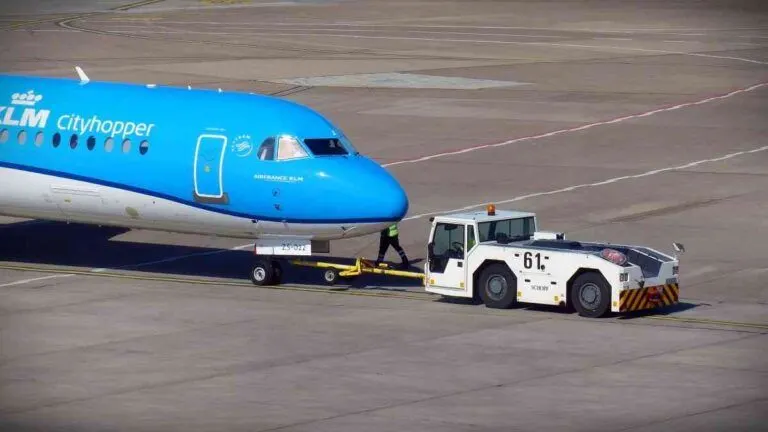
2 ) Towbarless Truck
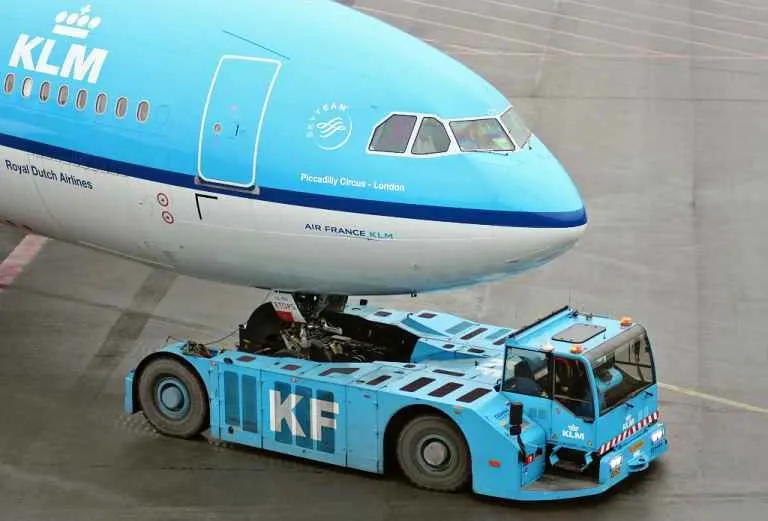
5. Learn about take off power, tyre design, rolling resistance, tyre pressure, brake forces when landing.
Take off power
Take off power is the amount of power that an engine is allowed to produce for a limited period of time for takeoff.
The take off power for reciprocating engines is usually limited to 5 minutes and for gas turbine engines it is 2 minutes.
There is the power required by the aircraft engines to lift them into a horizontal takeoff.
For a given aircraft the takeoff power is usually depends on the aircraft weight, heavier the weight , the greater the power needed.
Tyre Design
The airplane tyres are made with combination of synthetic rubber compounds which are made with Aluminium Steel reinforcement, nylon and aramid fabrics.
Airplane tires are twice the tyres of truck and 6 x much as a cars.
That is because the higher the pressure the firmer the tyre and the more strength it has to support the plane.
Airplane tyres are not filled with regular air they are filled with nitrogen.
Nitrogen is an inert gas, so high temperature and pressure changes have less effect on it.
Plane tyres are subjected to most rigorous conditions of any etyrvehicle tyres.
This tyres have an ability to handle a load up to 38 tons.
There are two types of tires are used in aircraft applications — bias-ply tires and radial tires.
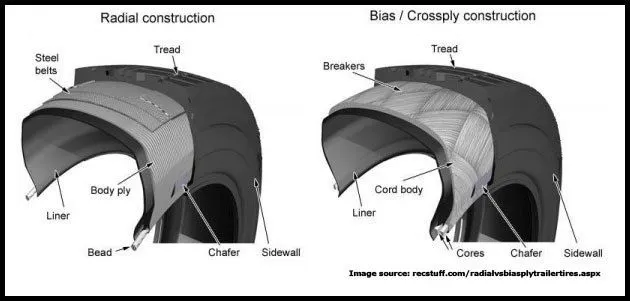
A radial tyre has the fibre strands of the ply fabric which are oriented with and at 90° to the direction of rotation and the tyre sidewall.
A bias-ply tyre has the fabric bias which are oriented with and across the direction of rotation and the sidewall.
Rolling Resistance
Rolling resistance is also called as a rolling friction or rolling drag .
It is a resistive force which resist the motion when tyre rolls on a surface or a ground.
It depends on many factors such as the surface of the road, dry or wet condition of the road, roughness of the road , tyre material , tyre pressure, tyre temperature etc.
Rolling resistance is applied only when aircraft is taxing or towing on runway.
Roling Resistance Formula
`F_R = mu_(rr)*m*g`
Tyre Pressure
The tyre pressure of an aircraft depends on the weight of the plane & number of tyre it has.
These tyres generally operate at high pressures up to 200 psi to 300 psi . Although tests of Airliners Aircraft tyre have shown that they are able to withstand pressures of maximum 800 psi before Busting.
Airplane tyres are filled with Nitrogen gas,
because Nitrogen gas minimizes expansion & contraction from extreme changes in ambient temperature & pressure experienced during flight.
Braking Force
In general Pilots operates the wheel mounted brakes of the aircraft by pushing the toe section of the Other Pedal forward.
Therefore the deceleration itself are achieved by one of the hydraulic systems providing the will based hydraulically activated break with pressure.
However braking is the process which can be taken care by software sometime.
Today's Airliners are equipped with so called Auto brake systems which can be capable of managing all necessary breaking in the longitudinal direction, hence helping not only while landing but also whilst taking off.
Aircraft brakes stops the moving aircraft by converting its kinetic energy to heat energy by means of friction between rotating and stationary Discs located in brake assembly in the wheels.
Aircraft Braking System includes
Aircraft disc brakes
Thrust reversers
Air brakes
Large drogue parachutes.
Part B:
6. A. With necessary assumptions, calculate the force and power required to push / pull an aircraft by a towing vehicle.
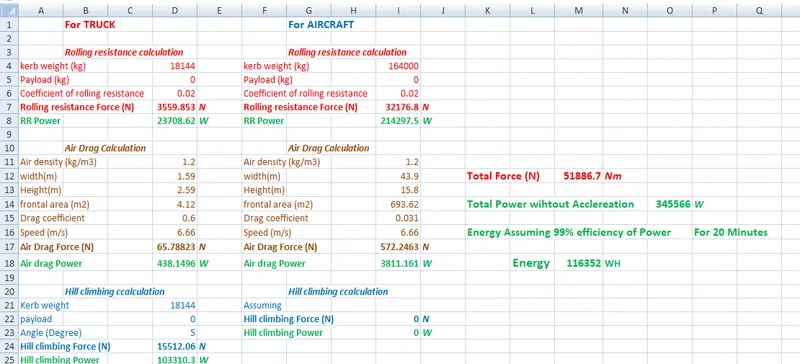
The forces acting on Towing Truck while pushing or pulling an aircraft are rolling resistance , Aerodynamic drag and grade resistance.
For this calculation we will assume B600 Towing Tractor.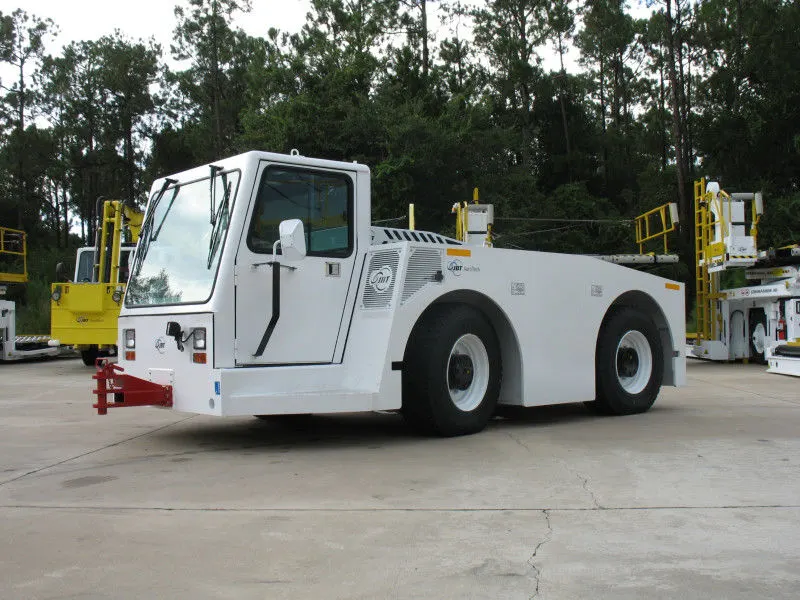
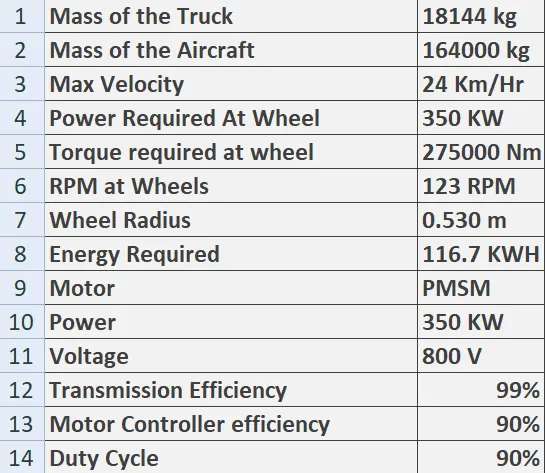
Mass = 18144 kg
Height = 2.59 m
Width = 1.59 m
`mu_(rr) = 0.02`
`C_d = 0.6`
Max Velocity = 24 km/hr
Tyres = 385/65 R22.5
# Calculations for Truck
1) `F_D=1/2*rho*C_D*A*v^2`
=`0.5*1.2*0.6*4.12*(6.66)^2`
`F_D = 65.79 N`
2) `F_R = mu_(rr)*m*g`
`= 3559.85 N`
3) `F_g = m*g*sintheta = 18144*9.81*sin(5)`
`= 15513.08N`
Therfore the tractive force for Truck is
`F_T = 19138.72 N`
Power required at WHEEL will be ,
`P= F_T*v = 127463.8752`
# Calculations For Aircraft
For This we will assume A310 Aircraft
Mass = 164000 kg
Height = 15.8 m
Width = 43.9 m
`mu_(rr) = 0.02`
`C_d = 0.031`
1) `F_D=1/2*rho*C_D*A*v^2`
`= 572.246 N`
2) `F_R = mu_(rr)*m*g`
`= 32176.8 N`
Assuming Zero Gradient Force
Therefore the Tractive force Required to move the Aircraft is
`F_T = 32749.046`
Power required at WHEEL will be ,
`P= F_T*v = 218108.34`
The Total Tractive Force to tow Aircraft is ,
`F_T = 51887.766`
The Total Power to tow Aircraft is ,
`P_T = 345572.2152 W`
Assuming Transmission Efficiency 99%
`therefore P_T = 350 KW`
Torque Required at Wheels will be,
`T = F_T*r`
`=51887.766*0.53`
`therefore T = 275000.5159 Nm`
# To Calculate Wheel RPM
r = 0.530 m
Dis/Rev `= 2*pi*r = 3.33 m`
Therefore
Wheel RPM `= ((Velocity)/((Dist)/(Rev)))=((6.66 )(m/s))/((3.33)(m/(Rev))`
`= 2 (Rev)/s`
Converting Answer in Rev/min
Wheel RPM `= 120 RPM`
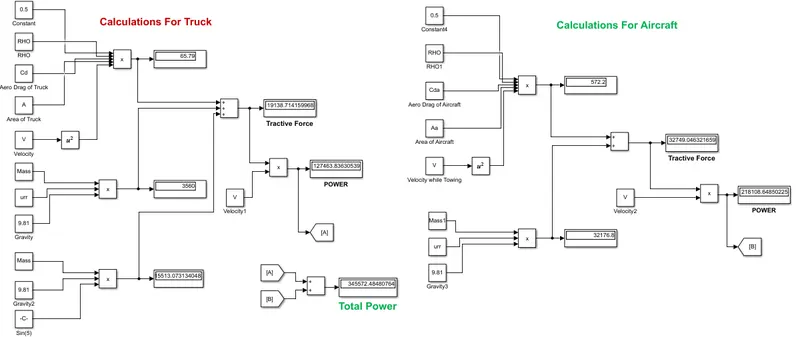
B. Develop the model for the calculated force and power using Simulink.
Q.7 Estimate the Energy and duty cycle range to control the aircraft speed from zero to highest.
Assming Time to Drive is 20 minute
Energy Required for Towing is ,
`E = P_T*Time`
`E = 350*(20)/60 = 116666.67 wh`
`therefore E = 116.7Kwh`
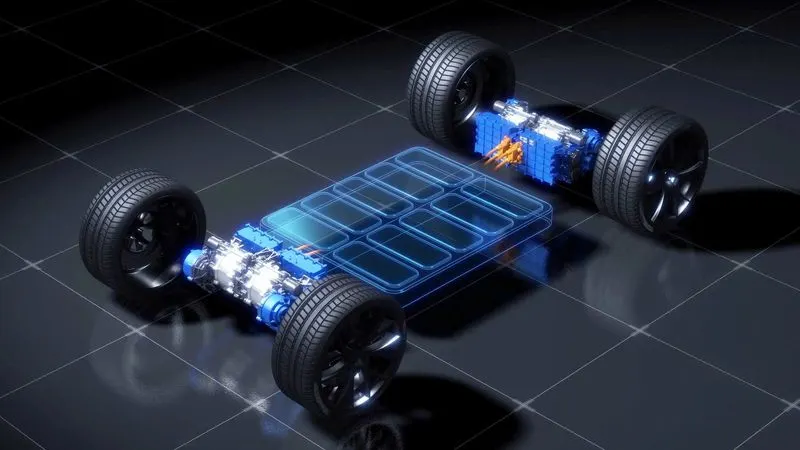
For this we have selected a Motor of YAMAHA PMSM 350KW, 800V
Calculating Duty Cycle to control the Speed ,
Assuming Battery Pack of 800V
Assuming Some losses in controller,
D`= (Vo)/(Vi) = 800/(800*(0.9)) = 0.9`
The Duty Cycle Range to control Speed is From 0 to 90% .
Prepare a table of assumed parameters.
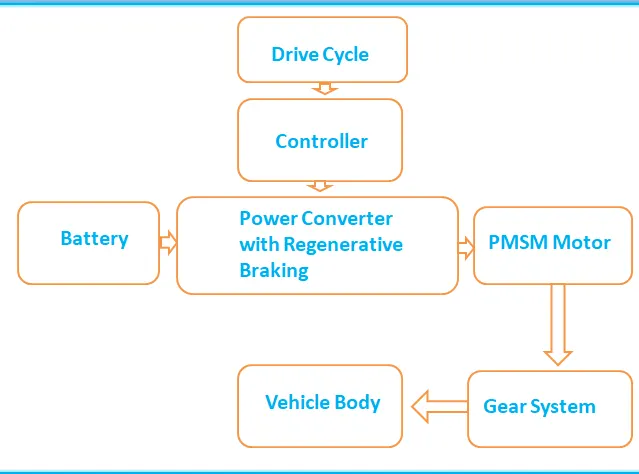
Draw a block diagram of powertrain.
B. Also, Design the parameters in excel sheet.