Project-1: Powertrain for aircraft in runways
PROJECT 1 (POWER TRAIN OF AIRCRAFT ON RUNWAY)
PART(A)
1)List of various aircraft total weights.
Total weight of aircrafts are classified as various categories,they are,
- Manufacturer's Empty weight.
- Dry operating weight.
- Operating weight.
- Maximum Zero fuel weight.
- Maximum Taxi weight.
- Maximum Takeoff weight.
- Maximum Landing weight.
Manufacturer's Empty weight(MEW):
This weight referers to the total weight of the flight after complete manufacture of a flight excluding fuel and pay loads during takeoff.These are including aircraft structure,Power unit,installations,furnishing,systems and other equipments before additional operator items are added for operations.This stage refeers to the built stage.
Dry operating weight(DOW):
This weight refers to the addition of aircraft crew members(Pilot ,their bags & commodities and pantry related weights) with the manufacturer's empty weight(MEW).In this stage no fuel is added with these weights.
Operating weight(OW):
This weight refers to the addition of takeoff fuel(Ramp fuel - Taxifuel) with the dry operating weight(DOW).Here takeoff fuel refers to the fuel remaing from takeoff to the departure of aircraft excluding taxi fuel.
Ramp fuel refers to the total fuel feed into the aircraft and taxi fuel refers to the fuel used for aircraft movements from boarding to runway in airports.
Maximum zero fuel weight(MZFW):
This weight refers to addition of all payload weights (passangers,luguages,CARGO,mails,anything make revenue for aircraft company) with dry operating weeight(DOW) excluding all fuel weights of plane.
Maximum Taxi weight(MTW):
This weight refers to adddition of taxi fuel weight with the operating weight(OW). (i.e) MZFW + ramp fuel.
Maximum Takeoff Weight(MTOW):
This weight refers to the maximum weight allowed by the avitation norms for an aircraft at takeoff condition.This weight consist of MZFW +Takeoff fuel.
Maximum Landing Weight(MLW):
This weight refers to the maximum weight for an aircraft to land or allowed for landing.This weight consist of MTOW -Trip fuel weight. Trip fuel refers to the used fuel from takeoff to landing.
Remaining fuel is present in plane as unused fuel.
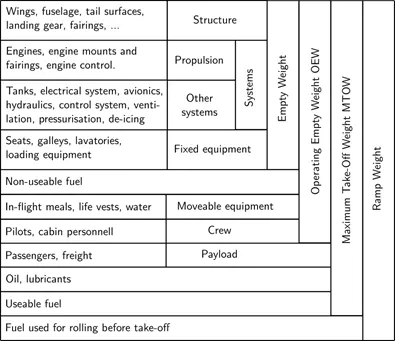
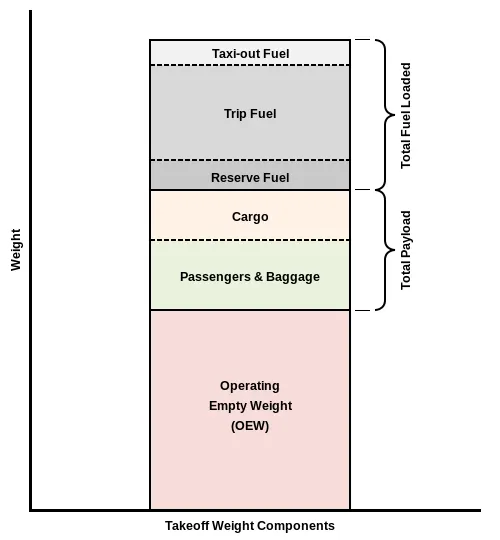
=>The below images shows overall weight sharing of aircraft(first) and during the takeoff time(second).
Here listed out the weight of various aircrafts during takeoff and landing period.
| Type | MTOW [kg] | MLW [tonnes] |
| Airbus A220-100 | 59,000 | 50.8 |
| Airbus A220-300 | 65,000 | 57.61 |
| Airbus A300-600 | 163,000 | 138 |
| Airbus A300-600R | 192,000 | 140 |
| Airbus A310-200 | 142,000 | 123 |
| Airbus A310-300 | 157,000 | 124 |
| Airbus A318 | 59,000 | 57.5 |
| Airbus A319 | 64,000 | 62.5 |
| Airbus A320-100 | 68,000 | 66 |
| Airbus A321-100 | 83,000 | 77.8 |
| Airbus A330-200 | 242,000 | 180 |
| Airbus A330-300 | 242,000 | 185 |
| Airbus A330-900 | 352,000 | 251.5 |
| Airbus A340-200 | 253,500 | 181 |
| Airbus A340-300 | 276,700 | 190 |
| Airbus A340-500 | 371,950 | 240 |
| Airbus A340-600 | 367,400 | 256 |
| Airbus A350-900 | 270,000 | 175 |
| Airbus A350-1000 | 308,000 | 233.5 |
| Airbus A380-800 | 575,000 | 394 |
| Airbus A400M | 141,000 | 122 |
| Antonov An-124-100M | 405,060 | 330 |
| Antonov An-225 | 640,000 | 591.7 |
| ATR 42-500 | 18,600 | 18.3 |
| ATR 72-600 | 22,800 | 22.35 |
| Avro RJ-85 | 42,000 | 36.74 |
| BAe Jetstream 41 | 10,890 | 10.57 |
| Beechcraft 1900D | 7,765 | 7.605 |
| Boeing 707-120B | 117,000 | 86.3 |
| Boeing 707-320B | 151,000 | 97.5 |
| Boeing 707-320C | 151,000 | 112.1 |
| Boeing 717-200BGW | 50,000 | 46.265 |
| Boeing 717-200HGW | 55,000 | 47.174 |
| Boeing 720 | 104,000 | 79.5 |
| Boeing 720B | 106,000 | 79.5 |
| Boeing 727-100 | 72,500 | 62.4 |
| Boeing 727-100 | 72,500 | 62.4 |
| Boeing 727-200 | 78,000 | 68.1 |
| Boeing 727-200 Advanced | 84,000 | 70.1 |
| Boeing 737-300 | 63,000 | 51.7 |
| Boeing 737-400 | 68,000 | 54.9 |
| Boeing 737-500 | 60,000 | 49.9 |
| Boeing 737-600 | 66,000 | 54.66 |
| Boeing 737-700 | 70,000 | 58.06 |
| Boeing 737-800 | 79,000 | 65.32 |
| Boeing 737-900 | 85,000 | 66.36 |
| Boeing 737-900ER | 85,000 | 71.35 |
| Boeing 747-8 | 443,613 | 306.175 |
| Boeing 747-8F | 447,700 | 346.091 |
| Boeing 747-100 | 340,200 | 265.3 |
| Boeing 747-200 | 377,840 | 285.7 |
| Boeing 747-300 | 377,840 | 260.32 |
| Boeing 747-400 | 396,900 | 295.742 |
| Boeing 747-400ER | 412,770 | 295.742 |
| Boeing 757-200 | 116,000 | 89.9 |
| Boeing 757-300 | 124,000 | 101.6 |
| Boeing 767-300 | 159,000 | 136.078 |
| Boeing 767-300ER | 187,000 | 136.08 |
| Boeing 767-400ER | 204,000 | 158.758 |
| Boeing 777-200ER | 297,550 | 213 |
| Boeing 777-200LR | 347,450 | 223.168 |
| Boeing 777-300 | 299,370 | 237.683 |
| Boeing 777-300ER | 351,800 | 251.29 |
| Boeing 777F | 347,800 | 260.816 |
| Boeing 787-8 | 228,000 | 172.365 |
| Boeing 787-9 | 254,000 | 192.777 |
| Boeing 787-10 | 254,000 | 201.849 |
| Bombardier CRJ200 | 23,000 | 21.319 |
| Bombardier CRJ700 | 33,000 | 30.39 |
| Bombardier CRJ900 | 36,500 | 33.345 |
| Bombardier Q400 | 28,000 | 28.01 |
| Cessna Citation CJ4 | 7,761 | 7.103 |
| Concorde | 185,000 | 111.1 |
| Embraer 120 Brasilia | 11,500 | 11.25 |
| Embraer 170 | 36,000 | 32.8 |
| Embraer 175 | 37,500 | 32.8 |
| Embraer 190 | 48,000 | 43 |
| Embraer ERJ 145 | 22,000 | 19.3 |
| Embraer Phenom 100 | 4,800 | 4.43 |
| Embraer Phenom 300 | 8,150 | 7.65 |
| Fokker 100 | 46,000 | 39.95 |
| Ilyushin IL-86 | 208,000 | 175 |
| Ilyushin IL-96-300 | 250,000 | 175 |
| Ilyushin Il-96M | 270,000 | 195.04 |
| Learjet 75 | 9,752 | 8.709 |
| Lockheed L-1011-500 | 231,300 | 166.92 |
| McDonnell Douglas DC-10 | 256,280 | 183 |
| McDonnell Douglas MD-11 | 273,300 | 185 |
| McDonnell-Douglas MD-83 | 73,000 | 63.28 |
| McDonnell-Douglas MD-90-30 | 71,000 | 64.41 |
| Pilatus PC-24 | 8,300 | 7.665 |
| Saab 340 | 13,150 | 12.93 |
| Saab 2000 | 22,800 | 21.5 |
| Tupolev Tu-154M | 104,000 | 80 |
| Tupolev Tu-204SM | 104,000 | 87.5 |
| Vickers VC10 | 152,000 | 151.9 |
2)Difference between ground speed and airspeed:
On the aspect of speed related on aircraft motion there are two types of speed considerations.
They are,
- Groung speed.
- Air speed.
Air speed can be classified as three types as pilot point of view.
They are,
- Indicated air speed.
- Calibrated air speed.
- True air speed.
Ground speed:
Ground speed refers to the speed of aircraft with respect to ground.For passengers in aircaft consider this speed only for their travel time for destinations.
Air speed:
Air speed refers to the speed of aircraft with respect to air otherwise speed of airflow over the aircraft wings. This can be also termed as true air speed.
Generally pilots consider both ground speed and true air speed as top most importance for a quick and extream safe condition of flight.
Ground speed of aircraft changes with respect to true air speed.
For better understanding we can see with an example.
A flight flies at an airspeed 500 mph to reach a destination of 2000miles.
If there is no wind at all means both the airspeed and ground speed becomes equal and aircraft reaches destination in 4 hours.
If there is wind flow 100mph against the travel direction and aircraft still maintaining at airspeed 500mph,the ground speed reduces to 400mph.Thus time taken for destination makes 5 hours.
If the wind flow of 100mph towards the direction of aircraft travel and aircraft still maintaining airspeed at 500mph,the ground speed increased to 600mph.Thus time taken for destination makes only 3 hours.
This makes us more understandable. Finally we comes to know about the relation between true air speed and groung air speed as, Ground speed=True air speed + Wind flow speed.
If wind flow is towards aircraft travel means positive sign and negative for wind flow against aircraft direction.
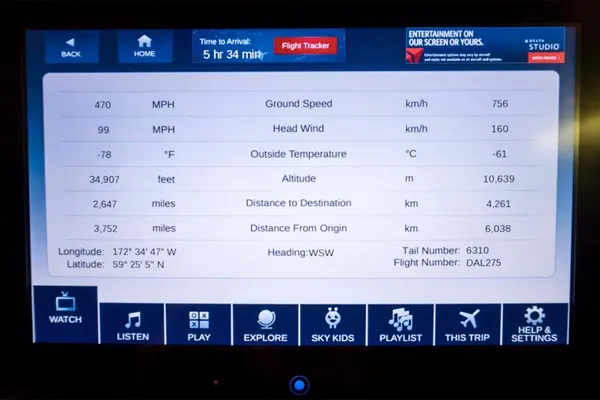
The image shows the passenger seat display monitor showing ground speed,head wind,outside temperature,altitude,remaining distance,distance covered,time remaining for destination.
We also have to know about what is indicated speed and calibrated speed of air speed.
Indicated air speed:
This speed is calculated directly by the pilot from the aircraft static system. This is calculatted of the dynamic pressure which is difference between the total pressure and static pressure.
This depends on aircraft speed and also the density of air.For higher altitudes the lesser air density make changes the true air speed.
Calibrated air speed:
It is indicated airspeed after some adjustion of various errors.For example adjustion of flap position error,since air flow on static system changes for various flap positions which affects indicated air speed readings.
True air speed:
Its the calibrated air speed adjusted for various exact condition say alltitude,temperature,air density etc..
Finally in pilot point of view both airspeed and ground speed are equally important for fast takeoff,landing and quick arrivals.
In passangers point of view ground speed consideration only estimates the toatal time duration for reaching their destinations.
3)Aircraft engine usage is not recommanded for moving on airport.
Aircrafts are actually designed with power ratings to withstand the takeoff energies,they are not having reverse gears for moving reverse.Aircraft using back thurst mechanism for moving reverse. However it is recommamded in ramp areas as it will damages the near by aircraft structures.And even it is very hazardious to human resources.
A sudden increase in reverse thrust is not aware by any working persons near aircraft will lead to loss of life.
Some accidents due to these lake of awareness caused many loss to airport and even to lifes.
Damages are occured to aircraft itself, for airport properties,near by aircrafts,ground working personnel who may be relatively near to aircraft engines.
Thus to reduce these operation risks towing and taxing vehicles are get into these operation.These vehicles push the aircraft or taxing the aircraft even upto runway positions.
Apart from these risk of using engine power on ground usages,lot of fuel are wasted for moving aircraft from one place to another on towing and taxiing.
So to overcome these low speed high torque producing electric vehicles are encouraged for these operations by many airport authorities.
The damages created by these are,
- Jet blast damage.
- Injuries,fatalities.
- Structural damages.
- Turbulance damages.
Some aircraft accidents due to usage of engine power shown below,
1)After pushback from the gate at the start of taxi, jet blast from an airplane overturned several loaded baggage carts, and one cart fell on a baggage handler.
Several coworkers lifted the cart to free the trapped worker. The individual was hospitalized with injuries that included a dislocation and multiple fractures.
2)After arrival and while taxiing into the gate, an airplane blew a nearby helicopter into a parked airplane.
3)An airplane sustained heavy structural damage to the 46 section and empennage sections during a high-power engine run.
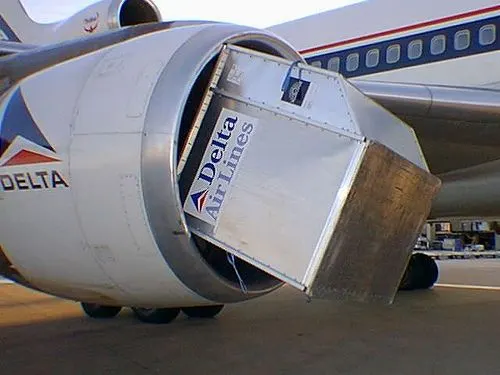
4)Usage of towing and taxing to push the aircraft to runway.
The aircrafts ready from takeoff are moved from ramp/parking area to taxiway and finally to runways.
These operations are done by sometimes a vehicle called TUG.
Using tugs we can move the aircrafts from ramp area to runway.
Here comes taxiing and towing of aircraft.
Taxiing:
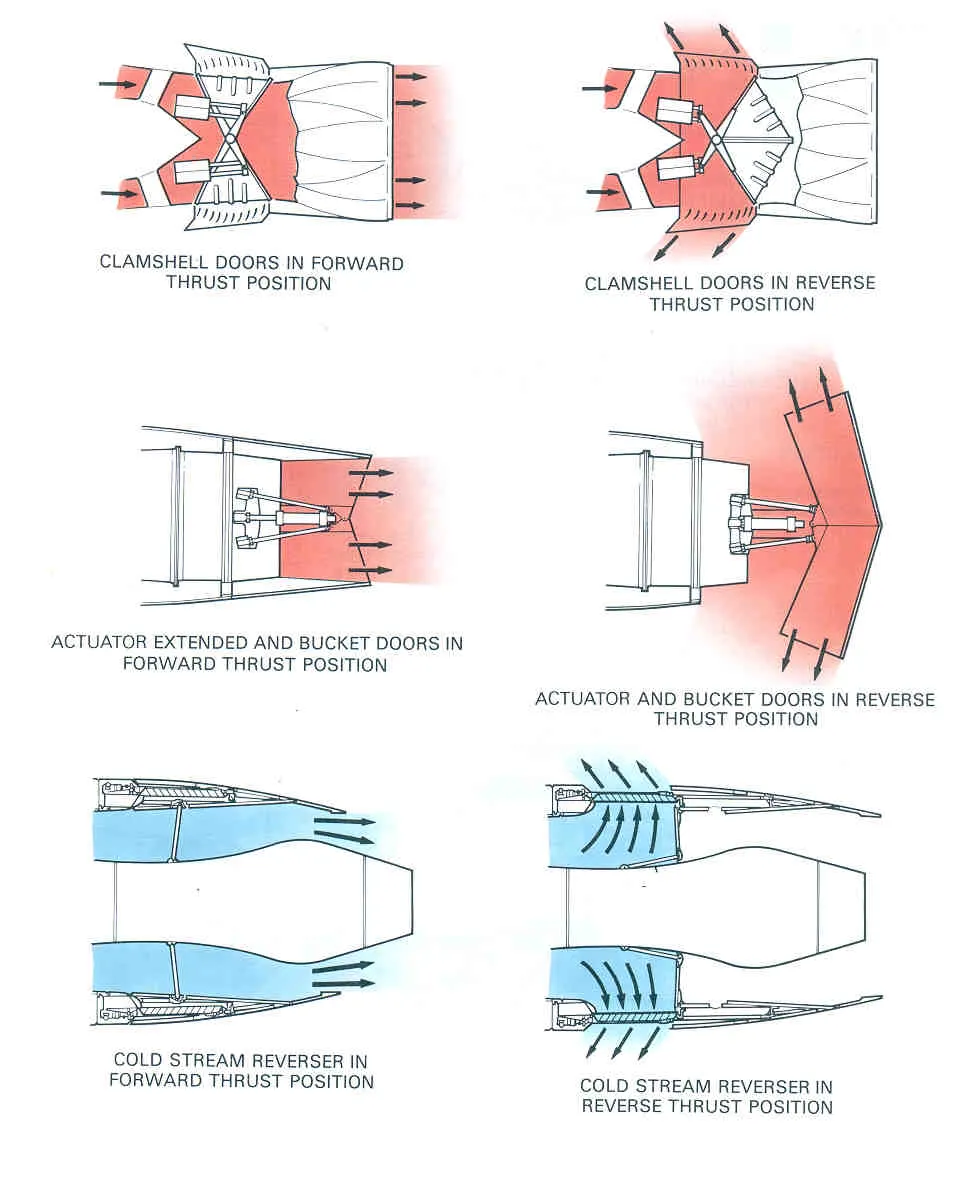
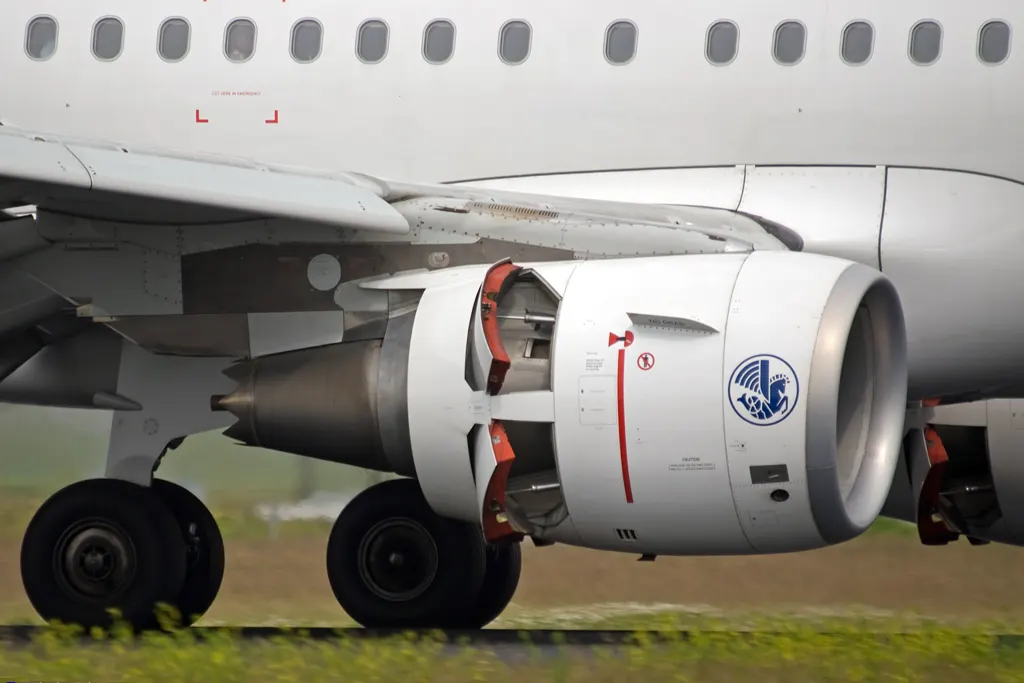
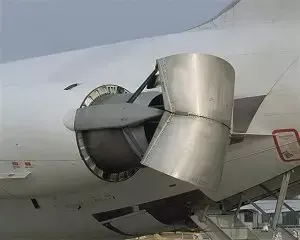
This refers to the movement of aircraft in ground area by its own engine power. However aircrafts not having reverse operation gears on default it uses reverse thrust mechanism.
But this method is not recommanded in ground movements.
Towing:
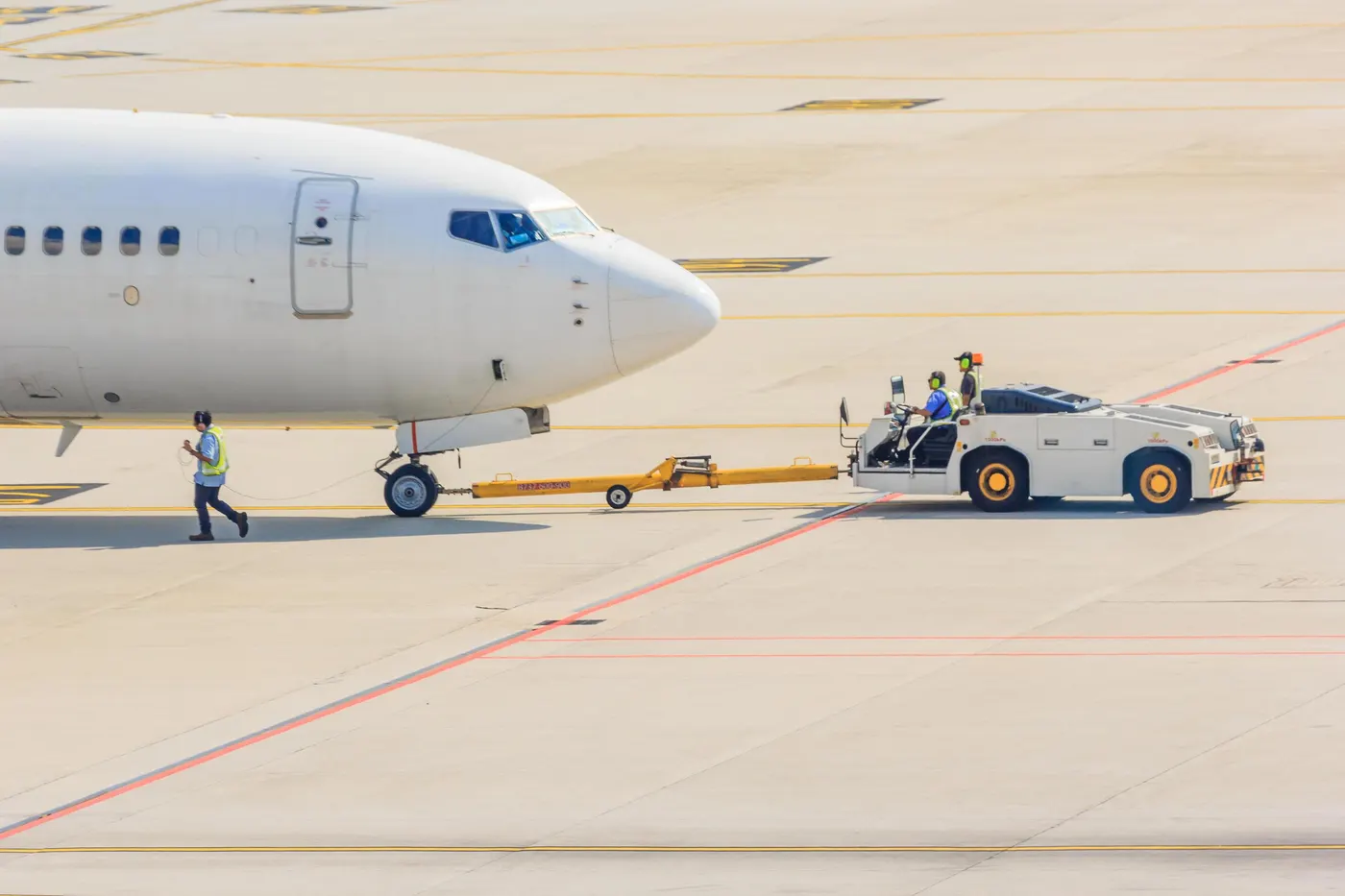
This refers to the movement of aircraft by pulling or pushing aircraft by a tug vehicle.This operation is hugely recommanded by airport authorities for moving aircraft from ramp area to
runways.
The below images shows pushback and towing operations.
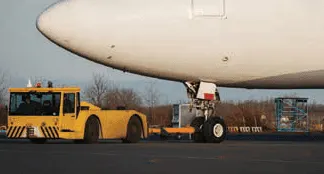
Procedures of towing aircrafts:
- Use appropriate tug vehicles for aircrafts according to the power required to move aircraft.
- Check the aircraft break system as it is most important aspect in towing operation.
- Preparing the aircraft for proper transporting.
- Ensure qualified operators in place of tug vehicle handling.
- Operate in slow and steady speed for safe turning and movements.
- Park aircraft efficiently at ramp area for loading and unloading pay loads.
- Utilizing the proper parking equipments.
- And finally give high importance on good communications between pilots and tug operators.
5) Takeoff power,Tyre design,Tyre pressure,Rolling resistance,Brake force when landing.
Takeoff power:
Takeoff power referers to the maximum power required to uplift the aircraft and position to a safe altitude away from terrain ,obstacles etc.
Generally light weight aircrafts takeoff at full engine power and high loaded commercial aircrafts takeoff at half of the engine power to make engine highly efficient,resuce maintainance cost,reduce noice from aircraft.
Aircrafts after takeoffs reduce power to minimize the noice pollutions.
The take off power will be considered of all these forces acting on aircraft.
- Gross weight of aircraft.
- Lift forces,drag forces.
- Rolling resistance of aircraft.
We have also to consider the aircraft performance in airfield(Runway) performance.
The above image shows various stages of runway at takeoff of the aircrafts.
TORA(Takeoff run available):This distance refers to the starting point of aircraft to takeoff to the point after that not able to bear the weight of aircraft to takeoff.
Clearway: This region is end of TORA and may be used in case to acheive 35ft screen height.It may be even open ground or water.
TODA(Takeoff distance available):This distance refers to addition of TORA with clearway.Distance between starting point to end of clearway.In case of no clearway TORA becomes TODA.
ASDA(Acceleration-stop distance available):The final distance that must be considered for takeoff performance is the ASDA. This is the distance of weight bearing surface available to the
aircraft to accelerate and then come to a safe stop in the case of a rejected takeoff.
Engine failure seanerio:
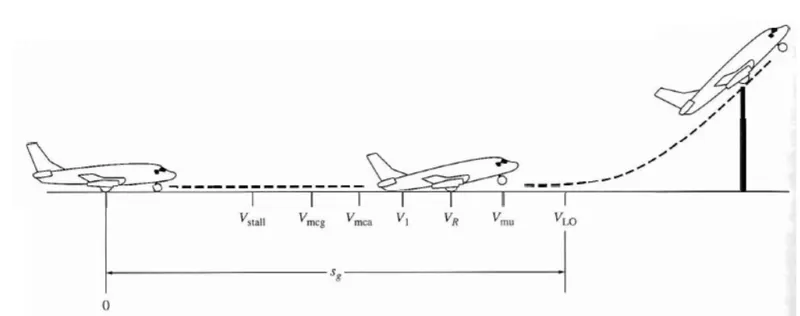
Here,
Sg=Total distance on ground (Ground roll).
Vstall=stall velocity.
Vmcg=Min. control speed on ground.
Vmca=Min.control speed on air.
V1=Decision speed.
Vr=takeoff rotational speed.
Vmu=Min.unstick speed.
VLo=Liftoff speed.
The aircraft can be stop takeoff when the landing gears or engine failures are occured before V1.Mcg is the minimum control speed on ground,the takeoff can be aborted within groung itself.
At Mca,mimimum control speed on air where landing gears are not in contact with ground,the takeoff can be cancelled. After V1 engine failure, the aircraft supposed to takeoff anyway and not able to land after reaching V1 speed.
The aircraft acheive the Vr speed at which the pilot initiates by the elevator deflection a rotation of the aeroplane inorder to increase the angle of attack and to overcome the weight.
The airplane must continue to accelerate while rolling along the ground afterrotation is achieved. This speed is called the minimum unstickspeed, denoted by Vmu.
VLo refers to lift off speed the aircraft actually lift off the ground.
Tyre design:
Aircraft tyres are more important as they carry the whole weight over takeoff and landing at higher weights.
When comes to safety tyres are one of the most important aspect on avitation.They are absorbing the shocking on landing and providing cushoning for safe landing.The number of tyres increases on increase in weights of different aircraft types as to share the laods evenly on the wheels.
Construction design of tyre:
Casing plies are used in construction.Aircraft tyres are not in use for longer period of time like cars but it should have its huge withstanding capacity from shocks during landing,cushioning the roughness of landing with huge weights. It also operates at huge weight and high speed of nearly 250Kmph during takeoffs.
Technical aspects of tyre:
Retreading- It is the method of restoring a worn tyre by renewing the tread area or by renewing the tread area one plus both side walls. Repairs are included in retreading process.
Load rating -Load rating is the maximum permissible load at inflation pressure.
Ply rating- To identify maximum recommanded load rating and inflation pressure for specified tyres.
Speed rating - maximum takeoff speed to which the tyre has been tested.
Skid depth - Skid depth is the distance between the tread surface and the deepest groove as measured in the mould.
Aircraft tyres has approved speed rating and load rating having sufficient clearance when retracted through landing gear to allow trye growth.Tyre growyh ois the increase in size of tyre due to centrifugal force at high speed.
Aircraft tyres are nowadays using tubeless tyres as they are more advantages than tubed tyres.
Aircraft tyres are radial or bias.Almost all aircrafts are using radial tyres and also they are expensive.
Aircraft tyres are conductive as they are using tread rubber with conducting compounds to permit earthing of static charges.
Tyre standard:
All aircraft tyre manufacturers should fallow the approved standards before being accepted by the FAA or CAA.All commercial aircraft tyres should fallow FAA Requirement Technical Standard
Order (TSO) C62. A TSO is the minimum performance standard for specified materials,parts and appliances used in civil aircrafts.
Tyre pressure:
Aircraft tyres are subjected to huge temerature variations,have much high pressures,and having narrow tolerance on what is or isn't acceptable wear.
They are subjected to huge swing of weight they must support and resulting amount of sidewall flex can damage inside the tyre that we see by us resulting in catastrophic
tyre explosion during takeoff and landing.
Keeping tyre pressures at their correct inflation pressure is most important thing for safe landing/takeoff.The problems caused by improper inflation may cause severe damage.
Overinflation may cause uneven treadwear,reduce traction,high risk of cutting and increase stress on aircraft wheels. Underinflation may cause uneven tyrewear,gradually increase tyre pressure and flex heat in tyre which shorten the tyre life.
Aircraft tyre pressures should be checked on every trips daily.These are carried out by proper inflation procedures,
- Check daily when tyres are cool -Tyre pressures should be always checked at ambient temperatures.The change in temperature of 3'c may change in 1% of tyre pressure.It takes 3hrs or more to return ambient temperature after landing of an aircraft.
- Ambient temperature effects on inflation - The ambient temperature difference two location can vary by 27'C should be adjusted to landind location prior.
- Use of dry nitrogen gas - Nitrogen will not sustain combustion and will not degradation of inner material,casing piles and tyre due to oxidation.
- Increasing tyre presssure by 4% on load - If unloaded pressure has been specified by aircraft manufactures,the number should be increased by 4% to obtain equal load inflation pressure.
- If loaded pressure is specified means 4% is reduced, if the tyre is being inflated while unloaded.
- Allow 12 hr-stretch after mounting - Tyres get stretched(grow) in 12 hrs after mounting.So pressure get reduced.Thus no service after mounting the wheels for 12hrs should be rechecked for tyre preeure and re-inflated if necessary.
- Never reduce pressure on hot tyre -Pressure should be reduced after ambient temperature is acheived.
- Equal pressure for duals - In a single gear coupled wheels, all tyres in that gear should be maintained equal pressure for equal load sharing rather than full load on a single mate tyre.
- Calibrate - Inflation gauges should be calibrated regularly.
The above plots shows the tyre pressure variation according to load.
Rolling resistance:
Rolling resistance if aircraft tyres are majorly depends on weight of the aircraft,tyre pressure,aerodynamic forces,tread construction of tyres.
They are called as rolling friction or rolling drag resisting the motion when a body moves in a surface.
In addition to the forces by weight,lift,drag,thrust rolling resistance froce caused by friction between ground and tyre.
Below shows the rolling resistance coefficients(Typical values) on various surfaces during break off &on conditions.
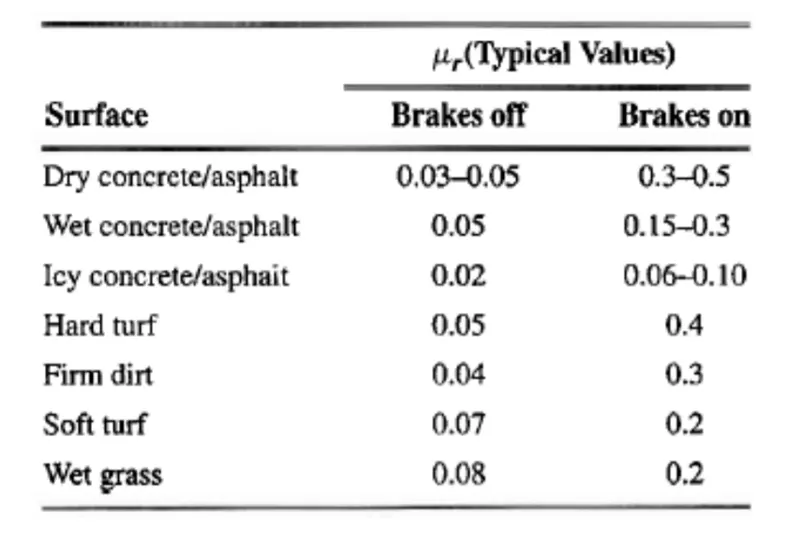
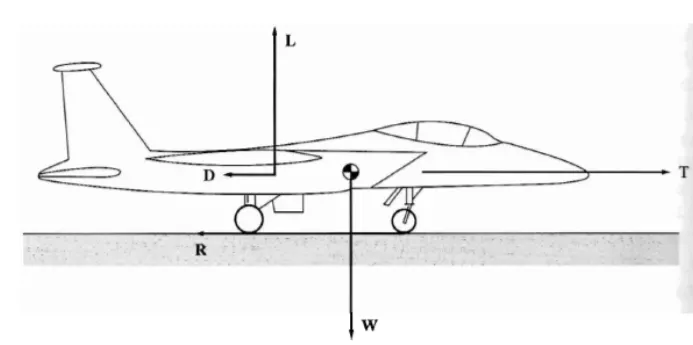
The rolling resistance force is given by,
R=μr(W-L)
Where, W-Force due to weight.
L-Force due to lift.
μr-Rolling resistance coefficient.
Braking forces when landing:
Aircraft braking system includes,
- Aircraft disc brakes.
- Reverse thrust.
- Air brakes.
- Drogue parachutes.
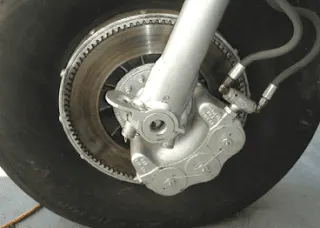
Disc braking system:
Disc break is a type of braking in which uses calipers to squeeze pairs of pads against the disc plate/a rotor to create friction.This type of breaking cause high energy loss in terms of heat.
These brakes are operated hydralically or pneumatically.
Reverse thrust:
Thrust reversal is the temperory diversion of aircraft engines to act against the forward travel of aircraft.This system is included in many jet planes to help slow down just after touch down.
Thrust reversal is achieved by momentarily diverting the hot exhaust gases towards the front of the aircraft or changing the propeller/compressor pitch so that the thrust produced is directed forward.
Air brakes:
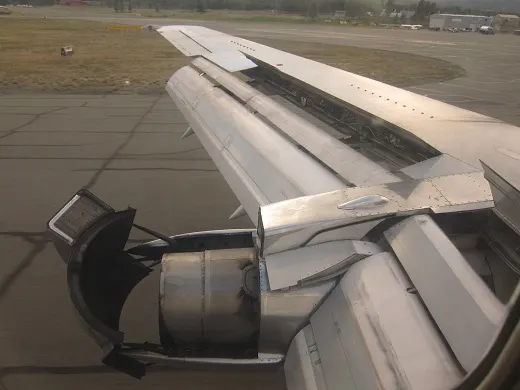
This type of brakes are also the same type as seen in above case. But they are different from spoilers present over the wings of planes.Spoilers are just plates over the wings used to control the lift force of air flow.
Air breaks represents the speed break that affects the drag force by increasing over the aircraft in a controlled way to slow down the forward traction landing force.
The below image show the airbreak system with wide open before landing.
Drogue parachutes:
These type of parachutes are used in various rapidly moving objects to slow down the speed, control and stability of vehicles.
This mechanism is also used in aircrafts to control the speed.
They are used in short runways to slow down immediately.They are particularly effective when used by aircraft that are landing on wet or icy runways and for high speed emergency landing.
These tyes of paarachutes are mostly use fighter jets.
PART(B)
6) (A) Power and force calculation of towing vehicle to push/pull an aircraft.
To push or pull an aircraft a high power motor/engine is required to overcome the huge weight of aircraft.The aircraft engine should not be in operating mode while towing process.
Only wheel brakes of aircraft in progress.
Forces to overcome on operation:
- Rolling resistance force of aircraft.
- Rolling resistance force of tug vehicle.
- Aerodynamic force acting over aircraft.
- Aerodynamic force acting on tug vehicle.
- As taxiway are in flat surfaces hill climbing force is negleted.
- As tug should operate in very slow and steady speed acceleration force in negleted.
Formulas:
Rolling resistance force, Fr=Cr*m*g . where Cr=Rolling resistance coefficient, m=Mass of vehicle, g=Acceleration due to gravity.
Aerodynamic force, Fa=(1/2)*Cd*ρ*A*v2. where Cd=Drag coefficient, ρ=Air density, A= Frontal area of crossection,v=velocity of vehicle.
Power = F * v where F=Force ,v=Velocity.
Meathod to find total power requirement of tug vehicle:
To find the total power requirement we have to find,
step 1:Fr of both tug and aircraft.
Step 2:Fa of both tug and aircraft.
Step 3:Calculate power to move aircraft and power to move tug.
Step 4:Adding powers of both tug and aircraft we can find total power requirement to push/pull aircraft.
Assumed values:
Cr of both aircraft,tug =0.002
Mass of aircraft(Kerb+payload)=400000 Kg.
Mass of tug vehhicle(Kerb+payload)=3000 Kg.
g=9.8 m/s2.
Cd of both aircraft and tug =0.031
ρ=1.125 Kg/m3.
A for aircraft=100 m2.
A for tug=20 m2.
Let vehicle to move in a speed v= 2m/s.
Calculations:
Fr of aircraft =0.002*9.8*400000 =7840 N.
Fr of tug =0.002*9.8*3000 =58.8 N.
Fa of aircraft =0.5*0.031*1.125*100*(2^2)=6.975 N.
Fa of tug =0.5*0.031*1.125*20*(2^2) =1.39 N.
Total force on aircraft =7840+6.975=7846.975 N.
Total force on tug=58.8+1.39=60.19
Total power required = (sum of forces on tug and aircraft)*velocity.
=(7846.975 + 60.19)*2
=15814.33 watts
=15.814 KW.
(B) Model for above calculations:
Model:
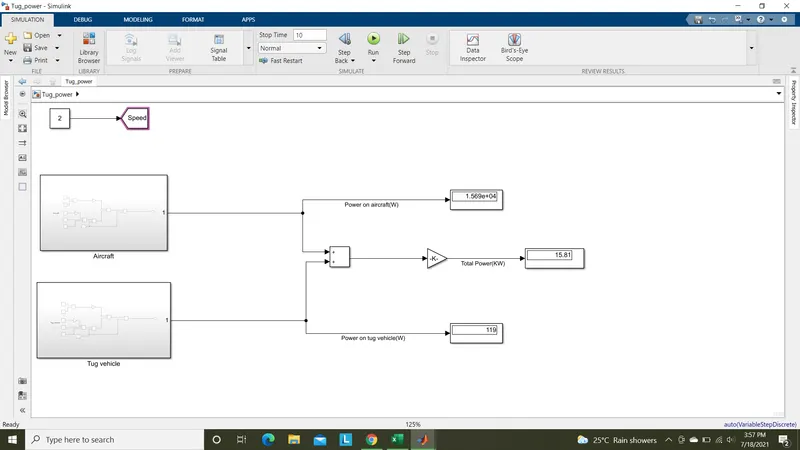
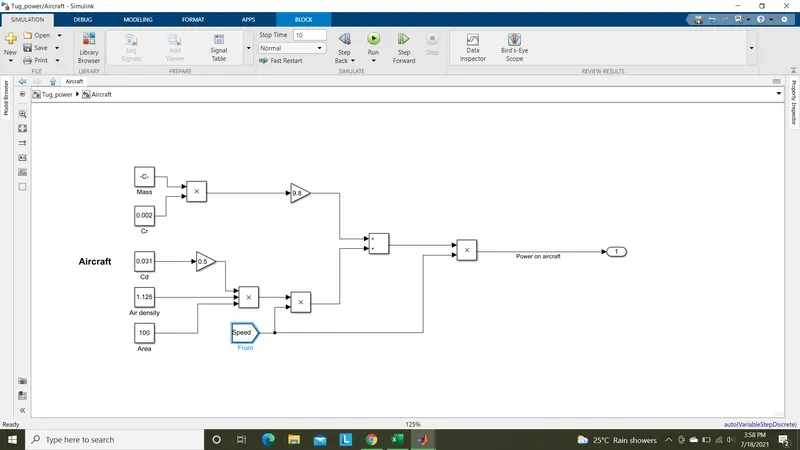
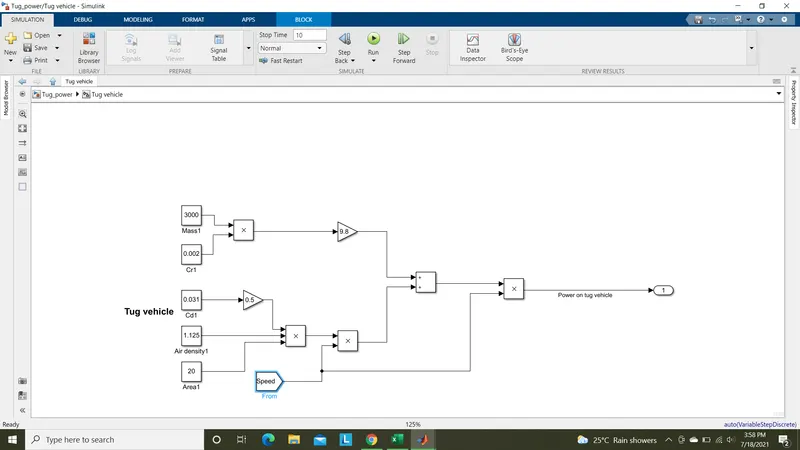
Here two subsystems are created for aircraft power and tug power calculations shown below.
Result:
The result shown as 15.81 KW in display total power.
Note: Model file and excel file are attached outside.
7) (A) Design a powertrain for tug vehicle on operation to pull/push a aircraft.
Introduction:
The power train of a vehicle consist of three main systems.They are
- Battery.
- Converter unit.
- Motor.
For design a power train first we have to calculate the load power, required motor power and then battery power.
Assumptions:
We are taking the assumption values from the previous case.
Additionally we are considering time duration for towing the aircraft as t=10 mins.
Gear ratio between Motor and wheel as 1:10.
Radius of tug wheel,r= 0.35m.
Calculations:
Torque calculation of motor:
Total force action on tug vehicle =7907.17 N (From previous case).
Therefore torque required to move the aircraft, T= F*r=7907.17*0.35=2767.50 Nm.
The torque required by the motor to move the tug vehicle=T/10=2767.50/10=276.75 Nm.
As considering some losses in gear transmissions as 10%.
Final torque required by motor to move the vehicle 276.75 + 10% =304.42 Nm.
Power calculation of motor:
Power required to move the aircraft,P=15.814KW.(From previous case)
Considering the power we calculated to move as 80% of total 90% efficiency motor design as safety, original motor power calculated as,
Final motor power required=15.814/(0.9*0.8)=21.94KW=29.42HP.
Selection of motor:
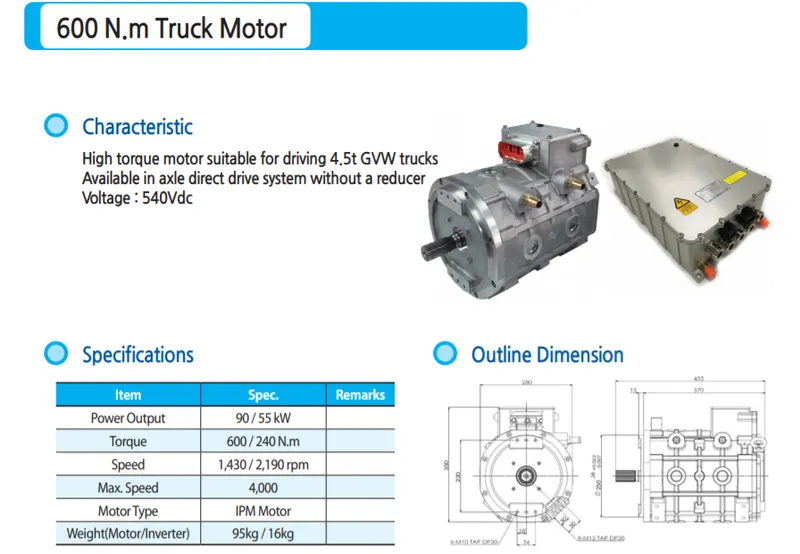
For our output specification we can choose this motor having specifications.
Calculating duty cycle:
Max. rated power output of motor =55KW
Power required to move aircraft by tug vehicle=21.94KW.
Thus estimated duty cycle required to start moving the aircraft= 21.94/55=0.39=40%.
Energy consumed by motor:
For 10 mins of towing energy consumed from battery, E=power *time
E = 21.94*10(60/3600)
E =3.65KWh
Approximately E=4KWh be assumed for some other moving operations.
Model:
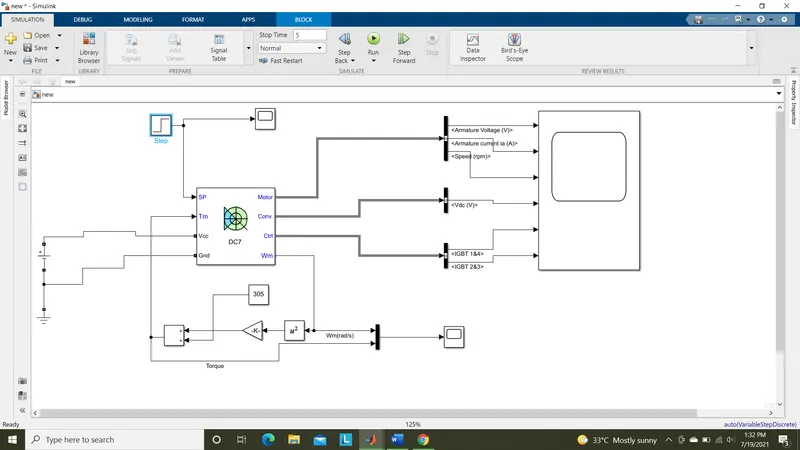
We are using DC7 block for controlling the speed of motor,where field voltage is given seperatelly.
Input armature voltage givan as 540V as rated voltage to motor.
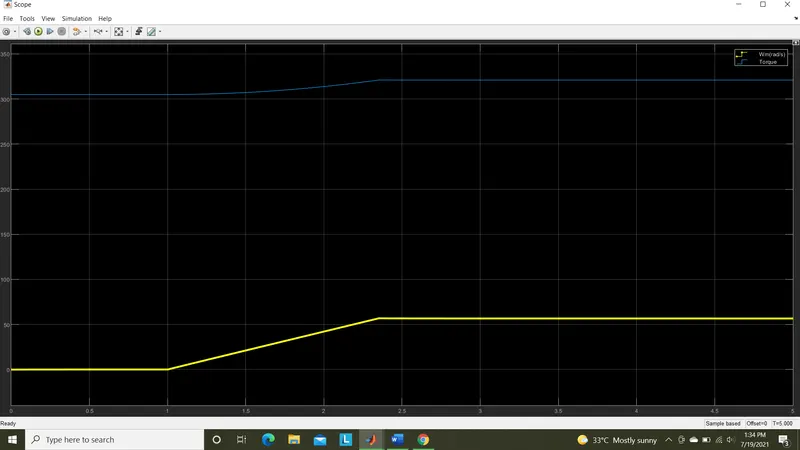
We are moving vehicle in 2m/s (i.e) nearly 54rpm in tug wheel = 540 rpm in motor. Which is given as step referance to DC block.
Results:
We are getting average duty cycle operations from converter as (70-30)= 40% (approx) at steady torque region after 1 sec.
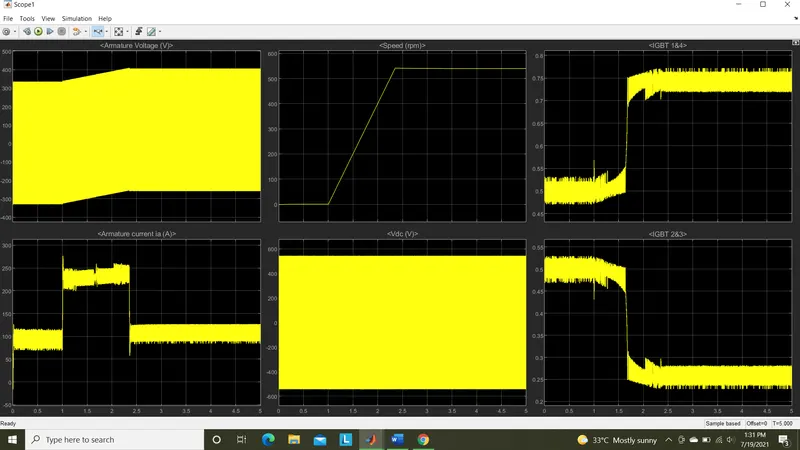
Torque and angular velocity of motor are shown below.
7)(B) Excel calculations are attached outside.
Thank you
Submitted by,
Praveen Kumar L V.
Date:19/07/2021.