Project-1: Powertrain for aircraft in runways
Part A:
1) Search and list out the total weight of various types of aircrafts.
For each flight, the weights are taken into account for several reasons.
A brief description about these is below:
Manufacturer's Empty Weight (MEW)
Also called Manufacturer's Weight Empty (MWE).It is the weight of the aircraft "as built" and includes the weight of the structure, power plant, furnishings, installations, systems and other equipment that are considered an integral part of an aircraft.This excludes any baggage, passengers, or usable fuel2.
Maximum Zero Fuel Weight (MZFW)
This is the total weight of the airplane and all its contents (including unusable fuel), but excluding the total weight of the usable fuel on board. As a flight progresses and fuel is consumed, the total weight of the airplane reduces, but the ZFW remains constant. Maximum zero fuel weight (MZFW) is the maximum weight allowed before usable fuel and other specified usable agents (engine injection fluid, and other consumable propulsion agents) are loaded.
Operating Empty Weight(OEW) (Roughly equivalent to basic empty weight on light aircraft)It is the basic weight of an aircraft including the crew, all fluids necessary for operation such as engine oil, engine coolant, water, unusable fuel and all operator items and equipment required for flight but excluding usable fuel and the payload.
Payload
It is the carrying capacity of an aircraft. It includes cargo, people, extra fuel. In the case of a commercial airliner, it may refer only to revenue-generating cargo or paying passengers.
Maximum Take off Weight (MTOW)
This is the maximum weight at which the pilot of the aircraft is allowed to attempt to take off3.
Regulated take off weight (RTOW)
Depending on different factors (e.g. flap setting, altitude, air temperature, length of runway), RTOW or maximum permissible takeoff weight varies for each takeoff. It can never be higher than MTOW.
Maximum Landing Weight (MLW)
This maximum weight at which an aircraft is permitted to land3.The following image depicts takeoff weight components.
Maximum ramp weight (MRW)
also called maximum taxi weight (MTW)
It is the maximum weight authorized for maneuvering (taxiing or towing) an aircraft on the ground.
It is the total aircraft weight at any moment during the flight or ground operation. This decreases during flight due to fuel and oil consumption
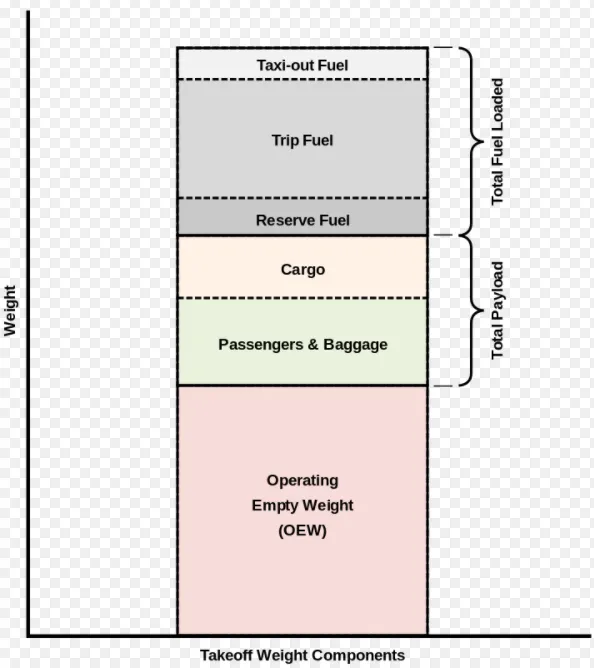
Various Aircarf Parameters:
| Type | MTOW [kg] | MLW [tonnes] | TOR [m] | LR [m] | ICAO category | FAA category |
|---|---|---|---|---|---|---|
| Antonov An-225 | 640,000 | 591.7 | 3500 | Heavy | Super | |
| Scaled Composites Model 351 Stratolaunch | 589,670 | 3660 | Heavy | Super | ||
| Airbus A380-800[1][2][3] | 575,000 | 394 | 3100 | 1930 | Super | Super |
| Boeing 747-8F | 447,700 | 346.091 | 3100 | 1800 | Heavy | Heavy |
| Boeing 747-8 | 443,613 | 306.175 | 3100 | Heavy | Heavy | |
| Boeing 747-400ER | 412,770 | 295.742 | 3090 | Heavy | Heavy | |
| Antonov An-124-100M | 405,060 | 330 | 2520 | 900 | Heavy | Heavy |
| Boeing 747-400 | 396,900 | 295.742 | 3018 | 2179 | Heavy | Heavy |
| Lockheed C-5 Galaxy[4][5][6] | 381,000 | 288.417 | 2530 | 1494 | Heavy | Heavy |
| Boeing 747-200[7] | 377,840 | 285.700 | 3338 | 2109 | Heavy | Heavy |
| Boeing 747-300[7] | 377,840 | 260.320 | 3222 | 1905 | Heavy | Heavy |
| Airbus A340-500[8] | 371,950 | 240 | 3050 | 2010 | Heavy | Heavy |
| Airbus A340-600[8] | 367,400 | 256 | 3100 | 2100 | Heavy | Heavy |
| Boeing 777F | 347,800 | 260.816 | 2830 | Heavy | Heavy | |
| Airbus A330-900 | 352,000 | 251.5 | 3100 | Heavy | Heavy | |
| Boeing 777-300ER | 351,800 | 251.29 | 3100 | Heavy | Heavy | |
| Boeing 777-200LR | 347,450 | 223.168 | 3000 | Heavy | Heavy | |
| Boeing 747-100[7] | 340,200 | 265.300 | Heavy | Heavy | ||
| Airbus A350-1000 | 308,000 | 233.5 | Heavy | Heavy | ||
| Boeing 777-300 | 299,370 | 237.683 | 3380 | Heavy | Heavy | |
| Boeing 777-200ER | 297,550 | 213.00 | 3380 | 1550 | Heavy | Heavy |
| Airbus A340-300[8][9] | 276,700 | 190 | 3000 | 1926 | Heavy | Heavy |
| McDonnell Douglas MD-11 | 273,300 | 185 | 2990 | 1890 | Heavy | Heavy |
| Airbus A350-900 | 270,000 | 175 | 2670 | 1860 | Heavy | Heavy |
2) Is there any difference between ground speed and air speed?
Ground Speed
Ground speed is the aircraft’s speed relative to the ground. One thing that should be noted here is that it’s its horizontal rather than vertical speed – an aircraft climbing completely vertically would have a ground speed of zero.
Airspeed
Airspeed is simply the speed at which an aircraft is moving relative to the air it is flying in. As such, it's also the speed at which the air is flowing around the aircraft's wings.
Airspeed = Ground Speed - Wind Speed
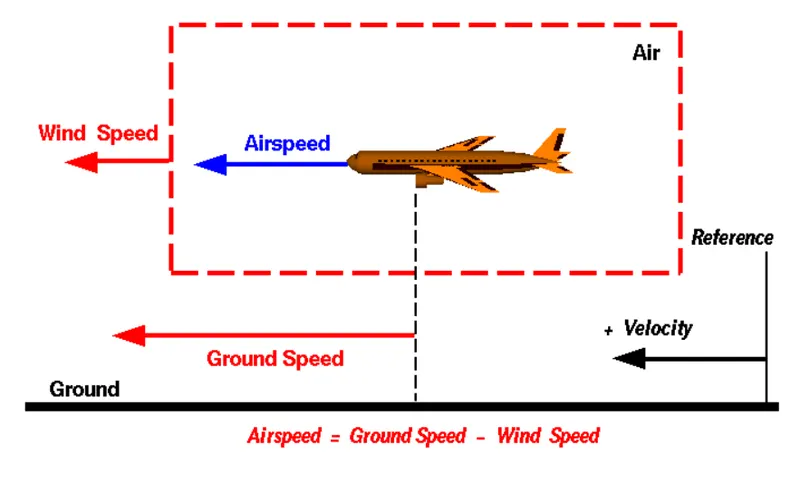
Relation between air speed and ground speed:
When the aircraft experiences tailwind, and its ground speed is higher than its airspeed. On the other hand, if the wind is blowing against the direction of aircraft is traveling in, the aircraft experiences headwind, and its ground speed is lower than its airspeed.
3)Why is it not recommended to use aircraft engine power to move it on the ground at Airport?
Jet blast is the phenomenon of rapid air movement produced by the jet engines of aircraft, particularly on or before takeoff. A large jet-engined aircraft can produce winds of up to 100 knots (190 km/h; 120 mph) as far away as 60 metres (200 ft) behind it at 40% maximum rated power.
Fuel Consumption :Large amount of fuel is required during the movement on ground when using engine power which
For safety reasons and surface fuel burn is also a to CO2 emissions this is why it is not recomended to use engine power on the ground.
Generally reversing is done via pushback tractors. Blasting jet reversers blows debris In the crowded gate area creating foreign object damage hazard for adjacent aircraft, gate equipment or terminal waiting area glass windows that is why it is not recomended to use engine power on ground.
4) How an aircraft is pushed to runway when its ready to take off?
Taxiing is the movement of an aircraft on the ground, under its own power, in contrast to towing or pushback where the aircraft is moved by a tug.The Airplane uses taxiways to taxi from one place to another. The tug might be directly attached to the plane's nose gear with a tow bar or could be a wheel-lift tug. These tugs cradle the nose gear, then lift it up before moving the plane. That gives the tug driver control over the plane's direction during pushback.
5) Learn about take off power, tyre design, rolling resistance, tyre pressure, brake forces when landing.
Take off Power:
Takeoff is the phase of flight in which an aircraft goes through a transition from moving along the ground (taxiing) to flying in the air, usually starting on a runway. Usually the engines are run at full power during takeoff. Before takeoff, the engines, particularly piston engines, are routinely run up at high power to check for engine-related problems. This makes a consid- erable noise. When the pilot releases the brakes, the aircraft starts accelerating rapidly until the necessary speed for take-off is achieved.The takeoff speed required varies with air den- sity, aircraft weight, and aircraft configuration (flap and/or slat position, as applicable). Air density is affected by factors such as field ele- vation and air temperature.
Tyre Design:
Design and Construction of Aircraft tyre
Carcass plies are used to form the tire. They are sometimes called casing plies. An aircraft tyre is constructed for the purpose it serves.
- They support the weight of an aircraft while it is on the ground.
- It also provides the necessary traction for braking and stopping of an aeroplane.
- Tyre also helps to absorb the shock of landing and provide cushioning the roughness of takeoff, roll-out, and taxi operations.
Unlike an automobile or truck tyre, it does not have to carry a load for a long period of continuous operation. However, an aircraft tyre absorbs the high impact loads of landing, and also it’s operating at high speeds for a short time when required.
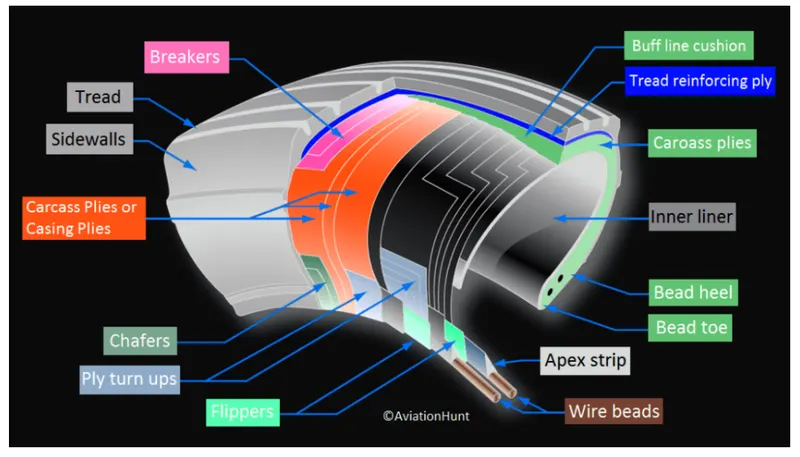
Retreading – Retreading is methods of restoring a worn tyre by renewing the tread area or by renewing the tread area plus one or both sidewalls. Repairs are included in the tyre retreading process.
Load Rating – Load rating is the maximum permissible load at a specified inflation pressure.
Ply Rating – Ply Rating is used to identify the maximum recommended load rating and inflation pressure for a specified tyre. It is an index of tyre strength.
Speed Rating – The speed rating is the maximum takeoff speed to which the tyre has been tested.
Skid Depth – Skid depth is the distance between the tread surface and the deepest groove as measured in the mould
Aircraft Tyre may be tube type or tubeless:
Tubeless tyres are more advantageous over tube-type. There is no longer the use of tube-type tyre in recent aviation. Nowadays all airliners are using tubeless tyres. Tubeless that are meant to be used without a tube has the word TUBELESS on the sidewall of the tyre.
Aircraft tyre may be Radial or Bias:
Almost all airliners are using Radial tyre. Bias is an older design, and it’s mainly used for road vehicles. Radial tyres have the word RADIAL on the sidewall. Radial tires are more expensive than bias-ply tyres. Radial tires are in demand because of their lower life cycle cost and long term value.
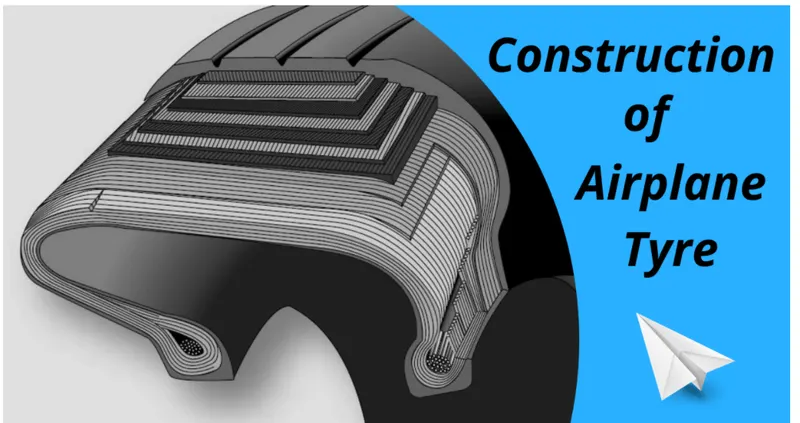
Tyre Pressure:
Aircraft tires generally operate at high pressures, up to 200 PSI (14 Bar; 1,400 kPa) for airliners, and even higher for business jets. The main landing gear on the concorde was typically inflated to 232 psi (16.0 bar), whilst its tail bumper gear tires were as high as 294 psi (20.3 bar).
Rolling Resisitance:
Rolling resistance is one of the forces that opposes you as you ride forward, the main reason for it being that the tyre is constantly deforming as you move (here we’re dealing with rolling resistance as it relates to your tyres; we’re not looking at things like bearing friction). Not all of the energy used to deform the tyre is recovered when the pressure is removed.
Its is the resistance that tyre offers against the motion while on ground. In case of aircraft rolling resistance can be experienced while take off and landing.
Brake forces when landing:
An electrical signal is sent from the flight deck to hydraulic actuators near the main landing gear. Here, hydraulic fluid at 3,000 pound per square inch is used to force the brake unit against the wheel, thus slowing it down. Also, Brake systems have antilock braking system (ABS) that prevents the tyre from sliding down a wet runway.The advantage of automatic brake system is that the aircraft brakes comfortably at constant deceleration. Passenger experience a constant force that presses them into their seats. The brake system automatically applies the brake just enough to create constant deleceration independent of air resistance, spoilers and reverse thurst.It is only the last phase of braking known as rollout that the pilot takes over the wheel brakes by pressing on both brakes pedals. Immediately after landing the aircraft is still moving fast enough that aerodynamic devices are much more efficient than brakes.
Part B:
A ) With necessary assumptions, calculate the force and power required to push / pull an aircraft by a towing vehicle.
Forces acting are Rolling resistance force,Airdrag Force, Hill climbing force is not considered as plane is moving on flat surface.
Assumptions
m = 75000 - Mass of Aircraft
ma = 5100 - Mass of the towing vehicle
D = 1.225 - Denisty
Cd = 0.25 - Drag coefficient
A = 2.5 - Frontal Area
V = 12 - Velocity
Cr = 0.02 - Rolling resistance coefficient
g =9.81 - Acceleration due to gravity
clear all
close all
clc
% Parameters considered
m = 75000; % Mass of Aircraft
ma = 5100; % Mass of the towing vehicle
D = 1.225; % Denisty
Cd = 0.015; % Drag coefficient
A = 2.5; % Frontal Area
V = 12; % Velocity
Cr = 0.02; % Rolling resistance coefficient
g =9.81; % Acceleration due to gravity

% Rolling resistance force
Fr = Cr*(m+ma)*g
fprintf('Rolling resistance force =%0.2f in N',Fr)

% Drag Force
Fad = 0.5*D*Cd*A*V^2;
fprintf('nDrag Force =%0.2f inN',Fad)

% Power Calculation
P = (Fr+Fad)*V/1000;
fprintf ('nTowing vehicle power =%0.2f in kWn',P)
Rolling resistance force =15715.62 N
Drag Force = 3.31N
Towing vehicle power =188.63 kW
7) A. Design an electric powertrain with type of motor, it’s power rating, and energy requirement to fulfill aircraft towing application in Simulink. Estimate the duty cycle range to control the aircraft speed from zero to highest. Make all required assumptions. Prepare a table of assumed parameters. Draw a block diagram of powertrain.
(Hint :DC7 Block)
B. Also, Design the parameters in excel sheet.
Motor Design:
Type of Motor = BLDC Motor
Rated Power =20 -25kW
Peak Power = 50kW
Speed = 3200-5000RPM
Rated Torque = 80Nm
Peak Torque =160Nm
Efficiency = 80%
In power rating of the motor is 25kW & the Peak Power of the motor is double the rated powe of motor which is 50kW
The converter used in this is DC-AC converter.
Assuming the input voltage = 349V
Input current = 70A
The energy requirement of an EV is similar to the towing vehicle to push/pull the aircraft is calculated on the basis of time.
Let, Energy = Power*Timetaken by towing the vehicle of Push/pull the aircraft
We know that the Power = 24.30kW
Time taken by the Towing Vehicle to Push/pull the aircraft = 15Min.
So energy = 24.30*15*60 =21870Kj
Therefore the Power required by single towing vehicle is 6.075kW.
Duty Cycle
Duty cycle of the Electric Powertrain is calculated as Output Power by the Input Power by this we get the efficiency of Duty cycle.
Duty = Output power/Input power
we know that
Output power = 19.94kW
Input power = 24.30kW
Therfore the duty cycle = 19.94/24.30 =0.82%