Project-1: Powertrain for aircraft in runways
Part A:
- Search and list out the total weight of various types of aircrafts.
The top aircraft which are popular today have been listed here and a study regarding them is been made :-
|
Aeroplane Name / Family |
Max take off Weight |
|
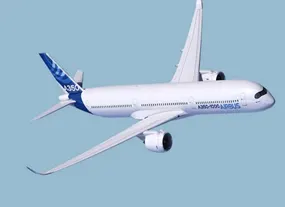
A350
|
1,95,000kg |
|
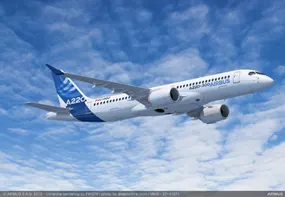
A220
|
57,600 kg |
|
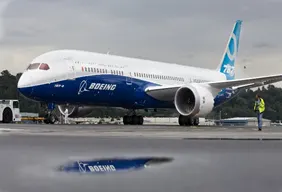
BOEING 787 DREAMLINER |
1,61,000 kg |
|
A350-1000
|
2,20,000 kg |
|
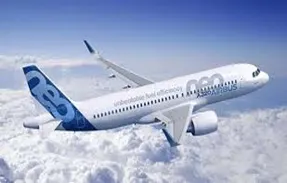
A320neo
|
64300 kg |
|
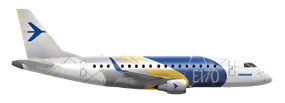
Embraer E170
|
33,300 kg |
|
Embraer E195
|
45,800 kg |
|
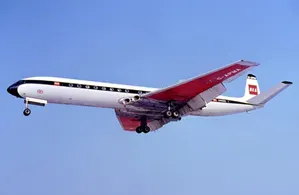
De Havilland Comet 3 & 4
|
72,000 kg |


- Cessna 172 – Used by many as initial training aircraft (27 feet long) – 1450lbs empty weight, 2450lbs max weight
- Citation Jet M2 – (42 feet long) – 3170 kg empty weight, 4853 kg max weight
- Boeing 767-300 – (185 feet long) –88450 kg empty weight, 181436 kg max weight
- Boeing 787-800 – (186 feet long) –119025 kg empty weight, 226125 kg max weight
- Boeing 777-300 – (242 feet long) – 159300 kg empty weight, 297000 max weight
- Boeing 747-400 – (232 feet long) – 183150 kg empty weight, 409500 kg max weight
- Airbus A320 – (123 feet long) – 36900 kg empty weight, 76500 kg max weight
- Airbus A330 – (210 feet long) – 123525 kg empty weight, 228150 kg max weight
2)Is there any difference between ground speed and air speed?
Let us first see what actually the airspeed and ground speed means:-
Airspeed:-
True airspeed is simply the speed at which an aircraft is moving relative to the air it is flying in. As such, it’s also the speed at which the air is flowing around the aircraft’s wings.
Ground Speed:-
Ground speed is the speed which is measured with respect to ground.
Ground speed, on the other hand, is the aircraft’s speed relative to the ground. One thing that should be noted here is that it’s its horizontal rather than vertical speed – an aircraft climbing completely vertically would have a ground speed of zero.
In other words, while airspeed is what determines whether there is enough airflow around an aircraft to make it fly, ground speed is what determines how fast an aircraft will get to its destination.
Yes , there is difference between the ground speed and the air speed,
Note:- if there is no air in atmosphere then an then only the airspeed and ground speed would be same.
In no wind speed the aeroplane speed will be measured relative to the ground, or tree as we would travel through car, in this the distance travelled through per unit time would be same.
The relationship between airspeed and ground speed is fairly simple. Ground speed is simply the sum of airspeed and wind speed.
If the aircraft is flying in the same direction as the wind is blowing, the aircraft experiences tailwind, and its ground speed is higher than its airspeed. On the other hand, if the wind is blowing against the direction the aircraft is traveling in, the aircraft experiences headwind, and its ground speed is lower than its airspeed.
For eg:-
Imagine an aircraft that cruises at an airspeed of 500 miles per hour that has to cover a ground distance of 2,000 miles.
If there is no wind at all, then both the aircraft’s airspeed and ground speed would be the same 500 miles per hour, and the aircraft would reach its destination in four hours.
If there was a 100 miles per hour headwind – wind blowing against the aircraft’s direction of travel – the aircraft would still be traveling at an airspeed of 500 miles per hour. However, its ground speed would be just 400 miles per hour (100 miles per hour slower than its airspeed). And as such, it would take the aircraft five hours to reach its destinations.
Finally, if there was a 100 miles per hour tailwind – wind blowing in the same direction as the aircraft’s travel – the aircraft would still be traveling at an airspeed of 500 miles per hour, but its ground speed would be 100 miles faster. And, at 600 miles an hour, the aircraft would reach its destination in just three hours and twenty minutes.
The above is the reason why some flights go “out of their way” to avoid headwinds or catch tailwinds. And, why some flights might appear to be traveling at “supersonic speeds,” even though their airspeed – the speed that would actually matter in determining whether or not the flight truly is supersonic – is subsonic.
- Why is it not recommended to use aircraft engine power to move it on the ground at Airport?
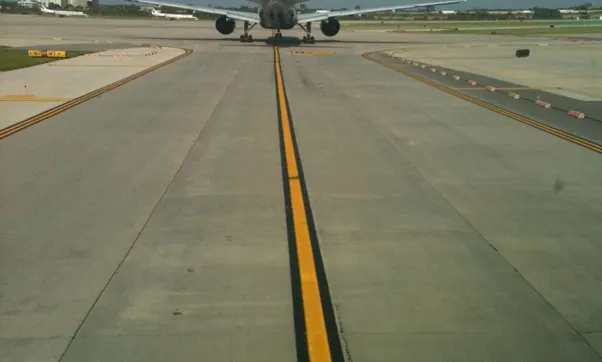
When the aircraft is on the ground at airport its not recommended to use aircraft engine power to move it on the ground because , if we use , a back thrust for reversing the propeller may start and it would prop wash or jet blast which may cause damage to the surrounding structure and even this propeller action may cause the dust and debris to enter into the blades of the engine which may cause the damage to engine of aircraft and even the other parts of aircraft. The aircraft engine power is very dangerous if its used when the aircraft is on ground.
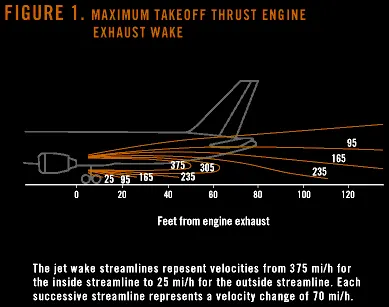
The below fif showns the thrust produced during takeoff , such type of thrust may cause a lot of damage to the structure around it as the thrust produce is very powerfull.
The aeroplane uses its engine power when its on ground to move , and this is called as taxing.
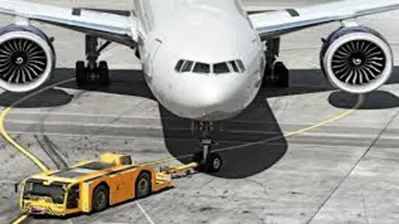
The forward movement of an aircraft, usually with engines off, using the power of a specialised ground vehicle attached to or supporting the nose landing gear. It may occur for the movement of both in service and out of service aircraft.
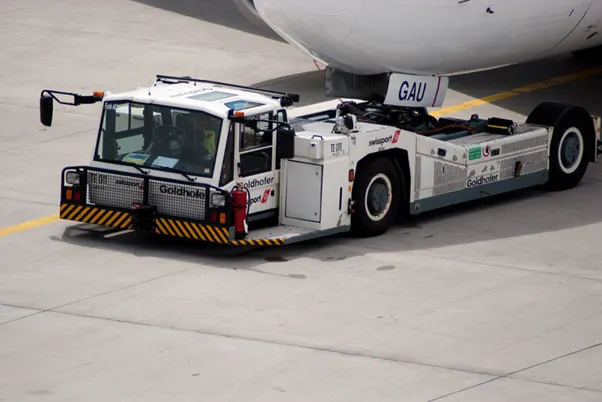
The ‘traditional’ method of allowing the ground vehicle to move an aircraft is to attach it to the aircraft nose landing gear by means of a towbar. These must be approved for use with a particular aircraft type and clearly marked as such since there is no universal towbar specification. An alternative method which is becoming more common for towing is the use of a specialised vehicle called a ‘towbarless tug’. This positions two low level ‘arms’ either side of the aircraft nose landing gear and these are used to engage with the aircraft gear leg and raise it slightly off the ground.
- How an aircraft is pushed to runway when its ready to take off?
There are different phases for a aircraft to take off , they are as follows:-
- Push-Back and Taxi-Out
This first phase of flight, after all doors have been secured, involves the movement of the aircraft away from the terminal jetway and along taxiways to a runway. A motorized vehicle called a tug sometimes is used to push the aircraft back from its gate.
The aircraft then moves under its own power along the taxiways. Since aircraft are designed primarily for flight, and are not ground vehicles, they are taxied at very low speeds. Push-back occurs only when the pilot has clearance to do so from Air Traffic Control, which monitors all aircraft movements during taxi.
- Takeoff and Climb
When ready for takeoff, and cleared by Air Traffic Control to proceed, the pilot or first officer of an aircraft releases the brakes and advances the throttle to increase engine power to accelerate down the runway. Once aligned on the runway, steering the aircraft is normally accomplished by using foot pedals that manipulate the nose wheel until the speed is sufficient enough that wind rushing by the rudder on the aircraft tail makes nose wheel steering unnecessary.
As the aircraft gains speed, air passes faster and faster over its wings and lift is created. Instruments onboard the aircraft display this airspeed, which equals not only the speed of the plane relative to the ground, but also the speed of any wind that may be blowing toward the aircraft (aircraft normally take off headed into the wind). When the airspeed reaches a certain predetermined point known as rotation speed, the pilot manipulates panels on the tail of the aircraft to rotate the nose of the plane upward. This creates even stronger lift and the plane leaves the ground.
- Cruise
Once a plane is in the air, it continues to climb until it reaches its cruising altitude, which is determined by the pilot and must be approved by Air Traffic Control. At this point, power is reduced from the setting that was needed to climb, and the aircraft maintains a consistent, level altitude. To fly level, the weight of the aircraft and the lifting force generated by the wings are exactly equal.
There is no standard altitude for cruising. Generally, it is around 35,000 feet, but that can vary considerably depending on length of flight, weather conditions, air turbulence and the location of other planes in the sky. Cruising speeds are at a constant mach number, about 82 percent of the speed of sound. This translates to a groundspeed of about 550 miles per hour, although that too can vary considerably with headwinds, tailwinds and other factors.
This are the phases which are been carried out for a aircraft to take off or fly.
- Learn about take off power, tyre design, rolling resistance, tyre pressure, brake forces when landing.
Take Off:-
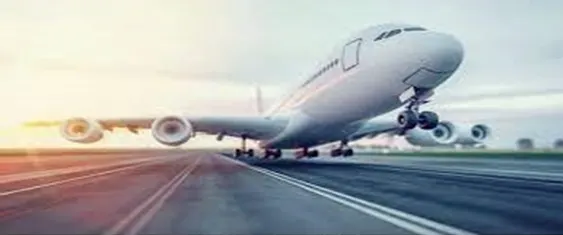
Takeoff is the phase of flight in which an aerospace vehicle leaves the ground and becomes airborne. For aircraft traveling vertically, this is known as liftoff.
For aircraft that take off horizontally, this usually involves starting with a transition from moving along the ground on a runway. For balloons, helicopters and some specialized fixed-wing aircraft (VTOL aircraft such as the Harrier), no runway is needed.
The amount of power that an engine is allowed to produce for a limited period of time for takeoff. The use of takeoff power is usually limited to 5 min for reciprocating engines and up to 2½ min for gas turbine engines. With respect to gas turbine engines, it is the thrust developed under static conditions at a specified altitude and atmospheric conditions of the rotor shaft rotational speed and gas temperature approved for the normal takeoff. It is limited in continuous use to the period of time shown in the approved engine specifications.
Tyre design:-
When it comes to safety, tyres are one of the most important components of aircraft. They help to absorb the shock of landing and provide cushioning. It also provides the necessary traction for braking and stopping of an aircraft.An aircraft tyre is designed to withstand extremely heavy loads while landing, take off, taxing, and parking. The number of wheels required for aircraft increases with the weight of the aircraft, as the weight of the aeroplane needs to be distributed more evenly.
Unlike an automobile or truck tyre, it does not have to carry a load for a long period of continuous operation. However, an aircraft tyre absorbs the high impact loads of landing, and also it’s operating at high speeds for a short time when required.
The below fig shows the technical design of an aircraft tyre:-
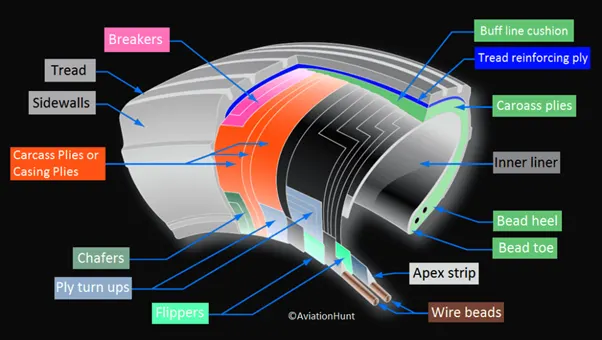
Some of the technical aspects related to tyre are as follows:-
Load Rating – Load rating is the maximum permissible load at a specified inflation pressure.
Ply Rating – Ply Rating is used to identify the maximum recommended load rating and inflation pressure for a specified tyre. It is an index of tyre strength.
Speed Rating – The speed rating is the maximum takeoff speed to which the tyre has been tested.
Skid Depth – Skid depth is the distance between the tread surface and the deepest groove as measured in the mould.
Rolling Resistance:-
The force that resists the motion of a body rolling on a surface is called the rolling resistance or the rolling friction.
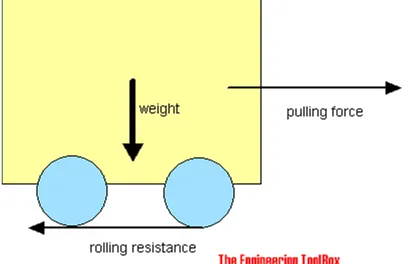
The rolling resistance can be expressed by the generic equation
Fr = c W
where
Fr = rolling resistance or rolling friction (N, lbf)
c = rolling resistance coefficient - dimensionless (coefficient of rolling friction - CRF)
W = m ag
= normal force - or weight - of the body (N, lbf)
m = mass of body (kg, lb)
ag = acceleration of gravity (9.81 m/s2, 32.174 ft/s2)
Below fig showns the graph of rolling Resistance (Fr) vs speed tested under different tyre pressure :-
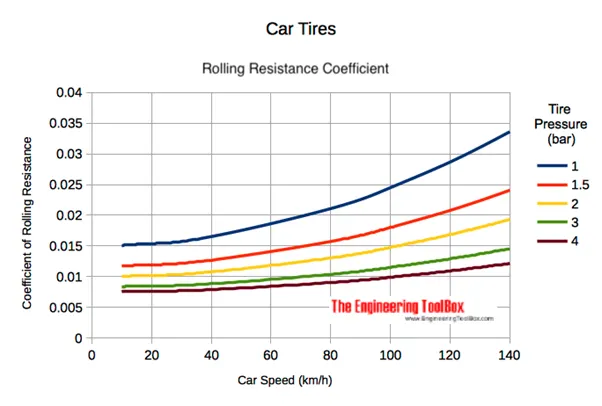
From the graph we can conclude that as the speed is increasing the Fr goes on increasing but if we see that for different tyre pressure the Fr is different for the same speed , if we increase the tyre pressure then the rolling resistance will be reduced comparably for the same speed with lower tyre pressure.
Brake force while landing:-
Aircraft types, the brake units are powered by the hydraulics system. An electrical signal is sent from the flight deck to hydraulic actuators near the main landing gear. Here, hydraulic fluid at 3,000 pound per square inch is used to force the brake unit against the wheel, thus slowing it down.
This system works fine, but the pipes and actuators that form this part of the hydraulic system come at a considerable weight cost. Extra weight means more fuel burn, which in turn increases costs and carbon emissions.
Definition of braking terms:-
Clamping Force (Fn) is the force pressing each brake pad against the disc.
Braking Force (Fb) is the tangential friction force acting between the brake pads and disc.
Fb = 2 . µ . Fn
Where: µ is the coefficient of friction between the pad and the disc (a nominal value of 0.4 is assumed
for fully conditioned pads of standard material).
Braking Torque (Tb) is the moment of braking force about the center of rotation.
Tb = Fb . re
Where re is the effective disc radius.
Part B:
A. With necessary assumptions, calculate the force and power required to push / pull an aircraft by a towing vehicle.
B)Develop the model for the calculated force and power using Simulink.
The following assumptions were made for the parameters:-
weight of aircraft (Boeing -747)= 4,00,000 kg
payload weight of aircraft - 9500 kg
rolling resistanve of an aircraft (Urr)= 0.004
Weight of towing vehicle = 50,000 kg
Rolling resistance of towing vehicle = 0.001
velocity of aircraft during towing = 25 kmph
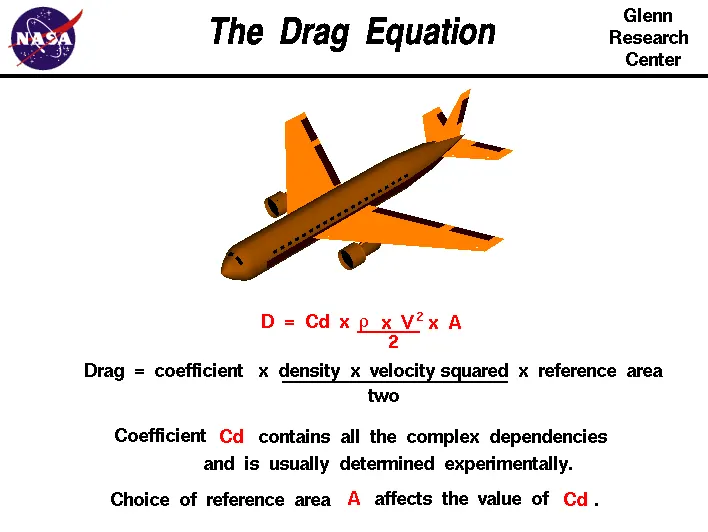
density of air (p)= 1.225
the frontal area of aircraft = 20 m^2
coefficient of drag coefficient = 0.026
the calculations for selecting the motor of towing vehicle ara performed in excel file :-
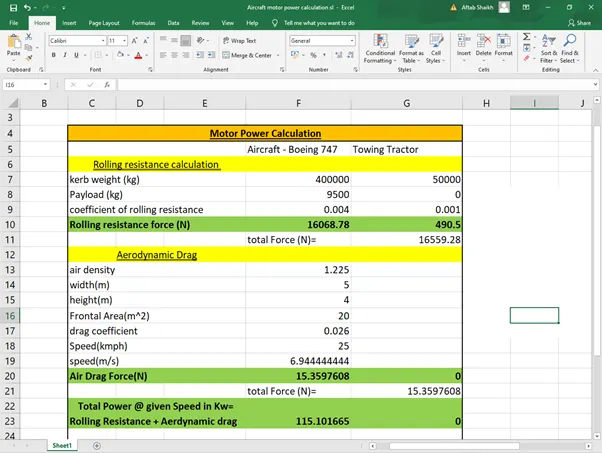
from the above performed calculations the motor required for towing the aircraft is about 115 Kw.
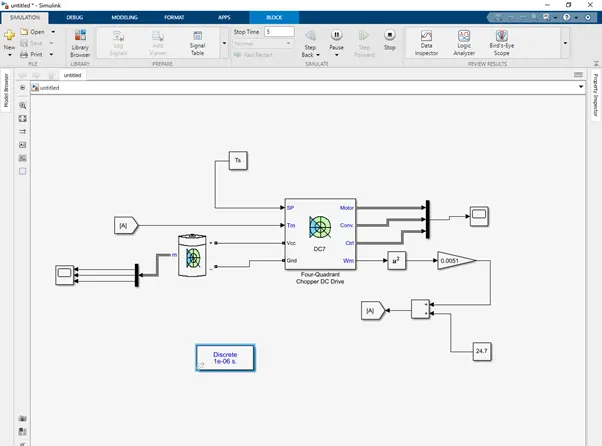
the simulink model is also been created as follows :-
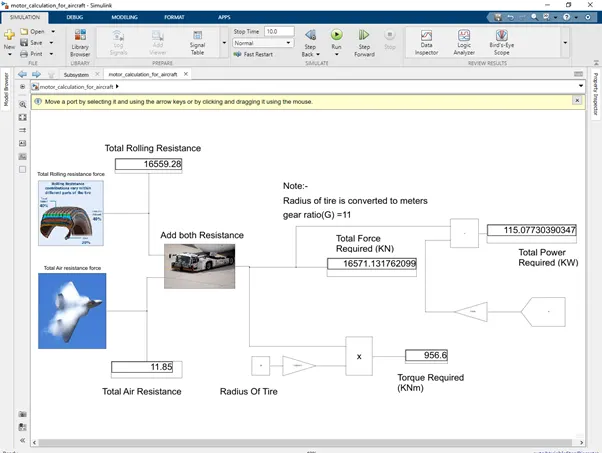
the calculation for rolling resistance is been model as shown:-
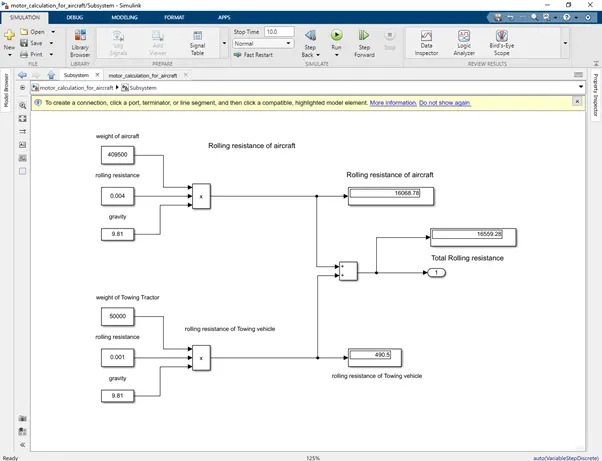
and for air drag as follows :-
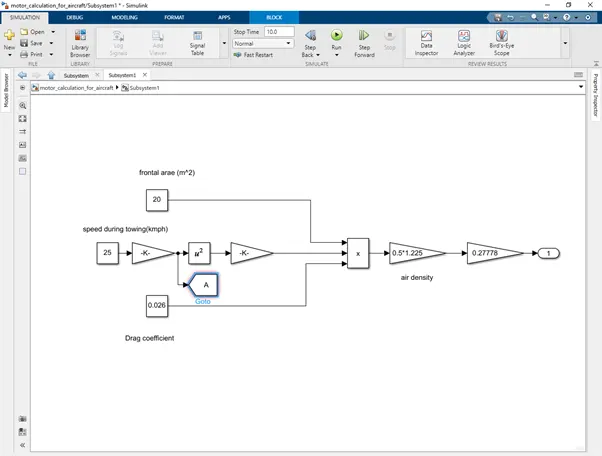
the results obtained are :-
total power required :-115.077 Kw
total force required :-16571.13 Kn
Torque required :-956.11 KNm
7. A. Design an electric powertrain with type of motor, it’s power rating, and energy requirement to fulfill aircraft towing application in Simulink. Estimate the duty cycle range to control the aircraft speed from zero to highest. Make all required assumptions. Prepare a table of assumed parameters. Draw a block diagram of powertrain.
(Hint :DC7 Block)
B. Also, Design the parameters in excel sheet.
the generalized block diagram for an EV is as below:-
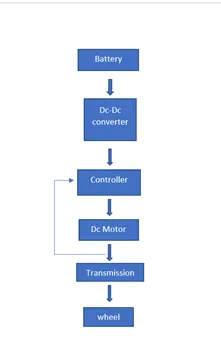
The torque- speed realtion is as follow :-
the battery is selected of 300kw
voltage of battery =300V
ampere of battery = 1000ah
T= 24.7 + 0.0051 + w^2
the model is been created by using DC7 bolck:-
i have attached the excel , .slx files.