Project 1 - Parsing NASA thermodynamic data
Aim – Write a code in MATLAB for Find Cp, H and S from a thermo data file
Objective –
- Write a function that extracts the 14 co-efficients and calculates the enthalpy, entropy and specific heats for all the species in the data file. You will be reading this file NASA thermodynamic data(Tip: use fopen and fgetl). The formulae are shown below.
Here R is the universal gas constant, T is the temeprature.
The FIRST 7 coefficients are HIGH-temperature coefficients and the SECOND 7 coefficients are LOW-temperature coefficients.
Also use the LOCAL TEMPERATURE RANGES which is unique for each individual species, not the GLOBAL TEMPERATURE RANGE.
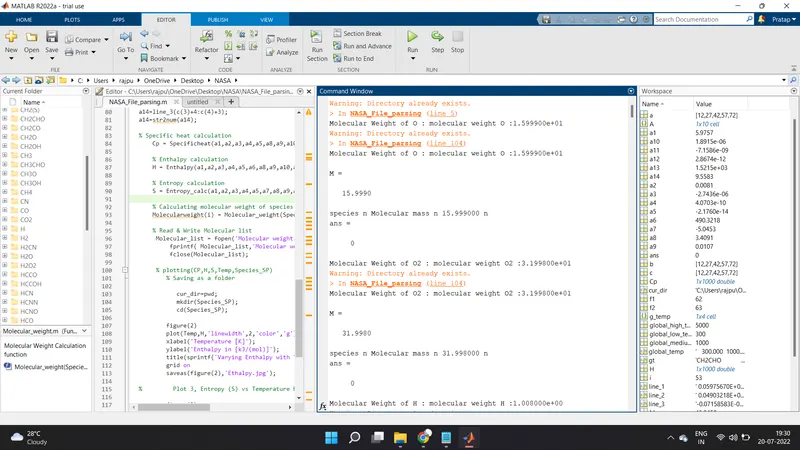
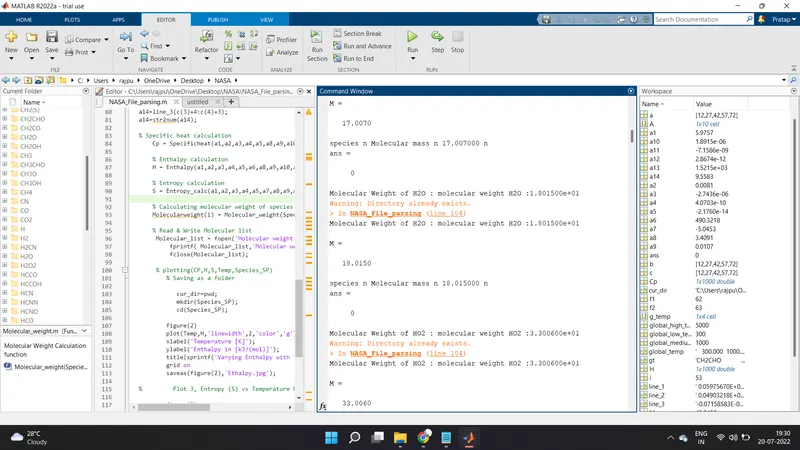
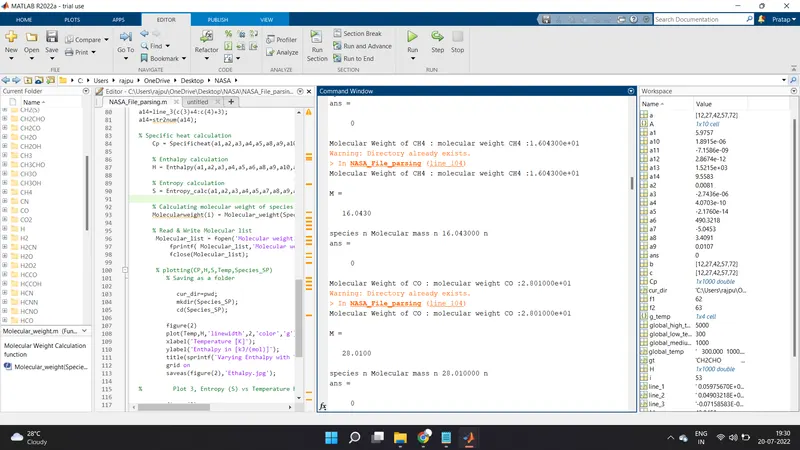
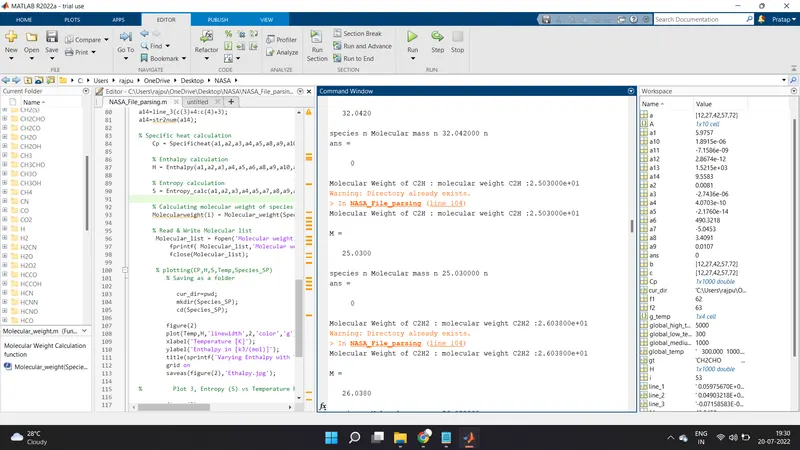
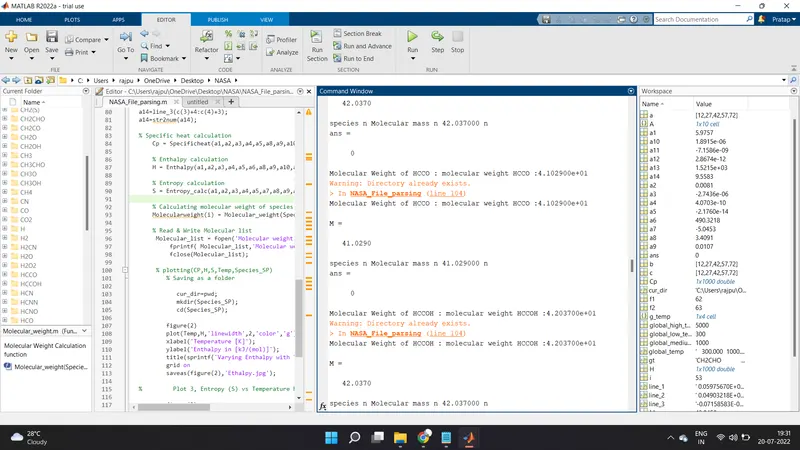
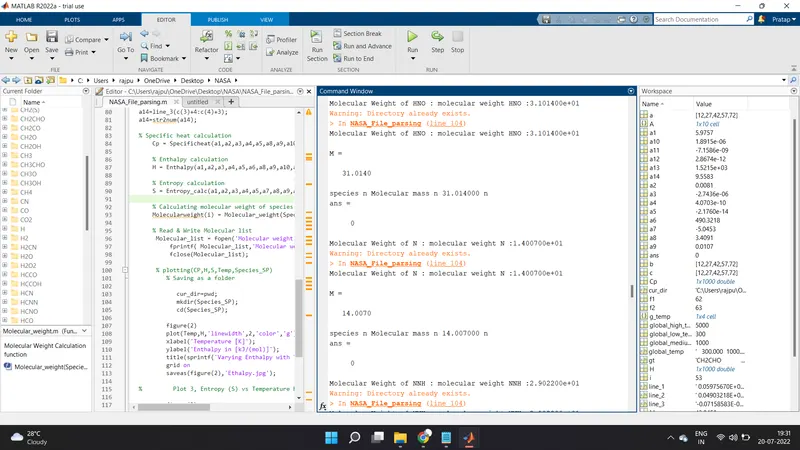
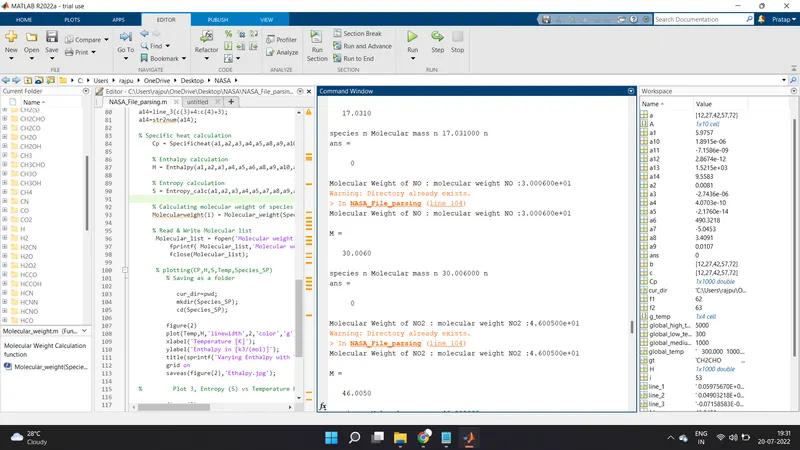
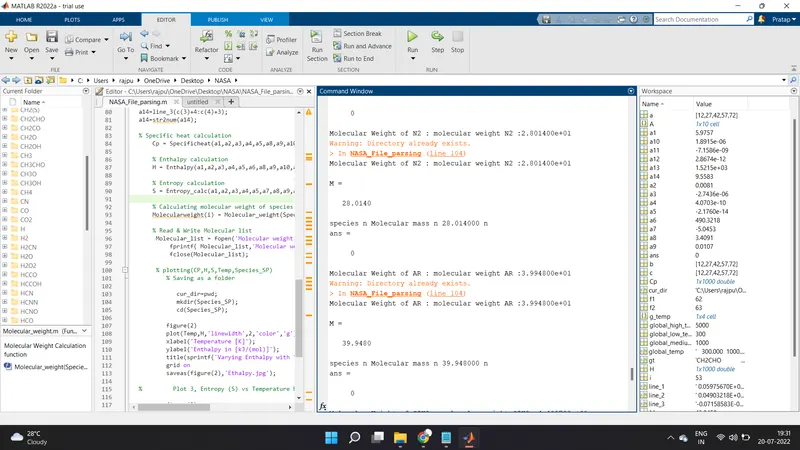
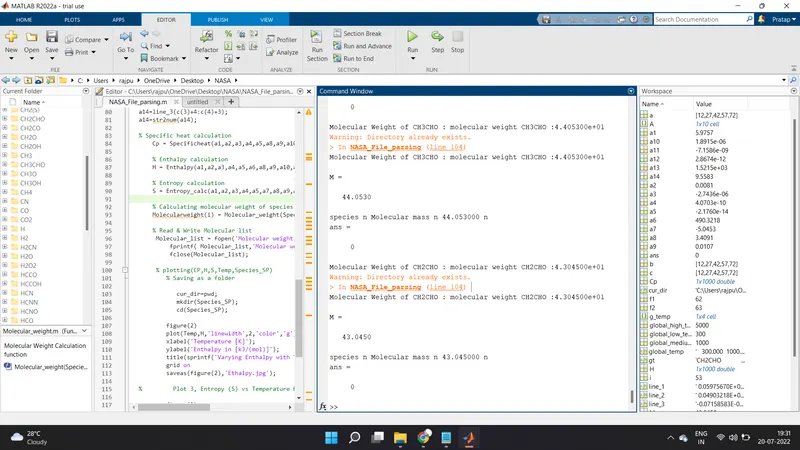
- Calculate the molecular weight of each species and display it in the command window.
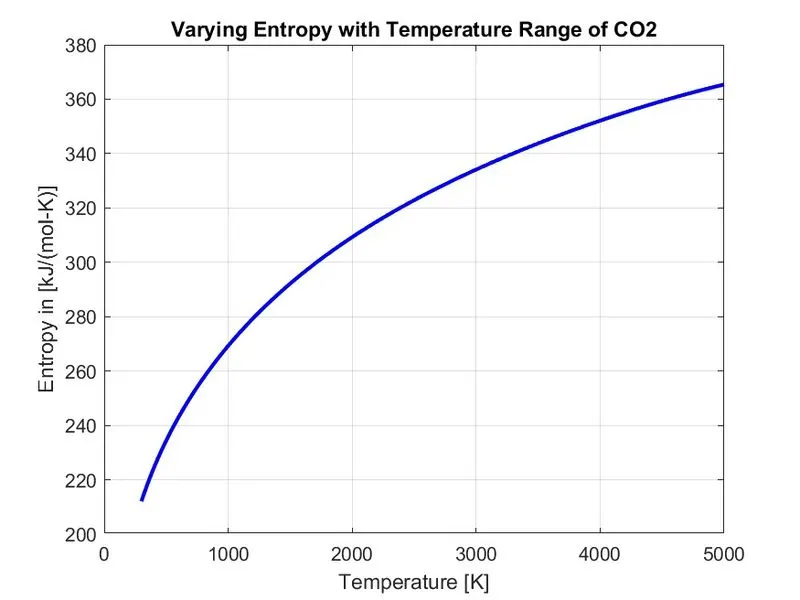
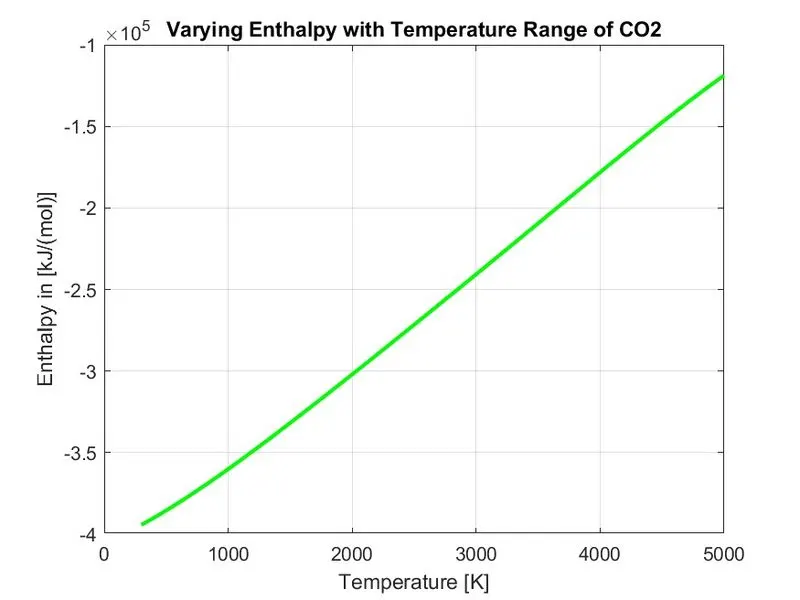
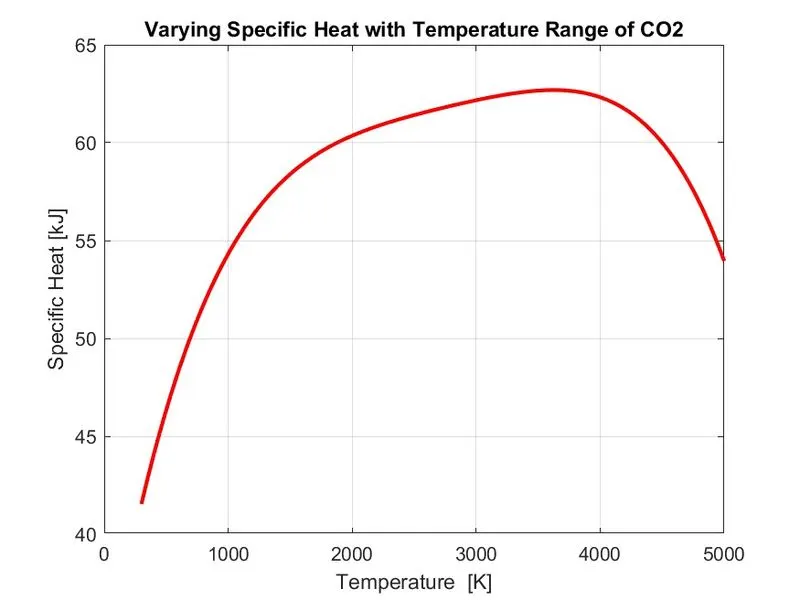
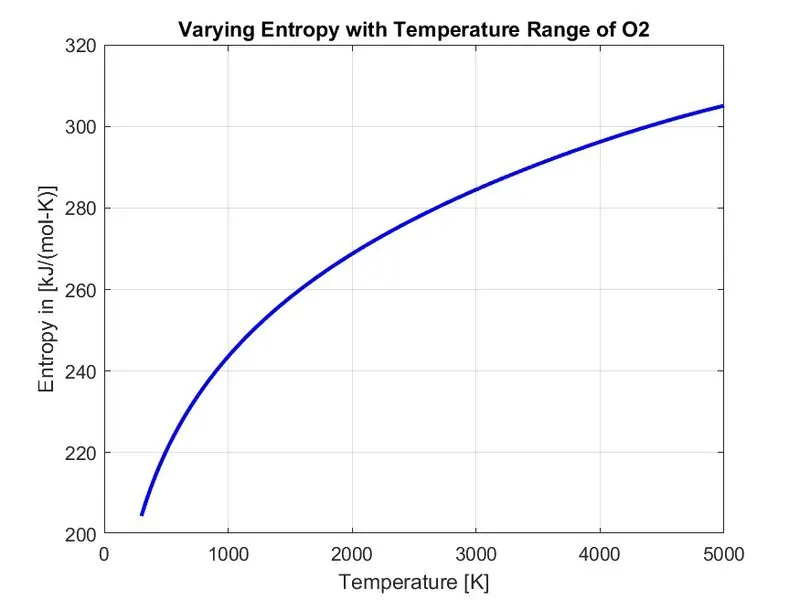
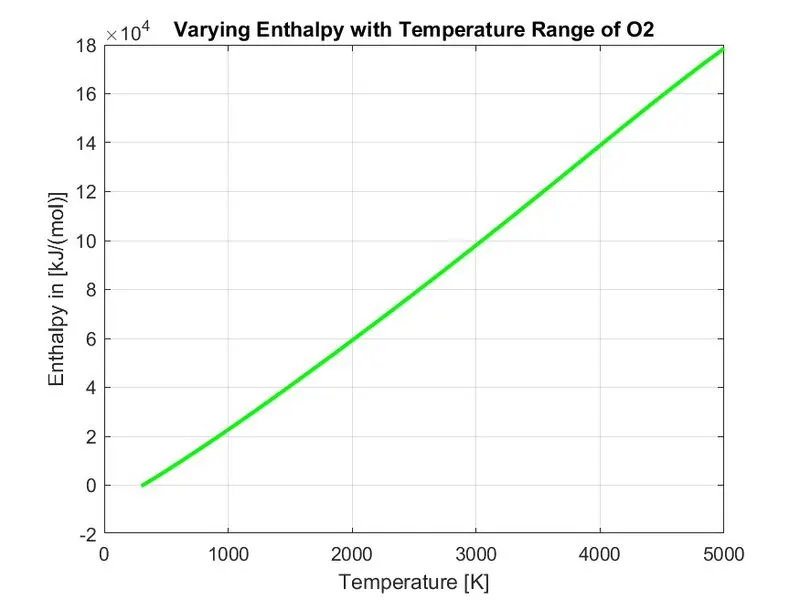
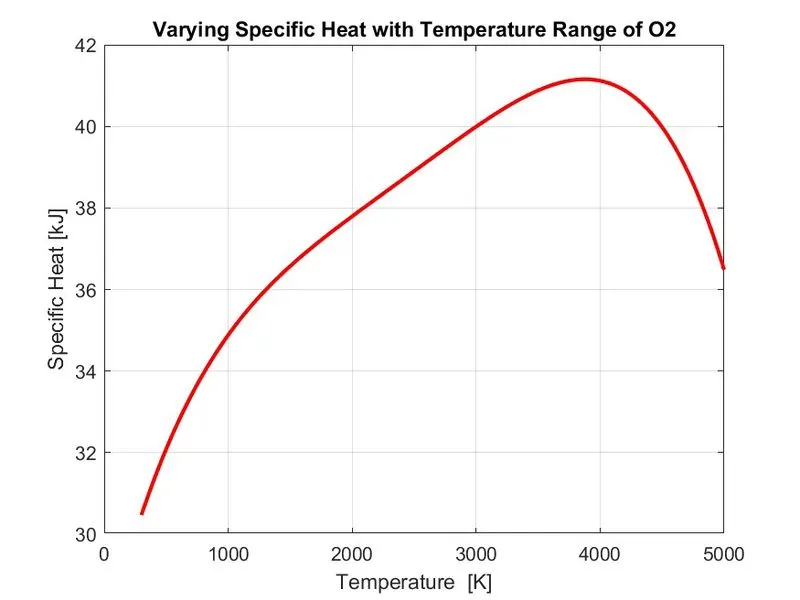
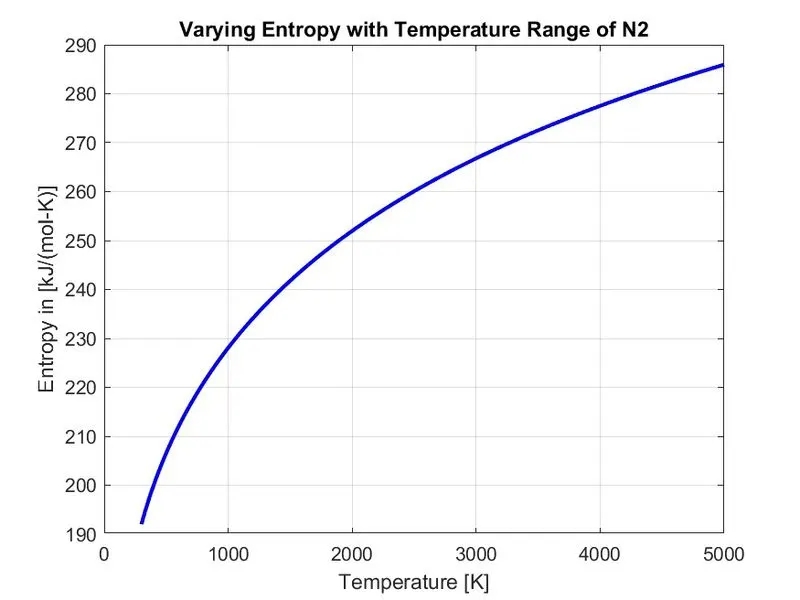
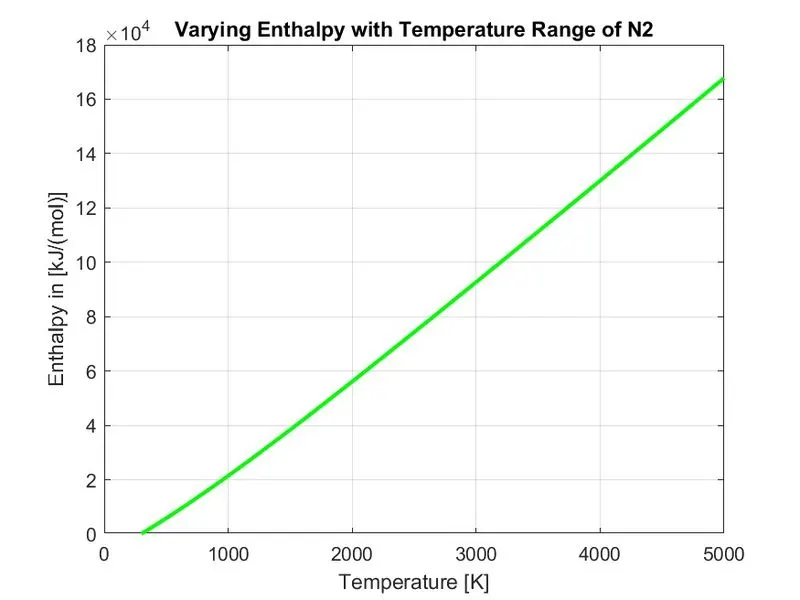
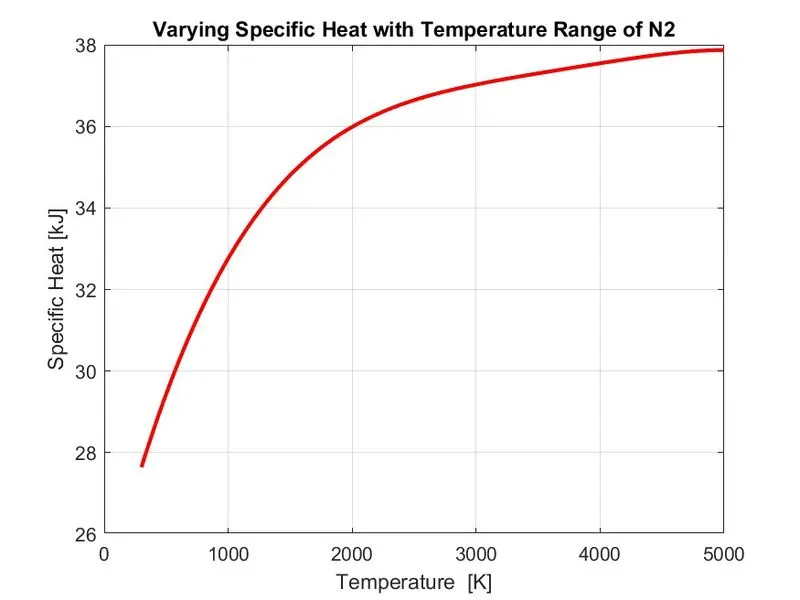
- Plot the Cp, Enthalpy and Entropy for the local temperature range (low temperature : high temperature) specific for each species.
- Save the plots as images with appropriate names and dump them in separate folders for each species with suitable name. All these should be generated automatically.
- The main program that you will submit will just take the "THERMO.dat" file as an input and generate Cp, H and S plots.
NASA Thermodynamic File
File parsing is a string or symbol either in natural language computer language or data structure conferming to the rules of the former grammer.
THERMO.dat file is a data file that contain 14 coefficient for 53 different elements which file given by NASA. These coefficients are utilized to calculate the specific heat, enthalpy & entropy. Each element has its own range of local temperature.
List of 53 Elements contained in 'THERMO.dat' file:
AR C C2H C2H2 C2H3 C2H4
C2H5 C2H6 C3H7 C3H8 CH CH2
CH2(S) CH2CHO CH2CO CH2O CH2OH CH3
CH3CHO CH3O CH3OH CH4 CN CO
CO2 H H2 H2CN H2O H2O2
HCCO CCOH HCN HCNN HCNO HCO
HNCO HNO HO2 HOCN N N2
N2O NCO NH NH2 NH3 NNH
NO NO2 O O2 OH
MATHEMATICAL EQUATION:
For specific heat
`(C_p)/R = a_1 + a_2T + a_3T^2 + a_4 T^3 + a^5 T^4`
For enthalpy
`H/(RT) = a_1 + a_2T+ a_3T^2/3 +a_4T^3/4 +a_5T^4/5+a^6/T`
For entropy
`S/R = a_1 logT + a_2T + a_3T^2/2 + a^4T^3/3 +a^5T^4/4 +a_7`
where
T=local temprature
a1-a7=high temperature coefficient
a8-a14=low temprature coefficient
R=Gas constant=8.314
PROGRAM:
The program for file parsing
clear
close
clc

mkdir 'C:\Users\rajpu\Onedrive\Desktop\NASA'

%For Reading data file
    f1=fopen('thermo.dat','r');
    gt= fgetl(f1);

%For Finding global temprature
    global_temp=fgetl(f1);

%Splitting Coefficient
    g_temp=strsplit(global_temp);

%Converting string cells into number using str2num
    global_low_temp   = str2num(g_temp{2});
    global_medium_temp= str2num(g_temp{3});
    global_high_temp  = str2num(g_temp{4});

%Temprature Range
    Temp=linspace(global_low_temp,global_high_temp,1000);
% Gas Constant
    R=8.314;

% using loop for skipping 3 lines
    for i = 1:3
        gt=fgetl(f1);
    end

    for i = 1:53;
        gt=fgetl(f1); %Printing by skipping 1 line
        A=strsplit(gt); %Splitting
        Species_SP=(A{1}); %select one char


line_1=fgetl(f1);
a=strfind(line_1,'E');

% %  Extracting higher and lower temperature coefficients
%
% %  Extracting FIRST 7 coefficients i.e HIGH-temperature coefficients
a1=line_1(1:a(1)+3);
a1=str2num(a1);
a2=line_1(a(1)+4:a(2)+3);
a2=str2num(a2) ;
a3=line_1(a(2)+4:a(3)+3);
a3=str2num(a3)  ;
a4=line_1(a(3)+4:a(4)+3);
a4=str2num(a4);
a5=line_1(a(4)+4:a(5)+3);
a5=str2num(a5)  ;

line_2=fgetl(f1);
b=strfind(line_1,'E');;
a6=line_2(1:b(1)+3);
a6=str2num(a6)  ;
a7=line_2(a(1)+4:b(2)+3);
a7=str2num(a7);

 % Extracting SECOND 7 coefficients - LOW-temperature coefficients
a8=line_2(b(2)+4:b(3)+3);
a8=str2num(a8);
a9=line_2(b(3)+4:b(4)+3);
a9=str2num(a9) ;
a10=line_2(b(4)+4:b(5)+3);
a10=str2num(a10) ;


line_3=fgetl(f1);
c=strfind(line_1,'E');

a11=line_3(1:c(1)+3);
a11=str2num(a11);
a12=line_3(c(1)+4:c(2)+3);
a12=str2num(a12);
a13=line_3(c(2)+4:c(3)+3);
a13=str2num(a13);
a14=line_3(c(3)+4:c(4)+3);
a14=str2num(a14);

% Specific heat calculation
    Cp = Specificheat(a1,a2,a3,a4,a5,a8,a9,a10,a11,a12,Temp,R,global_medium_temp);

    % Enthalpy calculation
    H = Enthalpy(a1,a2,a3,a4,a5,a6,a8,a9,a10,a11,a12,a13,Temp,R,global_medium_temp);

    % Entropy calculation
    S = Entropy_calc(a1,a2,a3,a4,a5,a7,a8,a9,a10,a11,a12,a14,Temp,R,global_medium_temp);

    % Calculating molecular weight of species
    Molecularweight(i) = Molecular_weight(Species_SP);

    % Read & Write Molecular list
     Molecular_list = fopen('Molecular weight.txt','a+');
         fprintf( Molecular_list,'Molecular weight of %s is %d \n',Species_SP,Molecularweight);
         fclose(Molecular_list);

     % plotting(CP,H,S,Temp,Species_SP)
        % Saving as a folder

           cur_dir=pwd;
           mkdir(Species_SP);
           cd(Species_SP);

        figure(2)
        plot(Temp,H,'linewidth',2,'color','g');
        xlabel('Temperature [K]');
        ylabel('Enthalpy in [kJ/(mol)]');
        title(sprintf('Varying Enthalpy with Temperature Range of %s',Species_SP));
        grid on
        saveas(figure(2),'Ethalpy.jpg');

%         Plot 3, Entropy (S) vs Temperature Range (Temp)

        figure(3)
        plot(Temp,S,'linewidth',2,'color','b');
        xlabel('Temperature [K]');
        ylabel('Entropy in [kJ/(mol-K)]');
        title(sprintf('Varying Entropy with Temperature Range of %s',Species_SP));
        grid on
        saveas(figure(3),'Entropy.jpg');

        cd(cur_dir);

        % Molecular weight

        M = Molecular_weight(Species_SP)
        f2 = fopen('molecular mass','w');
        fprintf('%s n %s n %f n','species','Molecular mass',M);
        fclose(f2)
end
Function Code For Specific Heat
% Specific heat calculation function

function Cp = Specificheat(a1,a2,a3,a4,a5,a8,a9,a10,a11,a12,Temp,R,Medium_temp_range )
% Comparing with global temperature
% If less than global temperature - minimum coefficients are taken

if  Temp <= Medium_temp_range
    Cp = R*(a8 + (a9*(Temp)) + (a10*(Temp).^2) + (a11*(Temp).^3) + (a12*(Temp).^4));
    else
    Cp = R*(a1 + (a2*(Temp)) + (a3*(Temp).^2) + (a4*(Temp).^3) + (a5*(Temp).^4));
    % Else maximum coefficients are taken
end
Function Code For Enthalpy
% Enthalpy Calculation function

function H = Enthalpy(a1,a2,a3,a4,a5,a6,a8,a9,a10,a11,a12,a13,Temp,R,global_medium_temp)
% Comparing with global temperature
% If less than global temperature - minimum coefficients are taken

       if Temp <= global_medium_temp
        H = R*Temp.*(a8 + ((a9*Temp)/2) + ((a10*(Temp).^2)/3) + ((a11*(Temp).^3)/4) + ((a12*(Temp).^4)/5) +((a13./Temp)));
       else
% Else maximum coefficients are taken

        H = R*Temp.*(a1 + ((a2*Temp)/2) + ((a3*(Temp).^2)/3) + ((a4*(Temp).^3)/4) + ((a5*(Temp).^4)/5) +((a6./Temp)));
end
Function Code For Entropy
% Entropy Calculation function

function S = Entropy_calc(a1,a2,a3,a4,a5,a7,a8,a9,a10,a11,a12,a14,Temp,R,global_medium_temp)
% Comparing with global temperature
% If less than global temperature - minimum coefficients are taken

    if Temp <= global_medium_temp
        S = R.*(a8.*log(Temp) + (a9.*Temp) + (a10*((Temp).^2)/2) + (a11*((Temp).^3)/3) + (a12*((Temp).^4)/4) + a14);
    else

% Else - maximum coefficients are taken
        S = R.*(a1.*log(Temp) + (a2.*Temp) + (a3*((Temp).^2)/2) + (a4*((Temp).^3)/3) + (a5*((Temp).^4)/4) + a7);
end
Function Code For Molecular Weight
% Molecular Weight Calculation function

function Molecularweight = Molecular_weight(Species_SP)
         % Standard - Atomic Name
         atomic_name = ['H','C','O','N','A'];
         % Hydrogen, Carbon, Oxygen, Nitrogen, Argon

         fprintf('Molecular Weight of ');
         fprintf(Species_SP);
         fprintf(' : ');
         % Standard Atomic Number
         Atomic_Weight = [1.008 12.011 15.999 14.007 39.948];
         % Starting Range of Molecule
         Molecularweight = 0;

         % Adding Atomic number to obtain particular value
        for i = 1:length(Species_SP)
            for j = 1:length(atomic_name)
                if strcmpi(Species_SP(i),atomic_name(j))
                        Molecularweight = Molecularweight +Atomic_Weight(j);
                    position = j;
                end
            end
            n = str2num(Species_SP(i));

            if n>1

                Molecularweight = Molecularweight + Atomic_Weight(position)*(n-1);

            end
        end
            fprintf('molecular weight %s :',Species_SP);
            fprintf('%d',Molecularweight);
            disp(' ');
end
Code Explanation:-
Clear close CLC command is used for clear screen clear work space and clear command window
mkdir command is used for making new folder
fopen command is used for read a file
fgetl command used for read a line from a data file
Strsplit used for split string or character vector
Str2num convert character array or string to numeric array
Space is used for dividing a line into a specific number of part
R is a gas constant
Now using for loop for skipping three line
Now using for loop for repeating a program 53 times for every coefficient of element
Strfind is used for find string within other string
Need to dividing the cooefficient and finding a number before E
Now writing a program to extract a coefficient from all lines coefficient or in the numbers of a1 a2 a3 .....
Creating a function for calculating for specific heat calculation, enthalpy calculation and Entropy calculation and Molecular weight calculation
Now creating a plot for a different -different condition for all the elements in of a data file and printing a molecular weight by using a command a fprintf command.
OUTPUT:
ScreenShot where all the folder are saved:

Screenshot of Molecular Weight
Attachment Of Plots for O2
Attachment Of Plots for N2
Attachment Of Plots for CO2