Project-1: Modelling an electric Car with Li-ion battery
Project Title: Modelling an electric Car with Li-ion battery.
Aim: Create a MATLAB model of electric car which uses lithium ion battery and suitable motor. Choose suitable blocks from Simscape or Powertrain block set. Implement the vehicle speed control using PI controller and generate brake and accelerator commands. Avoid using readymade driver block for speed control.
Prepare a report about your model including following:
Objectives, System level configurations, Model parameters, Results, Conclusion.
(Note- The simulink model file should be compulsorily attached)
Software Used: Simulink, MS Word.
Solution:
Simulink Model:
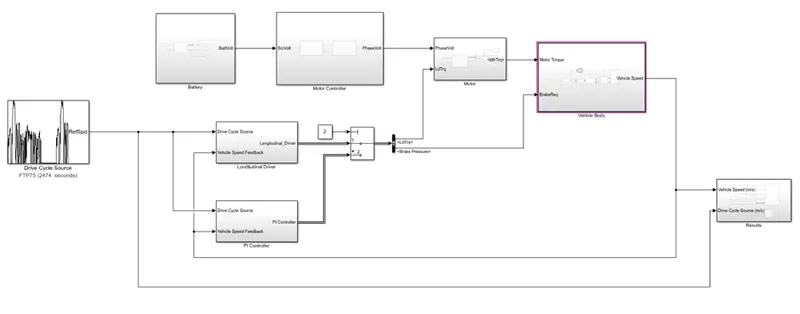
1. Objectives:
- To create a lithium-ion battery pack connected in series and parallel.
- To create a motor controller consisting of a DC-DC converter and 3-phase inverter.
- To use a permanent magnet synchronous motor for the electric vehicle.
- To implement a front wheel drive with differentials and a vehicle body with 3 DOF block.
- To get estimated torque requirement for motor using PI Controller from drive cycle source.
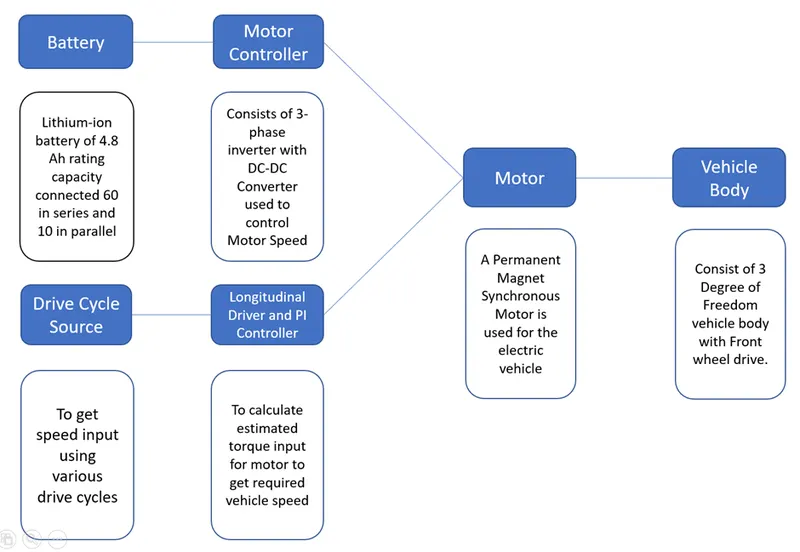
2. System Level Configurations:
3.Model Parameters:
a. Drive Cycle Source:
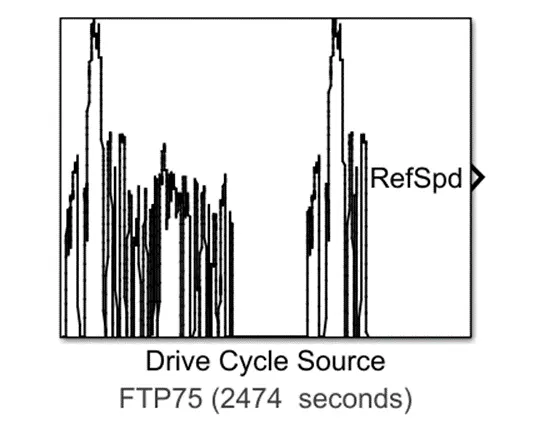
This block gives the vehicle speed input. For this Model, FTP75 Drive cycle is used which runs for 2474 seconds.
b. Longitudinal Driver/ PI Controller:
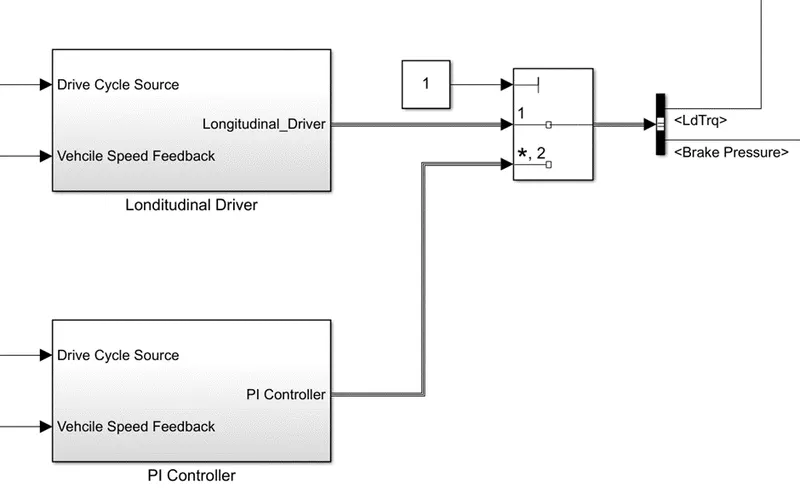
This block is used to calculated the estimated torque input for motor to get the desired vehicle speed from the drive cycle source. The multiport switch is used to switch between Longitudinal Driver and PI Controller.
Longitudinal Driver:
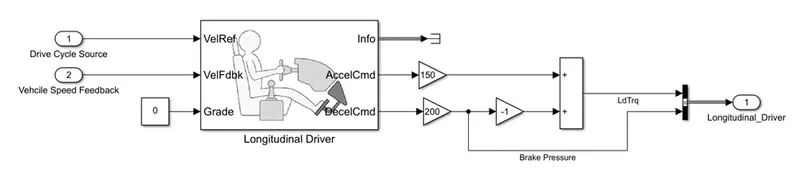
The block calculates the Acceleration and Deceleration commands. The acceleration command is multiplied by 150 so that the motor gets the load torque input up to 110 Nm. Similarly, the deceleration command is multiplied by 200 so that the braking pressure value should be up to 200 Pa.
PI Controller:

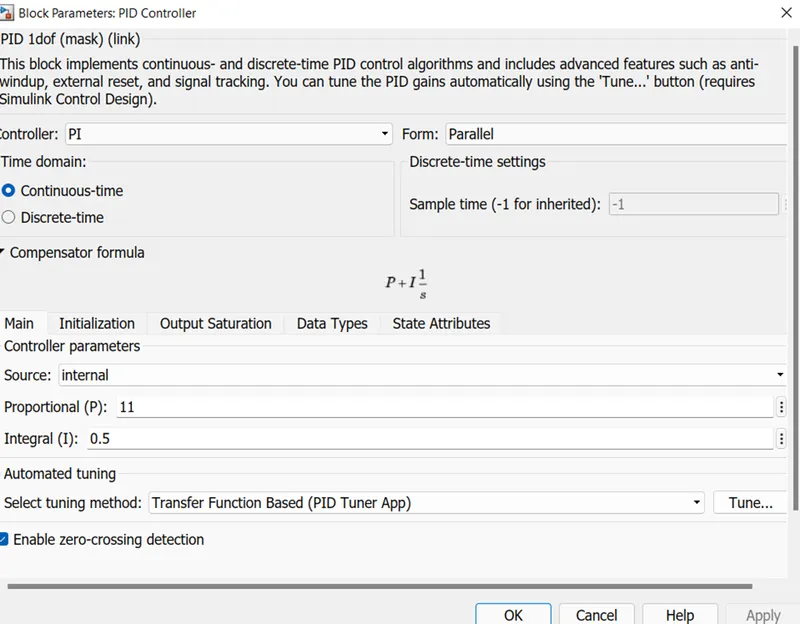
PI controller calculates the necessary torque required for the motor to reach the desired vehicle speed. The PI Controller is tuned for better response.
c. Battery:
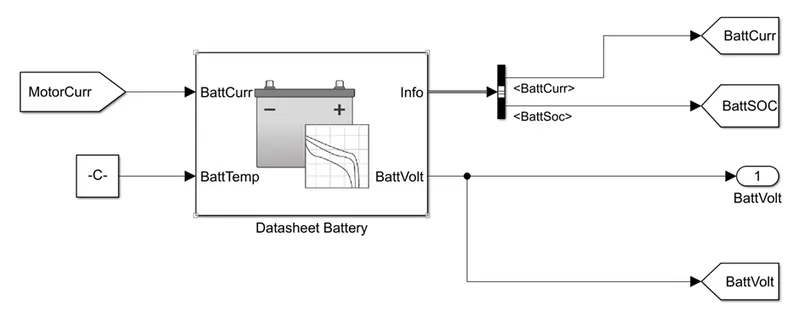
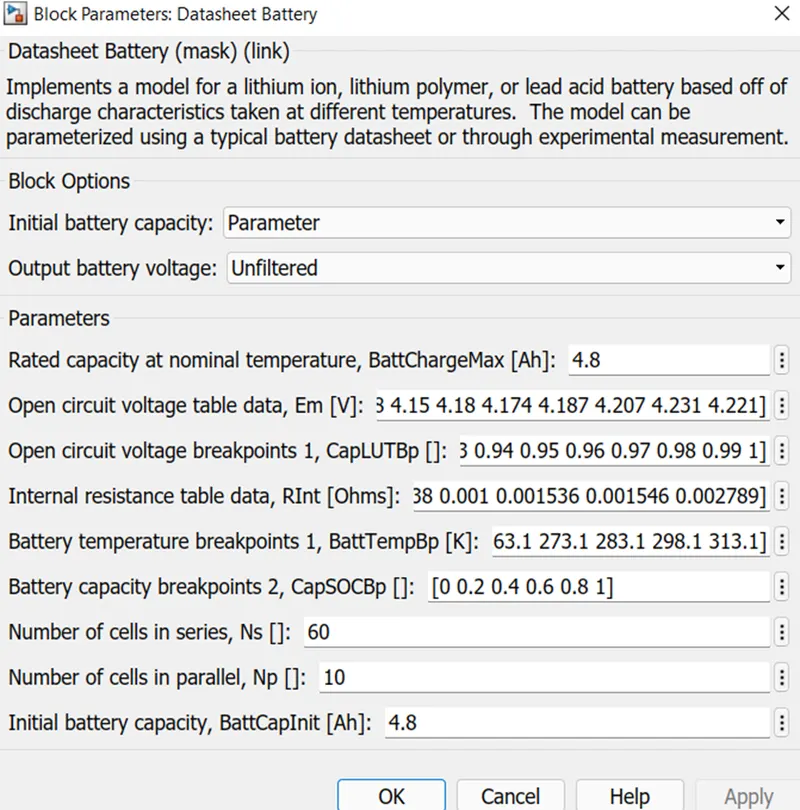
Datasheet battery block consisting of Lithium-ion batteries is used as the battery for the model. The initial rating capacity of the single cell is 4.8 Ah and the cells are connected 60 in series and 10 in parallel.
d. Motor Controller:
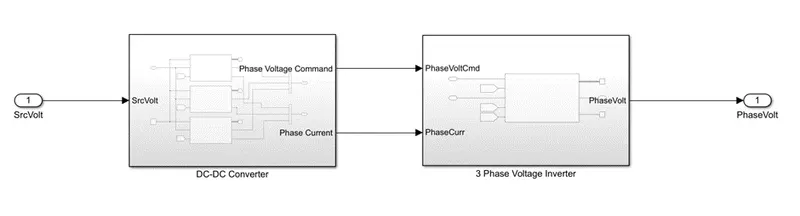
DC-DC Converter:
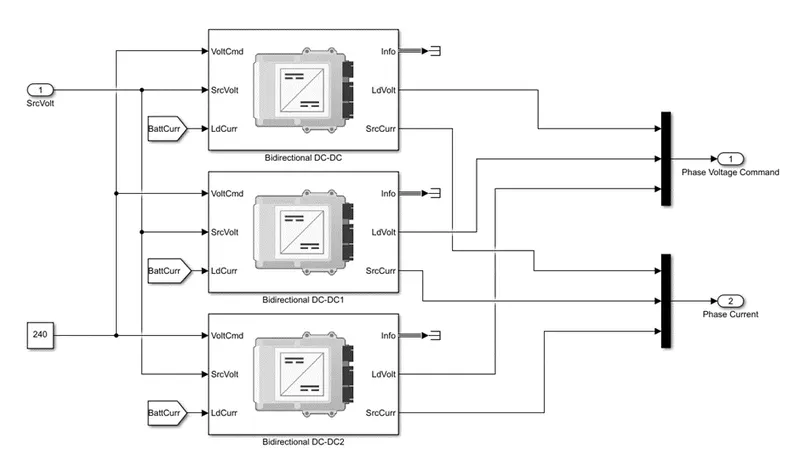
3 Bidirectional DC-DC Converters are used to give a stable 240V, 3 Phase supply to 3 Phase Voltage Source inverter from Lithium-ion Battery Pack. The blocks generate the required amount of voltage and current for the inverter.
3 Phase Voltage Inverter:
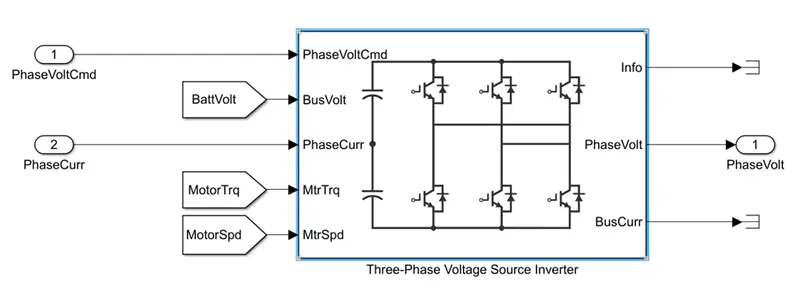
The Three-Phase Voltage Source Inverter block implements a three-phase voltage source inverter that generates neutral voltage commands for a balanced three-phase load for the motor. The main function of this kind of inverter is to change the input of DC to the output of three-phase AC. A basic 3 phase inverter includes 3 single phase inverter switches where each switch can be connected to one of the 3 load terminals.
e. Motor:
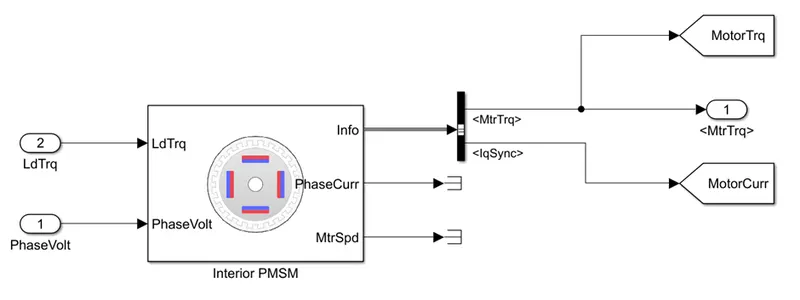
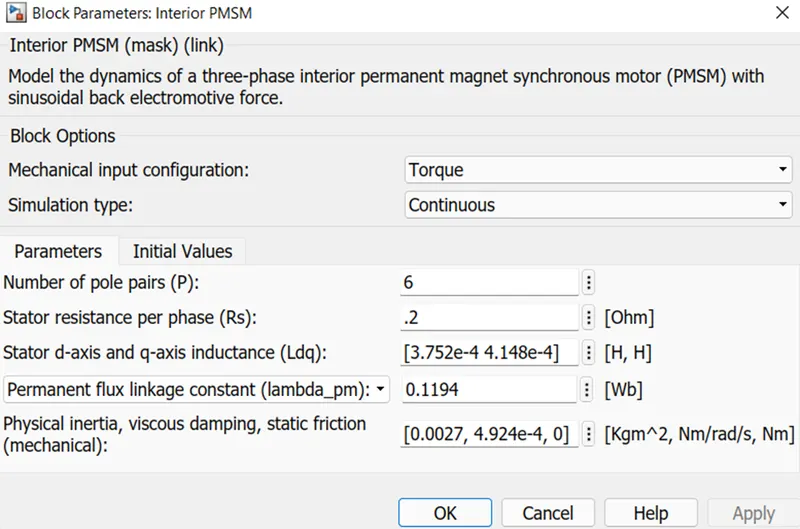
A Permanent Magnet Synchronous Motor is used for the model with 6 pole pairs. The permanent magnet synchronous motors are very efficient, brushless, very fast, safe, and give high dynamic performance when compared to the conventional motors. It is a 3-phase AC synchronous motor that runs at synchronous speed. Motor Torque is used for vehicle body calculations and motor current is sent back to the battery for Battery SOC calculations.
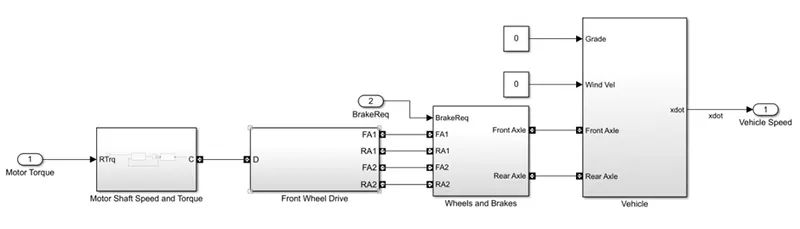
f. Vehicle Body:
Motor Shaft Speed and Torque:
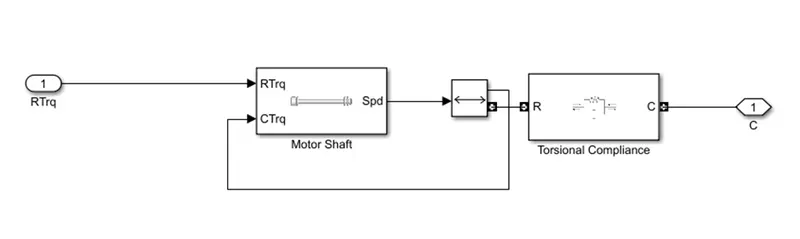
Rotor Torque from motor is connected to the Motor Shaft (Rotational Inertia) block which calculates angular speed in rad/sec. Motor Shaft is then connected to Torsional Compliance block which is used to calculate the Motor Shaft Torque. The two-way connection sends the shaft torque back to the Motor Shaft blocks as feedback.
Front Wheel Drive:
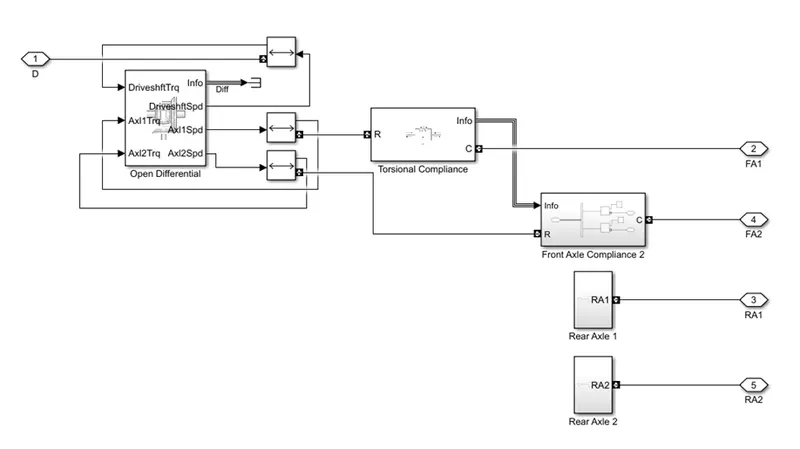
The Motor Shaft Speed from Motor Shaft Speed and Torque blocks is connected to a two connection which senses the motor shaft torque and connects with the Open Differential block which calculates the Driveshaft, Axle 1 and Axle 2 speeds.
Axle 1 and Axle 2 torques are send back by two-way connection to the open differential block as feedback.
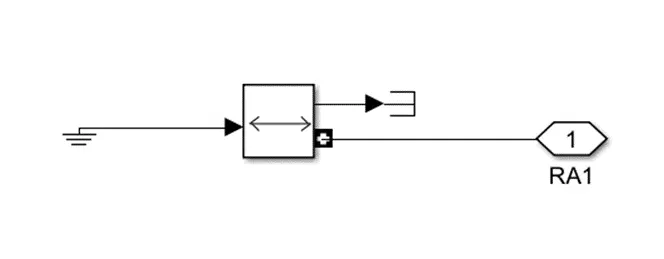
Outports FA1 and FA2 are the angular speed and torque of Front Driveshaft (Axle). Outports RA1 and RA2 are real axle outports which is grounded which means it doesn’t develop any torque and speed as the Vehicle is front wheel drive.
Wheels and Brake:
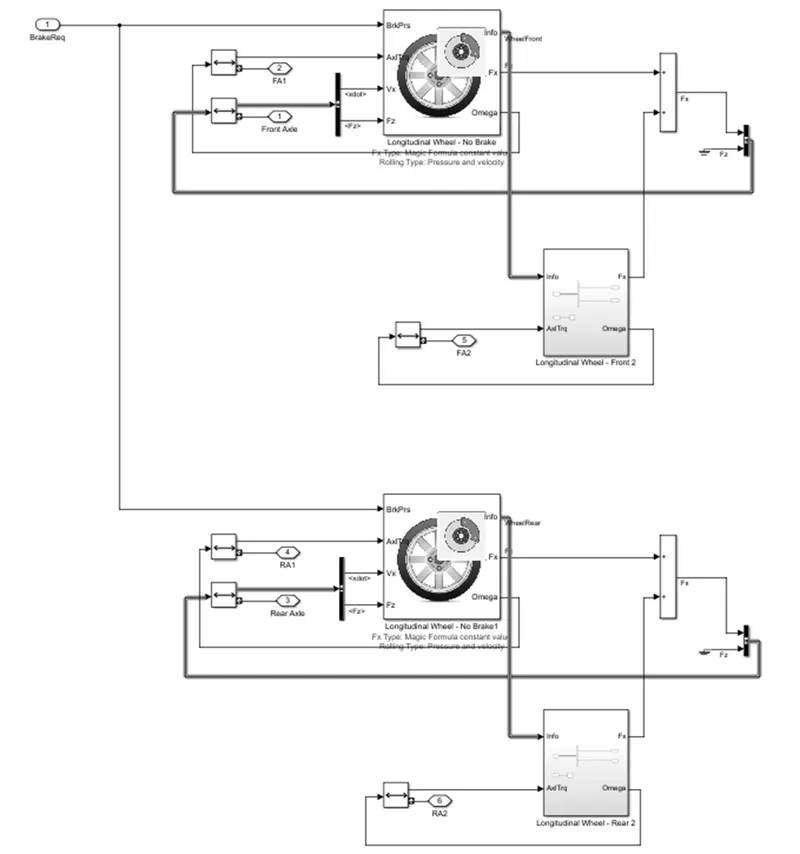
The Front and Rear Driveshaft torque is connected to the Front and Rear wheels. The Brake Pressure value from the PI Controller is used for Disc brake calculations. Vehicle speed and vertical force on the wheels signals comes from the vehicle subsystem. The wheel block calculates Wheel’s horizontal force and Wheel’s angular velocity.
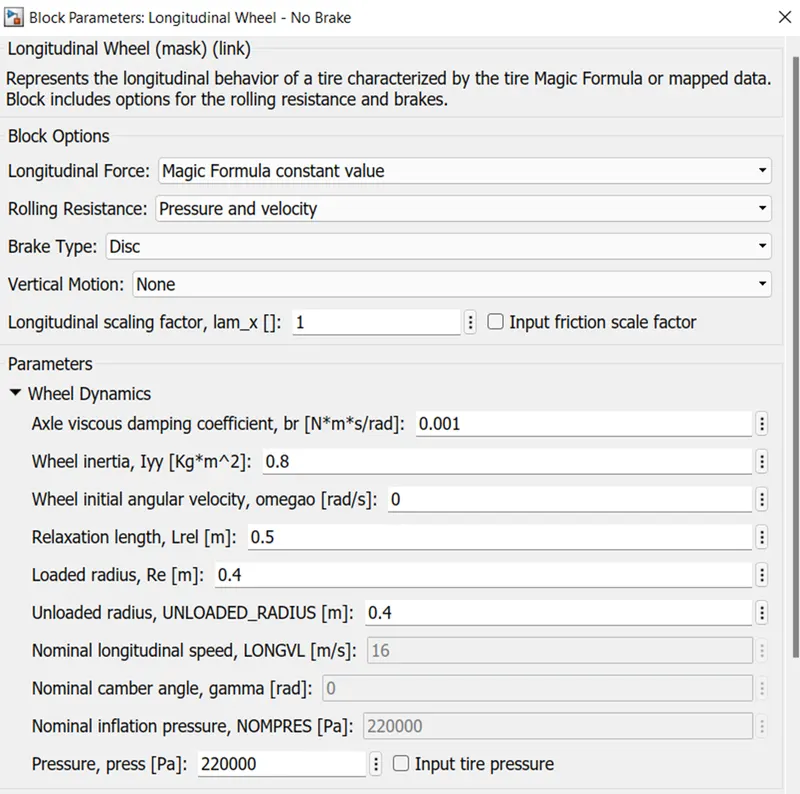
Wheel radius = 0.4 m,
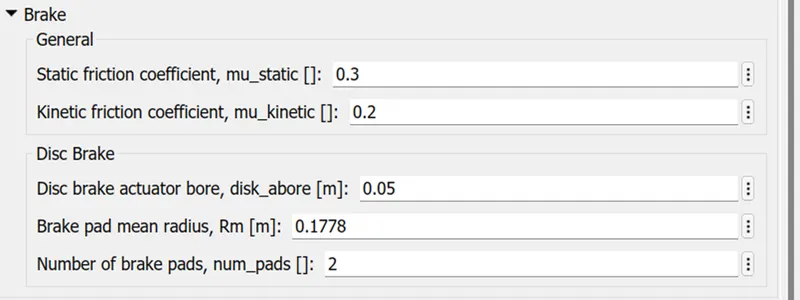
Type of Brakes: Disc Brakes.
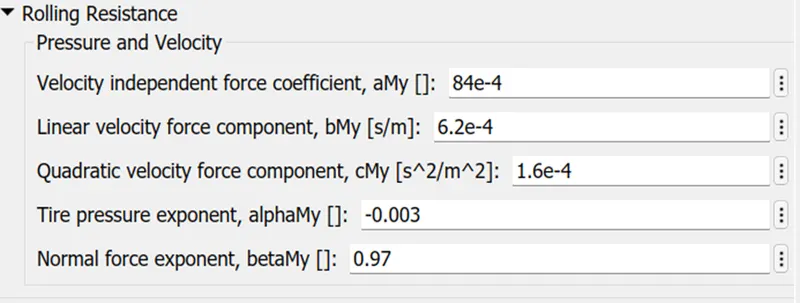
Rolling Resistance is also applied on the wheels.
Vehicle:
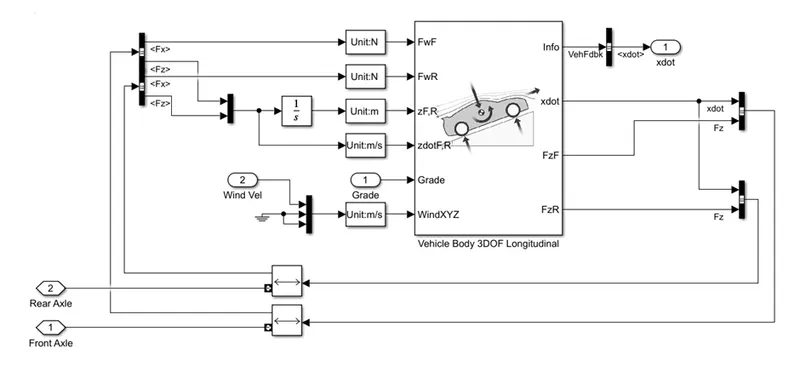
The vehicle block contains a Vehicle Body with 3 Degree of Freedom longitudinal motion block which requires the total horizontal forces acting on the front and rear wheels and also the position and speed of the rear and front axle with respect to z-axis. We can also add grade and wind velocity so that the block can calculate the vehicle speed considering Gradient and Aerodynamic Resistances.
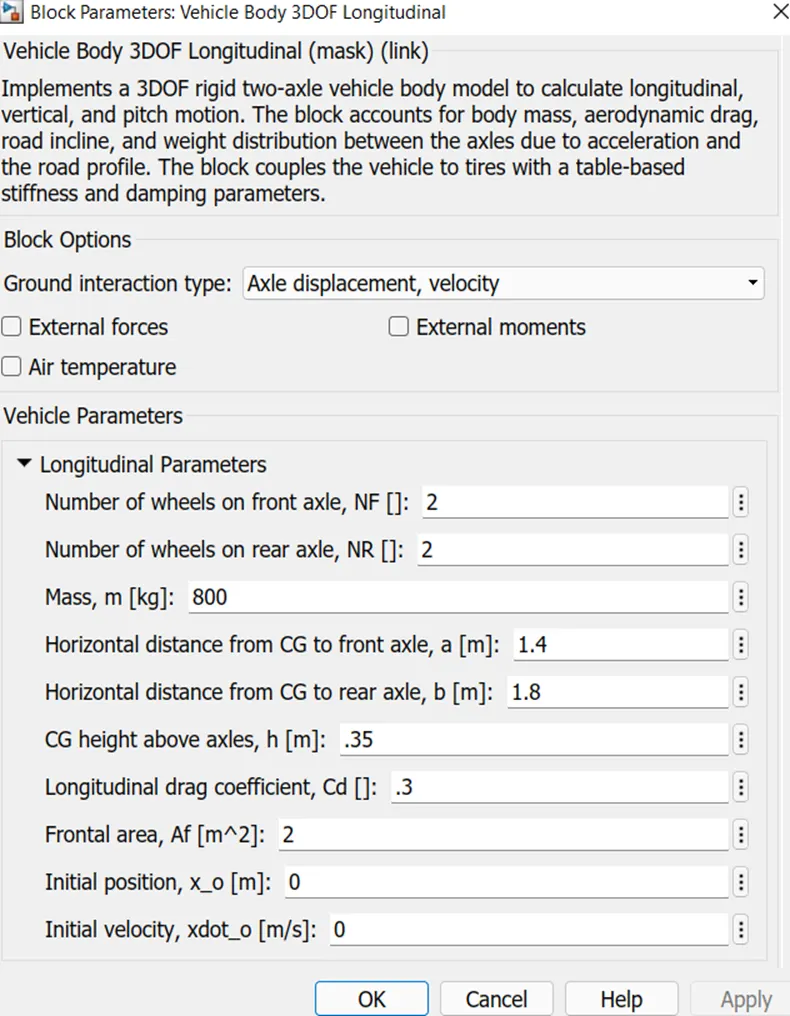
Total mass of the vehicle = 800 Kg,
Frontal area of the vehicle = 2 m2.
4. Results:
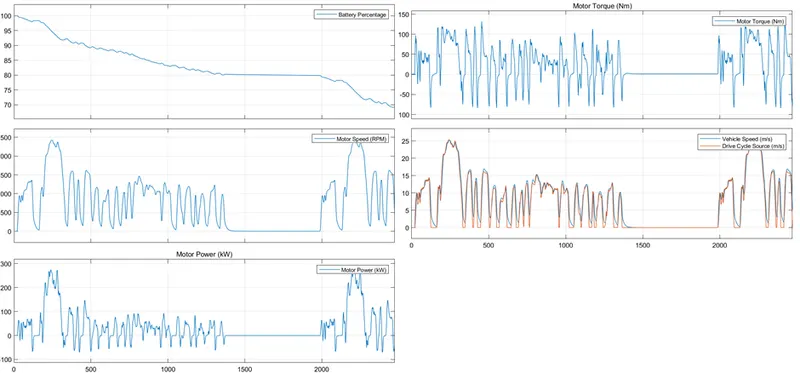
By using Longitudinal Driver:
|
Parameters |
Y-axis |
X-axis |
|
Motor Torque |
Nm |
Time (in seconds) |
|
Motor Speed |
RPM |
|
|
Motor Power |
kW |
|
|
Drive Cycle Source and Vehicle Speed |
m/s |
Battery and Motor current and voltage:
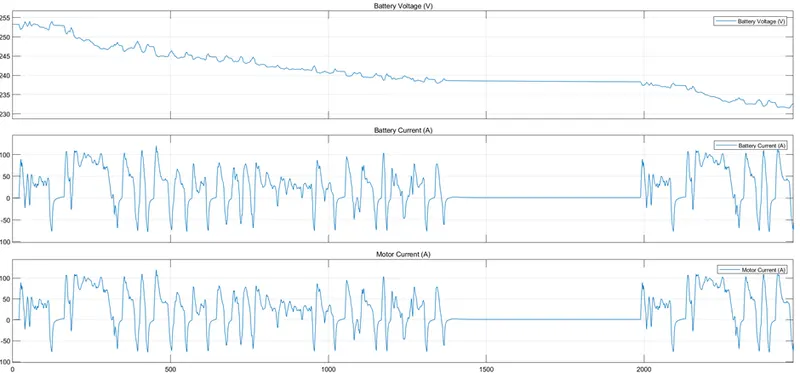
By using PI Controller:
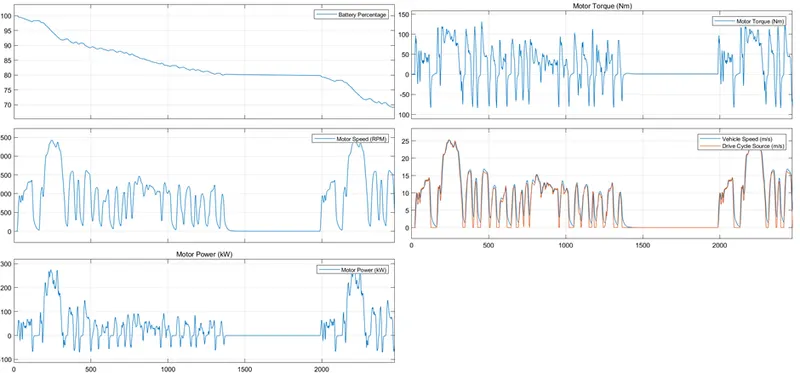
|
Parameters |
Y-axis |
X-axis |
|
Motor Torque |
Nm |
Time (in seconds) |
|
Motor Speed |
RPM |
|
|
Motor Power |
kW |
|
|
Drive Cycle Source and Vehicle Speed |
m/s |
Battery and Motor current and voltage:
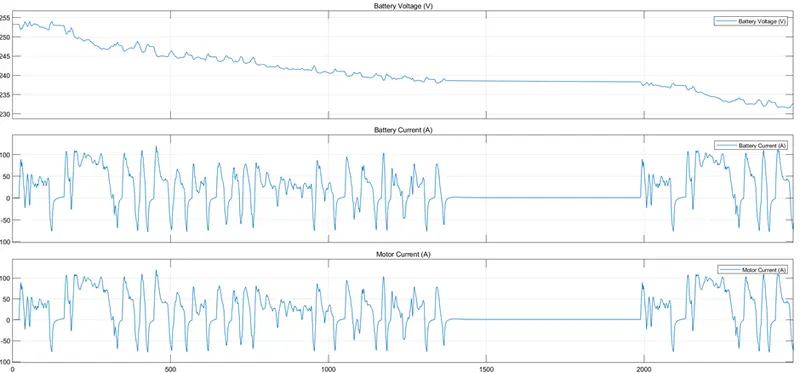
5. Conclusion:
- The model calculates the required torque and power for the motor to move the vehicle with a particular mass up to the desired speed.
- The battery SOC is also calculated by the power consumed by the motor.
- The motor used in the model can be adjusted between permanent magnet synchronous motor and induction motor.
- The drawback of this model is that it doesn’t include a thermal management system, but the temperature of the battery is maintained at 600 C (333.25 K).