Project 1 - Meshing of Floor Panel
Title: Sheet metal 2D meshing od Floor Panel
Aim:- To comprehend and utilise ANSA for 2D meshing on sheet metal part.
Objective: - To study and exercise geometry correction
To become proficient in meshing and properly extracting midsurface
To maintain adequate mesh flow while reducing the tria % to its minimum
To eliminate the majority of any potentially undesirable elements in accordance with the standards for quality
Body of the content: -
Model Name:- Floor Panel Model
procedures used with a CAD model
Importing geometry
Geomerty Check:-
Topo and geometry checks are being done on imported geometry.
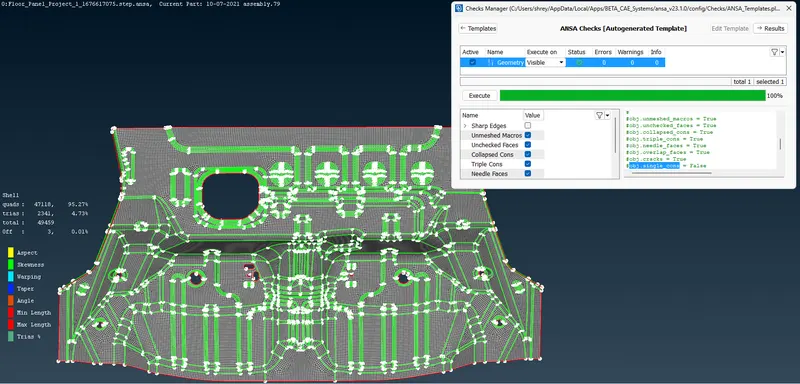
Addressing each and every error the checks reveal.
Mid-surfacing:-
Geometry must be flawless in order to accomplish Auto-Midsurfacing.
Determining a part's thickness at several points.
It is found out that thickness is same all over the panel.
We must make sure sheet metal is uniformly thick and entirely encased from all sides before doing automatic mid surfacing.
Choose the components that need to be mid surfaced, then choose Mid surface > Skin.
Before completing the previous step, make sure to disable the delete original faces option in case we need the parent geometry.
Executing mid-surface.
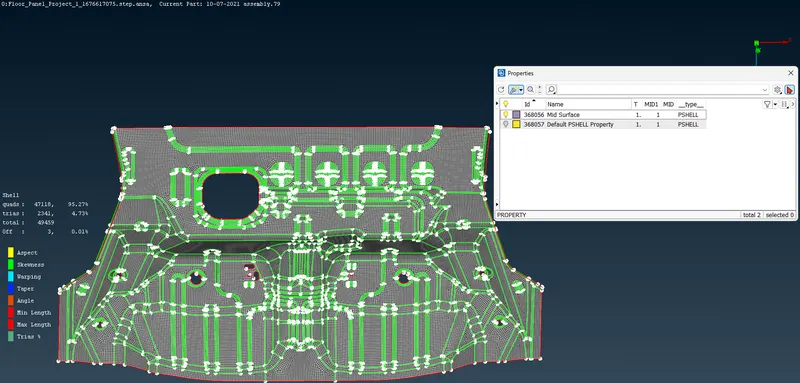
Preprocessing(before meshing):-
Assigning Length (the supplied value of "5") to both parameters and macros.
Whatever element length that is provided should be assigned; in our example, this is the 5.
Feeding provided quality criteria. - In accordance with the model's accuracy requirements, we have established quality standards.
The criteria in this case are
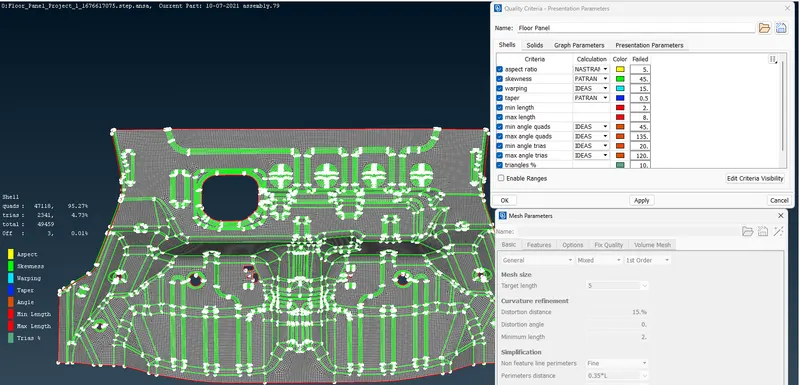
Meshing:-
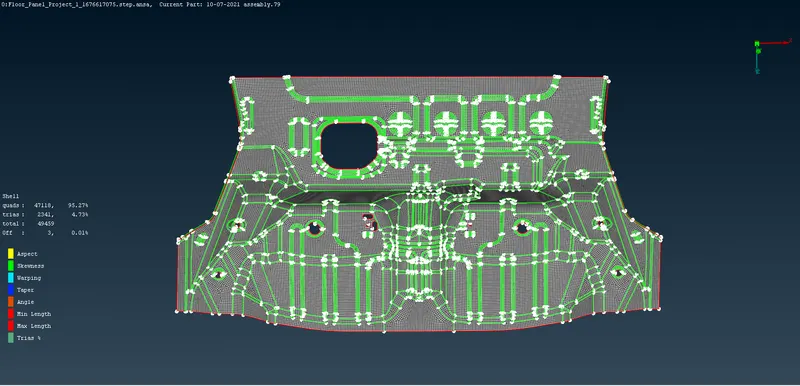
In the beginning, utilise the "Best" meshing option, and then use the "Reconstruct" feature on the parts where the mesh flow can be enhanced.
To Removing error occurring elements (off elements) according to quality criteria we can try to reconstruct them.
It is important to avoid trias (at the free edge, at the circumference of the circle, and opposite trias), which can be eliminated or enhanced using the independent or combined methods of split, swap, collapse, and join.
We can observe fine mesh flow from image below..
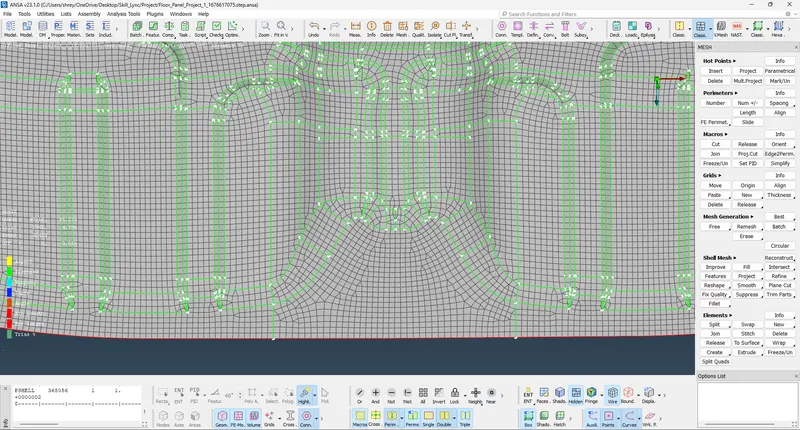
Completed model image:-
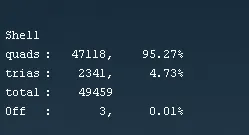
Results:- Quads: 47118
Quad percentage: 95.27%
Trias: 2341
Trias Percentage: 4.73%
Total: 49459
Off elements: 3
Conclusion: -
I have gained a thorough understanding of 2D sheet metal meshing via this project, including geometry cleanup, fine meshing, and error-free results.