Project 1 Mechanical design of battery pack
Objective:
To study and write a detailed project report on design and construction of 18 kWh ANR 26650 cells.
Overview:
Lithium Werks’ 26650 cells are capable of delivering very high power due to its use of patented Nanophosphate ® battery technology. Based on lithium iron phosphate chemistry (LiFePO4 ), the cells are inherently safe over a wide range of temperatures and conditions. Whether the application requires outstanding cycle life or stable float reliability, the Lithium Werks’ 26650 cells are suitable for a wide variety of power, pulse, or stand-by applications. Nanophosphate® Technology 26650 Lithium Ion Power Cell Nanophosphate® battery technology offers stable chemistry, faster charging, consistent output, excellent cycle life and superior cost performance. It provides the foundation for safe systems while meeting the most demanding customer requirements. Multiple layers of protection are employed at the chemistry, cell and system level to achieve an energy storage solution with superior safety and abuse tolerance compared to metal oxide lithium-ion chemistries.
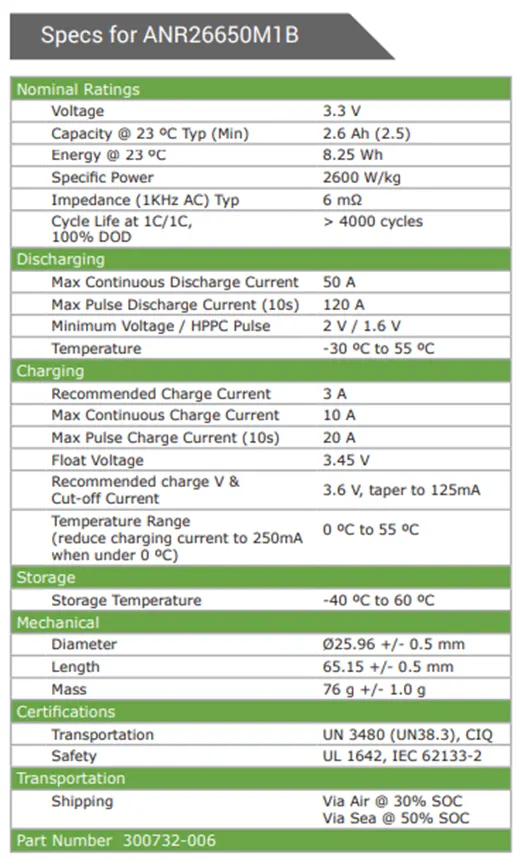
ANR 26650 datasheet:
Cylindrical Cell specifications:
- Cell dimensions (mm):Ø26X65
- Cell weight (g):76
- Cell capacity (nominal/minimum, Ah):2.5/2.4
- Voltage(nominal, V): 3.3
- Internal Impedance (1kHz AC typical, mΩ) : 6
- HPPC 10 sec discharge pulse power 50% SOC:200W
- Recommended standard charge method:1C to 3.6V CCCV, 45 min
- Recommended fast charge method to 80% SOC: 4C to 3.6V CC, 12 min
- Maximum continuous discharge (A): 70
- Maximum pulse discharge (10 Sec, A): 120A
- Cycle life at 10C discharge, 100% DOD: >1,000 cycles
- Operating temperature: -30 ⁰C to 55 ⁰C
- Storage temperature: -40 ⁰C to 60 ⁰C
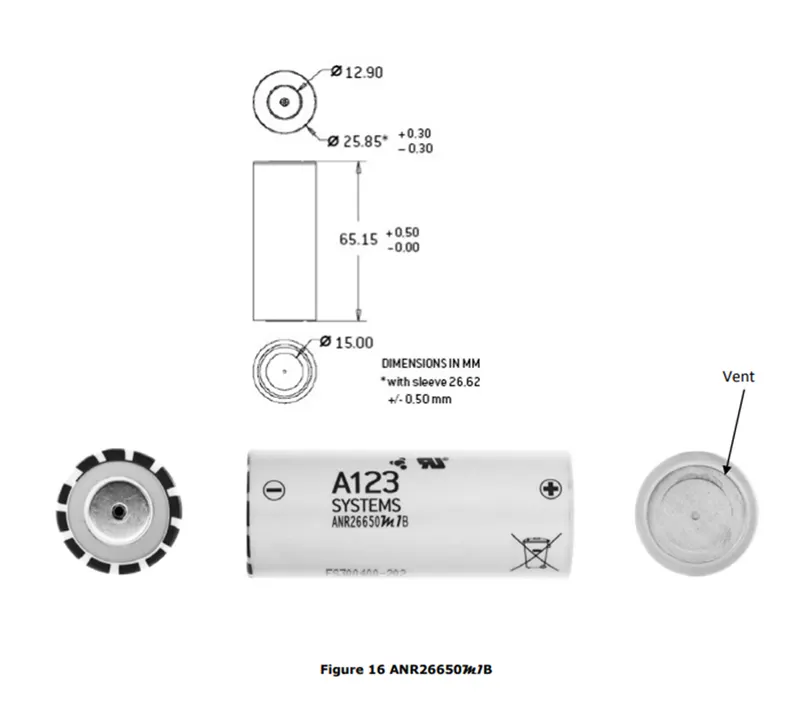
Cells can be combined together either in series or in parallel to achieve higher operating voltages and capacities, respectively.
Series Strings:
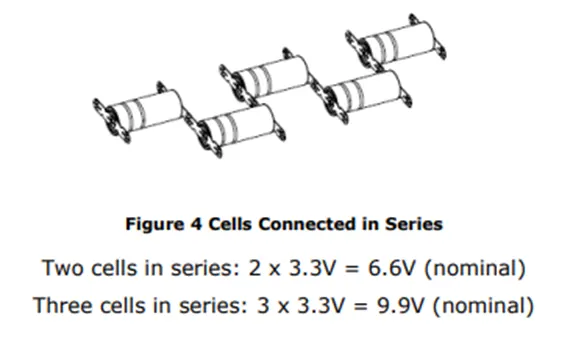
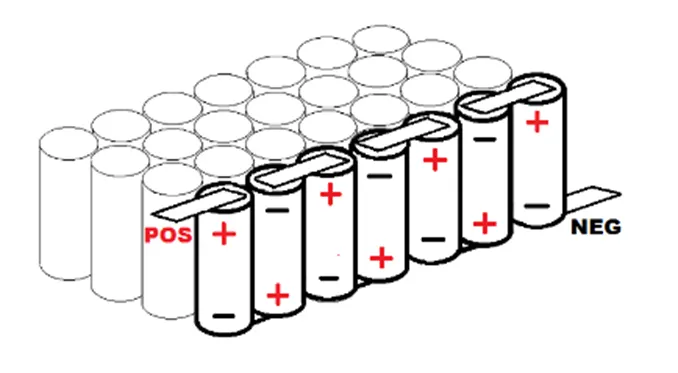
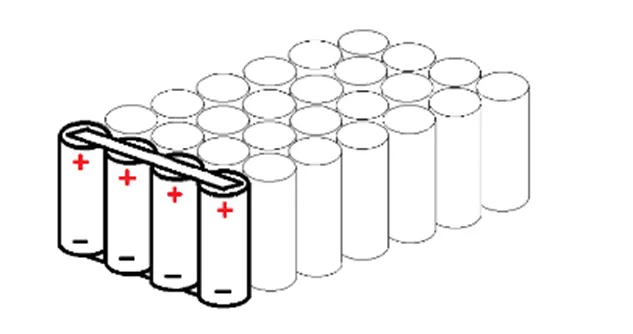
Cells combined in series strings can achieve higher operating voltages by connecting the positive terminal of one cell to the negative terminal of the next cell. Connect strings of series cells using their current collection tabs in a manner similar to that illustrated in Figure.
Parallel Strings
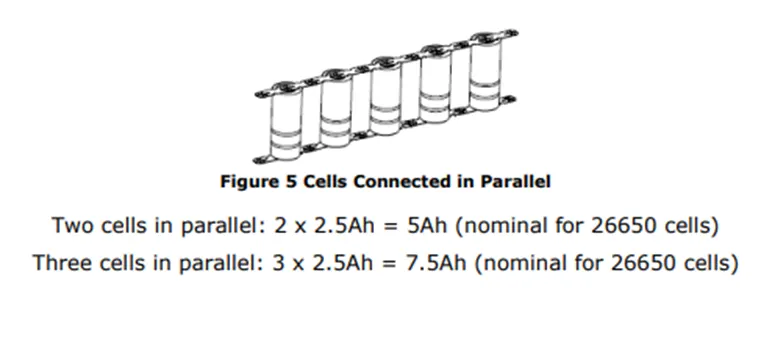
Cells combined in parallel strings can achieve higher operating capacities by connecting like-polarity terminals of adjacent cells to each other. Connect strings of parallel cells using their current collection tabs in a manner similar to that illustrated in Figure.
Battery pack design:
A battery pack is a device that stores electrical energy to provide power to an electrical system, such as an electric vehicle (EV) or an energy storage system (ESS). The energy is stored in cells that are all connected to one another in the battery pack.
To provide sufficient power, battery packs require a minimum voltage level which a single cell cannot achieve. Multiple cells are therefore connected in series to boost voltage. Some designs use small-capacity cells. To achieve the desired battery energy, cells are connected in parallel to boost capacity. Cells connected in parallel provide power as if they were a single, larger cell.
Battery packs are made of multiple, smaller sections called battery modules (or sub packs). These modules include a smaller number of cells connected in series and parallel. They are usually at a lower voltage, which is safe for handling. Modules facilitate servicing when only a few cells are defective and if they can be replaced without replacing the entire battery. EV batteries are typically made of 4 to 40 modules connected in series to one another.
Components of a battery pack:
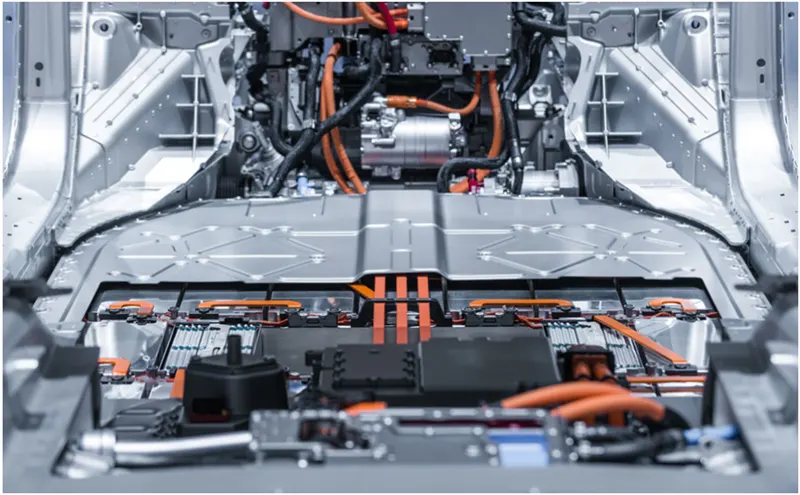
A battery pack is the most expensive part in an electric vehicle. It is a complex system made of a wide range of components. Here are some of the important components.
- Cellsare the most important components of a battery pack. The mixture of materials comprising the cell is known as its chemistry. Different battery chemistries can achieve different performances and specifications. There are two common types of cells: energy cells and power cells. There are also many variants to provide the perfect trade-off depending on the application. In the EV industry, the lithium-ion cell (li-ion cell) is the most common chemistry. Alternative chemistries are sometimes used, such as Nickel-Metal Hydride (NiMH), which offers a slightly better lifecycle.
- Electrical connectorssuch as busbars, wires, or other distribution conductors are used to make series or parallel connections between cells and groups of cells. These connections are typically done using ultrasonic bonding or laser welding. Busbar connections between modules can also be done mechanically using fasteners.
- Thermal interface materials(TIMs) such as pastes, adhesives and gap fillers are inserted between battery components to join them mechanically while improving thermal properties between surfaces. With the rise of the structural battery pack, TIMs are becoming essential components.
- The Battery Management System (BMS) protects cells by monitoring key parameters such as voltages, currents, and temperatures. It is responsible for cell balancing (to maintain the optimal performance of the cells at the right voltage) and communicates with several systems such as engine management and temperature control. It also includes protection devices that can shut down the battery if needed.
- TheBattery Thermal Management System (BTMS) controls the thermal energy in the electric vehicle’s powertrain and cabin, providing cooling or heating as needed to meet the battery’s thermal needs and protect the cells. The BTMS includes several components such as a heat exchanger, tubes, hoses, cold plates, pumps, valves, and temperature sensors.
- The Contactor Systemis a switch controlled by the battery management system. It can cut off the electrical connection between the main battery and the high voltage bus, which delivers current to the traction motor and other high-voltage components.
- The Housingis a rigid enclosure that protects the battery from environmental factors such as water, dust, and salt. It helps maintain a precise temperature and electrical insulation in the battery, and it prevents damages like rust and slow shorts.
- The Communications Systemensures communication with other components in the electric vehicle. The most used protocol is CAN bus.
The 4 Main Types of Battery Pack Designs
12V Battery Packs for Accessories
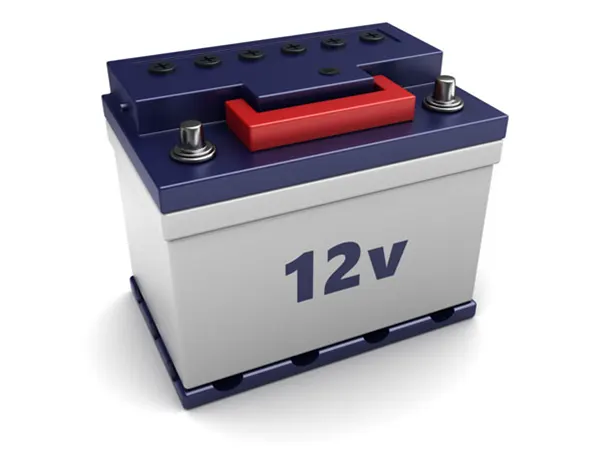
With their low voltage, 12V batteries are used for low energy applications such as headlights, radio systems, and other accessories. In hybrid and petrol cars, they are used to start the engine. In electric vehicles, they are used as an energy source that can function without the main electric battery (traction battery). For example, it is used to activate the traction battery and provide power to some vital components if power has been cut off for safety reasons.
Traditionally, the most known type of 12V batteries were made using the lead-acid cell chemistry and were hence referred to as lead-acid batteries. The number of cells in these packs was limited to 6. The most recent 12V batteries are lithium ion battery packs whose lithium cells offer better performance and lighter weight.
12V batteries are small and are typically placed under the hood. More recently, manufacturers have started placing them inside the trunk to improve safety, as it minimizes chances of short circuits during crashes. Since more collisions occur at the front, the battery is better protected from impacts when it is positioned at the back.
Hybrid Battery Packs
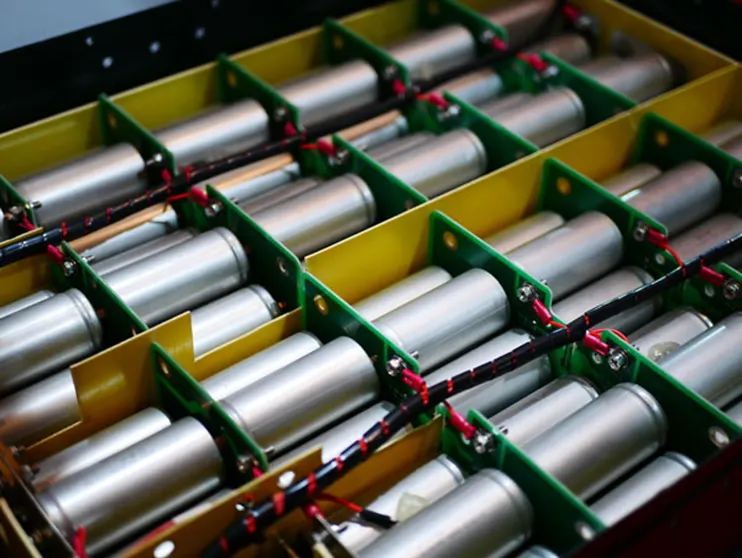
Hybrid batteries contain a smaller amount of energy than EV batteries and are much smaller. Still, today’s hybrid batteries typically have a range between 30 and 50 miles (50 and 80 km). They can be used for most short-distance trips without having to fall back on the internal combustion engine (ICE). That’s a major improvement compared to the very first models, which offered a mere 0.6 miles of autonomy (1 km).
Hybrid battery packs are built to complement the combustion engine when it is least efficient, such as when accelerating. The goal is to diminish petrol consumption as much as possible. The battery can also recharge itself by recovering wasted energy when braking (regen braking).
EV Battery Packs
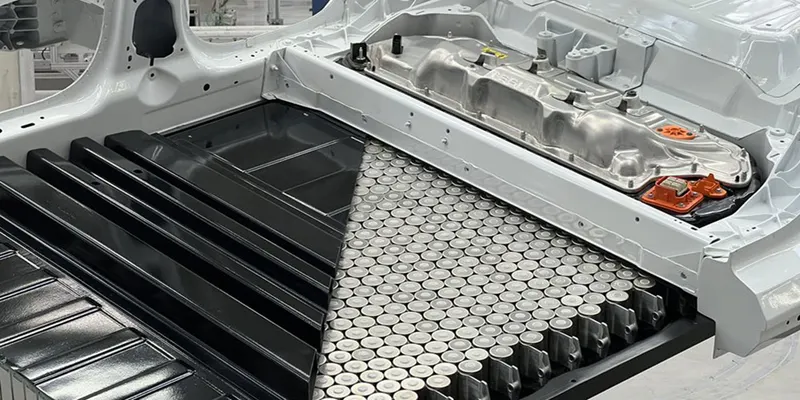
Unlike other battery pack designs, EV batteries are full-sized batteries made to supply the entire range of the vehicle, including the traction motor and accessories. Current EV batteries offer between 20 and 130 kWh of energy and can use between 90% and 95% of that energy—a much higher percentage than other types of batteries. The Mercedes EQS is the electric car with highest range, offering 485 miles of autonomy (780 km).
EV batteries represent a significant portion of the vehicle’s weight and volume. They can weigh up to 450 kg (1000 lbs), representing one-fourth of the car’s total weight. Different designs come with high voltage going from 400V to 900V. In the most recent designs, they are being integrated as part of the vehicle’s structure.
High Performance Battery Packs
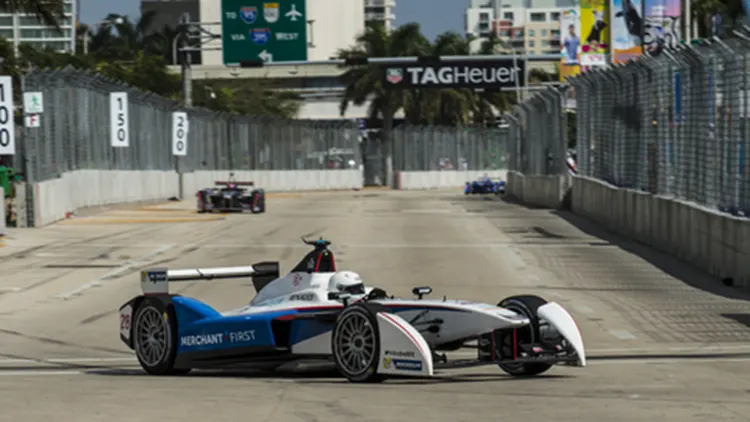
High performance battery packs are batteries designed for Formula E races. They are divided in two categories: hybrid and pure EV. They are made with composite materials to obtain an ultra light structure. Some high-performance batteries are removable so they can be replaced during races.
Even though they are small, these batteries can deliver ultra high power. More precisely, they can deliver several hundred kW of power, which is enough to output power for an entire neighbourhood. Their cooling system is oversized due to the aggressive power demand.
High-performance battery packs are more energy efficient than other types of batteries. For example, they can recover a larger portion of lost energy during braking (regen braking).
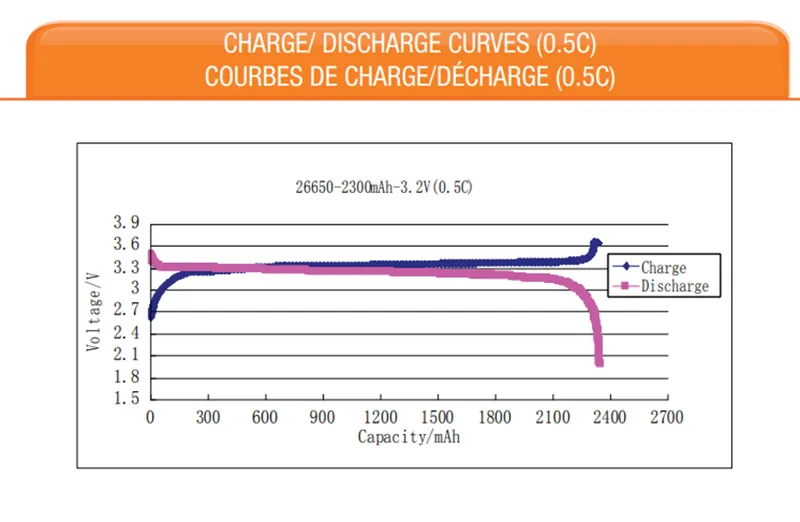
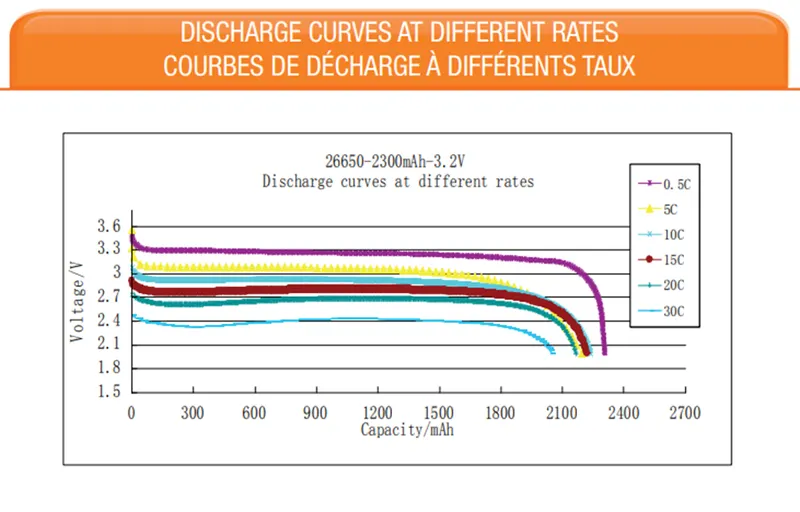
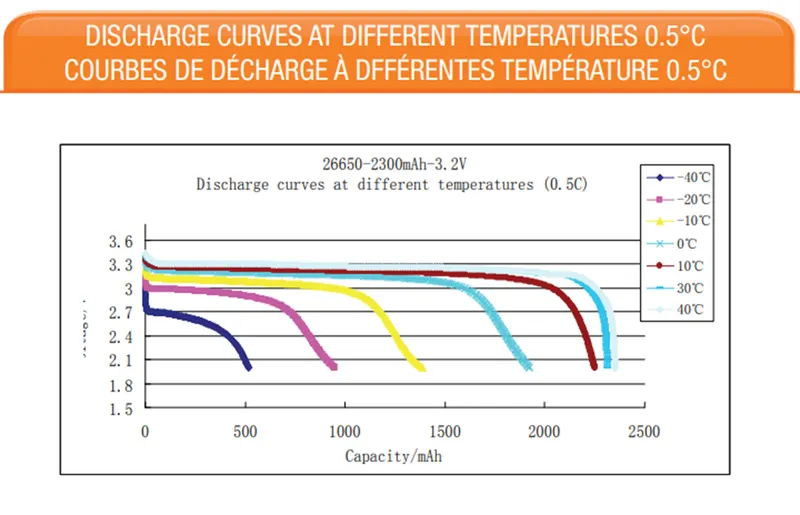
Discharge curve at different conditions:
Assumptions:
We are assuming the overall voltage required to operate the motor and other accessories of electric vehicle as 400V.
So we have construct the battery pack of 18kWh for a 400V input voltage motor.
Construction of battery pack:
To construct a battery pack initial we have to estimate the voltage requirement of the overall load of vehicle.
We had assumed as 400V as mentioned above. Then the battery modules should be created in such a way that the overall voltage is matched with the load requirement voltage.
The module can be created in series/parallel connections of individual cells. Then every module should be connected in series/parallel to construct final battery pack.
In series connection voltage added and current is constant where in parallel connection voltage remains same and current gets added.
Here in our case single cell voltage is 3.3V and a capacity of 2.56Ah.Energy provided from single cell is give 8.25Wh. ,So for 18KWh battery pack we need approximately(18000/8.25=2182 cells).
We have to create a single module to produce 400V for our load requirement. So to obtain 400 V output ,cells are connected in series where voltage become added and current remains same. T obtain 400 V output cells are connected in series where voltage becomes added and current remains constant.
To obtain 400V no. of cells required approx..
400/3.3=122 cells.
Thus single module gives as 400V from 122 cells but energy of one module is not enough to run the vehicle as motor power rating is higher. The energy generated from
Single module is (122*8.25Wh=1006.5Wh).
So to construct a battery pack with 18KWh with not exceeding 400V the modules are connected in parallel. In this parallel connections the currents are getting added and voltage remains same as 400V.As current increases the power of battery pack increase to run the motor load of high power rating.
Now we have to find how many similar modules should be connected in parallel to acheive 18KWh battery pack.
This can be calculated as (18KWh/1006.5Wh =17.88),which gives as nearly 18 similar modules should be connected in parallel to achieve 18KWh battery pack.
Thus the battery model is said to be 122S18P configuration(122 series and 18 parallel connections),which gives us (122*18 =2196 cells).From this we have created overall capacity of battery pack as (2196*8.25Wh=18117Wh) which is slightly higher than 18KWh.
The overall Capacity(Ah) of battery pack is given as (2.5Ah * 18 = 45Ah).
This means it provided 45A of current continuously for one hour to full charge.
Thus 18 modules should be arranged in a way as battery pack to fit in an EV chassis.
Enclosure Construction:
To find overall enclosure volume we have to find the volume of single module volume consist of 122 cells in series connection and multiplied with 18 parallel connected module volume.
Let’s assume 122 cells (Single module) are divided into 2 modules of 61+61 cells.
The length of the module=No of cell in a row*(cell dia + margin at both side of cells) +Clearance at side*(2*(cell dia + margin))
=61*(26+4)+60
=1890 mm
The breadth of the module=(cell dia +Margin of both side of cells + clearance)
=26+4+60=90 mm
Height of the module=Height of cell + connecting strip thickness, wires say 35 mm
=65+35 = 100 mm
Thus the volume required for single module is 1.8*0.09*0.1 = 0.0162 m^3.
Total number of modules assumed is 18*2 =36 modules, since single module is divided into two modules.
Therefore total volume required for battery pack of 122S18P configuration construction is 0.0162*36 = 0.583 m3
Thus from the above result it is assumed approximately 1m^3 of volume should be used for EV battery pack with additional ventilation spaces for pack.
Conclusions:
- The detailed report for ANR 28650 battery was prepared with complete drawing and datasheet details.
- Enclosure constructions were calculated with suitable assumptions required.