Project 1 Mechanical design of battery pack
AIM
Design a mechanical battery pack
OBJECTIVE
Battery pack capacity: 18 kWh
Cell: ANR26650M1-B
Prepare a detailed battery pack drawing along with its enclosure. State the assumptions.
BATTERY PACK CALCULATION
The data sheet I m taking for calculation is attached here as A123_datasheet.pdf
The page we are working with data sheet is shown below as screen shot
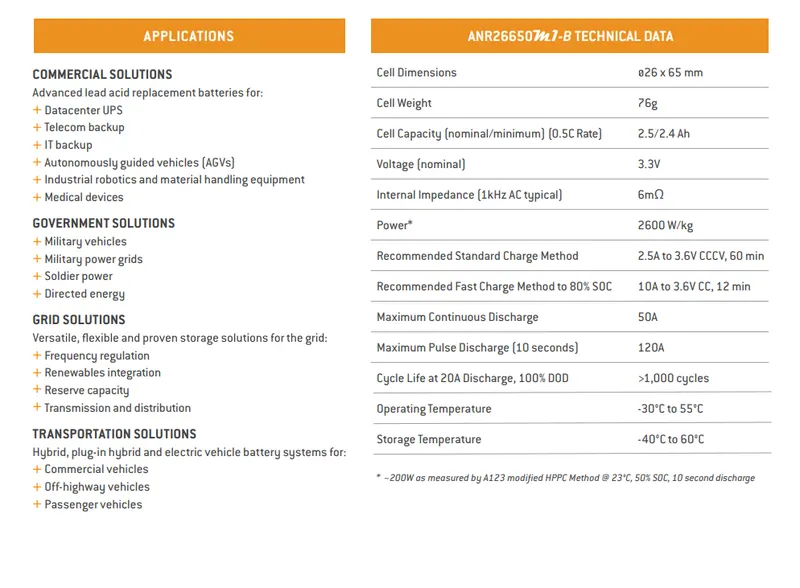
Assume battery pack Voltage as 300 V.
So, the battery pack current capacity(q) for 18 kWh can be calculated from the equation, E=qV.
E=18000 Wh, Vbp=300 V,
q=E/Vbp;
q=18000/300
q=60 Ah
The battery pack current, q=60 Ah.
So, the effective battery pack is 300 V,60 Ah.
Let's calculate the number of cells in series and parallel required for this configuration.
For series, No: of cells required(Ns) = battery pack voltage/nominal voltage of a cell;
From data sheet screen shot above, the nominal voltage of a cell=3.3 V.
Ns=300/3.3; Ns= 90.909 nos;
Approximating it to the highest integer it becomes 91 nos. Ns=91 nos.
As approximating to highest integer, then the battery pack voltage is little bit greater than 300 V, but if losses are considered in battery this is fine.
So, the theoretical net battery pack voltage will be 91x3.3=300.3 V.
For parallel, No: of cells required(Np) = battery pack capacity/individual nominal cell capacity;
From data sheet screen shot above, the nominal voltage of a cell=2.5 Ah.
Np=60/2.5; Np= 24 nos;
So, the battery pack configuration of 300 V,60 Ah, is having 91 nos of cells in series and 24 nos of cells in parallel.
Now, calculate the Volume of the cell
Volume of single cell = pi x (D^2)/4 x H;
From data sheet D=26 mm=0.026 m;
H=65 mm=0.065 m;
Vol_cell= 3.14 x (0.026^2) x 0.065/4;
Vol_cell=3.451 x 10^(-5) m3;
Vol_cell=3.451 x 10⁻⁵ m3;
In terms of litres, it is 0.03451 lit;
Volume of the battery pack = Volume of single cell X Total number of cells;
Vol_bp=Vol_cell X NsXNp;
Vol_bp=3.451 x 10-5 X 91 x 24;
Theoretical Volume of the battery pack,Vol_bp=0.07537 m3;
In terms of litres, it is 75.37 lit;
But, if we consider some clearance then the volume will increase. Lets do that also.
Volume of single cell,Vol_cell=3.451 x 10⁻⁵ m3;
Vol_cell=34510 mm3;
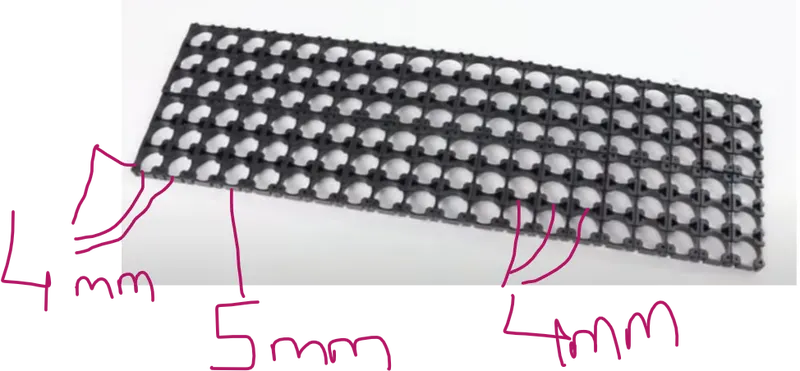
If we make 91 cells in series, there is some clearence gap between cells. Lets assume the clearence between 2 cell is 4 mm.
So, clearance gap between 91 cells=90x4=360 mm;
Also, there is gap between first and last cell with surroundings which is assumed to be 4 mm each.
So, total clearance gap for series cells=368 mm;
Similarly for 24 cells in parallel, if we assume 4 mm as clearance gap and end gap, total clearance gap for parallel cells=100 mm;
See the image below
Area of cell space = (0.368+Dcellx91) x (0.100+Dcellx24);
Dcell=0.026 m (from data sheet);
Area of cell space = (0.368+0.026x91) x (0.100+0.026x24) = 2.734 + 0.724 = 3.458 m2;
If there is a combined clearance of 5 mm for cells at top and bottom with the outer covering box, then the height of the configuration increases by 5 mm;
Total height=Single cell height + 5 mm;
From data sheet,Single cell height = 65 mm;
Total height=70 mm=0.07 m;
Volume of the battery pack = 3.458 x 0.07 = 0.24206 m3;
So, the Practical Volume of the battery pack= 0.24206 m3;
In terms of litres it is 242.06 lit.
So, there is a difference of 0.16669 m3 or 166.69 lit of Volume we will get if we add clearance;
Now, lets calculate the mass of the entire battery pack.
Mass of battery pack = Weight of single cell X total number of cells;
From data sheet,Weight of single cell=76 g=0.076 kg;
Mass_bp= 0.076 x 91 x 24 = 165.984 kg;
Mass of battery pack = 165.984 kg;
RESULT for mechanical design calculation
1)Total number of cells = 91 x 24 = 2184 nos
a)No: of series connected cells=91 nos;
b)No: of parallel connected cells=24 nos;
2)Battery pack Voltage = 300 V
3)Battery pack capacity = 60 Ah
4)Theoretical Volume of the battery pack= 0.07537 m3;
5)Practical Volume of the battery pack= 0.24206 m3;
6)Mass of battery pack = 165.984 kg;
The configuration is 91S24P with 300V,60 Ah.
CONSTRUCTION OF BATTERY PACK
As 91S24P is difficult to demonstrate, I m going with 8S4P configuration. Apply the same principle to create 91S24P LiFePO4 battery pack.
Create a structure like this shown below using Polyethylene terephthalate glycol(PETG) material and using 3D printing machine

Put the cells in the hexagonal shape item as shown below. the positive terminals and negative terminals are marked in image
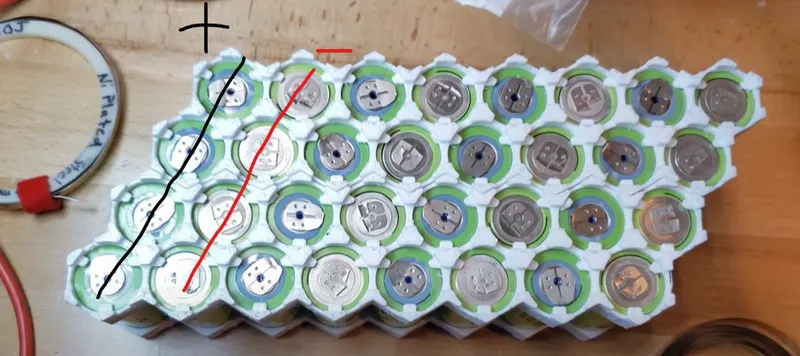
Do the series connection now
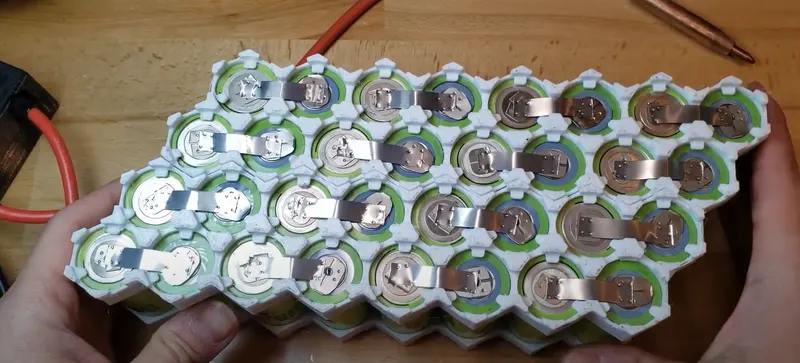
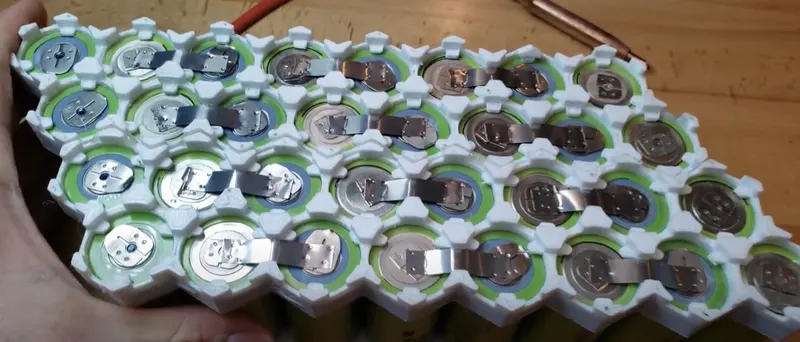
Join all the positive and negative terminal on top side and bottom side of the cell using nickel strip as shown below. Use spot weld to join the styrips with the cells
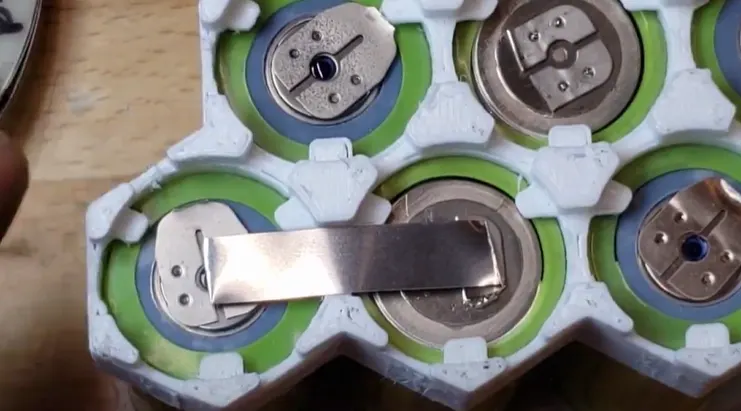
After spot weld, the strip look like this
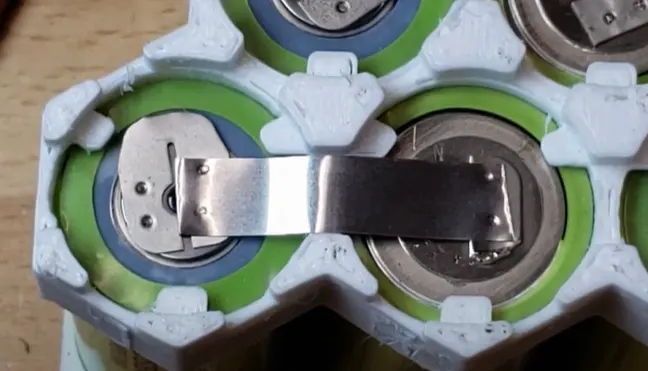
After all the cells are spot welded, the top side looks like this as shown below. Do the similar for bottom also
The bottom side looks like this as shown below
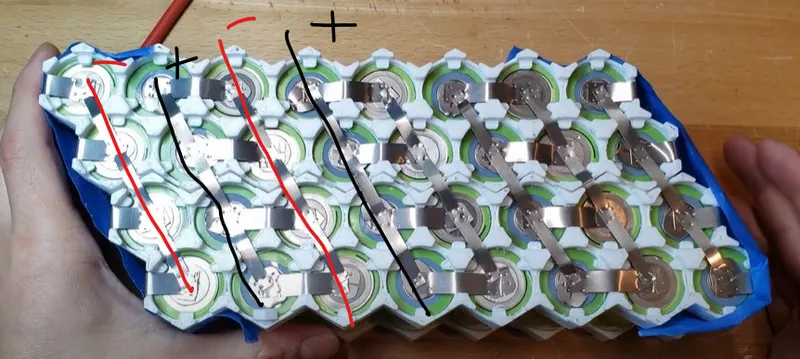
The series connection is over and do parallel connection.
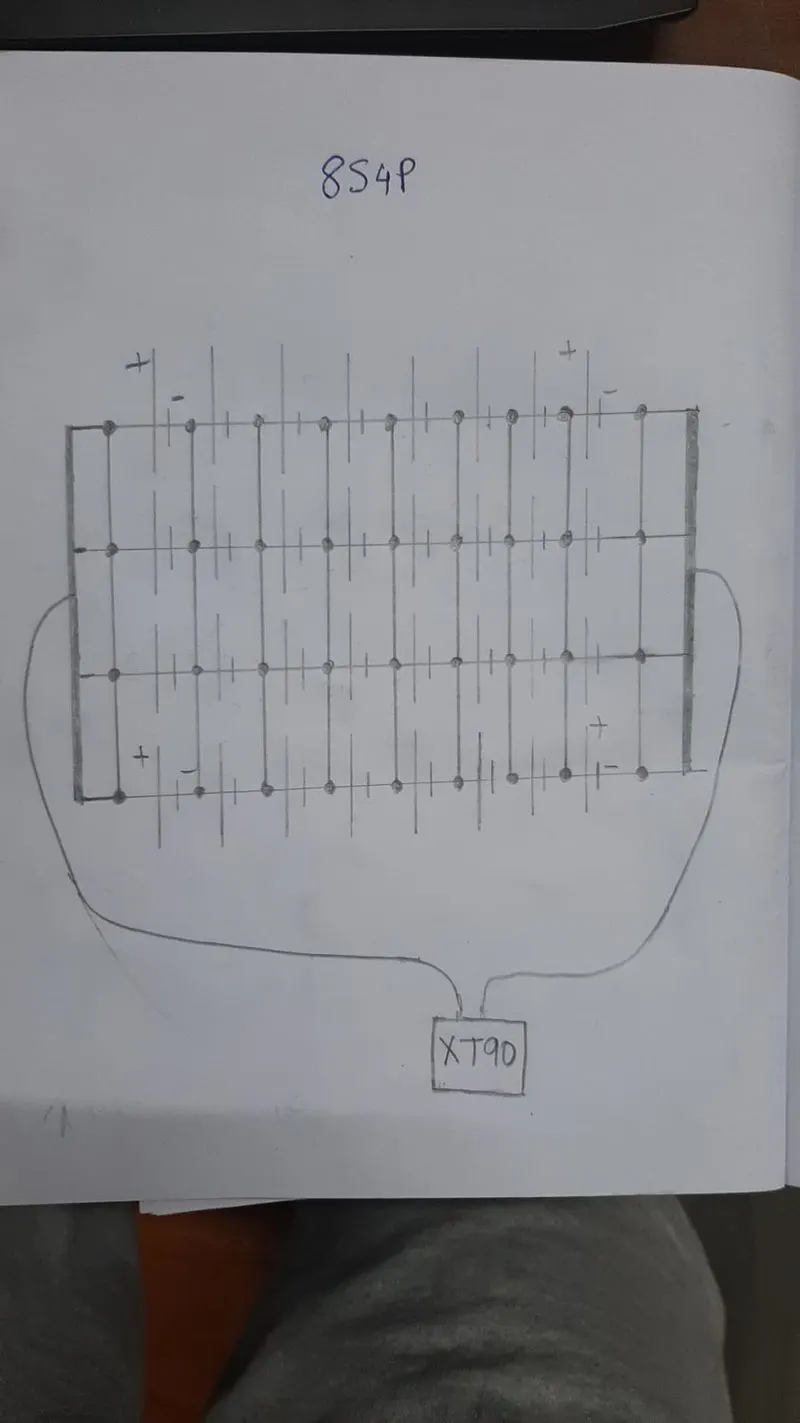
The parallel connection is done by connecting the same terminals of cells together using nickel strip and spot weld it. The 4 nickel strip in the image is marked with + and - symbols in the image below. Do, the same for bottom part also
Connect the positive and negative ends together using a wire of guage 10 mm to xT90 anti spark connector as shown below
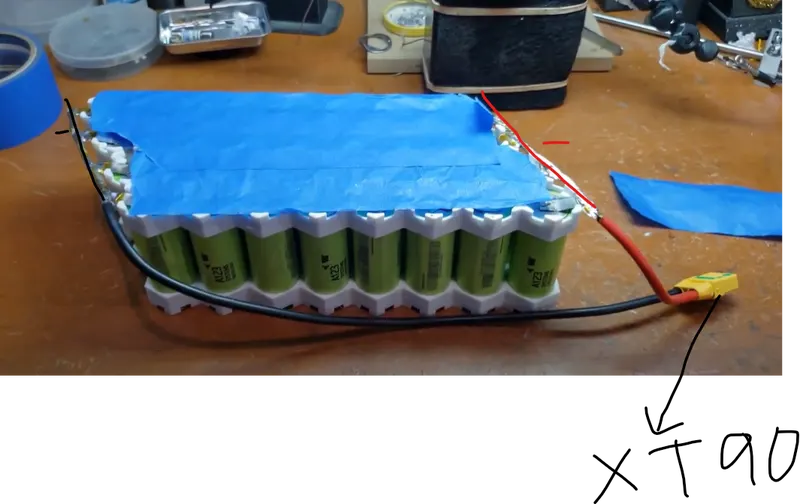
The top view of the battery pack looks like this shown below

The side view of the battery pack looks like this shown below
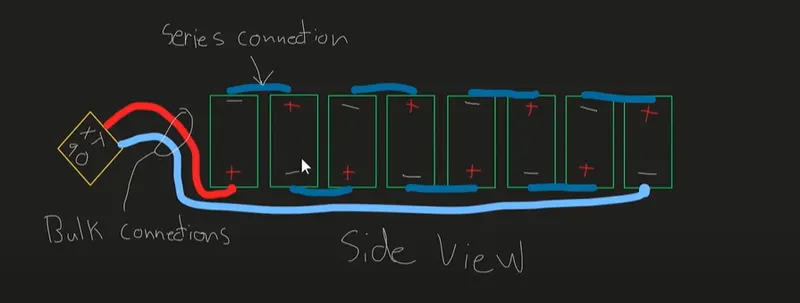
The connection circuit looks like this shown below
Now, place the battery in a box that fit the battery pack
Maintain spacers inside the box
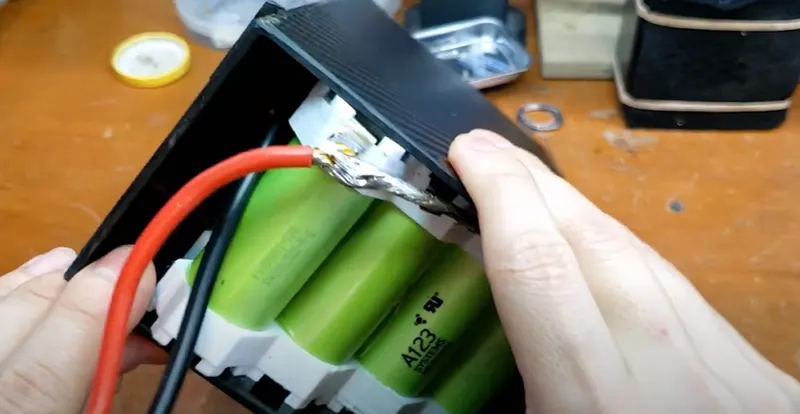
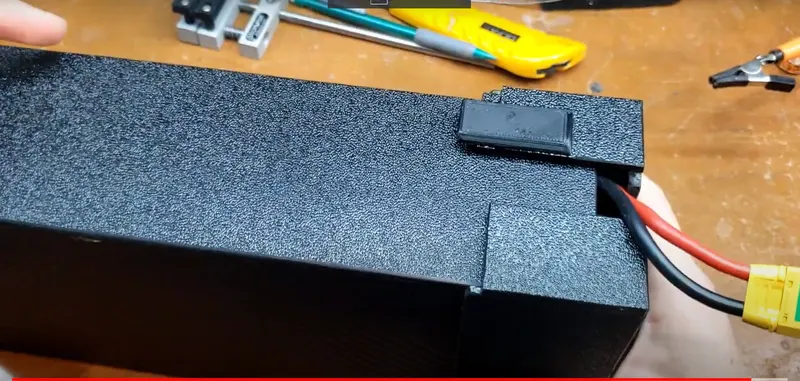
Now, the battery pack is ready in the box
REFERENCE video used here which is https://www.youtube.com/watch?v=veCY7lVOHZ8