Project 1 Mechanical design of battery pack
Aim:
To prepare a detailed battery pack drawing along with its enclosure. State your assumptions.
Objective:
- Battery pack capacity: 18 kWh
- Cell: ANR26650M1-B
Li-ion cell ( ANR26650M1-B):
This cell is manufactured by lithiumwerks. They deliver very hhg power due to the usage of patented Nanophosphate baattery technology.
- Based on the Lithium iron phosphate chemistry(LiFePO4),the cells are inherently safe over a wide range of temperature and conditions.
- For outstanding cycle life,stable float reliability this cells are suitable for a wide varity of power,pulse and stand by applications.
- Nanophosphate battery technology offers thermal stable chemistry,fast charging,consistent output,low capacity loss over time.
- It provides extremely safe conditions for while meeting most demanding customers requirements.Multiple layers of protections are employed on chemistry,cell and system
- level to acheive an energy storage solution with superior safety.
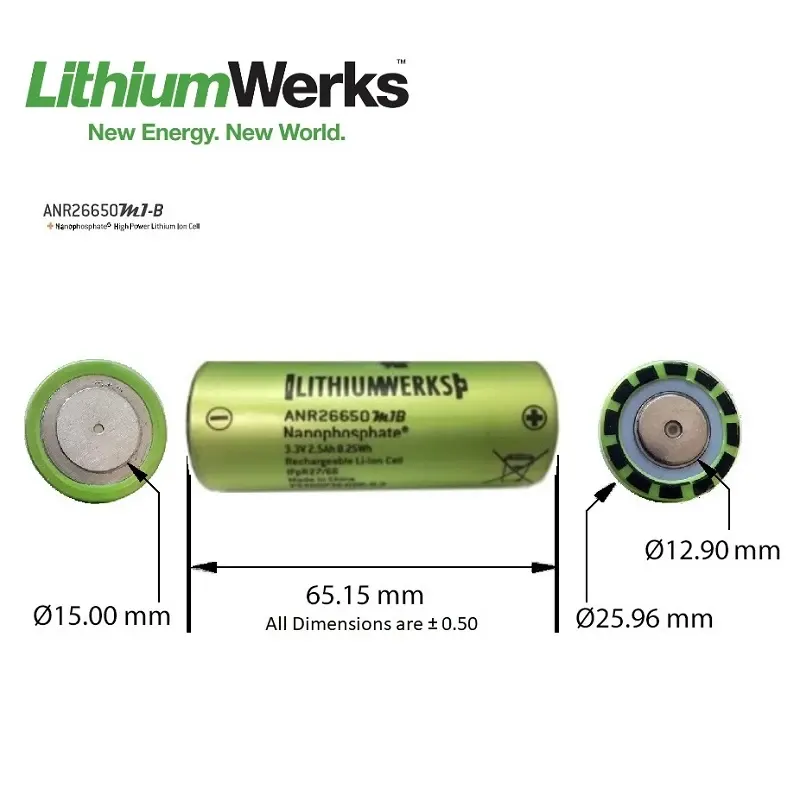
| Manufacturer: | LithiumWerks |
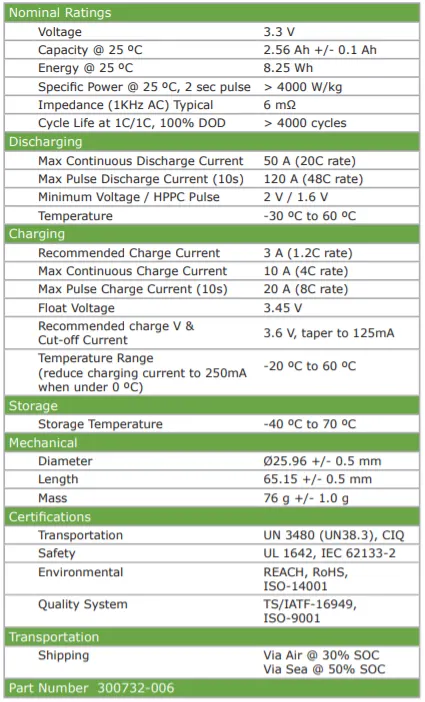
| Mfg PN: | 300732-006 |
| Chemistry: | Lithium Iron Phosphate (LiFePO4) |
| Voltage: | 3.3 Volts |
| Capacity @ 25°C: | 2.56 Ah |
| Energy @ 25°C: | 8.25 Wh |
| Specific Power: | > 4000 W/kg (@ 25°C, 2sec pulse) |
| Impedance: | > 6 mΩ (1kHz AC) Typical) |
| Cycle Life: | > 4000 Cycles (@ 1C/1C, 100% DOD) |
| Dimensions | |
| Height (max): | 65.15 (+/- 0.5 mm) |
| Diameter (max): | 25.96 (+/- 0.5mm) |
| Mass: | 39.5 (+/- 1.0 g) |
| Warranty: | DOA |
Cylindrical Cell Primary Applications
- Portable high power devices
- Stationary battery backup systems
- Grid stabilization energy storage systems
- Commercial truck and bus hybrid electric vehicles (HEVs)
Nanophosphate® LiFePO4 Benefits
- Cycle Life at 1C/1C, 100% DOD, > 4000 cycles
- Safety: Excellent abuse tolerance and environmentally friendly
- Life: Excellent calendar life, 10X cycle life vs. conventional lithium ion
Applications:
Commercial Solutions:
Advanced lead acid replacement batteries for:
- Datacenter UPS
- Telecom backup
- IT backup
- Autonomously guided vehicle (AGV's)
- Industrial robotics and material handling equipment
- Medical devices
Government Solutions:
- Military vehicles
- Military power grids
- Soldier power
- Directed energy
Grid Solutions:
- Frequency regulation
- Renewables integration
- Reserve capacity
- Transmission and Distribution
Transportaion Solutions:
- Commercial vehicles
- Off-highway vehicles
- Passenger vehicles
ANR26650M1-B Technical data:
|
Cell Dimensions
|
26 x 65 mm
|
|
Cell Weight
|
76 g |
|
Cell Capacity (nominal/minimum) (0.5C Rate)
|
2.5/2.4 Ah
|
|
Voltage (nominal)
|
3.3 V |
|
Internal Impedance (1kHz AC typical)
|
6mΩ
|
| Power |
2600 W/kg
|
|
Recommended Standard Charge Method
|
2.5A to 3.6V CCCV, 60 min
|
|
Recommended Fast Charge Method to 80% SOC
|
10A to 3.6V CC, 12 min
|
|
Maximum Continuous Discharge
|
50 A |
|
Maximum Pulse Discharge (10 seconds)
|
120 A |
|
Cycle Life at 20A Discharge, 100% DOD
|
>1,000 cycles
|
|
Operating Temperature
|
-30°C to 55°C
|
| Storage Temperature |
-40°C to 60°C
|
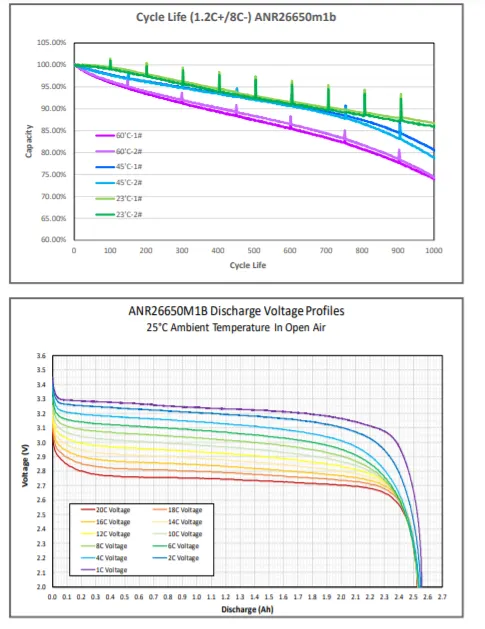
All the ceels have a discharge rate according to their capacity and chemical formula as even for the Cell ANR26650M 1B Disccharge and operating temperature are given in the data sheet its been shared below:
Discharge voltage profile and cycle life with respect to different operating temperature from data sheet:
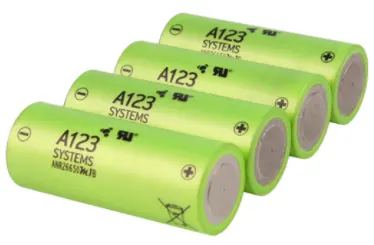
The LithiumWerks ANR26650M1-B is the next generation of A123 Systems' pioneering 26650 cylindrical cell, now with greater power and energy density and lower impedance. This versatile lithium ion cell is suitable for a wide variety of applications and system designs
About Battery pack:
A battery pack is a set of any number of (preferably) identical batteries or individual battery cells. They may be configured in a series, parallel or a mixture of both to deliver the desired voltage, capacity, or power density.
Mechanical Design of battery pack:
The high voltage battery it is one of the most important component of a battery electric vehicle (BEV). The battery parameters have a significant influence on other components and attributes of the vehicle, like:
- maximum traction motor torque
- maximum regeneration brake torque
- vehicle range
- vehicle total weight
- vehicle price
- chemistry
- voltage
- average energy consumption of the vehicle on a driving cycle
- vehicle range
A battery consists of one or more electrochemical cells (battery cells) which are converting chemical energy into electrical energy (during discharging) and electrical energy into chemical energy (during charging). The type of elements contained within a battery and the chemical reactions during discharging-charging events define the chemistry of a battery.
Now,
As informed in the objective construction of the ANR26650M1-B cell with a capacity of 18 kWh
Construction of battery pack:
Assumptions:
Battery energy = 18 kwh
Voltage (to run the vehicle) = 400V
To construct a battery pack
Initially we have to estimate the voltage requirement of the overall load of vehicle.
We had assumed as 400V as mentioned above.
Then the battery modules should be created in such a way that the overall voltage is matched with the load requirement voltage.
The modules can be created in series/parallel connections of individual cells.Then every modules should be connected in series/parallel to construct final battery pack.
In series connection-Voltage added and Current remains same.
In Parallel connection-Voltage remains same and Current gets added.
Here in our case single cell voltage is 3.3V and a capacity of 2.56Ah.Energy provided from sigle cell is give 8.25Wh.
So,
for 18KWh battery pack we need approximately(18000/8.25=2182 cells).
We have to create a single module to produce 400V for our load requirement.
So to obtain 400 V output ,cells are connected in series where voltage become added and current remains same.
To obtain 400V ,
no of cells required is approximately(400/3.3=122 cells).
Thus single module gives as 400V from 122 cells but energy of one module is not enough to run the vehicle as motor power rating is higher.The energy generated from
single module is (122*8.25Wh=1006.5Wh).
So to construct a battery pack with 18KWh with not exceeding 400V the modules are connected in parallel.In this parallel connections the currents are getting added and voltage remains same as 400V.As current increases the power of battery pack increase to run the motor load of high power rating.
Now,
We have to find how many similar modules should be connected in parallel to acheive 18KWh battery pack.
This can be calculated as (18KWh/1006.5Wh =17.88),which gives as nearly 18 similar modules should be connected in pararallel to acheive 18KWh battery pack.
Thus the battery model is said to be 122S18P configuration(122 series and 18 parallel connections),which gives us (122*18 =2196 cells).From this we have created overall capacity of battery pack as (2196*8.25Wh=18117Wh) which is slightly higher than 18KWh.
The overall Capacity(Ah) of battery pack is given as (2.5Ah * 18 = 45Ah).
Which means it provided 45 A of current continuously for one hour to full discharge.
Thus 18 modules should be arranged in a way as battery pack to fit in an EV chasis.
Enclosure construction:
To find overall enclosure volume we have to find the volume of single module volume consist of 122 cells in series connection and multiplied with 18 parallel connected module volume.
Single module,
Let as assume 122 cells(single module) are divided into 2 modules of 61+61 cells.
The length of the module=No.of cell in row*(Cell dia + Margin at both side of cells) + clearance at side(2(cell dia + margin)).
=61*(26+4) +60 =1890mm.
The bredth of the module=(cell dia +Margin of both side of cells + clearance)
=26+4+60 =90mm.
Height of the module=Height of cell + connectiing strip thickness,wires say 35mm
=65+35 =100 mm.
The volume required for single module is 1.8*0.09*0.1 = 0.0162 m3.
Total number of modules assumed are 18*2 =36 modules,since single module is divided into two modules.
Therefore total volume required for battery pack of 122S18P configuration construction is 0.0162*36 = 0.583 m3.
Thus from the above results it is assumed approximately 1m3 of volume should be used for EV battery pack with additional ventilation spaces for pack.
We can assume that two modules are combained into one cabinet. So 18 cabinets should be connected to form final battery pack.
Weight of battery pack:
Cell weight = 76g
Number of the cells = 2182
Battery pack weight (W) = cell weight*number of cells + weight of accessories
W = 76*2182 + 4.5 = 165.8 + 4.5 = 170.3 kg
Cylindrical battery pack assembly equipment:
| Product Name | Description |
| Automatic Cylindrical Battery PVC Heat Shrink Wrapping Machine |
Film speed:50~70PCS/MIN Film precision:±0.1MM |
| 512 Channel Battery Tester | 5V 2A/3A/5A/6A 512 Channel Battery Testser optional |
| Battery Labling Insulation Paper Sticking/Pasting Machine |
Sticker Matrials:Barley paper or PVC Barley paper Maxium 350mm;Scroll Internal Diameter 72-75MM |
| Battery Sorting Machine | (5/6/9/11/13/22 Channel Battery Sorter optional) Data record funtion is selectable |
| Manual Spot Welding Machine |
Pneumatic AC Spot Welding Machine (Single Welding Point or Doubel Welding Point) |
| Manual Spot Welding Machine | AC Pedal Manual Spot Welding Machine |
| Manual Spot Welding Machine | AC Pulse Pneumatic Spot Welding Machine |
| Manual Spot Welding Machine | DC Output Spot Welding Machine |
| Manual Spot Welding Machine | 5000A/8000A Pneumatic Inverter DC Spot Welding Machine |
| Automatic Spot Welding Machine | Double Sides Spot Welding Machine |
| 1-24 series or 1-32 series BMS Tester |
Over-discharge Protection Current:0-120A Overcharge Protection Current:0-50A Overcharge/Overdischarge Voltage:0.5-5V |
| Battery Comprehensive Tester |
100V 120A 18650 Battery Pack Comprehensive Tester |
| Aging Machine |
30 V 10A Charging 20 A Discharging Aging Machine |
| Aging Machine | 70 V 5A Charging 10 A Discharging Aging Machine |
| Aging Machine | 100 V 10A Charging 20 A Discharging Aging Machine |
Joining technologies of cells:
The interconnections between cells/modules are practised by various welding techniques.Some of them are,
- Ultrasonic metal welding.
- Resistance welding.
- Laser beam welding.
- Wire bonding.
- Mechanical Joining.
Battery pack constructions Materials:
Battery pack constructions consist of three major levels of processings namely cell level,module level,pack level constructions.
The electrodes are combined with electrolyte to various cell models as cylindrical,prismatic,pouch type cells.
After case sealing cells are combained to form module level construction.Finally these modules are combained to form pack level constructions.