Project 1 Mechanical design of battery pack
I AM A STUDENT OF LIVE BATCH-16
AIM: Battery pack capacity: 18 kWh
Cell: ANR26650M1-B
Prepare a detailed battery pack drawing along with its enclosure. State your assumptions.
SOLUTION:
Nanophosphate® High Power Lithium Ion Cell ANR26650M1-B
Lithium Werks’ 26650 cells are capable of delivering very high power due to its use of patented Nanophosphate ® battery technology. Based on lithium iron phosphate chemistry (LiFePO4 ), the cells are inherently safe over a wide range of temperatures and conditions. Whether the application requires outstanding cycle life or stable float reliability, the Lithium Werks’ 26650 cells are suitable for a wide variety of power, pulse, or stand-by applications.
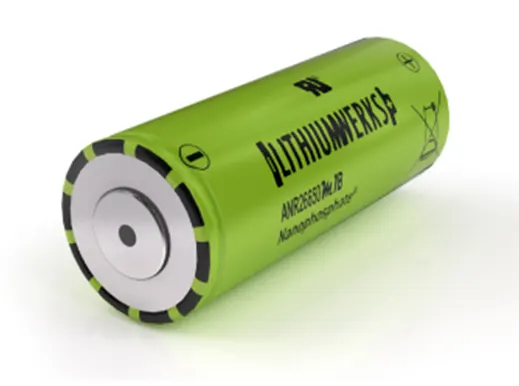
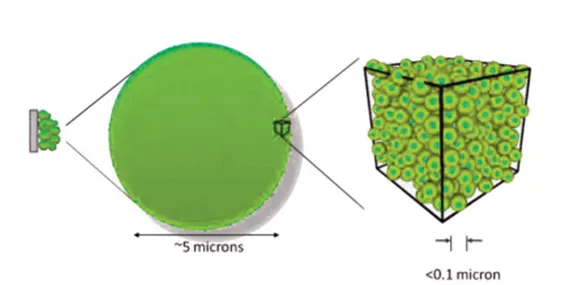
- Nanophosphate® battery technology offers stable chemistry, faster charging, consistent output, excellent cycle life and superior cost performance.
- It provides the foundation for safe systems while meeting the most demanding customer requirements.
- Multiple layers of protection are employed at the chemistry, cell and system level to achieve an energy storage solution with superior safety and abuse tolerance compared to metal oxide lithium-ion chemistries.
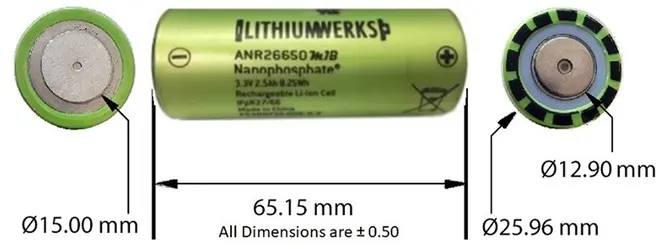
CELL DIMENSIIONS:
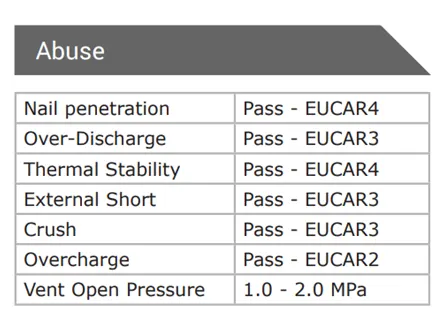
We have
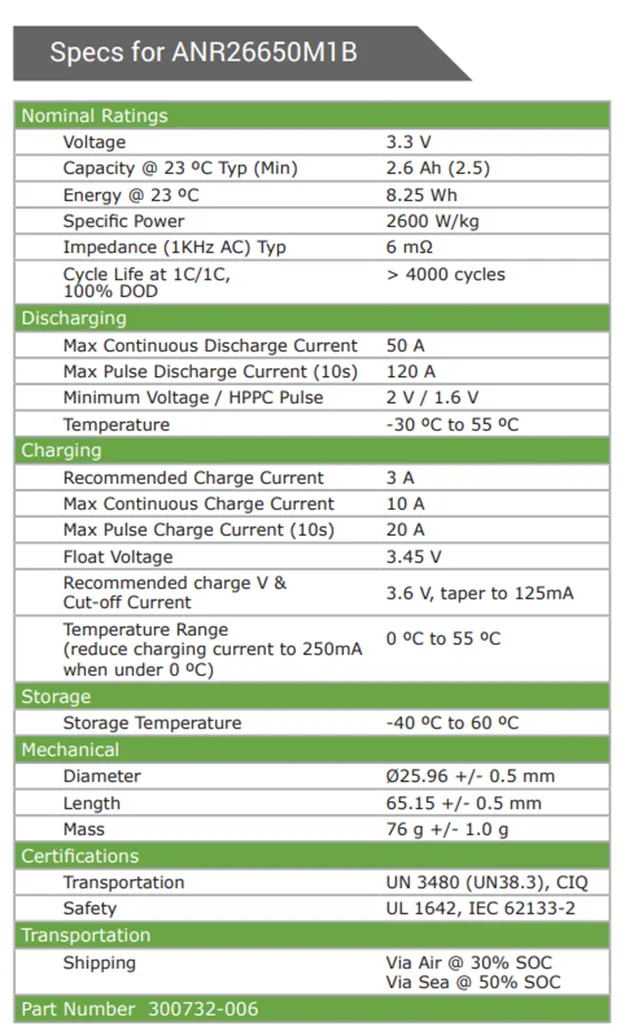
Cell nominal voltage=3.3V
Cell nominal capacity=2.5Ah
The cell energy capacity is product of cell nominal voltage and cell capacity= 3.3*2.5=8.25Wh
The required battery capacity is 18KWh
Lets assume battery voltage of battery pack is 200V
Pack capacity= energy capacity/Pack voltage=(18*10^3)/200=90Ah
No of cells in series= pack voltage/cell voltage=200/3.3= 60.60= so nearly 61 cells in series
No of cells in parallel= pack capacity/cell capacity=90/2.5= 36 cells in parallel
Total number of cells in battery pack = no. of cells in series* no. of cell in parallel
=61*36=2196 cells
Total energy of the pack= pack voltage * pack capacity
= 200*90 = 18000Wh=18kWh
So, for 18KWh capacity of the battery we need 61S36P configuration
Weight of the battery pack = Total number of cells in battery pack*cell weight
= 2196*76*10-3=166.896 kg
Length of the battery pack= No. of cells in series * cell diameter
= 61*0.026=1.586m
Width of the battery pack= length of the battery pack* breadth of the battery pack
=1.586*0.6424=1.019m
Area of the battery pack= length of the battery pack*width of the battery pack
=1.586*1.019 =1.616 m2
Volume of the battery pack= area of the battery pack * cell height
=1.616*0.0956
=0.15449m3
=154.49 litres
Specific energy density = pack energy capacity / weight of the battery pack
= (18*103)/ 166.896
= 107.856 Wh/kg
Volumetric energy density= pack energy capacity/Volume of the battery pack
=(18*103)/154.49
=116.51 Wh/L
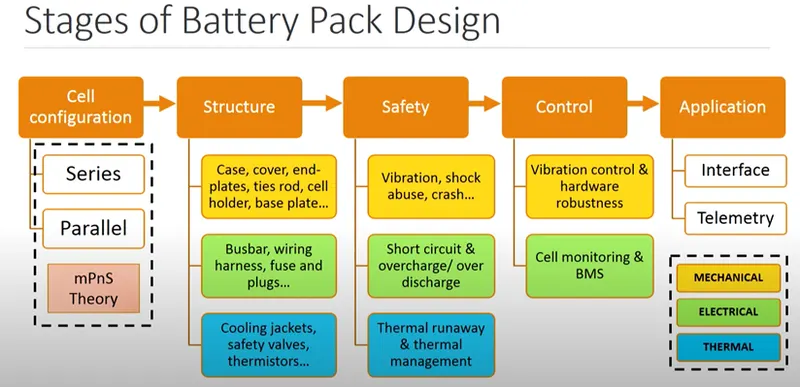
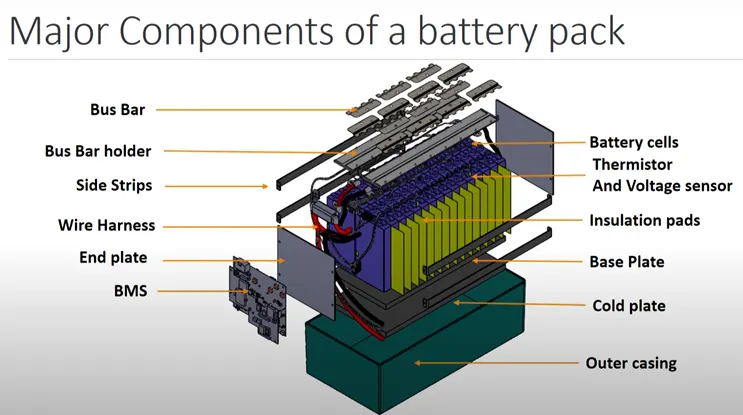
Important considerations
- Material selection
- Base plate design for individual cell accommodation
- Cell movement constrain and control
- Uniform pressure over cell surface
- Material cost optimization
- Outer case design for overall protection
- Bus bar designing
- Packing constraints
Mechanical elements and packaging should consider how cell-to-cell interconnects are designed; the particular cell, module, and electronic assembly; the structural protection points for shock and vibration; how the pack is crush-protected; the desired attachment points to the vehicle; and the mechanical interfaces with other components . Electrical management includes the interfaces with the vehicle so that the DC power can go back and forth from the battery to the inverter or motor controller; how voltage, current (pressure), and temperature are measured and monitored; and how the state of charge (SOC), capacity, available energy, power capability, state of health, impedance, and rate of degradation are measured. Electrical safety also has to be considered by the appropriate use of fuses and automatic interconnects. Thermal management is a must, because, as the battery is used and power goes in and out, the inefficiency of the battery, even if it is less than 5%-10%, could lead to heating of the cells (sometimes not uniformly), and high temperatures could lead to lower life and reduced vehicle fuel economy.
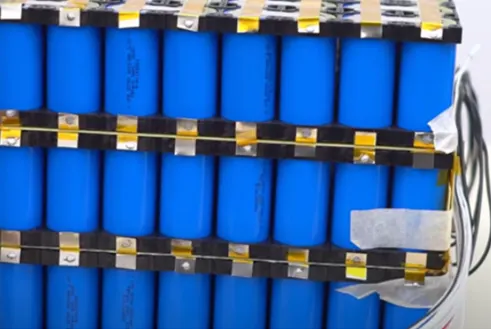
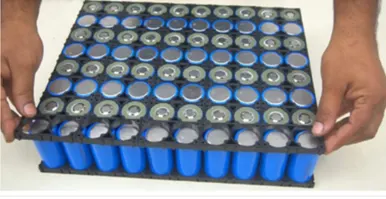
This is a battery holder and we can connect them as per requirements
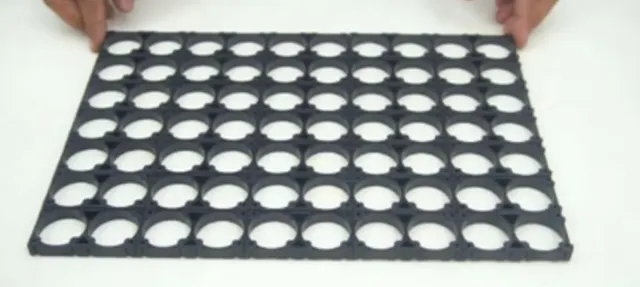
Battery are placed on this holder and holder is covered at top and bottom of the battery rigid enough for use
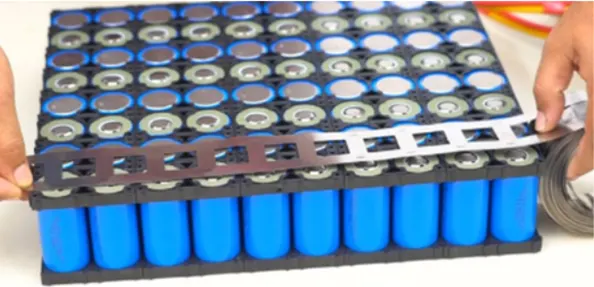
nickel strips: Nickel strip is generally used in battery building. Its due to its efficiency of usage in spot welding and soldering as well its high corrosion resistance over time. It has good properties and excellent resistance to many corrosive environments. The pure nickel will never get rust after it applied to battery packs.

Then connect it by nickel strips
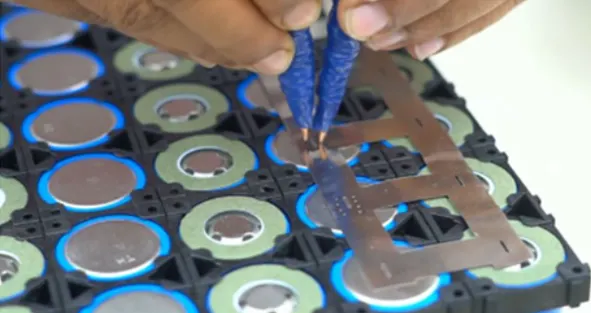
And then spot welding is used to connect the cells
PVC heat sink films used to connect the multiple pack of the battery and Multiple pack is again connected by the nickel strips.
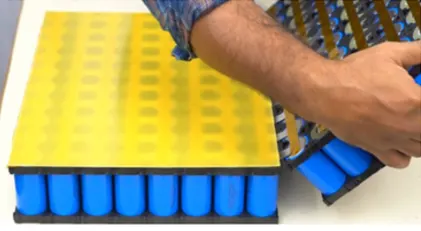
SO this way battery pack is made.