Project 1 Mechanical design of battery pack
Aim:
From this Cell: ANR26650M1-B model to prepare a detailed battery pack along with its enclosure.state your assumptions.
Introduction:
A123’s high-performance Nanophosphate® lithium iron phosphate (LiFePO4) battery technology delivers high power and energy density combined with excellent safety performance and extensive life cycling in a lighter weight, more compact package. Our cells have low capacity loss and impedance growth over time as well as high usable energy over a wide state of charge (SOC) range, allowing our systems to meet end-of-life power and energy requirements with minimal pack oversizing.
Technical parameters of the Cell: ANR26650M1-B
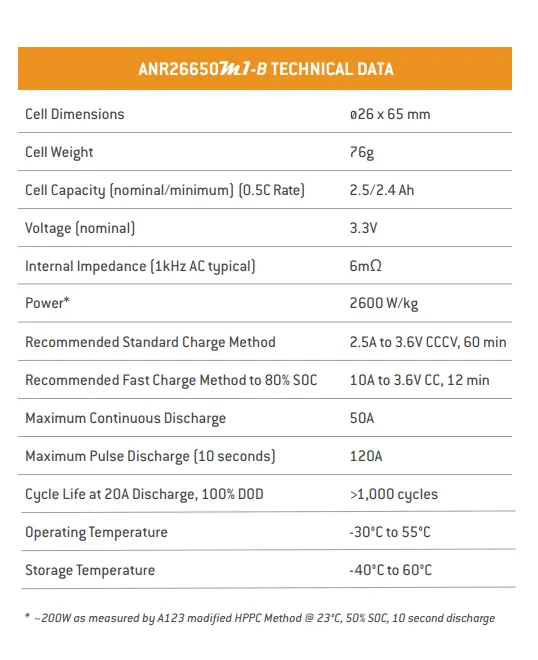
From the datasheet, I can take the parameters to do the calculation for an batterypack.
Nominal voltage=3.3V
cell capacity:2.5 Ah
Internal impedence=6m ohms
cell weight=76g
cell dimension=26*65mm
operating temp=-30 t 55 deg celcius
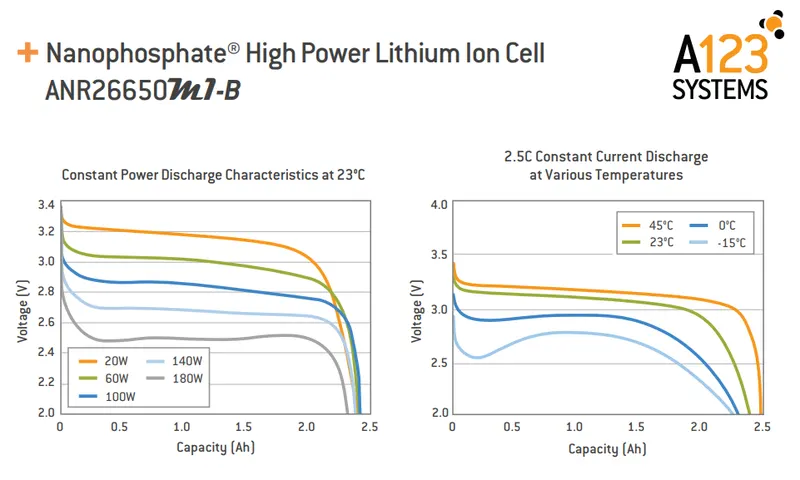
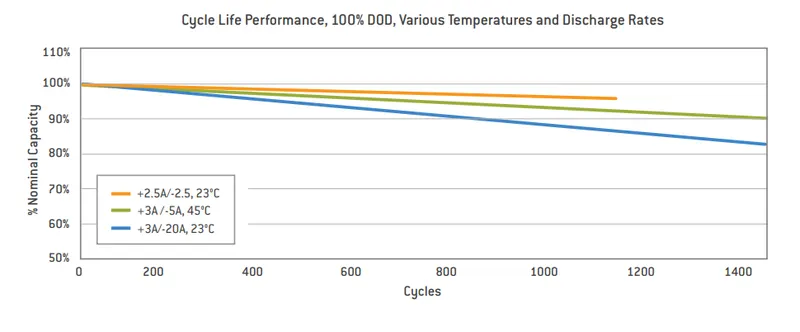
Depth of discharge characteristic of a cell from the datasheet.
1. To find the total no. of cells for 18kwh battery-pack capacity.
given:
Energy=18kwh*1000=18000
cell Nominal voltage=3.3v
cell capacity = 2.5 Ah
Total number of cell=energy/(cell nominal voltage * cell capacity)
=18000/(3.3*2.5)
Total no of cells =2182 cells
We need a minimum of 2182 cells to get 18kwh of energy, now based on that we need to configure the cells as series and parallel connections.
2. To find the series connection:
- In the series connection, the voltage will be high.
- We can assume 500 voltage is required to run the vehicle.
No of series cells required to produce (500v) =Required voltage/nominal voltage.
=500/3.3
=151.5
Let us consider the no of cells in series =152
3. To find the parallel connection:
total connection=series connection * parallel connection
parallel connection=total connection/series connection
- For parallel connection capacity can increases.
=2182/152
parallel connection= 14.35
let us consider the parallel connection as 15
Now the cell architecture is 152s15p means 152 series and 15 parallel connections
4. Total Battery pack capacity
we know the parallel configured cell multiplies individual cell capacity so,
single battery pack capacity=parallel cell row*nominal cell capacity
= 15*2.5
=37.5Ah
Total battery pack capacity=(152*3.3) * (15*2.2)
Total battery pack capacity=18.81 kwh.
5. Current supplied by the battery:
We have already calculated the battery capacity which is 37.5Ah means it is going to supply 37.5A current per hour which can be considered as C-rate.
6. Range
Lets powertrain energy consumption = 100 WH/km
Range=capacity/energy consumed per km
=18000/100
Range =180 km
7. To find the area required for the battery pack:
Length= No of series * diameter
L=152*26m=3952mm
L=3952/100=39.52 M
Width=No of parallel * diameter
w=15*26=390
w=390/100=3.9
Area required for the battery pack is 152s15p=2*(length + width)* height
=2*(3.95+0.39)*65m
Area required for the battery pack is 152s15p=0.564m^2
8. Total weight of the battery pack:
Total weight of the battery pack= Total cell*each cell weight
Total weight of the battery pack=2182*76
Total weight of the battery pack=165.83 kgs
This battery is given in a cylindrical shape so we can use the holder to make 152s15p architecture and spot welding for connection in the battery pack.
Cylindrical: Cylindrical lithium cells are used for high specific energy density and good mechanical stability. This shape offers good safety and a high cycle life at a low cost. The disadvantage is that it has low packaging density.
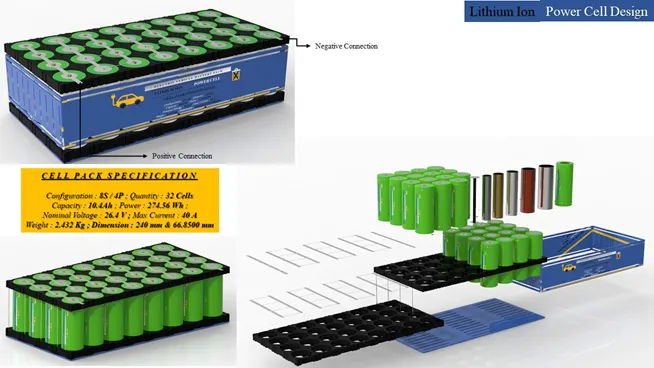
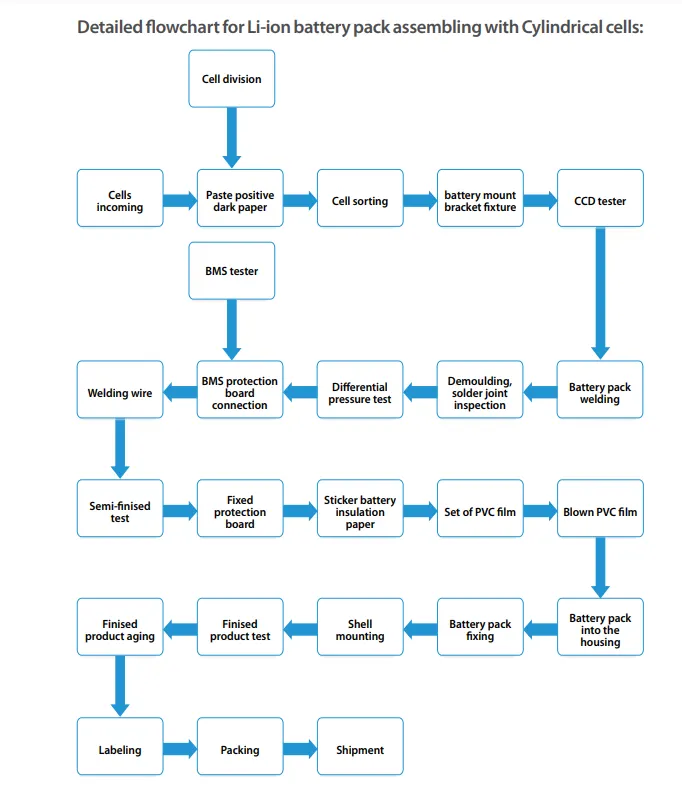
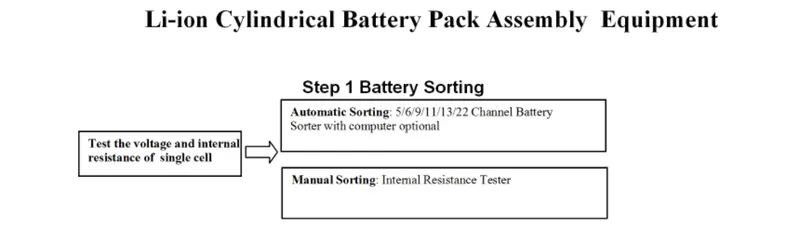
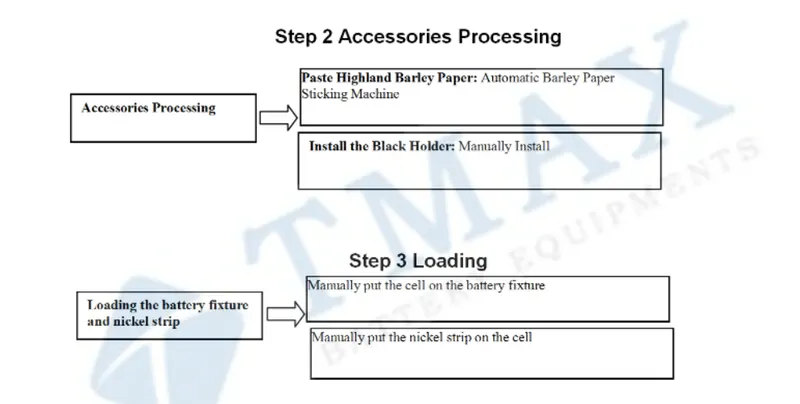
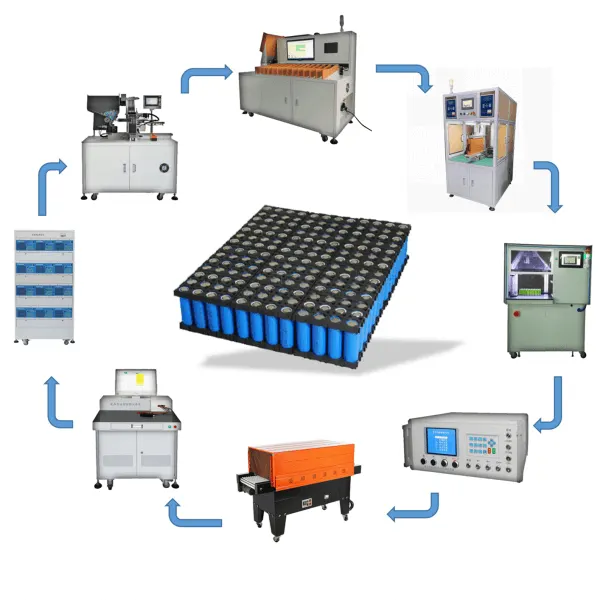
Cylindrical battery-pack assembly management steps for EV:
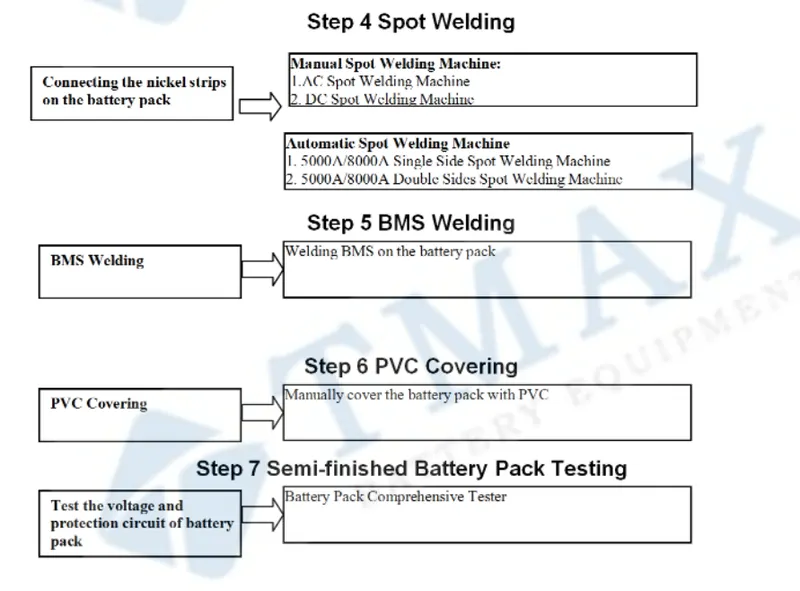
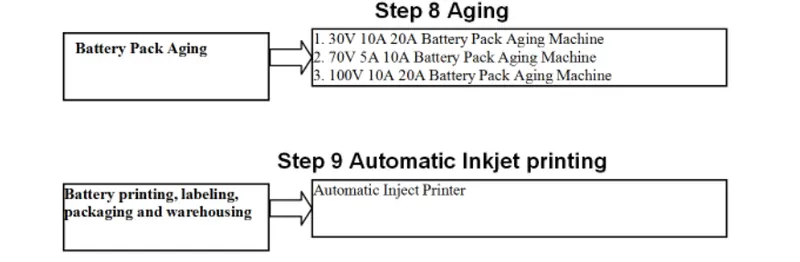
Welded battery sample:

Variant types of machines and devices are used stepwise to make a battery pack.
Various interfaces in battery pack:
| Interface | Remarks | Solution |
| Mechanical | Design features for safety | Cell spacer,damping pads,gaskets etc |
| structural | protection and isolation | case,cover,endplates etc. |
| Thermal | To maintain cell temperature | Coolant, fans,heat exchange etc. |
| Electrical | Transmit power from the battery pack | Bus bars,reley,fuse etc |
| control | To monitor and regulate the battery pack | BMS,Various sensor. |
Even below the factors have to be considered while designing the battery pack.
- Lightweight
- Compactly packaged
- Ergonomic
- Structurally rigid
- Swappable
- Configurable
- Thermally stable
- Impact-resistance
- Fire-proof
- Easy to manufacture
- Easy to service
- Low-cost