Project 1 Mechanical design of battery pack
The cell which is been selected for the construction of battery pack is ANR26650M1-B , this cell is based on Lithium-iron Phosphate Chemistry (LiFePO4) . Lithium Iron Phosphate battery is new generation Lithium-ion rechargeable battery. The abbreviations of this batteries are Li-Fe/ LiFePO4 battery. The first model of the lithium iron phosphate battery made after the discovery of phosphate as a cathode material for use in li-ion batteries in 1996. Improvements in the coatings and usage of nano-scale phosphate have made this type of battery more efficient.
Features of LiFePO4 battery :-
- Low discharge rate
- Better power density
- Less heating
- Flat discharge curve
- Increased safety
- Higher charge cycles
- non-explosive
Advantages of Li-FePO4 battery:-
- Very safe and secure technology (No Thermal Runaway)
- Very low toxicity for environment (use of iron, graphite and phosphate)
- Calendar life > 10 ans
- Cycle life : from 2000 to several thousand
- Operational temperature range :up to 70°C
- Constant power throughout the discharge range
- Ease of recycling
- These batteries have a longer life span than conventional lead acid batteries. It dramatically diminishes the need for battery changes.
- These batteries operate with the lower resistance and hence,
- Lithium iron phosphate batteries are lightweight than lead acid batteries, generally weighing about ¼ less.
- These batteries offers twice battery capacity with the similar amount of space.
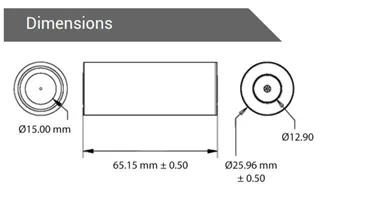
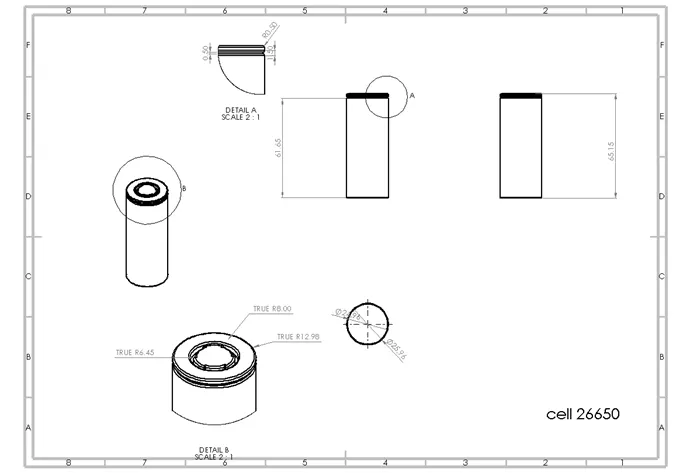
The dimensions of battery are 26mm in diameter and 65mm length. The weight of each cell is 76g.
The parameters of cell are as follows :-
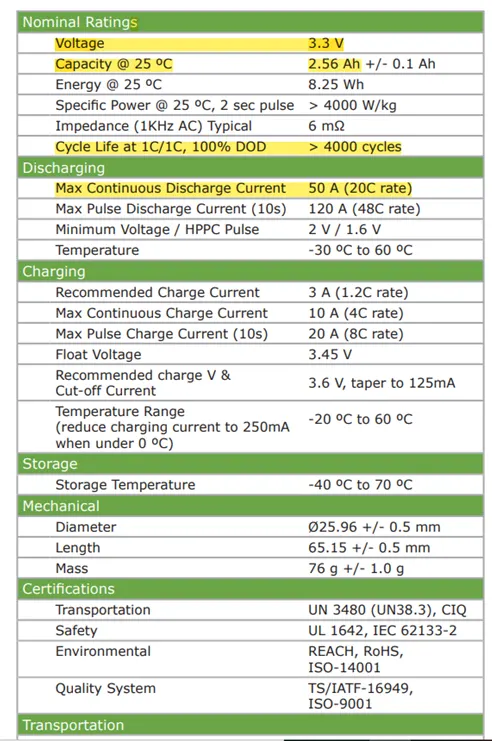
As mentioned in the data sheet the nominal voltage of the cell is 3.3V and nominal capacity in Ah is 2.65Ah ,the cell has 4000+ number of cycles at 1 rate.
We know that for making a battery pack we need to connect the cells in both parallel and series to get the required capacity battery pack. Here we are going to construct the battery pack of 18KWh.
We know that power is nothing but the product of voltage and current.
P=V*I
Here we are assuming to create a battery pack of 72V rating , so here we have fixed our voltage rating the second step is to decide the ampere hour rating for the battery pack.
1kWh = 1000 W
Therefore ,
18 kWh = 18000 W
`P=V×I`
Where P = power
V= voltage
I= current
Therefore, we get I
`I=P/V`
`I=18000/72`
`I=250 Ah`
For construction of a battery pack of 18KWh , with 72 V rating we need a current of 250Ah .
Therefore ,
`P=72 v×250 Ah`
`P=18000 kWh`
The next step is decide the connections of cell to be made is series and parallel .
We know that when the connection is made in series the current remains same but the voltage is increased and when the parallel connection are made the voltage remains same but the current goes on increasing.
We are having each cell rating as :-
V= 3.3 V
A= 2.56 Ah
Therefore ,
The no of cells to be connected in series to get the 72V rating , we have to divide the total voltage required by the per cell nominal voltage .
`No.of Cells in series=((Total voltage required)/(per cell voltage ))`
`No.of Cells in series=((72 v)/(3.3 v ))`
`No.of Cells in series=21.81=22 cells`
Decide the number of cells to be connected in parallel ,
We require total current rating of 250Ah and we are having a cell of 2.56Ah rating each ,So
`No.of Cells in parallel=((Total Ampere hr.required)/(per cell current rating ))`
`No.of Cells in parallel=((250 Ah)/(2.56 Ah ))`
`No.of Cells in parallel=97.65=98 cells`
From the above calculations we have decided the total number of cells to be connected in series and parallel to get the 72v and 250 Ah rating , so in total we can get 18Kwh battery pack.
In overall the total number of cells we require to construct this battery pack will be ,
`No.of Cells required =no.of cells in series ×no.of cells in parallel`
`No.of Cells required =22 ×98`
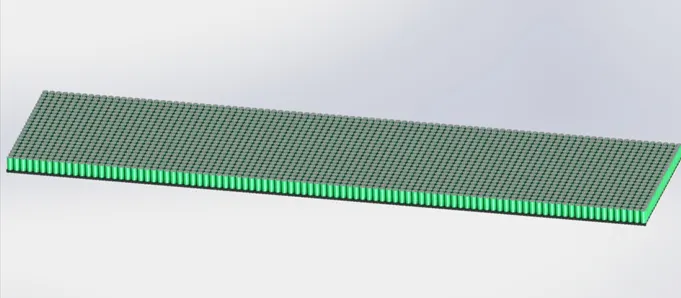
`No.of Cells required =2,156 cells`
In all we require 2,156 number of cells to get 18KWh battery pack.
As we are having 2156 number of cells and each cell weight about 76 grams therefor the weight of 2156 cells will be 164 kg and we will add 15% of weight for the rest of the components for connection strips , BMS , cell holders , housing , etc.
Therefore the total weight of the battery pack will be near about 187 kg.
The dimensions of cell are as shown in below fig :-
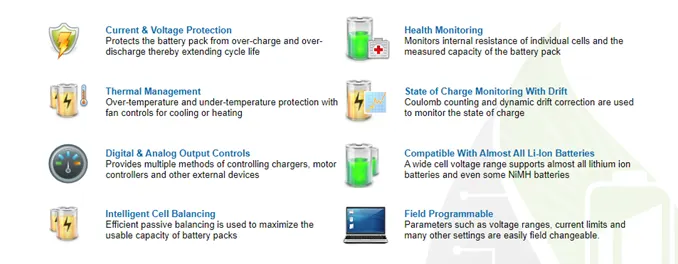
As we are having 2156 number of total cells and 22 cells in series and 98 cells in parallel , so we require a Battery Management System (BMS) for monitoring the safety of such a high power battery pack . The BMS will sense the temperature , cell voltage , current , calculate State of Charge (SOC) and monitor all the health related parameters of the battery pack.
Mechanical design of battery pack :-
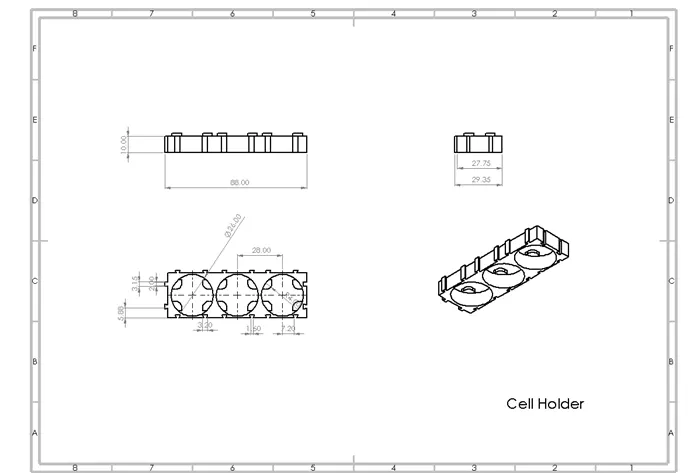
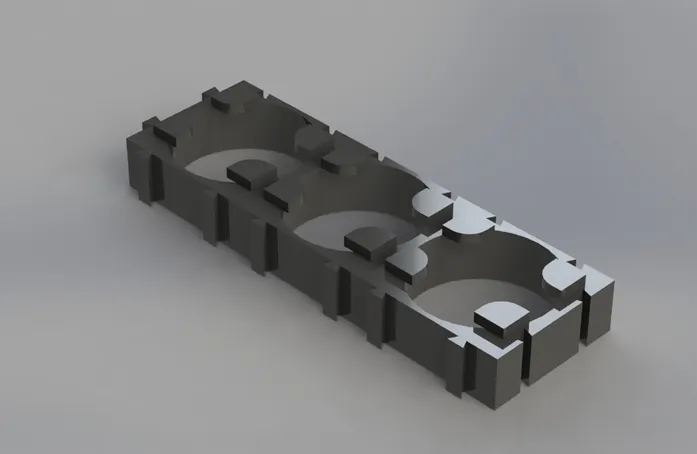
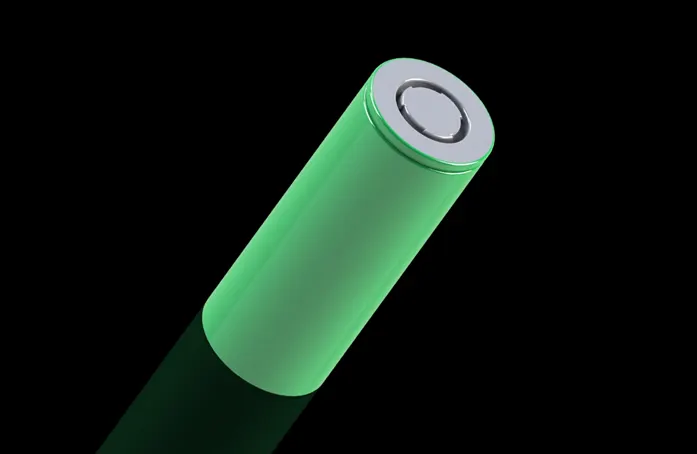
Cell 26650 :-
Battery Pack Assembly :-
So the BMS is an very important part of any battery pack.
After deciding the no. of cells to be connected in series and parallel and the total no. of cells required the next step is to select a BMS for the battery pack.
A Battery Management System BMS monitors and regulates internal operational parameters, i.e. temperature, voltage and current during charging and discharging of the battery.
In technical terms, the BMS estimates the SoC (State of Charge) and SoH (State of Health) of the battery to improve safety and performance.
It avoids over-charging and over-discharging of the battery pack. This way, it maintains charge level within maximum and minimum allowed capacity to prevent sudden accidents [explosion].
Hence a BMS is a highly crucial device to ensure the safety of the battery and user.
A BMS is an electronic board consisting of a variety of components and circuitry. After detecting a problem in operational parameters (voltage, temperature etc.) BMS triggers input to the alarm system followed by disconnecting the battery pack from the load or charger.
Block Diagram of BMS :-
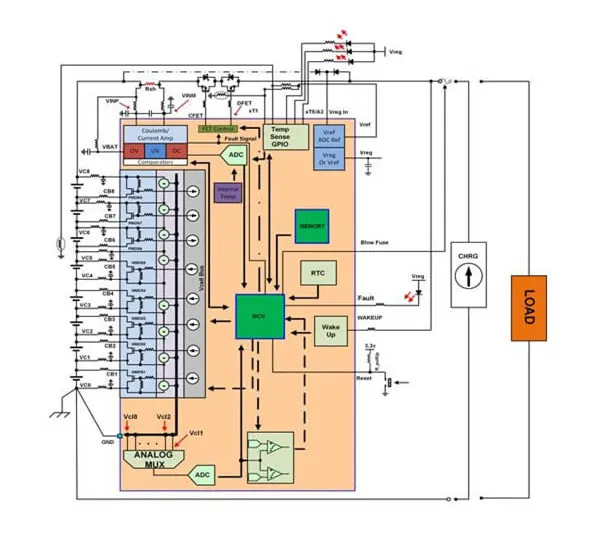
There are four main functional blocks,
- Cut-off FETs
- Fuel Gauge Monitor
- Cell voltage monitor
- Temperature Monitor
- Cut-off FETs
A FET-driver acts as isolation between the battery and the charger. It is used to connect the high-side and low-side of the battery pack.
High-side – Activates NMOSFET using the charge pump driver
Low-side – Activates NMOSFET without charge pump driver
This integrated Cut-off FETs reduce the overall cost of the BMS. It is also eliminating the use of high voltage devices that could consume a large die area.
- Fuel Gauge Monitor
This helps in keeping track of the charge entering and exiting the battery pack. The charge flowing is calculated by multiplying current and time.
Although several methods are used to measure the current flow, the most efficient and cost-effective solution is to measure the voltage of sense resistor using a 16-bit ADC with low offset and high common-mode rating.
Higher ADC is beneficial to obtain an extensive dynamic range at more speed.
- Cell Voltage Sensors
Cell voltage monitoring can be called as a standard function of the Battery Management System. It is useful in determining the health of the battery.
All cells in a battery should operate at standard voltage levels during charging and discharging for safety and improving the lifecycle.
- Temperature Monitoring
As technology is evolving, batteries are made to supply high currents in the meantime keeping the voltage constant.
Since a high current flow through batteries can cause sudden temperature rise and force them to explode accidentally. It needs to be avoided. For this reason, the BMS continuously monitor the temperature of the battery and regulate it to the rated value.
This feature is handy because if the temperature rises above the rated value, it will inform you to start/stop charging or discharging.
- Other Building Blocks
Few more of the available blocks are,
- Battery Authentication – prevents the connection of BMS electronics to the third-party battery pack.
- Real-time Clock (RTC) – used in black-box application
- Memory – used in black-box application
- Daisy Chain – simplifies the connection between stacked devices
After deciding the cells and BMS for the battery the further parameters to be taken into consideration are as follows :-
Pack Design Options :-
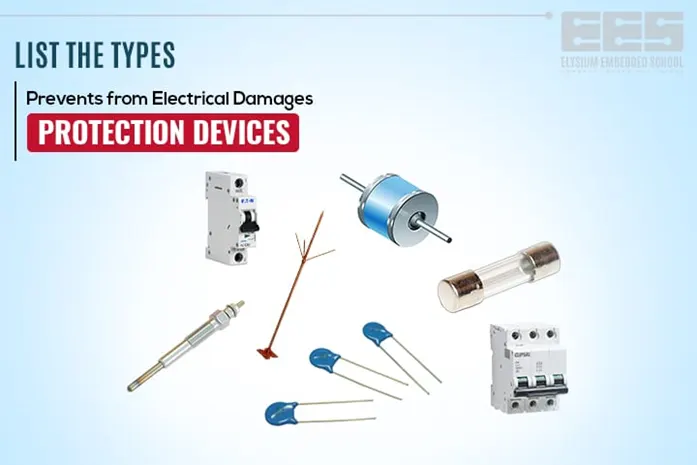
The design of the outer package or housing of the battery depends to a great extent on the components it has to accommodate and the physical protection it has to provide for them. These components are not just the cells, but also protection devices, electronic circuits, interconnections and connectors which must all be specified before the final battery case can be designed. For high power, high energy batteries robust packaging is required for safety reasons.
Cell Configuration :-
The ultimate shape and dimensions of the battery pack are mostly governed by the cavity which is planned to house it within the intended application. This in turn dictates the possible cell sizes and layouts which can be used. The types of cell configuration are as follows :-
- Prismatic Cell
- Cylindrical Cell
- Pouch Cell
Battery Electronics :-
There may be protection devices and circuits, monitoring circuits, charge controllers, fuel gauges, and indicator lights. Electronics for high power multi-cell packs also include cell balancing and communications functions. In addition to the basic battery support electronics the battery pack may include other functions such as heaters to extend the lower working temperature or solar cells to keep the battery fully charged. These circuits in turn have their own control circuits. Space, fixing points and methods and interconnections need to be allocated for all these electronic circuits.

External Connections :-
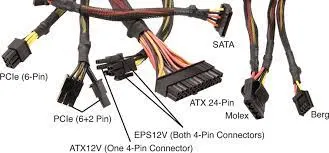
The type of terminals or connections to the external circuits depend on, the current to be carried, the frequency with which the battery may be connected and disconnected and the design of the design of the circuit to which the battery will be connected.
Thermal Design :-
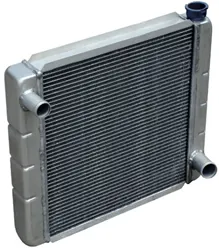
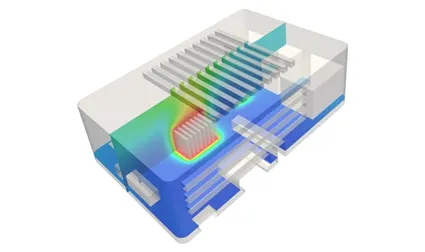
Thermal management is a major issue in high power designs, it may be necessary to provide air or water cooling ducts, pumps or fans and heat exchangers for high temperature working or heaters for operating in low temperature environments. The layout of the cells should be conducive to managing heat flows within the pack.
Battery Packaging :-
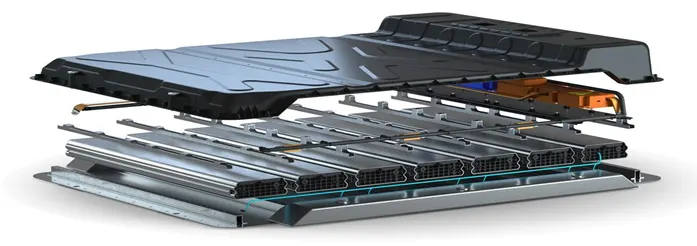
The battery casing has to provide the mechanical and electrical interfaces to the product it is designed to power as well as to contain all the components outlined above.
Pack Costs :-
The costs involved in designing custom battery packs are often underestimated.
Design Engineering Costs
Tooling Costs
Prototypes
Production Costs
Cost Comparison :-
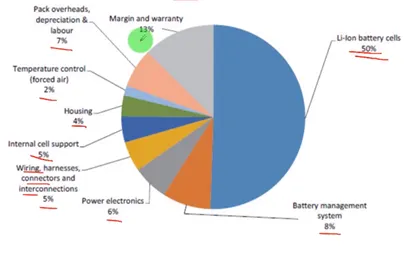
As shown in the above pie chart the half of the cost for a battery pack is acquired by the lithium ion cells which is 50% of overall cost , after that its followed by BMS which takes near about 8% , power electronics 6% , wiring harness conncetions and interconnections cost about 5% , internal cell support 5% , housing 4% , Temperature control 2% , pack overheads and depreciation and labour 7% and last is the margin and warrenty which shares 13% of overall cost of the battery pack.
After some research on internet I found supplier for ANR26650M1-B cell the manufacturer is A123 Batteries the cost of $ 5.14
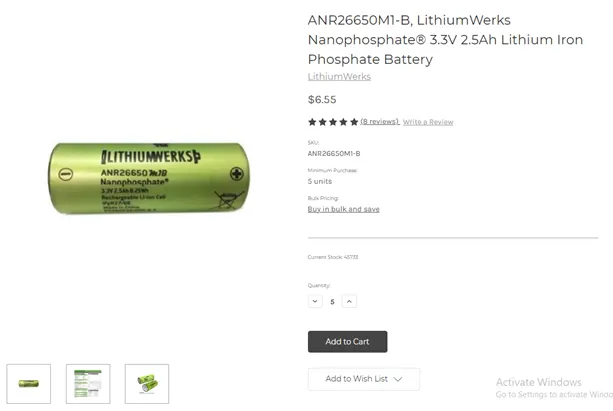

Therefore the total cost of the lithium ion cells will be Rs 8,19,994/-
Total cost of the battery pack :-
|
Sr. No |
Component |
Price (Rs) |
|
1 |
Li-ion cells |
8,19,994/- |
|
2 |
Battery management System BMS (8%) |
65,000/- |
|
3 |
Power Electronics (6%) |
49,000/- |
|
4 |
Wiring Harness , connections & interconnections (5%) |
41,000/- |
|
5 |
Internal cell Support (5%) |
41,000/- |
|
6 |
Housing (4%) |
33,000/- |
|
7 |
Temperature Control (2%) |
16,000/- |
|
8 |
Pack Overhead , Depreciation & labour (7%) |
57,000/- |
|
9 |
Margin & Warrenty (13%) |
1,06,000/- |
|
Total |
12,27,994/- |
|
Therefore , the total cost if the battery pack for 18kwh rating will be near about Rs12,27,994/-
References :-
https://robu.in/lithium-iron-phosphate-battery/
https://www.mpoweruk.com/pack_construction.htm
https://robu.in/what-is-battery-management-system-bms-building-blocks-working/
https://www.renesas.com/eu/en/products/power-power-management/battery-management-system-tutorial