Project 1 Hood
Project Objective
-
To design the inner and outer panels of the front hood of an SUV model car according to Euro NCAP standards.
-
<!--[endif]-->To design a hinge and striker and design the mountings in the inner panel, keeping the latch and striker in mind.
-
<!--[endif]-->Calculation of the section modulus of the hood at ‘0Y region’.
Introduction
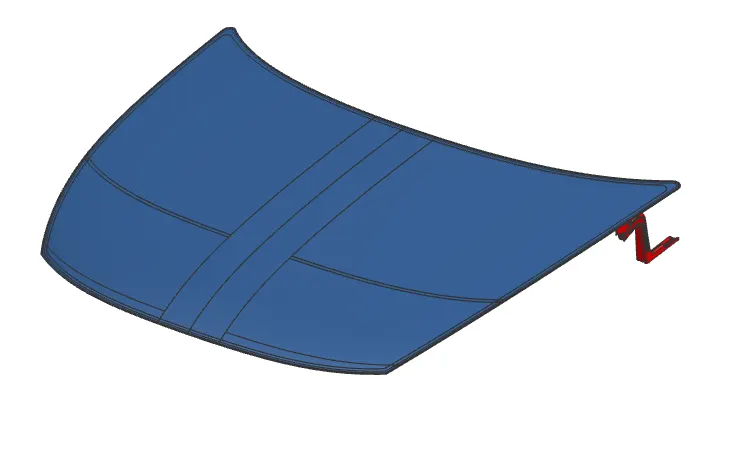
A car hood, also known as a bonnet in some other countries, is the hinged cover that sits over a front-engine vehicle's engine.
- Access to engine components: Its function is to allow access to the engine for repairs and maintenance.
- Engine Protection: The hood's inner panel provides strength, while the outer panel serves as a metal cover that shields it from external elements that could potentially damage or interfere with its operation.
- Aesthetics: Hoods, too, play an important role in the optimal design of the car in this way, decreasing drag and expanding the car's downward force.
- Safety Features: Hoods are designed in such a way that the pedestrian suffers less harm in the event of an accident.
- Materials: Hoods are commonly made from materials such as steel, aluminium, or composite materials like carbon fibre. The choice of materials can affect the hood's weight, durability, and overall performance.
- Latch and Hinge System: The hood is typically attached to the vehicle using hinges at the rear, allowing it to be lifted for access. A latch mechanism at the front secures the hood in the closed position.
According to the study, the hood surface is only responsible for 15% of all head injuries.
An Insight into the Art and Science of Hood Design
<!-- [if !supportLists]-->1. The Art of Hood Design:
Aesthetics: The external appearance of a car's hood is a crucial aspect of its overall design. It involves considerations of lines, curves, and contours that contribute to the vehicle's visual appeal.
Brand Identity: Automotive designers use the hood as a canvas to express the brand's identity. Distinctive hood designs can create a recognisable and memorable brand image.
Trends and Styles: The art of hood design is also influenced by contemporary design trends and styles. Designers often draw inspiration from various sources to create hoods that are both timeless and modern.
<!-- [if !supportLists]-->2. Integration of Art and Science:
Skilfully crafted hood designs combine scientific considerations with artistic aspects in a seamless manner.
A well-designed hood improves the car's overall operation, safety, and performance in addition to its appearance.
To balance form and function, engineers and automotive designers work together. This teamwork guarantees that the finished design satisfies all technical and aesthetic requirements.
All things considered, "An Insight into the Art and Science of Hood Design" acknowledges the dual nature of hood design, recognising both the creative artistic input that shapes an automobile's visual character and the scientific principles that control its performance, usefulness, and safety.
Components of the Hood
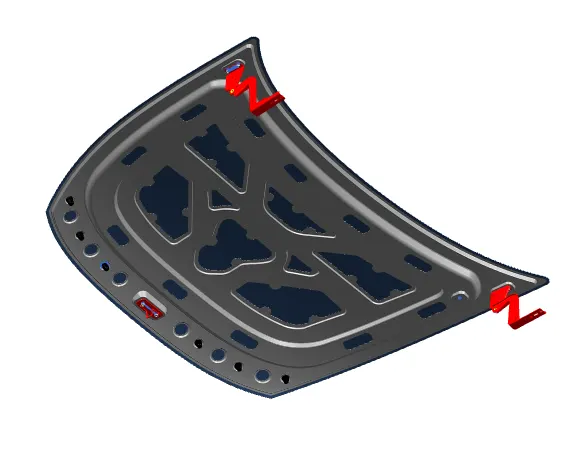
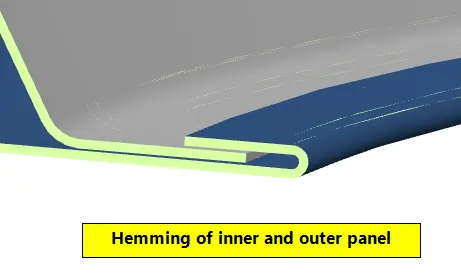
The hood is not a single component; there are a lot of components, as we can see, like the outer panel, the inner panel (these two are joined by the heamming process), and the small reinforcements.
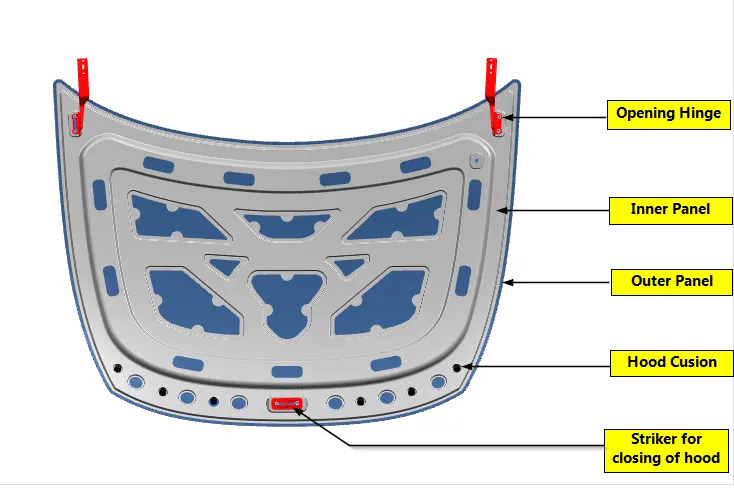
1. Hood Outer Panel:
- Outer panels are the aesthetic elements, also called styling, of a car.
- It is the styling team that provides the skin for the outer panel.
- The shape, position, and size of the hood should satisfy the safety norms. So while designing the hood, we should give more importance to pedestrian safety.
- The outer panel is attached to the inner panel by the hemming process. So, it is necessary to provide the required hemming flange and reliefs for the hemming operation.
- We also provide mastic sealants between the outer and inner panels to reduce vibrations between the inner and outer panels.
- The thickness of the outer panel is in between 0.65 and 0.85
2.Hood inner panel
- The inner panel is the part that gives strength and rigidity to the outer panel.
- It is the muscle of the hood because of the additional structures provided within it.
- The master section represents the initial emboss shape and size.
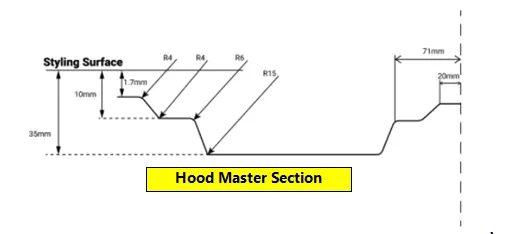
- The shape and size of the embosses also determine the direction of the force distribution resulting from the frontal collision.
- Due to the embosses provided within it, it can prolong the action of force due to collisions that actually reach the body.
- Its structure helps to resolve the forces, divert the forces towards the hinges, and make away from the main body and deform the inner and outer panels of the hood together so that forces will not affect passengers sitting inside the vehicle.
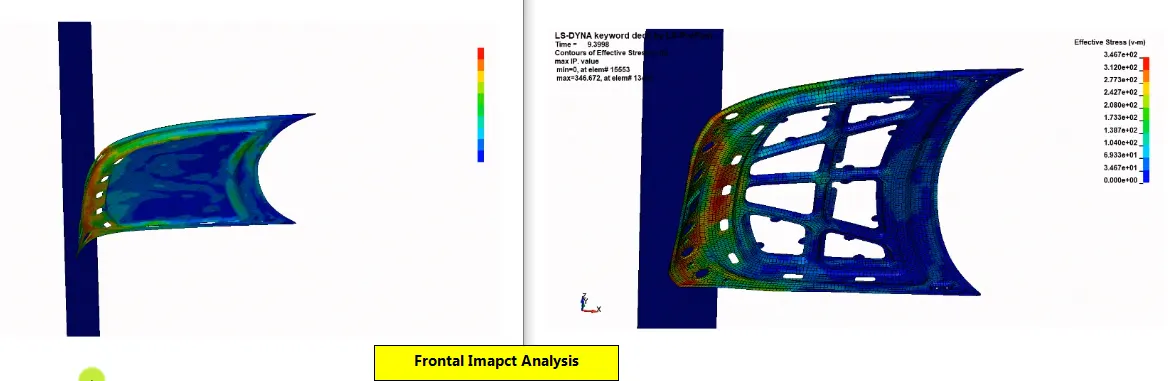
- Mostly, we prefer the V and Y embosses because they prolong the acting force to reach the hinge.
- The below images show the difference between the panel with a minimum emboss and the panel with a V and Y emboss. This shows the force acting with respect to time: on a plane surface, force reaches easier and takes less time to reach its end, whereas with a V and Y emboss, forces are distributed and take more time to reach the end of the body, and maximum stress is generated at the front side of the panel, such that less amount of force will be transmitted at the body side.
3.Reinforcements
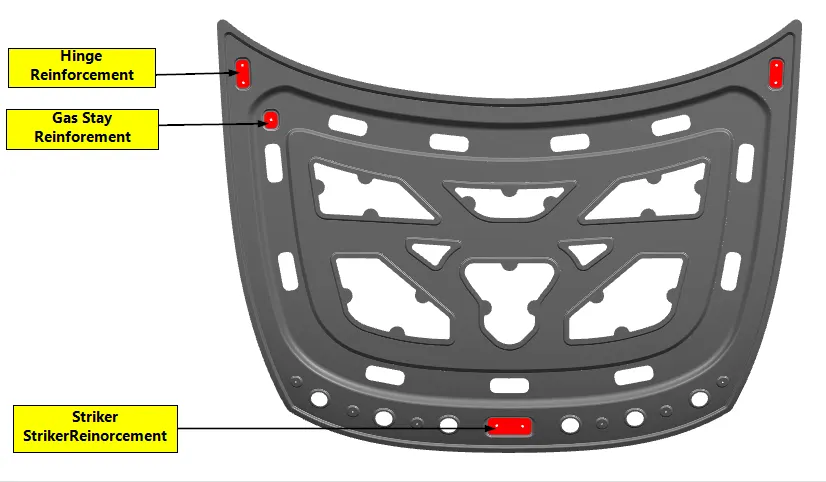
Reinforcements are provided according to the design requirements. Mainly, it is provided at the hinge and latch regions to improve the strength locally. Usually, the thickness of reinforcements will be higher than that of the inner panels and the value varies according to cost and requirement.
4. Latch, Stiker and Hinges
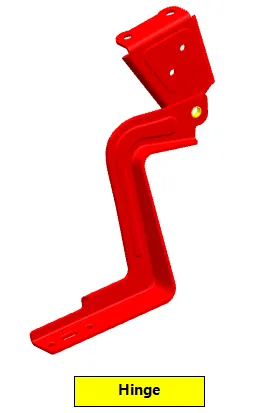
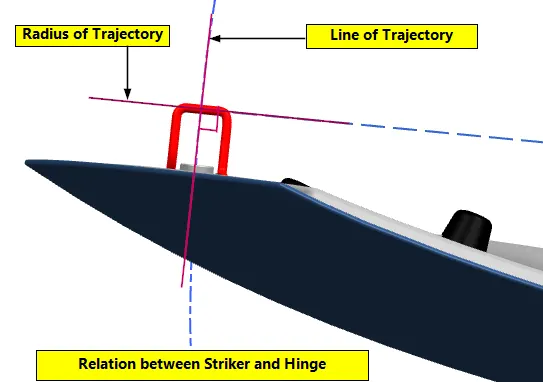
- Hinges should be far away from each other or as wide as possible and towards the end of the hood.
 <!-- [if mso & !supportInlineShapes & supportFields]> SHAPE \* MERGEFORMAT <![endif]--><!-- [if gte vml 1]>
- This distance between them makes the hood easier to open.
- After positioning the hinge, the striker decided to be positioned.
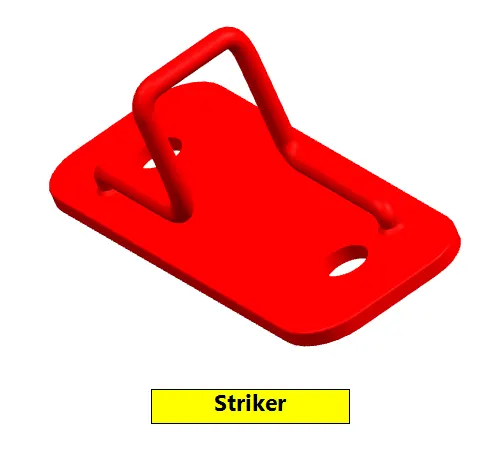
- The relationship between the hinges and latch is as follows: the latch has to be perpendicular to the tangent that has to be drawn to the circle. If this condition is satisfied, then only then can we achieve a smooth closing of the hood.
<!-- [if mso & !supportInlineShapes & supportFields]> SHAPE \* MERGEFORMAT <![endif]--><!-- [if gte vml 1]>
- After this, the latch has to be positioned, which is attached to the engine compartment
5.Latch Trajectory
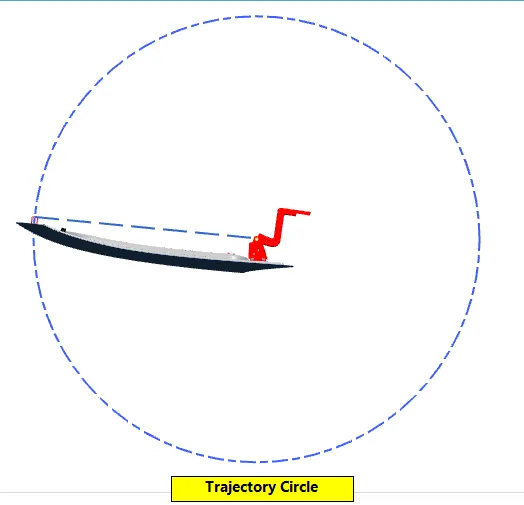
- The latch trajectory is given by the circle drawn from the hinge axis point.
- The hinge axis point is the center point of the hinge axis.
- First, we can fix either the latch or the hinge. If we have fixed the hinge position, then we should plot the trajectory circle for the latch. For a proper mating condition, the striker axis through the tip of the striker should be tangential to the latch trajectory.
 <!-- [if mso & !supportInlineShapes & supportFields]> SHAPE \* MERGEFORMAT <![endif]--><!-- [if gte vml 1]>
6.Mastic Sealents Points:
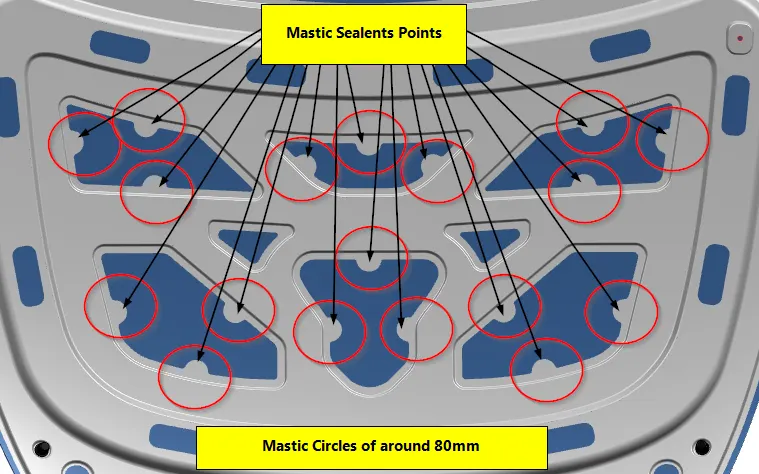
- Viscous materials called mastic sealants, or just "mastics," are employed in bonding and sealing applications of the inner and outer panels because they cannot be weld together.
- The inner panel and outer panels are connected with these points.
- Mastic sealants are often used to reduce noise and vibrations in a vehicle. When applied to the hood inner panel, they can help dampen the sound generated by the engine and road noise.
- Every mastic point adds strength diametrically around 80mm to it as shown below in figure, and about all the mastic points cover the maximum area of the hood inner panel locally, improving its strength.
7. Stoppers:
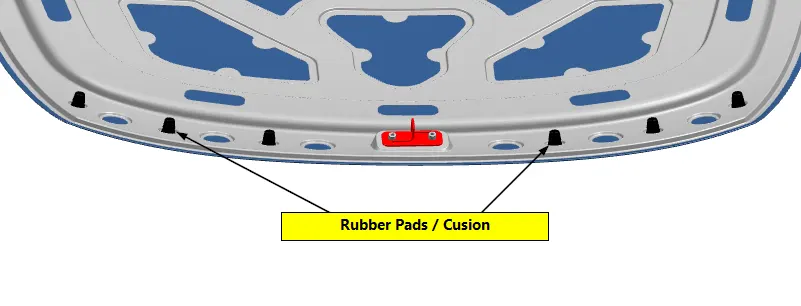
They are often made from materials with good shock-absorbing properties, such as rubber or other elastomers.
The functions of stoppers are as follows:
- Act as a damper of vibrations and noise
- Prevent metal-to-metal contact
- Protect against scratches and dents
<!-- [if !supportLineBreakNewLine]-->
<!--[endif]-->
Stiffner:
Stiffeners in the context of a car hood refer to structural reinforcements or elements added to enhance the strength, rigidity, and durability of the hood. These stiffeners are strategically placed within the hood assembly to provide support and prevent deformation under various conditions
<!-- [if !supportLineBreakNewLine]-->
<!--[endif]-->
This is just glued to the inner panel to reduce the vibrations that may happen between the inner panel and the outer panel.
<!-- [if !supportLineBreakNewLine]-->
<!--[endif]-->
Joining method of Inner Panel and Outer Panel
Hemming
Hemming is a forming operation in which the edges of the sheet are folded over another part in order to achieve a tight fit. Normally, hemming operations are used to connect parts together, to improve the appearance of a part and to reinforce part edges.
There are two types of hemming operations:
- Conventional die hemming
- Roll hemming
HOOD SECTION MODULUS
- One important factor in structural analysis is the moment of inertia.
- Understanding the mass distribution with respect to the rotational axis is essential for comprehending the structural behaviour of the hood section.
- Engineers can forecast the hood's response to different loads, including those brought on by wind, acceleration, or impacts, with the use of this analysis.
- The stability of the hood is affected by the moment of inertia. Greater resistance to rotational changes is typically indicated by a higher moment of inertia. This contributes to stability by reducing unwanted vibrations and hood flutter, especially at high speeds.
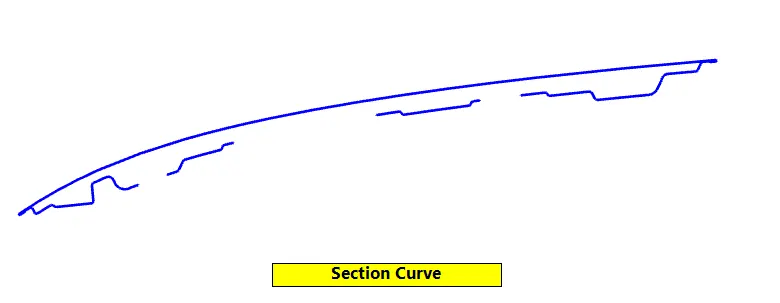
Edit the section at Y plane and get the section curve of the hood as shown below:
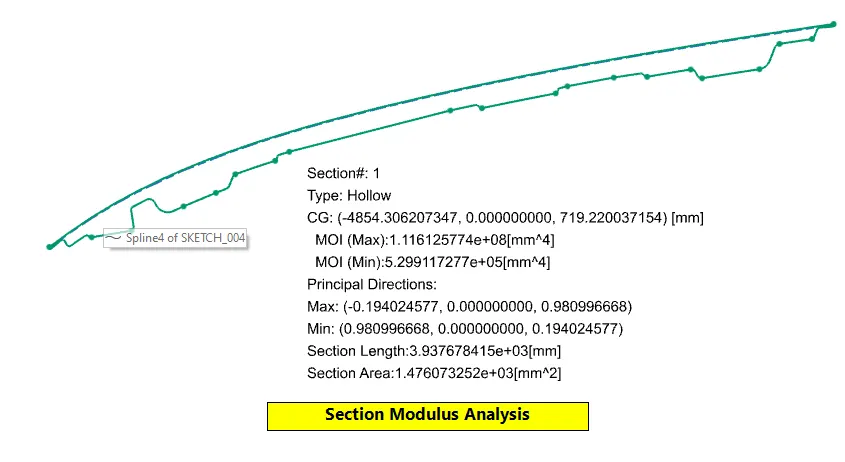
In conclusion, determining a hood section's moment of inertia is an essential step in the design and engineering process. It gives engineers important information about the structural behaviour of the hood, empowering them to make decisions that affect performance, safety, and efficiency in automotive design.
Final Thought:
Finally, I want to sincerely thank each and every one of you for spending this important time with us today. Your involvement and attention are highly valued. We would be glad to have a conversation with you if you have any more queries, ideas, or insights. I appreciate it. Have a great day.