Challenge 4-Windshield Modeling
Windshield
- A glass or transparent screen placed in front of the passengers to protect them from flying objects.
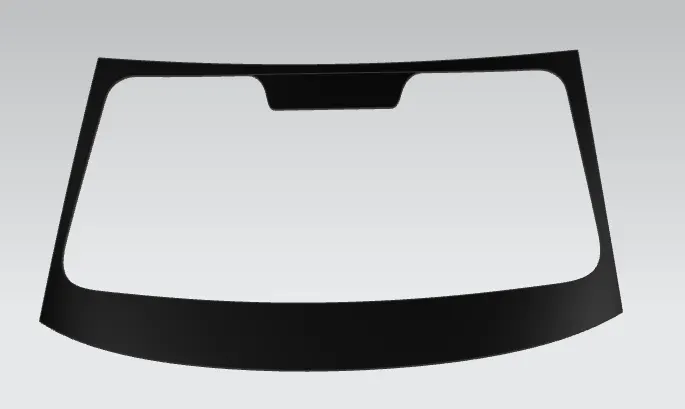
Fig.(1) Front Windshield
The Function of a Car Windshield
The windshield of a car, sometimes referred to as the front car glass or windscreen, has several purposes inside your car. Let's look at a couple of them.
- Good Vision
One of the most basic functions of a windshield of a car is to provide a clear, unobstructed view of the roads ahead to the driver. A clear view is of much importance if you want to drive your car safely without getting into potentially dangerous situations.
- Protective Shield
A windshield for a car, as the name implies, is a ‘shield' that protects the vehicle's occupants and the interiors from dust, stones, debris, bugs, rain, wind, and other such outside elements as UV rays.
- More Than Just a Decoration
A car's windshield is also an important safety component. It gives the car roof 40% more structural strength. In the event of a rollover, the windshield acts as a supportive beam, preventing the car roof from caving in and collapsing on you and your loved ones.
- Proper Deployment of Airbags
The windshield of the car helps in the proper deployment of the front airbags. The car windshield acts as the backstop for the airbag to inflate towards the occupants of the vehicle. Without the windshield absorbing the impact on the airbags, the airbags will not work efficiently and malfunction. Undoubtedly, the windshield of a car plays an integral part in keeping you and your loved ones safe inside the car. This is why you must keep the windshield in top-notch condition. Unfortunately, no matter how much you try, windshield damages cannot altogether be avoided. Outside elements and unfortunate incidents can leave your car windshield with damages. Whether the damage is a minor or a major one, you should be proactive about it and get it fixed without any delay since a good quality windshield for cars is extremely important.
Design Requirements
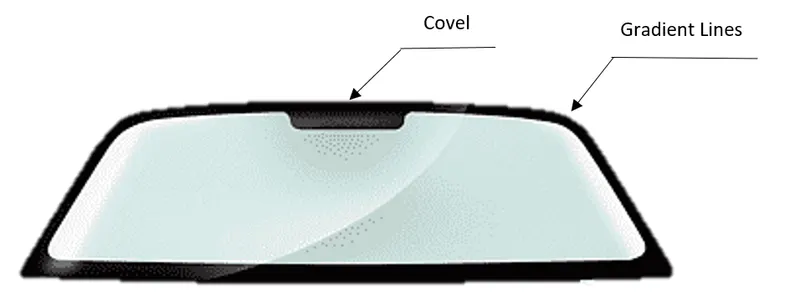
Fig.(2) Front Windshield
- As you see there are the two features here one is windshield glass and other is gradient lines so what is these gradient lines and what is this purpose to have it in windshield so these gradient lines are nothing but a filament that are actually printed on windshield, so they are being done all around.
- On the top as we already know that there is a roof and those are metal part and on the front and rear rails of the roof, we are going to place the rubber sealant and so in order to hide all of these we need gradient lines the small piece of gradient line on the top.
- Comes to side, on the front two front A pillars on both side and on the rear, it is either C pillars or D pillars so for these reasons we have gradient lines which give aesthetic looks to windshield also hide the car entire.
- On the bottom when we consider the front windshield, we have the engine components and we also have a plastic part called COVEL. It’s a shape provided as shown in fig. (1) above.
- There are provisions that cover a major wiper motor, mountings, its axis and its mechanism so all these mechanisms when customer sees them, that’s not going to be aesthetic point of view so in order to hide all of those so we have gradient lines on bottom as well. This particular shape is given because here inside a rear-view mirror and this should not be seen from the person outside also in modern cars and higher cars
- we have many electronic control units like sensors that help drive top give him information or even the Bluetooth, microphone may be set there and also others added features advance driver system even the camera and mic for the added system are mounted here so all these small micro electronic components are hidden here.
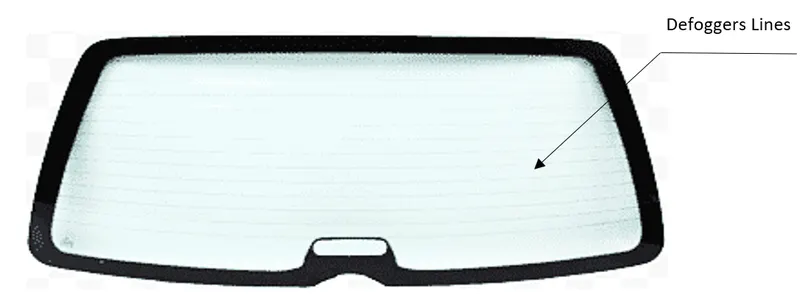
Fig.(3) Rear Windshield
- When it comes to rear windshield in some car models, we have noticed that 4 to 5 dotted lines are here in windshield from one end to other so why do we have here, those are not actually lines those are filaments, they are there in case of rainy season and winter season or too much AC in car those filaments are actually going to be heated and they act as defoggers in the rear windshield.
Basic dimensions and basic shape need to be followed during designing the windshield.
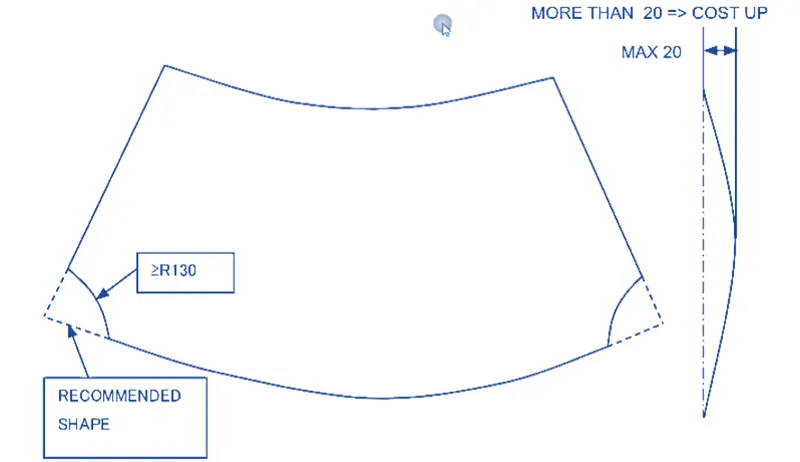
Fig.(4) Shape of Front Windshield
- Here the above shape is either going to be square or rectangle.
- There are two basic dimensions one is Open and other is closed shape
- The open shape is the dotted lines that is shown above and it is recommended shape
- In case when we have a close shape, the recommended value is that the radius od the closure should be greater than or equal to radius 130mm
- This is so, because windshield is quite brittle in nature and in order to work with this windshield in various level of manufacturing process it is quite hard if it’s radius less than 130mm.
- Windshield usual thickness will be 4.7mm
- In order to increase the ease of workability with glass component we need a minimum radius 130mm this will make sure that the scrap rate of windshield production is lesser.
- Whenever the windshield glass is going to be bend it is recommended that its bending value does not go beyond 20mm.
- If bending value is more than 20mm its process and production cost will increase
- The rejection rate in metal working production should be in between 2% to 3% but in glass production it is going to be 25%.
Types of Windshields Glasses:
- Curved laminated glass
- Curved tempered glass
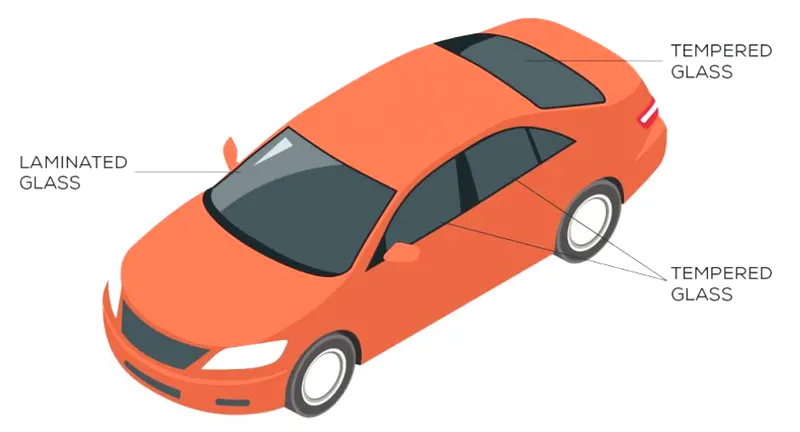
Fig.(5) Types of Windshield
Curved laminated glass:
- High Strength
Unlike normal glass, laminated glass consists of two panes of glass with an interlayer of polyvinyl butyral in between. This thickness, along with the interlayer material, builds up the strength of the glass. There is more material for a projectile, that is, energy transference from an impact, to penetrate through. The strong plastic interlayer possesses high tensile strength and good rigidity. All this means that it would take a lot of force to break through a windshield of laminated glass, unlike conventional single pane glass.
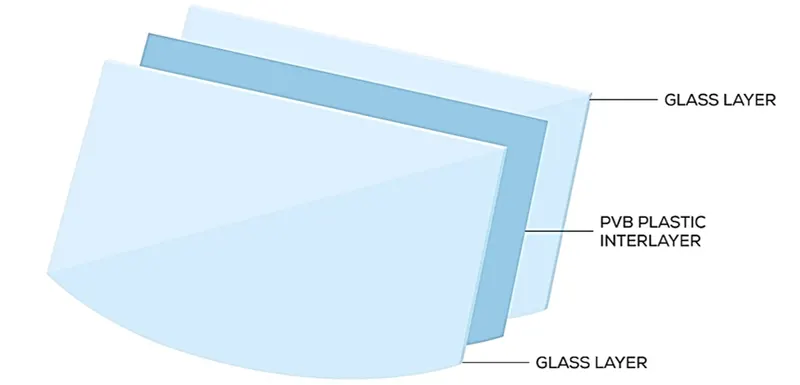
Fig.(6) Layers of Windshield
- Resistance to Shattering
Laminated glass also displays high resistance to shattering. Where many standard windshields crack under normal to above normal pressure, laminated glass can remain intact. The interlayer holds the broken glass fragments in place using compressional forces. This means that laminated glass does not shatter. Thus, it also cuts down the risk of cuts and injuries and ensures the safety of the driver and passengers.
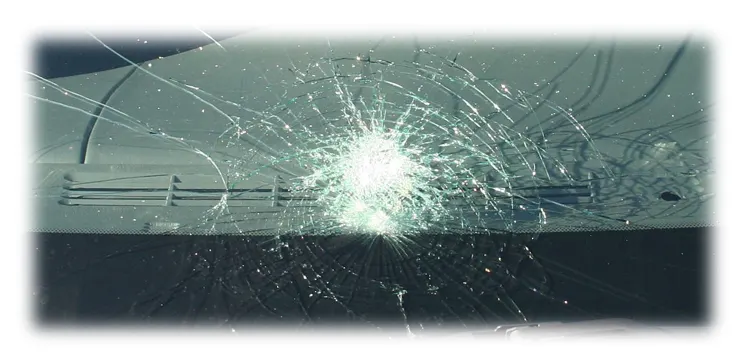
Fig.(7) Shattering Windshield
- Sound Proofing
Laminated glass acts as a strong barrier to outside noise. Most of the sound waves passing through laminated glass get absorbed by its two layers of glass panes and the interlayer. The high soundproofing ability of laminated glass prevents the driver from distracted by outside noises and therefore it is less likely to incur damage because of audible external distraction.
- Security
Laminated glass also protects passengers from projectiles that can come from stone chips being thrown up from the road or passing alongside a gritter. The high strength and blast resistance to projectiles of laminated glass give the passengers much greater security. A conventional glass will get a hole on being hit by a projectile and leave small shards of glass all around with some being released towards the passengers. Laminated glass, on the other hand, is unlikely to be penetrated fully and therefore, the glass shards released are minimal. In case of serious damage, the windshield will have to be replaced before taking it to the road again.
5.Blocks UV rays
The firm resist the effect of ultraviolet light and temperature changes so that it may appear clear and strong for a long year of use.
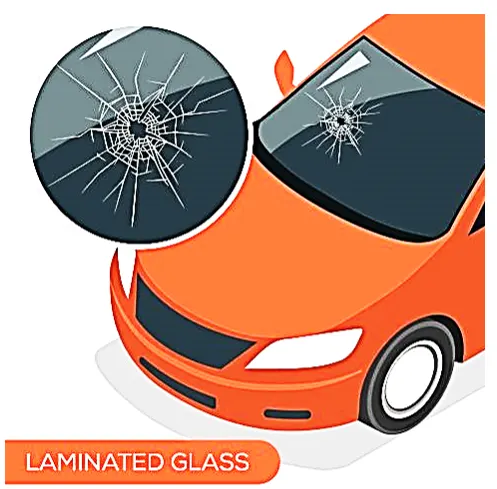
Fig.(8) Laminated Glass
Curved Laminated Glass Production Flow
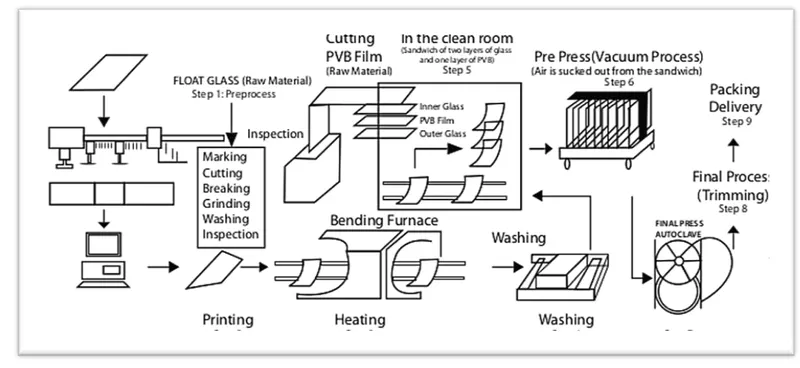
Fig.(9) Process Flow Diag. of Curved Laminated Windshield
Curved tempered glass:
- Temperedor toughened glass is a type of safety glass processed by controlled thermal or chemical treatments to increase its strength compared with normal glass.
- Tempered glass can be made from annealed glass via a thermal tempering process. The glass is placed onto a roller table, taking it through a furnace that heats it well above its transition temperatureof 650 to around 680°C. Then Quenching it by et of air.
- The compressive force created in the glass surface makes it 3 to 5 times stronger than untreated glass and highly resistant to thermal shocks.
- When broken, the glass shatters into small granular chunks rather than splintering into jagged shards as ordinary annealed glass does.
- Side door, rear door and backdoors uses tempered glass because it breaks into smaller pieces and does not create long sharp which will cause serious injury to passenger.
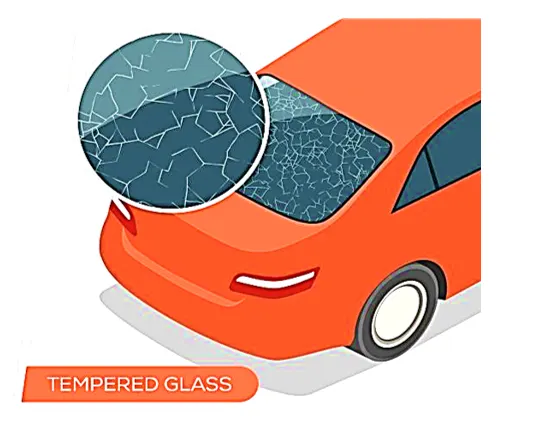
Fig.(10) Tempered Glass
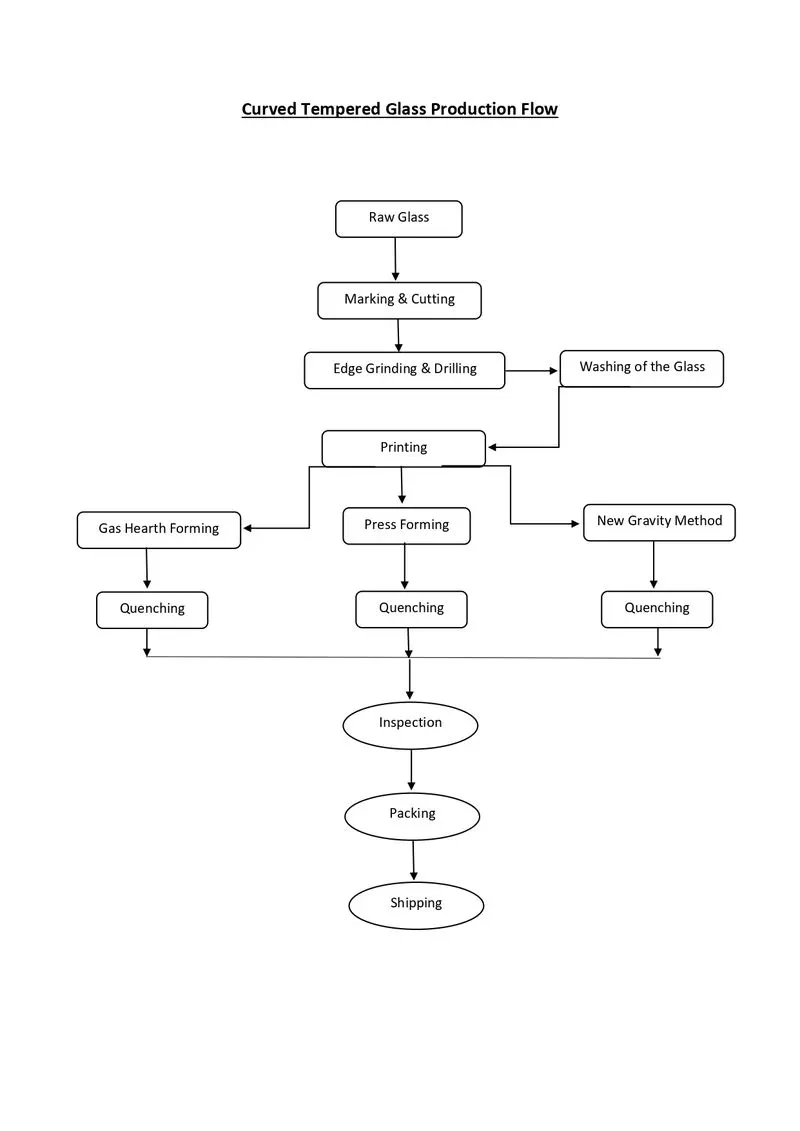
Fig.(11) Production Flow Chart of tempered Glass
Design Of Windshield in NX CAD
Aim: To Design the front windhield from the given styling. Also give appropiat headliners and Thickness
Given Data: Styling as shown Below.
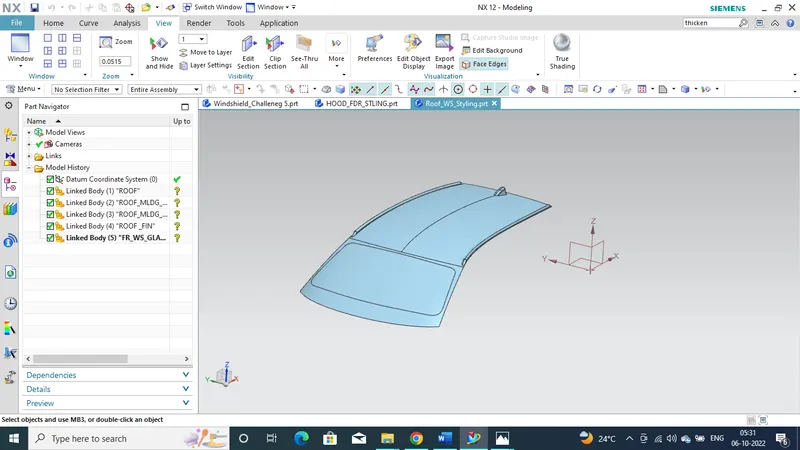 Fig.(12) Styling Data
Part Navigator:
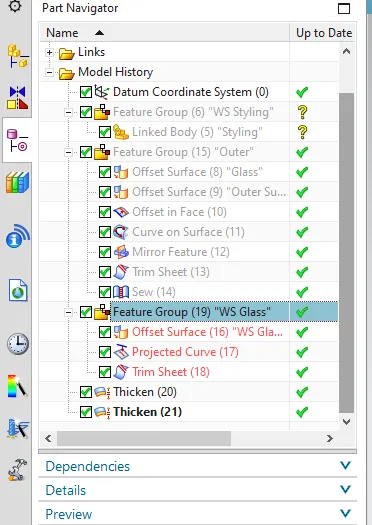
Fig.(12) Part Navigator
Steps followed during designing the windshield:
- We have a styling given
- Rename it and put it into one feature group named WS Styling.
- Extract the surfaces from the sheet, make two offset surface one for glass and other for headliner, renamed it "Glass" and "Outer"/"Headliner".
- In order to create the curve, offset the curve to make a cut on the headline.
- Take one half of the view and make a curve giving G1 continuity.
- Now Clip the section
- Use mirror feature in order to make mirror of the curve.
- Now trim the sheet (Headliner) with respect to the curve.
- Hide Feature Group “WS Styling”, Offset in face, curve on surface and mirror feature
- Now Sew two separate entities together.
- Make them all in one feature group name it “Outer”/"Headliner".
- Make same cut on the glass.
- For such that again do offset surface and project the curve.
- Now trim the sheet (Glass)
- Change the color for glass and headliner
- Again, make a one feature group named “WS Glass”
- Thicken The headliner to 4.5mm and glass also to 4.5 mm
- Again, change the appearance for both the headliner and glass.
- Shaded the translucency to 90 since it is a glass
- Now we have a required windshiled design.
Curve on the surface for Covel:
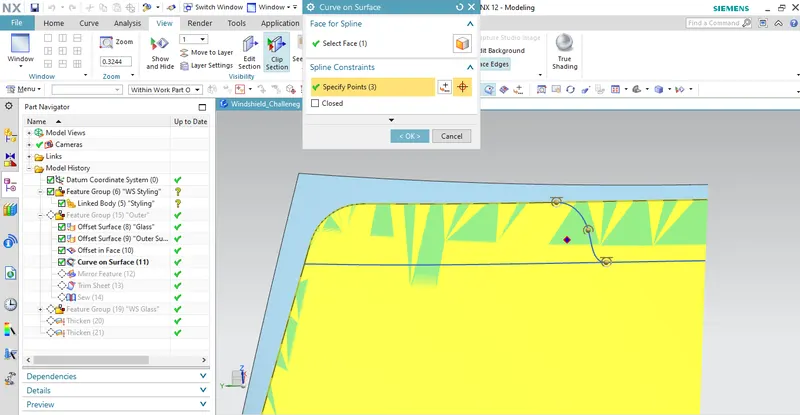
Fig.(13) Curve on Surface
Thickness Given:
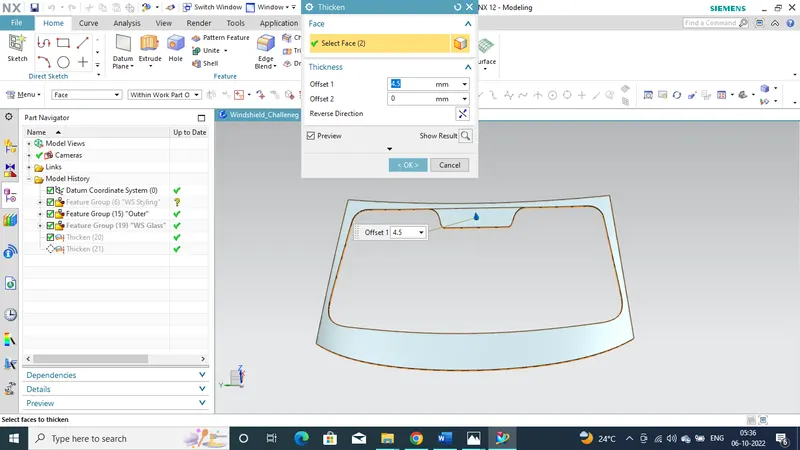 Fig.(14) Thickness of the surface
Given Thickness to Outer/Headliner: 4.5mm
Given Thickness to Glass: 4.5mm
Result:
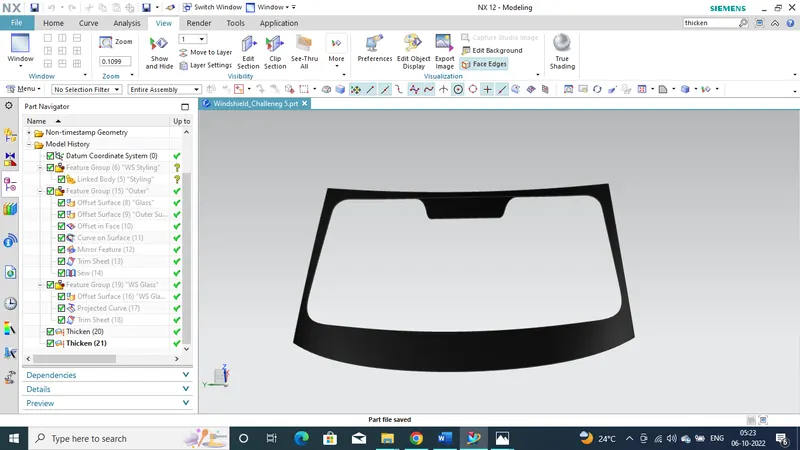
Fig.(12) Required Windshield
The above is the result of design of windshiled as per given styling data.