Project 1 Hood
ABSTRACT:
A car hood also referred to as a bonnet in some other countries is the hinged cover that rests over the engine of a front-engine vehicle. Its purpose is to provide access to the engine for repair and maintenance. Car hoods are typically constructed from steel and sometimes from aluminum.
In UK terminology, a hood refers to a fabric covering over the passenger compartment of the car (known as the “roof” or “top” in the US). For many motor vehicles built in the 1930s and 1940s, the resemblance to an actual hood is clear when it is opened and viewed from the front; in modern vehicles, it still serves the same purpose, but no longer resembles head covering.
On front-engined cars, the hood may be hinged at either the front or the rear edge, or in earlier models (e.g. the Ford Model T) it may be split into two sections, one on each side, each hinged along the centerline. A further variant combines the bonnet and wheel arches into one section and allows the entire front bodywork to tilt forwards around a pivot near the front of the vehicle.
Objective:
The main objective of this project is to come up with a design idea for the bonnet BIW that satisfies the manufacturing requirements, functional requirements and as well as Euro NCAP standards
COMPONENTS:
The hood or the Bonnet consists of the following parts.
- Hood outer panel
- Hood inner panel
- Latch and Striker re-enforcement
- Hinge re-enforcement
Manufacturing process:
While designing the inner panel hood that will be manufactured using the deep drawing process, there are some minimum requirements that we need to fulfil:
- Minimum fillet radius = 3mm+Thickness
- No sharp corners inside the component
- No curvatures lesser than 5mm
- Small embosses should not exceed the maximum depth of 6mm (staying on the safe side)
- Mounting areas and welding areas need to be flat
- Provide appropriate corner relief on the area of curvature.
Mastic Sealant:
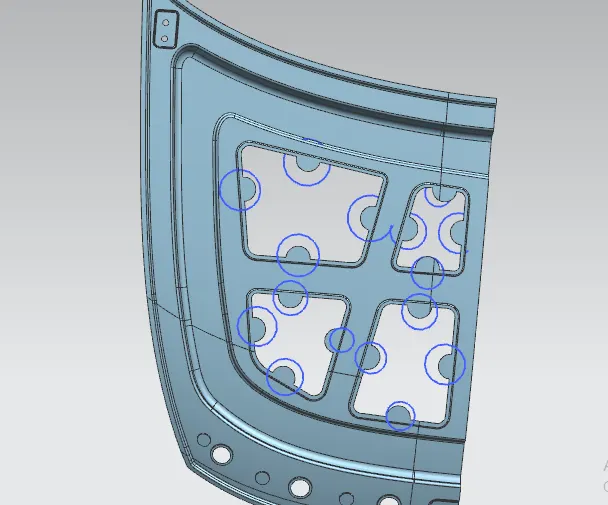
The Mastic sealant or the Mastic point is an elastic compound that behaves like a rubber. The mastic points are defined on the hood inner panel where the hood can easily deform. They help the hood outer panel to come back to its original shape after it gets deformed. The mastic has an influence area of 80mm
Emboss:
To mould or carve (a decoration or design) on (a surface) so that it is raised above the surface in low relief is called as emboss. This emboss is designed to divert the force which is created during a sudden impact or collision from getting towards the passenger compartment into sideways towards the hinges. This diversion is necessary according to safety regulations of the passengers and the pedestrians.
Hemming:
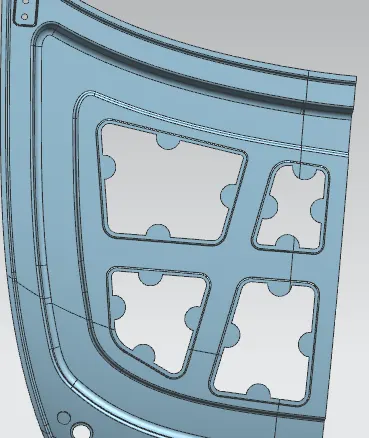
Hemming is the process of joining both the outer and inner panel together. The hemming process roles and wraps the hood outer panel around the inner panel and holds it tightly together.
In car part production, hemming is used in assembly as a secondary operation after deep drawing, trimming and flanging operations to join two sheet metal parts (outer and inner) together. Typical parts for this type of assembly are hoods, doors, trunk lids and fenders.
The accuracy of the hemming operation is very important since it affects the appearance of the surface and surface quantity. Material deformations, which occur during the hemming process, can lead to dimensional variations and other defects in parts. Typical hemming defects are splits or wrinkles in the flange, material overlaps in the corner areas or material roll-in. This is why it is important to use simulation tools in order to, on the other hand, significantly reduce the number of “trial and error” loops during try-out and production.
Latch Trajectory:
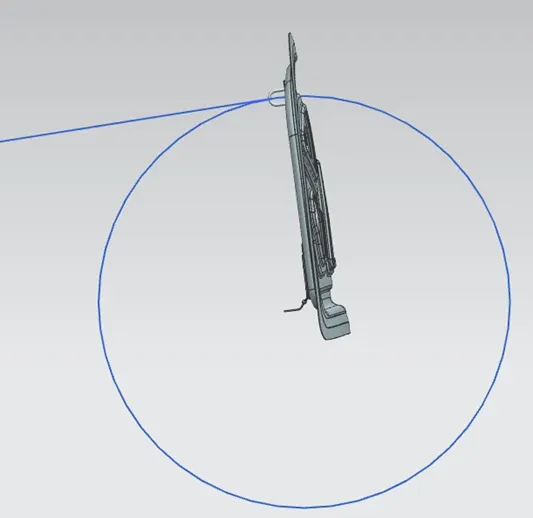
Latch trajectory is the path which decides the striker movement when the hood is opened/closed. This trajectory is created with the help of hinge rotation axis. With reference to the hinge axis a circle is drawn with required dimension and then a tangent line is created which is perpendicular to the reinforcement. This line and circle is said to be the latch trajectory.
Conclusion:
Therefore, we have designed a hood that falls under the rules and regulations of the manufacturer's standards.With the completion of the design and analyzing it for successful manufacturability, we can conclude that this can be utilized for a vehicle. Also, the design was executed under the EuroNCAP safety standards and hence satisfies hood safety both for occupants and the pedestrians.