Project 1 - Device Master File
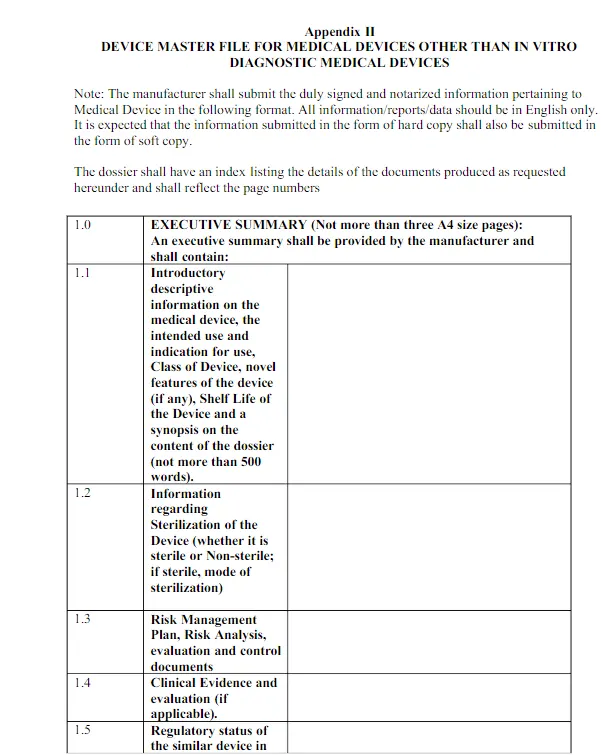
Device Master File provides confidential information related to about facilities, manufacturing processes, sterilization, packaging materials, and contract packaging and storing of the products, as well as nonclinical and clinical study data] associated with device regulatory submissions to a specific country. This file may contain general description of the device, its variance, intended purpose, & accessories in combination with other device, Warnings, mode of action scientifically demonstrated with description and novel features of the device. They may also include, device specifications, for example, drawings, calculations, components relevant GSPR information, tissues of human and animal origin, toxicity, biological safety and biocompatibility with stability, storage, analytical performance with verification and validation information with clinical data risk management analysis, including risk minimizing measures.
DEVICE MASTER RECORD/File DEFINITION
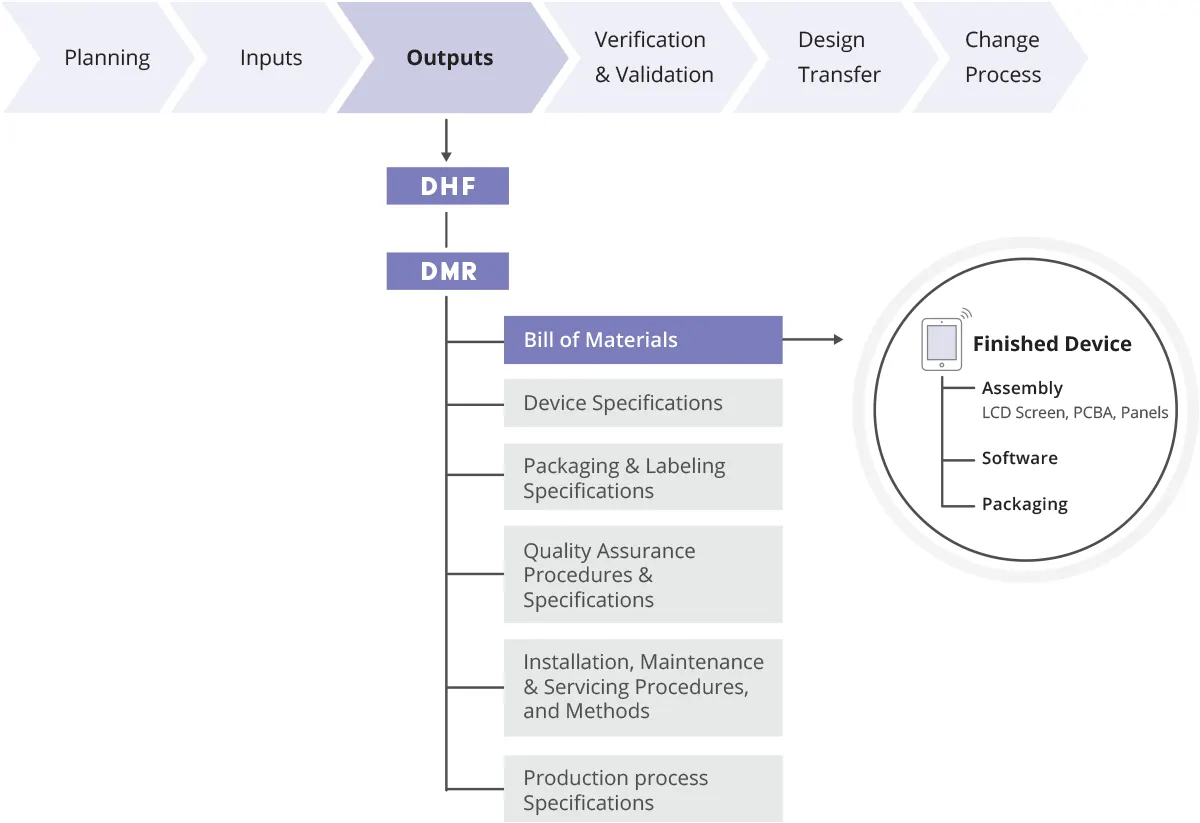
A device master record (DMR) is a collection of records that contains the procedures and specifications for a finished medical device. According to the FDA quality system regulation, a device master record should include, or refer to the location of, the following items:
(a) Device specifications including appropriate drawings, composition, formulation, component specifications, and software specifications
(b) Production process specifications including the appropriate equipment specifications, production methods, production procedures, and production environment specifications
(c) Quality assurance procedures and specifications including acceptance criteria and the quality assurance equipment to be used
(d) Packaging and labeling specifications, including methods and processes used
(e) Installation, maintenance, and servicing procedures and methods
Source: https://www.accessdata.fda.gov
A Device Master File (DMF) is a confidential document that is submitted to a regulatory agency, such as the US Food and Drug Administration (FDA), to provide information about a medical device. The DMF contains detailed information about the device, including its design, manufacturing processes, sterilization, packaging materials, and clinical data. It may also include information about the intended use of the device, any risks associated with its use, and any measures that have been taken to minimize those risks. The DMF is intended to provide regulators with the information they need to evaluate the safety and effectiveness of the device, and to determine whether it meets the regulatory requirements for marketing and use in a specific country.
A device master file (DMF) is a document that contains confidential, detailed information about a medical device or pharmaceutical product. It is submitted to regulatory authorities, such as the US Food and Drug Administration (FDA) or the European Medicines Agency (EMA), to provide information about the design, manufacture, and testing of the product.
DMFs are typically used for products that are difficult to describe in a traditional regulatory submission, such as products with complex designs or those that use new technologies. DMFs can also be used to provide information about raw materials, component parts, and finished products that are used in the manufacture of a medical device or pharmaceutical product.
Regulatory authorities may require that companies submit a DMF as part of the process of obtaining marketing authorization for a product. DMFs are typically kept confidential and are not made available to the public. However, regulatory authorities may share information from a DMF with other regulatory agencies or with other interested parties, such as academic researchers or manufacturers of related products, in order to promote the safe and effective use of the product.
Design output means the results of a design effort at each design phase and at the end of the total design effort. The finished design output is the basis for the device master record. The total finished design output consists of the device, its packaging and labeling, and the device master record.
For some devices, many of the design output documents are the same as the device master record documents. Other device output information is used to create a DMR drawing such as for a test or an inspection procedure. Figure 6.1 shows the close relationship between design output and the device master record.
The DMR for each type of device shall include, or refer to the location of, the following information:
(a) Device specifications including appropriate drawings, composition, formulation, component specifications, and software specifications;
(b) Production process specifications including the appropriate equipment specifications, production methods, production procedures, and production environment specifications;
(c) Quality assurance procedures and specifications including acceptance criteria and the quality assurance equipment to be used;
(d) Packaging and labeling specifications, including methods and processes used; and
(e) Installation, maintenance, and servicing procedures and methods
Regulatory authorities may require that companies submit a DMF as part of the process of obtaining marketing authorization for a product. DMFs are typically kept confidential and are not made available to the public. However, regulatory authorities may share information from a DMF with other regulatory agencies or with other interested parties, such as academic researchers or manufacturers of related products, in order to promote the safe and effective use of the product.
The Food and Drug Administration (FDA) has established classifications for approximately 1,700 different generic types of devices and grouped them into 16 medical specialties referred to as panels. Each of these generic types of devices is assigned to one of three regulatory classes based on the level of control necessary to assure the safety and effectiveness of the device. The three classes and the requirements which apply to them are:
Device Class and Regulatory Controls
1. Class I General Controls
- With Exemptions
- Without Exemptions
2. Class II General Controls and Special Controls
- With Exemptions
- Without Exemptions
3. Class III General Controls and Premarket Approval
The class to which your device is assigned determines, among other things, the type of premarketing submission/application required for FDA clearance to market. If your device is classified as Class I or II, and if it is not exempt, a 510k will be required for marketing. All devices classified as exempt are subject to the limitations on exemptions. Limitations of device exemptions are covered under 21 CFR xxx.9, where xxx refers to Parts 862-892. For Class III devices, a premarket approval application (PMA) will be required unless your device is a preamendments device (on the market prior to the passage of the medical device amendments in 1976, or substantially equivalent to such a device) and PMA's have not been called for. In that case, a 510k will be the route to market.
Device classification depends on the intended use of the device and also upon indications for use. For example, a scalpel's intended use is to cut tissue. A subset of intended use arises when a more specialized indication is added in the device's labeling such as, "for making incisions in the cornea". Indications for use can be found in the device's labeling, but may also be conveyed orally during sale of the product. A discussion of the meaning of intended use is contained in The 510(k) Program: Evaluating Substantial Equivalence in Premarket Notification [510(k)].
In addition, classification is risk based, that is, the risk the device poses to patient and/or the user is a major factor in the class it is assigned. Class I includes devices with the lowest risk and Class III includes those with the greatest risk.
As indicated above all classes of devices as subject to General Controls. General Controls are the baseline requirements of the Food, Drug and Cosmetic (FD&C) Act that apply to all medical devices, Class I, II, and III.
- Learning of regulatory policies requiring the information about device master file.
- Understanding the requirements of market clearance of devices in the Indian market.
- Requirements on product description including risk analysis related to design & manufacturing processes.
- Characteristics of verification & validation – Analytical & clinical performance reports.
- Understanding the stability of the products – Shelf-life, in Use, shipping
- Requirement of labelling for all class of device.
- Understanding the necessities of post market surveillance – Vigilance, PSUR, PMSP, PMSR, etc.,
kkmm
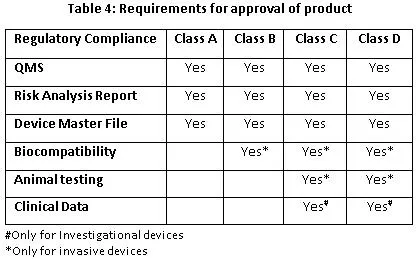
The process for obtaining market clearance for medical devices in India generally involves the following steps:
- Classification of the medical device: Medical devices are classified into four categories based on their intended use and potential risk to the user. Class A devices are considered low-risk and do not require any regulatory clearance, while Class B, C, and D devices are considered to have increasing levels of risk and require progressively more stringent regulatory clearance.
- Registration of the device: Manufacturers of Class B, C, and D devices must register their products with the CDSCO before they can be sold in India. This involves submitting a registration application and supporting documentation, including information about the device's design, intended use, and manufacturing process.
- Testing and certification: Manufacturers of Class B, C, and D devices must also obtain a certificate of conformity from the CDSCO, which confirms that the device meets the relevant quality, safety, and performance standards. This may involve submitting the device for testing at an accredited laboratory.
- Marketing authorization: Manufacturers of Class C and D devices must also obtain marketing authorization from the CDSCO before they can be sold in India. This involves submitting a marketing authorization application and supporting documentation, including clinical data demonstrating the safety and effectiveness of the device.
It is significant to note that getting market certification for medical equipment in India can be a difficult and drawn-out procedure. Manufacturers must be ready to back their applications with thorough and in-depth documentation, and they must collaborate closely with regulatory affairs specialists to guarantee that their goods adhere to all applicable laws.
As part of the procedure for obtaining market clearance, regulatory agencies frequently demand companies in the pharmaceutical and medical device sectors to produce comprehensive information regarding the design, production, and testing of their goods. This covers details about the intended usage, technical specs, usability, and safety profile of the product.
Product description is an important part of this process, as it provides regulatory authorities with a clear and comprehensive understanding of the product and how it is intended to be used. Product descriptions typically include information about the product's design, materials, and manufacturing processes, as well as its intended use, intended population, and any relevant contraindications or precautions.
Risk analysis: The regulatory process also includes risk analysis, which aids regulatory authorities in evaluating potential risks related to a product and determining whether it is safe and effective for the use for which it is designed. The process of doing a risk analysis often include determining and assessing the potential dangers posed by a product's construction, components, and manufacturing methods, as well as putting in place the necessary protections and controls to reduce such dangers.
In addition to providing information about the product and its risks, companies may also be required to provide data from clinical trials or other studies demonstrating the safety and effectiveness of the product. This may include data on the product's performance, side effects, and any other relevant clinical outcomes.
Risk Management
For making sure that the things checked above do not happen, several things have been kept in mind during the designing of the machine. The materials that are used in the machine are electric proof, will prevent the fire from happening and are temperature sensitive and can easily disperse the heating that happens from overcharing the device and also its continuous use. Also sensors are added to the design to make sure the machine does not pull the blood out of the patient if the nurse accidentally puts the infusion set in reverse.
Analytical performance reports are documents that provide detailed information about the analytical methods and testing procedures used to evaluate a product's quality and performance. These reports may include information about the accuracy, precision, and sensitivity of the analytical methods, as well as the results of the testing.
Clinical performance reports are documents that provide detailed information about the clinical studies conducted to evaluate a product's safety and effectiveness. These reports may include information about the study design, population, and results, as well as any adverse events or other clinical outcomes observed during the study.
Stability is an important consideration in the development and manufacture of medical devices. It refers to the ability of a product to maintain its quality and performance over time, under specified storage and handling conditions.
Shelf-life is the period of time during which a product is expected to remain stable and suitable for use, when stored under the conditions specified by the manufacturer. Shelf-life is typically determined through stability testing, which involves storing the product under specified conditions and periodically evaluating its quality and performance over time.
In-use stability refers to the ability of a product to maintain its quality and performance when it is being used or administered. This may be influenced by factors such as the product's handling and storage conditions, as well as the duration of use.
Shipping stability refers to the ability of a product to maintain its quality and performance during transportation. This may be influenced by factors such as the product's packaging, handling, and storage conditions, as well as the duration of transportation and the environmental conditions encountered during shipping.
Stability testing is an important part of the regulatory process, as it helps to ensure that products are safe and effective for their intended use. Manufacturers are typically required to provide stability data as part of the process of obtaining market clearance for their products. This may include data on the product's shelf-life, in-use stability, and shipping stability, as well as any relevant storage and handling instructions.
Labelling is an important aspect of the regulatory process for medical devices, as it helps to ensure that products are properly identified and that their intended use, risks, and instructions for use are clearly communicated to users.
Regulatory authorities typically have specific requirements for the labelling of medical devices, which may vary depending on the class of the device. In general, medical device labels must include the following information:
-
Product name and identifier: The label must include the product's trade name or identifying mark, as well as its model or catalogue number.
-
Manufacturer's name and address: The label must include the name and address of the manufacturer or distributor of the device.
-
Intended use: The label must include a clear and concise statement of the device's intended use, as well as any relevant contraindications or precautions.
-
Directions for use: The label must include detailed instructions for using the device safely and effectively, including any necessary warnings or precautions.
-
Cautionary statements: The label must include any necessary cautionary statements or warnings related to the use of the device, such as the risk of adverse reactions or potential interactions with other products.
-
Sterilization method: If the device is intended to be sterile, the label must include information about the method of sterilization used.
-
Expiration date: If the device has a limited shelf-life, the label must include the expiration date.
-
CE mark: In the European Union, medical devices must bear a CE mark to indicate that they meet the relevant regulatory requirements.
It is important to note that these requirements may vary depending on the specific regulatory jurisdiction and the class of the device. Manufacturers should consult with regulatory affairs professionals and consult the relevant regulations to ensure that their products are properly labelled.
Technical specifications of a device for instance infusion pumps
-
Flow rate programmable range atleast from 0.1 nl/hr to 1000ml/hr.
-
Saves last infusion rate even when the AC power is switched off.
-
Bolus rate should be programmable to approx, 500ml, with infused volume display.
-
Selectable occulusion pressure trigger levels selectable from 300, 500 and 900 mmHg.
-
Accuracy of +-2% or better for set parameters.
-
Maximum pressure generated 20 psi.
-
Pause infusion facility required.
-
Self-check carried out on powering on.
-
Comprehensive alarm package required including: occlusion alarm, near end of infusion pre-alarm and alarm, volume limit pre-alarm and alarm, low battery pre-alarm and alarm, AC power failure, drive disengaged.
-
It should be open system
Physical Characterstics
-
Dimensions: NA
-
Weight: 150gms
-
Configuration: Tamper resistant case made of impact resistant material. Securely mountable on tabletop, IV stand or bed fitting.
-
Noise: Noise free
-
Mobility: Yes
Energy Source
-
Voltage: 220V, 60Hz
-
Battery operated: Yes, backup of 50 hours
-
Tolerance: +-10%
-
Protection: Battery powered alarm for power failure or disconnection
Working condition of the machine and how it should be cleaned
The machine is capable of operating continuously in ambient temperature of 0 to 50 deg C and relative humidity of 15 to 90% ideal circumstances. The machine should be cleaned only with alcohol or chlorine.
Biocompatibility test
Biocompatibility is the most commonly used term to describe appropriate biological requirements of a biomaterial or biomaterials used in a medical device. Biocompatibility has also been described as the ability of a material to perform with an appropriate host response in a specific application. Biocompatibility or safety evaluation addresses the identification of an appropriate host response. The goal of this chapter is to provide a pathway or roadmap for the practical approach to the identification of biocompatibility and/or safety. This chapter discusses biocompatibility, materials for medical devices, and in vitro and in vivo tests for biocompatibility. It also discusses inflammation, wound healing, and the foreign body reaction.
Brief note on Accuracy and Precision Test.
Calibration is the most necessary thing that helps in minimizing the uncertainity in measurements. Because of that there are less chances for errors.Especially when it comes to medical devices safety is the priority for FDA so precision and accuracy is most important.Precision and Accuracy states that how close the instrument will work as per the standards. This is utmost important factors as wrong values would affect the diagnosis and would be hazardous for patients. As time goes by there are some differences in measurements of instrument so for this FDA has safety standards for calibration for maintenance of original standards. FDA might recall for drift in precision and accuracy.
Brief note on Analytical Sensitivity Test
Sensitivity indicates how likely a test is to detect a condition when it is actually present in a patient.1 A test with low sensitivity can be thought of as being too cautious in finding a positive result, meaning it will err on the side of failing to identify a disease in a sick person. When a test’s sensitivity is high, it is less likely to give a false negative. In a test with high sensitivity, a positive is positive.
brief note about Analytical Specificity Test?
"Analytical specificity" refers to the ability of an assay to measure on particular organism or substance, rather than others, in a sample. An assay's analytical sensitivity and analytical specificity are distinct from that assay's clinical diagnostic sensitivity and diagnostic specificity.
Specificity refers to the ability of a test to rule out the presence of a disease in someone who does not have it.1 In other words, in a test with high specificity, a negative is negative. A test with low specificity can be thought of as being too eager to find a positive result, even when it is not present, and may give a high number of false positives. This could result in a test saying that a healthy person has a disease, even when it is not actually present. The higher a test’s specificity, the less often it will incorrectly find a result it is not supposed to.
Brief note on Metrological traceability Test
Metrological traceability is the fundamental concept of modern measurements. It assures the inter-comparability of measurement results globally and is required by standards such as ISO 9001, USP, ISO 17025 and many more.Metrological traceability is a property of a measurement result. This means that, although it is sometimes stated, a measurement device or instrument cannot be traceable. It is only a result that is (or is not) traceable. Metrological traceability always requires a reference. This can be the definition of a unit or a realization of a unit (a measurement standard). According to this definition, an organization cannot be a reference.
Brief note on Measuring range of the assay Test
The analytical range or reportable range is the analyte concentration range over which the measurement is within the declared tolerances for imprecision and bias of the method. In practice, the upper limit is often set by the linearity limit of the instrument response and the lower limit corresponding to the lower limit of quantification (LoQ).
Brief note on Claimed Shelf Life Test
Shelf-life testing is a critical step in preparing a medical device for the market and is mandatory for all products. Fail to perform this testing correctly and you will likely have to recall products, and risk significant damage to your market profile.There are many reasons one needs to know the shelf life of medical devices. Engineers are tasked with discovering a device’s expiration date so that it can be used by medical professionals. In the world of healthcare and medical devices and supplies, there must be stringent testing procedures to ensure safety. Here are some things that go into determining shelf life of medical devices.
The shelf life of medical devices is determined by putting a device through a variety of testing procedures and many engineers follow this step by procedure to avoid any errors:
Describe the organizational processes for determining the phases of testing.
Put together a sampling plan that includes the amount of devices used, as well as how often each will be sampled, selection criteria, and what has to be sampled.
Design a plan for simulating shipping environments to determine an accurate shelf life.
Use follow-up procedures to define steps that could be taken after the test is finished.
Note on Labelling and Packaging
The device is labelled as Class B since the machine will be using invasing procedure to provide the medicine to the patient. the packaging of the material is made in a way that the package does not get damaged during the delivering procedure. The packaging is made out of 100% recyclable material and several layers are used so that the packaging is quite sturdy when it comes to bumps and slight nudging during the delivering. The shelf-life of the product is quite good since the machine needs to be put on patients for use. The shelf life of the material outlasts the shelf life other products in the market. Also the PCB is sturdy and better at handling heat as well as the components used are of good quality.
Note on Post Marketing Surveillance Study
Post-market surveillance is the ongoing process of monitoring and evaluating the safety and performance of medical devices after they have been placed on the market. It is an important part of the regulatory process, as it helps to ensure that medical devices continue to meet the relevant regulatory requirements and remain safe and effective for their intended use.
There are several mechanisms and activities that are commonly used as part of post-market surveillance, including:
-
Vigilance: Vigilance refers to the process of monitoring and reporting adverse events or other safety concerns related to medical devices. Manufacturers are typically required to establish and maintain vigilance systems to identify and report any potential safety issues that may arise after a device has been placed on the market.
-
Periodic Safety Update Reports (PSURs): PSURs are documents that provide an overview of the safety and performance of a medical device over a specified period of time. Manufacturers are typically required to submit PSURs to regulatory authorities on a regular basis, in order to provide updates on the safety and performance of their products.
-
Post-market surveillance plans (PMSPs): PMSPs are documents that outline the specific post-market surveillance activities that a manufacturer plans to undertake in order to monitor and evaluate the safety and performance of a medical device. PMSPs may include activities such as clinical follow-up studies, analysis of adverse event reports, or monitoring of product performance.
-
Post-market surveillance reports (PMSRs): PMSRs are documents that provide a summary of the results of post-market surveillance activities. Manufacturers are typically required to submit PMSRs to regulatory authorities on a regular basis, in order to provide updates on the safety and performance of their products.
-
User Manuals (BAsic adn technical)
-
Service Manual
-
Calibration certificate
-
All of the accessories and parts price list and part number
-
Post market surveillance reports
-
AMC and CMC
Post-market surveillance is an important part of the regulatory process, as it helps to ensure that medical devices continue to meet the relevant regulatory requirements and remain safe and effective for their intended use. Manufacturers should work closely with regulatory affairs professionals to ensure that their post-market surveillance activities are in compliance with all relevant regulations.