Project 1- Creating your own OpenFOAM solver
AIM: Use the icoFoam solver to create your own solver - scalarFoam.
Description:
Solver Name: icoFoam
Directory: applications/solvers/incompressible/icoFoam
The icoFoam is transient solver for incompressible and laminar flows. It solves the Navier-Stokes equation using the PISO(Pressure Iimplicit with Spliting of Operators) algorithm.
The scalar transport equation is defined as:
`(dels)/(delt) + nabla.(us) = 0`
where s is the scalar quantity being transported by the velocity u.
Procedure:
- First, I copied the icoFoam solver from applications/solvers/incompressible/icoFoam and renamed it as scalarFoam.
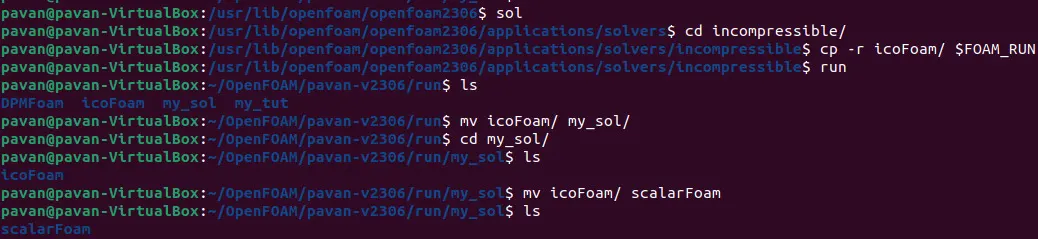
- Here, the copied the icofoam tutorial from the $FOAM_TUTORIALS/incompressible/icoFoam/cavity as a test case, and moved it into the scalarFoam solver file.

- scalarFoam.c
/*---------------------------------------------------------------------------*\ ========= | \\ / F ield | OpenFOAM: The Open Source CFD Toolbox \\ / O peration | \\ / A nd | www.openfoam.com \\/ M anipulation | ------------------------------------------------------------------------------- Copyright (C) 2011-2016 OpenFOAM Foundation Copyright (C) 2019 OpenCFD Ltd. ------------------------------------------------------------------------------- License This file is part of OpenFOAM. OpenFOAM is free software: you can redistribute it and/or modify it under the terms of the GNU General Public License as published by the Free Software Foundation, either version 3 of the License, or (at your option) any later version. OpenFOAM is distributed in the hope that it will be useful, but WITHOUT ANY WARRANTY; without even the implied warranty of MERCHANTABILITY or FITNESS FOR A PARTICULAR PURPOSE. See the GNU General Public License for more details. You should have received a copy of the GNU General Public License along with OpenFOAM. If not, see <http://www.gnu.org/licenses/>. Application icoFoam Group grpIncompressibleSolvers Description Transient solver for incompressible, laminar flow of Newtonian fluids. \heading Solver details The solver uses the PISO algorithm to solve the continuity equation: \f[ \div \vec{U} = 0 \f] and momentum equation: \f[ \ddt{\vec{U}} + \div \left( \vec{U} \vec{U} \right) - \div \left(\nu \grad \vec{U} \right) = - \grad p \f] Where: \vartable \vec{U} | Velocity p | Pressure \endvartable \heading Required fields \plaintable U | Velocity [m/s] p | Kinematic pressure, p/rho [m2/s2] \endplaintable \*---------------------------------------------------------------------------*/ #include "fvCFD.H" //#include "pisoControl.H" // * * * * * * * * * * * * * * * * * * * * * * * * * * * * * * * * * * * * * // int main(int argc, char *argv[]) { argList::addNote ( "Scalar solver for scalar quantity being transported by velocity U" ); #include "postProcess.H" #include "addCheckCaseOptions.H" #include "setRootCaseLists.H" #include "createTime.H" #include "createMesh.H" //pisoControl piso(mesh); #include "createFields.H" //#include "initContinuityErrs.H" // * * * * * * * * * * * * * * * * * * * * * * * * * * * * * * * * * * * // Info<< "\nStarting time loop\n" << endl; while (runTime.loop()) { Info<< "Time = " << runTime.timeName() << nl << endl; #include "CourantNo.H" // Momentum predictor fvScalarMatrix sEqn ( fvm::ddt(s) + fvm::div(phi, s) //- fvm::laplacian(nu, U) ); solve(sEqn); runTime.write(); runTime.printExecutionTime(Info); } Info<< "End\n" << endl; return 0; } // ************************************************************************* //
Here, the scalar quantity 's' is defined as sEqn and stored it in fvScalarMatrix. In the sEqn the LHS side the first term is the time derivative of s i.e.., `(dels)/(delt)` and the second term is a convection term i.e.., divergence of velocity cector field (`nabla.(us)`). - createFields.H
Info<< "Reading transportProperties\n" << endl;

/*IOdictionary transportProperties
(
    IOobject
    (
        "transportProperties",
        runTime.constant(),
        mesh,
        IOobject::MUST_READ_IF_MODIFIED,
        IOobject::NO_WRITE
    )
);

dimensionedScalar nu
(
    "nu",
    dimViscosity,
    transportProperties
);

dimensionedScalar su
(
    "su",
    dimViscosity,
    transportProperties
);*/

Info<< "Reading field U\n" << endl;
volVectorField U
(
    IOobject
    (
        "U",
        runTime.timeName(),
        mesh,
        IOobject::MUST_READ,
        IOobject::AUTO_WRITE
    ),
    mesh
);


Info<< "Reading field s\n" << endl;
volScalarField s
(
    IOobject
    (
        "s",
        runTime.timeName(),
        mesh,
        IOobject::MUST_READ,
        IOobject::AUTO_WRITE
    ),
    mesh
);


#include "createPhi.H"


/*label sRefCell = 0;
scalar sRefValue = 0.0;
setRefCell(s,  sRefCell, sRefValue);
mesh.setFluxRequired(s.name());
*/
Here, created IOobject fields of U and s in this file.
- Make/files
scalarFoam.C EXE = scalarFoam - Make/options
EXE_INC = \ -I$(LIB_SRC)/finiteVolume/lnInclude \ -I$(LIB_SRC)/meshTools/lnInclude EXE_LIBS = \ -lfiniteVolume \ -lmeshTools
Then run the solver by using the command 'wmake' and results as follows:
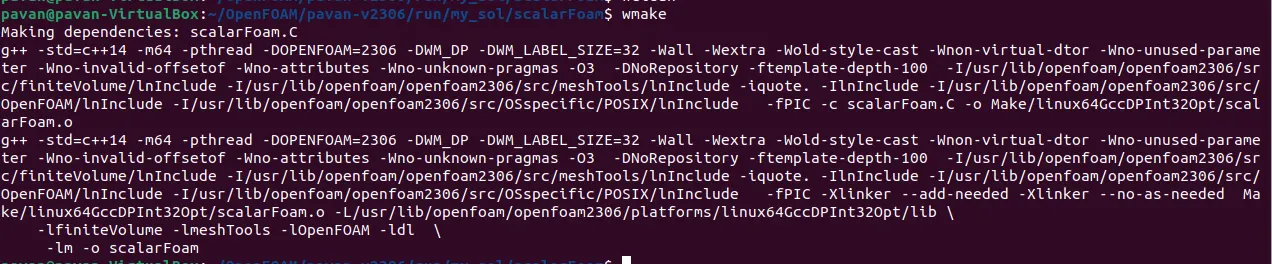
Here, no error is found, and our solver is working fine. Then, Now setup the test case files i.e.., scalarCavity files as follows
Now inside the sclarCavity there are '0', 'constant', 'system' folders.
- system/ blockMeshDict
Here, the test case is a rectangle of dimensions 5x1x1 meter. And the boundries are named as inlet, outlet, frontAndback, topAndbottom. And defined the boundary type of each boundary as shown above./*--------------------------------*- C++ -*----------------------------------*\ | ========= | | | \\ / F ield | OpenFOAM: The Open Source CFD Toolbox | | \\ / O peration | Version: v2306 | | \\ / A nd | Website: www.openfoam.com | | \\/ M anipulation | | \*---------------------------------------------------------------------------*/ FoamFile { version 2.0; format ascii; class dictionary; object blockMeshDict; } // * * * * * * * * * * * * * * * * * * * * * * * * * * * * * * * * * * * * * // scale 1; vertices ( (0 0 0) (5 0 0) (5 1 0) (0 1 0) (0 0 1) (5 0 1) (5 1 1) (0 1 1) ); blocks ( hex (0 1 2 3 4 5 6 7) (500 100 1) simpleGrading (1 1 1) ); edges ( ); boundary ( inlet { type patch; faces ( (0 4 7 3) ); } outlet { type patch; faces ( (2 6 5 1) ); } frontAndBack { type empty; faces ( (3 7 6 2) (1 5 4 0) ); } topAndbottom { type wall; faces ( (0 3 2 1) (4 5 6 7) ); } ); mergePatchPairs ( ); // ************************************************************************* // - system/ controlDict
/*--------------------------------*- C++ -*----------------------------------*\ | ========= | | | \\ / F ield | OpenFOAM: The Open Source CFD Toolbox | | \\ / O peration | Version: v2306 | | \\ / A nd | Website: www.openfoam.com | | \\/ M anipulation | | \*---------------------------------------------------------------------------*/ FoamFile { version 2.0; format ascii; class dictionary; object controlDict; } // * * * * * * * * * * * * * * * * * * * * * * * * * * * * * * * * * * * * * // application scalarFoam; startFrom startTime; startTime 0; stopAt endTime; endTime 2; deltaT 0.005; writeControl timeStep; writeInterval 20; purgeWrite 0; writeFormat ascii; writePrecision 6; writeCompression off; timeFormat general; timePrecision 6; runTimeModifiable true; // ************************************************************************* //Here, the solver is renamed as scalarFoam and also defined the start time and endtime and deltaT to our case setup as shown above.
- fvSchemes
/*--------------------------------*- C++ -*----------------------------------*\ | ========= | | | \\ / F ield | OpenFOAM: The Open Source CFD Toolbox | | \\ / O peration | Version: v2306 | | \\ / A nd | Website: www.openfoam.com | | \\/ M anipulation | | \*---------------------------------------------------------------------------*/ FoamFile { version 2.0; format ascii; class dictionary; object fvSchemes; } // * * * * * * * * * * * * * * * * * * * * * * * * * * * * * * * * * * * * * // ddtSchemes { default Euler; } gradSchemes { default Gauss linear; } divSchemes { default none; div(phi,s) Gauss upwind; } laplacianSchemes { default Gauss linear corrected; } interpolationSchemes { default linear; } snGradSchemes { default orthogonal; } // ************************************************************************* // - fvSolutions
/*--------------------------------*- C++ -*----------------------------------*\ | ========= | | | \\ / F ield | OpenFOAM: The Open Source CFD Toolbox | | \\ / O peration | Version: v2306 | | \\ / A nd | Website: www.openfoam.com | | \\/ M anipulation | | \*---------------------------------------------------------------------------*/ FoamFile { version 2.0; format ascii; class dictionary; object fvSolution; } // * * * * * * * * * * * * * * * * * * * * * * * * * * * * * * * * * * * * * // solvers { s { solver PBiCG; preconditioner DILU; tolerance 1e-06; relTol 0.05; } } // ************************************************************************* // - setFieldsDict
/*--------------------------------*- C++ -*----------------------------------*\ | ========= | | | \\ / F ield | OpenFOAM: The Open Source CFD Toolbox | | \\ / O peration | Version: v2306 | | \\ / A nd | Website: www.openfoam.com | | \\/ M anipulation | | \*---------------------------------------------------------------------------*/ FoamFile { version 2.0; format ascii; class dictionary; object setFieldsDict; } // * * * * * * * * * * * * * * * * * * * * * * * * * * * * * * * * * * * * * // defaultFieldValues ( volScalarFieldValue s 0 ); regions ( boxToCell { box (1 0.2 0.2) (2 0.8 0.8); fieldValues ( volScalarFieldValue s 1 ); } ); // ************************************************************************* //
Here, a setFieldsDict is setup as shown above. Here two scalarfields are defined at s=0 and s=1 fieldvalues. One phase is at setfield of 0 and another phase is made at setfield of 1. - 0/s file
/*--------------------------------*- C++ -*----------------------------------*\ | ========= | | | \\ / F ield | OpenFOAM: The Open Source CFD Toolbox | | \\ / O peration | Version: 2306 | | \\ / A nd | Website: www.openfoam.com | | \\/ M anipulation | | \*---------------------------------------------------------------------------*/ FoamFile { version 2.0; format ascii; arch "LSB;label=32;scalar=64"; class volScalarField; location "0"; object s; } // * * * * * * * * * * * * * * * * * * * * * * * * * * * * * * * * * * * * * // dimensions [0 0 0 0 0 0 0]; internalField uniform 0; boundaryField { inlet { type zeroGradient; } outlet { type zeroGradient; } frontAndBack { type empty; } topAndbottom { type zeroGradient; } } // ************************************************************************* // - 0/ U file
/*--------------------------------*- C++ -*----------------------------------*\
| =========                 |                                                 |
| \\      /  F ield         | OpenFOAM: The Open Source CFD Toolbox           |
|  \\    /   O peration     | Version:  v2306                                 |
|   \\  /    A nd           | Website:  www.openfoam.com                      |
|    \\/     M anipulation  |                                                 |
\*---------------------------------------------------------------------------*/
FoamFile
{
    version     2.0;
    format      ascii;
    class       volVectorField;
    object      U;
}
// * * * * * * * * * * * * * * * * * * * * * * * * * * * * * * * * * * * * * //

dimensions      [0 1 -1 0 0 0 0];

internalField   uniform (2 0 0);

boundaryField
{
    inlet
    {
        type            fixedValue;
        value           $internalField;
    }

    outlet
    {
        type            zeroGradient;

    }

    frontAndBack
    {
        type            empty;
    }
    topAndbottom
    {
        type            noSlip;
    }
}


// ************************************************************************* //
And here the velocity at inlet is 2m/sec.
Post-Processing:
Run the solver on the test case by using the following commands:
1. blockMesh: Used to create the mesh as the specifications provided inside the blockMeshDict file
2. setFields: Used to setup the phases of the case file as per instructions given inside the setFieldsDict
3. scalarFoam: Finally run the scalarFoam solver to start the stimulation.
4. paraFoam: Used to visualize the results.
Results:
Here, the courant number is resulted as 0.5
And the residual of 's' as intial residual = 0.00307136 and final residual = 2.85487e-17
At timestep = 0
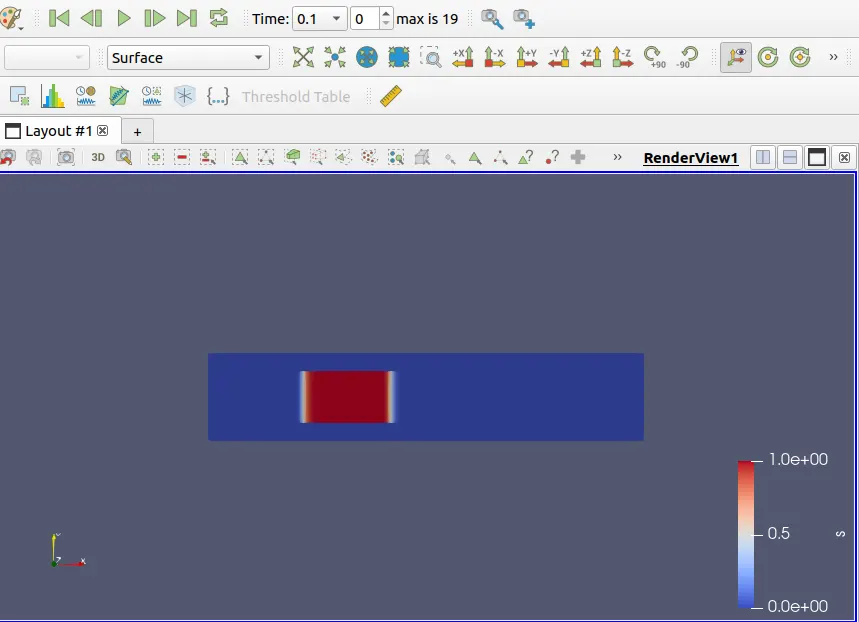
At the final timestep = 2
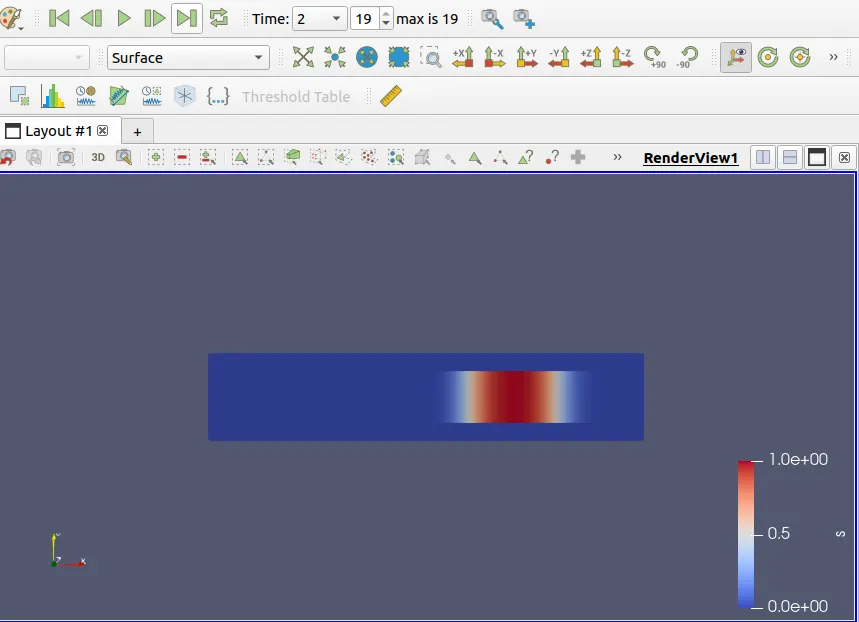
Here the animated results are attached in the given link: https://drive.google.com/file/d/13bwnoTbHvILuHNaVAKnk0sMyDUubU1Xl/view?usp=drive_link