Project 1_Comparative study of different storey buildings for Seismic forces
Aim:
- To model the buildings from A to K as per the details given in the challenge:
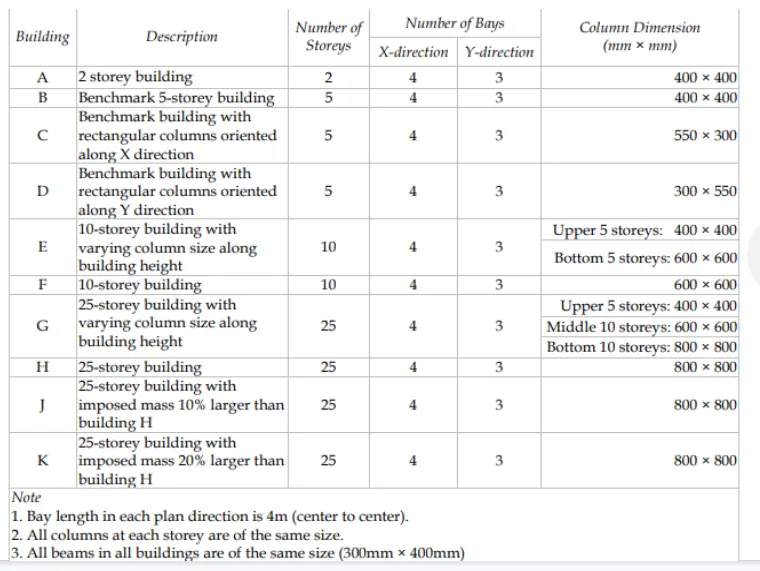
- To to carry out a comparative study of these buildings for seismic forces.
In this project we need to find out the effects of various parameters on Natural period of the building as well as on the mode shapes of oscillations, details of which are given below:
- Factors affecting Natural period of building:
- Effect of stiffness on T: Compare fundamental natural periods of buildings E & F as well as G & H. Why is there a marginal or significant difference in the fundamental natural periods?
- Effect of mass on T: Compare fundamental natural periods of buildings H, J and K. Have the buildings become more flexible or stiff due to change in mass?
- Effect of Building Height on T: How does the fundamental natural periods of Buildings A, B, F and H change with change in building height?
- Effect of Column Orientation on T: How does the fundamental natural periods of Buildings B, C and D change with change in column orientation?
- Factors influencing the mode shapes of oscillations:
- Effect of Flexural Stiffness of Structural Elements on mode shapes: Compare fundamental mode shape of Building B in two situations when flexural stiffness of beams relative to that of adjoining columns is very small versus when it is large.
- Effect of Axial Stiffness of Vertical Members on mode shapes: Compare fundamental mode shape of Building H in two situations when axial cross-sectional area of columns is very small versus when it is large.
- Effect of Degree of Fixity at column bases on mode shape: Compare fundamental mode shape of Building B in two situations when base of columns is pinned versus when it is fixed.
PROCEDURE:
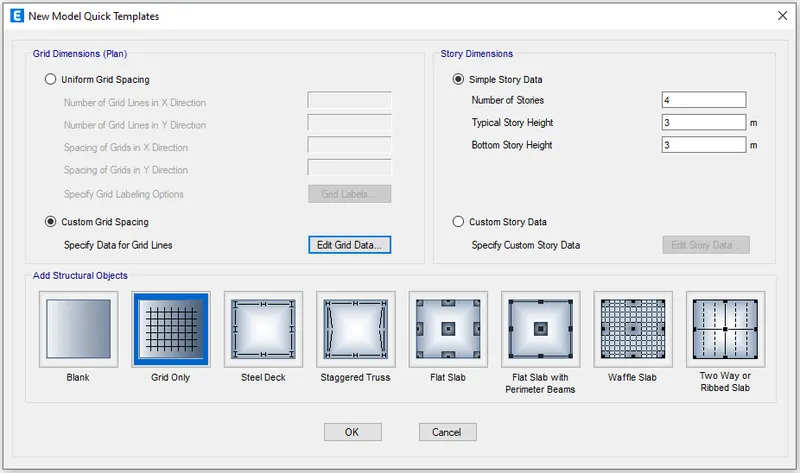
- Open the ETABS software and provide units, grid and storey data.
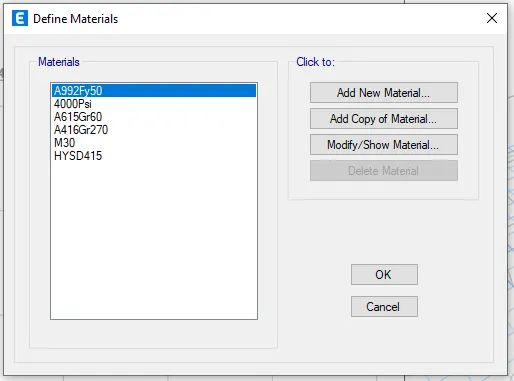
- Now, define the material property and section properties.
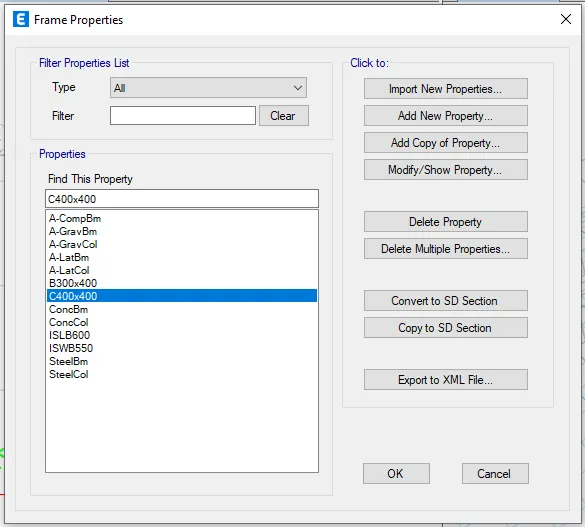
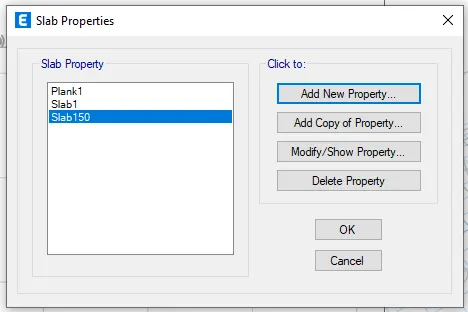
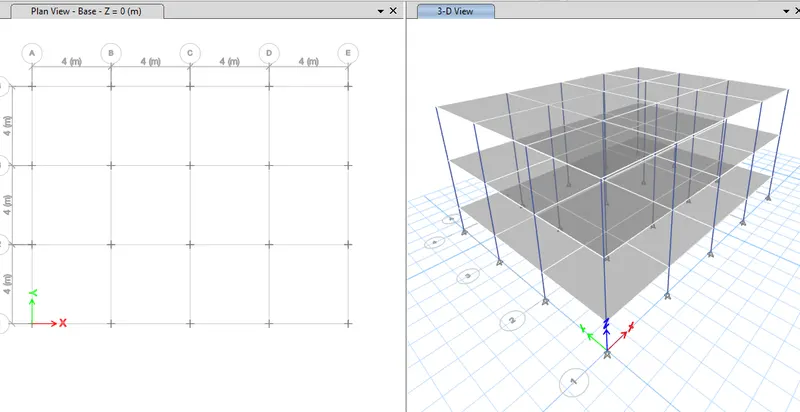
- Now, add the columns, beams and slabs.
- After applying frame components it looks as given below:
- Now assign loads to the frame members and floors.
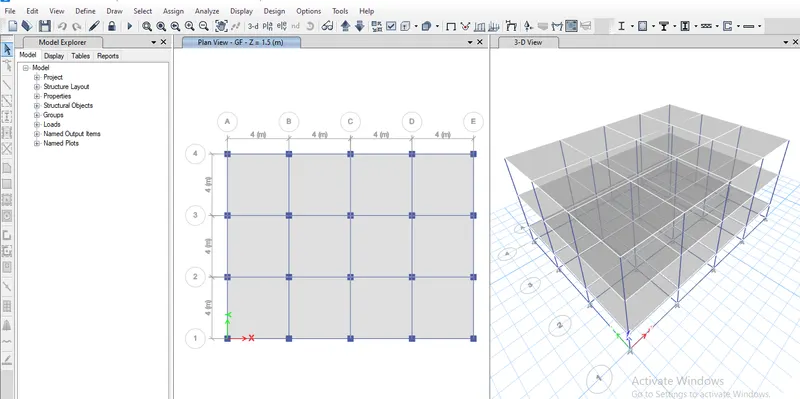
- After assigning all the loads, check the model and run the analysis.The results are as follows:
- Building A:
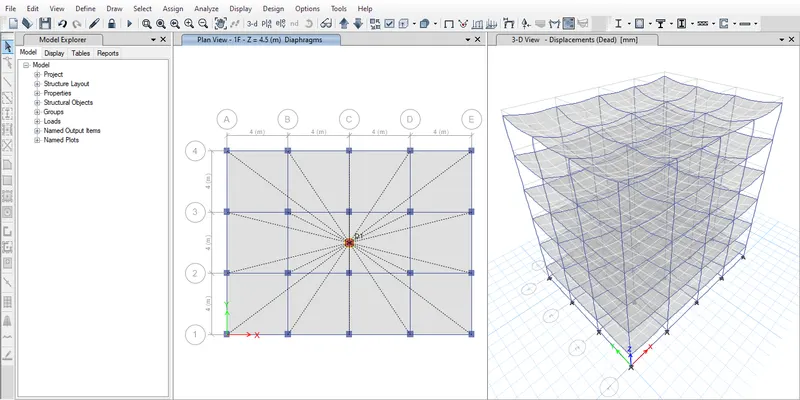
- Similarly repeat the same process for other buildings. The results are as follows:
- Building B:
- Building C:
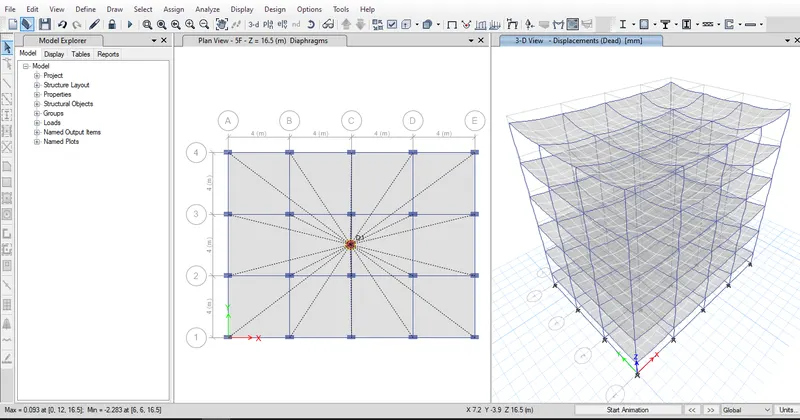
- Building D:
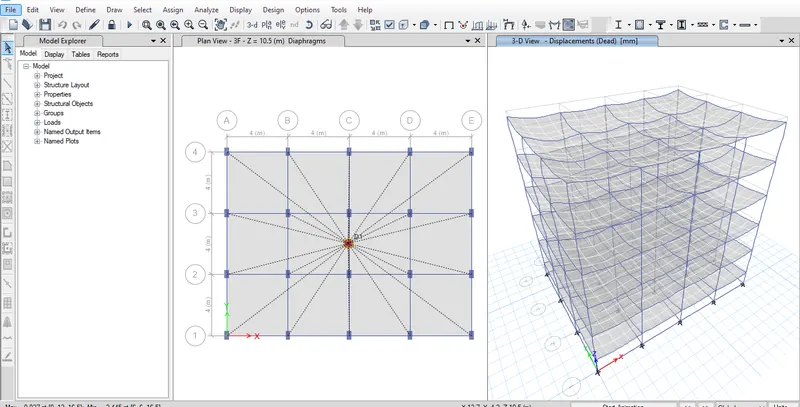
- Building E:
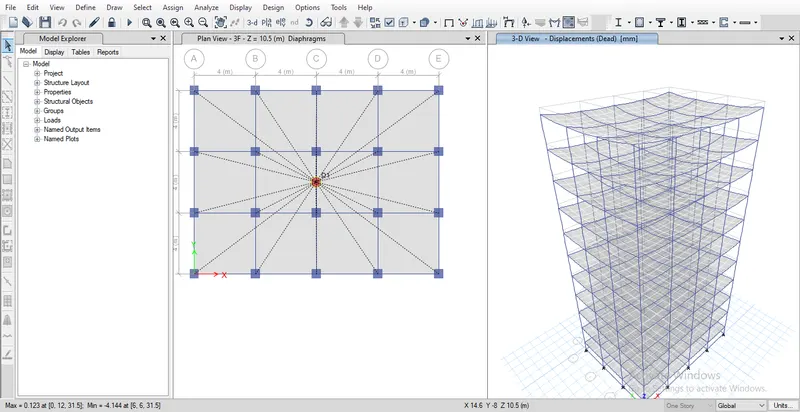
- Building F:
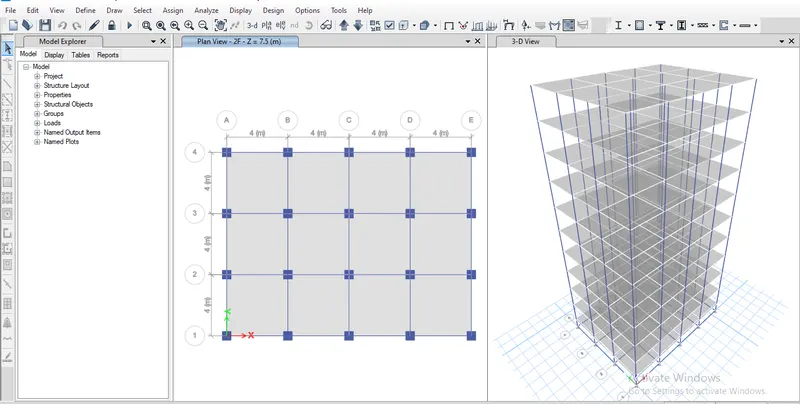
- Building G:
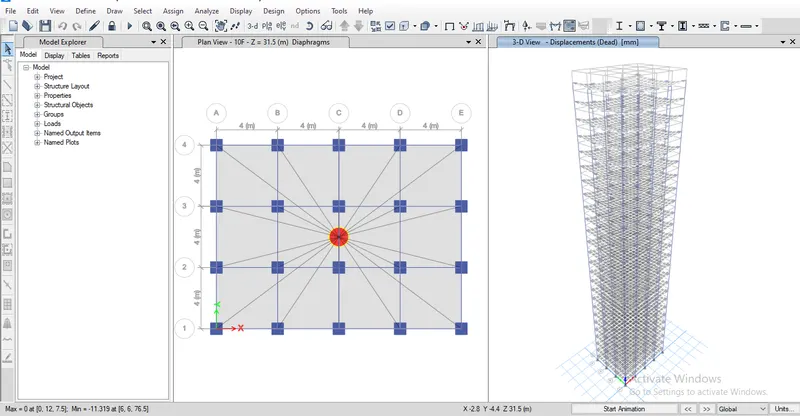
- Building H:
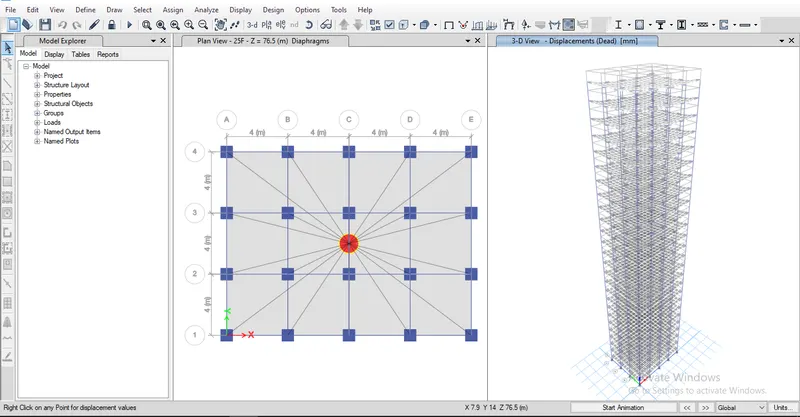
- Building J:
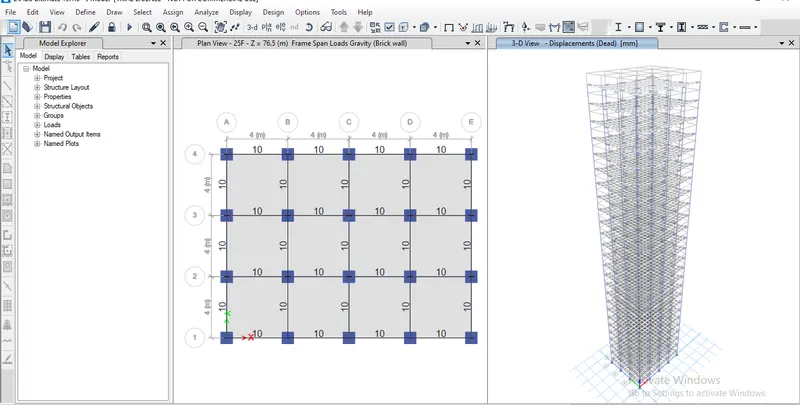
- Building K:
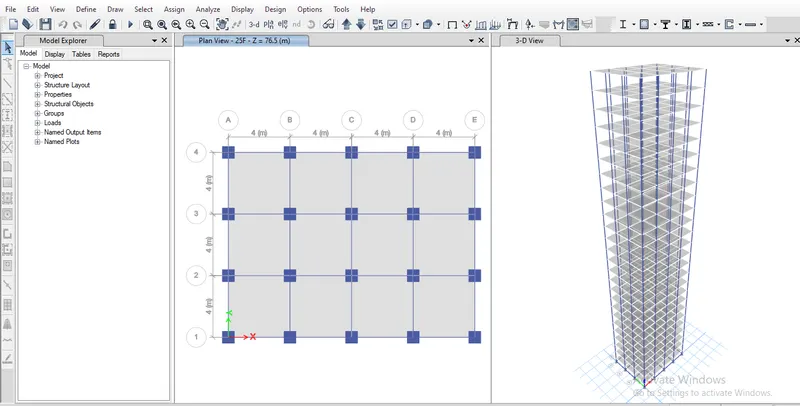
- Modelling of the buildings is completed.
- Now, lets compare to find out the differences .
Effect of stiffness on T: ( considering first three modes)
- For buildings E & F:
-
Building E Building F Tx = 1.59s
Tx = 1.635s Ty = 1.638s
Ty = 1.683s Tz = 1.434s
Tz = 1.495s
-
- For buildings G & H:
Building G Building H Tx = 3.982s Tx = 4.158s Ty = 4.154s Ty = 4.338s Tz = 3.552s Tz = 3.773s
- In both E & F buildings and G & H buildings, the difference in time period is very less
- In buildings E & F, the total mass of the structure varies, as the column size varies in Building E whereas in building F the column size is uniform. Similarly, in building G & H also both the buildings are 25 storey buildings but their masses varies due to the variation in column sizes.
- Buildings E and G has comparatively less mass compared to the buildings F and H respectively and also the time period of the E and G is also less than that of F and H respectively.
- Now, considering the stiffness of the structures, in both the structures the columns are arranged in a regular manner and hence there won't be much shift in the centre of stiffness from centre of mass. Hence, the small difference in time period of the two buildings is mainly due to the difference in their masses.
T ∝ 1/k
Effect of mass on T : ( comparing H, J and K buildings)
| Building H | Building J | Building K |
| Tx = 4.158s | Tx = 4.166s | Tx = 4.174s |
| Ty = 4.338s | Ty = 4.346s | Ty = 4.354s |
| Tz = 3.773s | Tz = 3.778s | Tz = 3.784s |
- All the three buildings have same storey height and column sizes, but the mass imposed on the buildings vary.
- Here, the variation of time period in the three buildings is very minimal in range and this variation is due to the variation in the mass imposed on it which adds to the total mass of the building.
Effect of building height on T: ( Comparing buildings A,B,F and H)
| Building A (2 storey) | Building B (5 Storey) | Building F (10 Storey) | Building H (25 Storey) |
| Tx = 0.439s | Tx = 0.988s | Tx = 1.635s | Tx = 4.158s |
| Ty = 0.447s | Ty = 1.009s | Ty = 1.683s | Ty = 4.338s |
| Tz = 0.397s | Tz = 0.89s | Tz = 1.495s | Tz = 3.773s |
- From the above table it is clear that, with the increase in height the time period of the building also increases.
- This is because as the height increases the stiffness of the building decreases, as stiffness is inversely proportional to height of the structure and as the stiffness decreases the time period of the building increases as T∝1/k.
Effect of column orientation on T: ( Comparing buildings B, C and D)
- In Building B, all the columns are squares i.e 400mmx400mm, hence, the entire stiffness of the building will be equal in both X and Y directions`
| Building B (Column 400x400) |
| Tx = 0.988s |
| Ty = 1.009s |
| Tz = 0.89s |
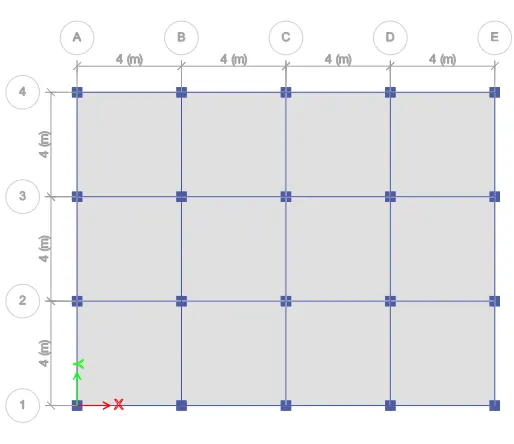
- In Building C the longer edge of the column is arranged in X direction as shown in the figure below.
- Hence, the stiffness will be more in X direction compared to y direction. So, the time period will be less in X direction and will be more in Y direction. That is the reason for this building to have the least time period in X direction.
| Building C (Column 550x300) |
| Tx = 0.837s |
| Ty = 1.041s |
| Tz = 0.757s |
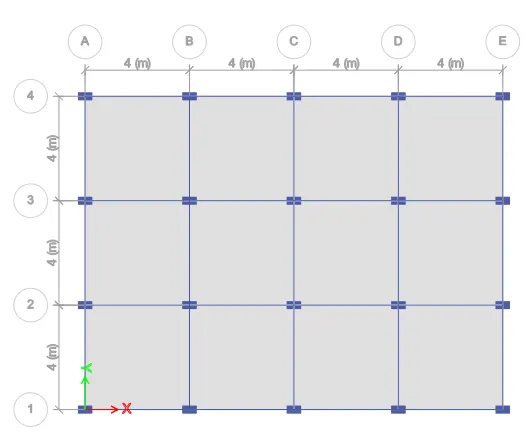
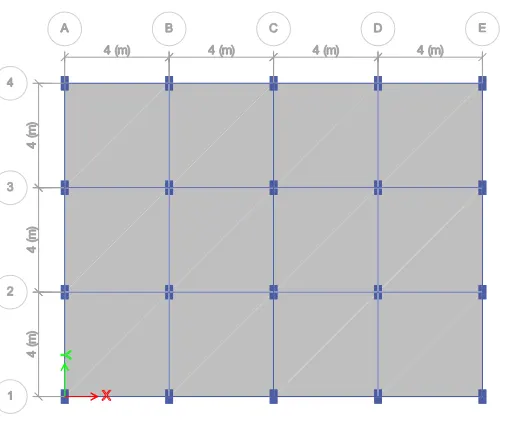
- In Building D, the longer edge of the column is arranged in Y direction as shown below and as such the stiffness of the structure in the Y direction is higher compared to X direction. So, the time period of the structure will be lesser in the Y direction than in X direction.
| Building D (Column 300x550) |
| Tx = 0.916s |
| Ty = 1.109s |
| Tz = 0.869s |
Effect of flexural stiffness of structural elements on mode shapes:
- Comparing the fundamental mode shapes of the building B in two situations:
1. For the original building B.
2. For the building B with flexural stiffness very small compared to the original building.
- So, for this we need to develop another model B with lesser flexural stiffness of beam.
- In this model the moment of inertia about the 2 and 3 axis is changed to 0.1.
| Original building B | Modified building B1 |
| Tx = 0.988s | Tx = 1.768s |
| Ty = 1.009s | Ty = 1.791s |
| Tz = 0.89s | Tz = 1.696s |
- From table, it is clear that the time period of the building has been increased.
- As the flexural stiffness of the beam is reduced, the building becomes more flexible and the time period is increased as they are inversely proportional between.
Effect of Axial stiffness of vertical members on mode shapes:
- Comparing the mode shape of building H in two situations:
1. Original building H
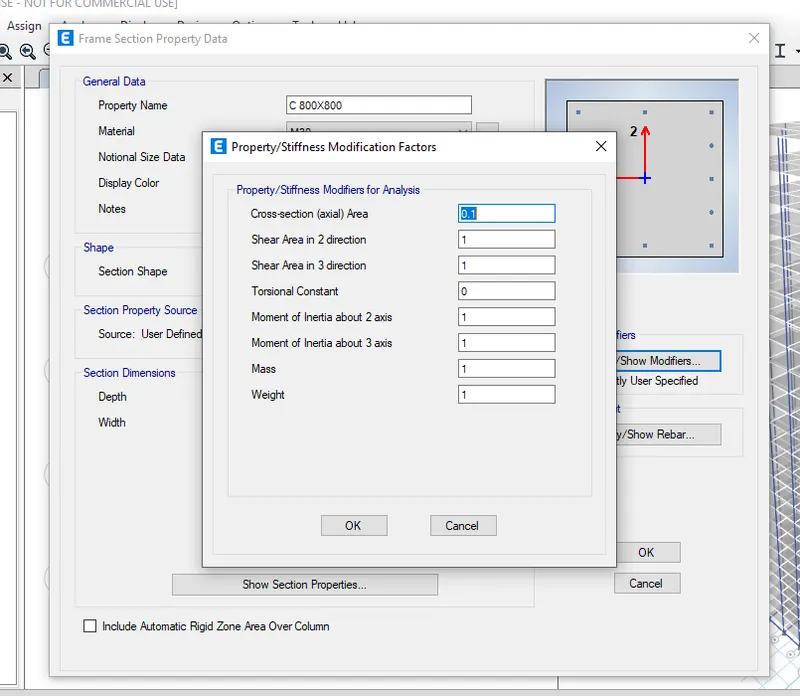
2. When axial cross sectional area of the column is reduced by a factor of 0.1.
- So, for this we need to develop another model H with smaller axial cross section of column.
| Original building H | Modified building H1 |
| Tx = 4.158s | Tx = 5.412s |
| Ty = 4.338s | Ty = 6.145s |
| Tz = 3.773s | Tz = 3.82s |
- Here, as the axial stiffness of column is reduced, the time period of the building is increased.
Effect of Degree of fixidity at column bases on mode shape:
- Comparing the mode shape of building B in two situations:
1. Original building B i.e when the base is pinned
2. Another model of the building B, when the base of the column is fixed.
| Original building B | Modified building B2 |
| Tx = 0.988s | Tx = 0.967s |
| Ty = 1.009s | Ty = 0.987s |
| Tz = 0.89s | Tz = 0.87s |
- From the table we can understand that, as the support is changed from pinned to fixed, the time period of the building got reduced.
Results:
All the 10 building models from A to K have been analysed and comparitive study has been made with regarding to the time period of the structures.