Project 1
ANSWER
WIRING HARNESS FOR ENGINE
AIM
- The wire harness's location for the specified engine.
- All packaging regulations and industry best practises covered in this course must be applied, as shown in the design.
- As needed, apply protective covers.
INTRODUCTION
WIRING HARNESS OR CABLE HARNESS.
An assemblage of electrical cables or wires that transfer signals or electrical power is referred to as a cable harness. It is also referred to as a wire harness, wiring harness, cable assembly, wiring assembly, or wiring loom. A strong substance, such as rubber, vinyl, electrical tape, conduit, a weave of extruded thread, or a mix of these, is used to bind the wires together.
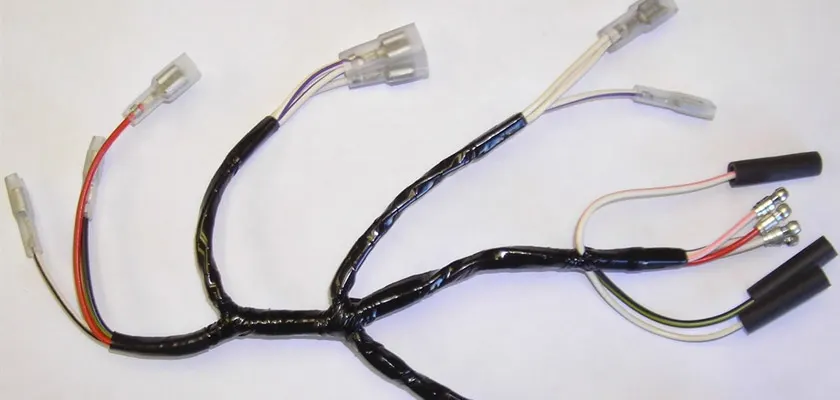
Typically, cable harnesses are created in accordance with the electrical and geometric specifications. After that, a diagram for the assembly preparation and assembly is provided (either on paper or on a monitor).
First, the wires are cut to the required length, typically with the aid of a specialised wire-cutting equipment. During the cutting process or on a different equipment, a dedicated machine may also print on the wires. The wires are then stripped at their ends to reveal their metal (or core), which is then outfitted with any necessary terminals or connector housings. To create the cable harness, the cables are assembled and secured together on a special workbench or onto an assembly board in accordance with the design requirements. The harness is then either placed immediately in the car or shipped after any protective sleeves, conduit, or extruded yarn have been installed.
PACKAGING RULES.
- Wire harness routing must make it simple to manufacture attached equipment and wiring harnesses and to remove and maintain them.
- Avoiding routing through minor structural apertures and holes will reduce handling and chaffing of the wiring harness during installation.
- When assembling or using the harness, avoid routing and clipping in the operator's blind zone.
- Routing must provide defence against potential harm caused by frequent abuses like being handed and serving as temporary support for test equipment.
- According to the environment and the harness's bending requirements, add more slack to the harness.
-
Verify that the route allows for the necessary clearance with the various adjacent parts.
-
When routing close to bolted joints, avoid going over the bolts. The harness could be harmed or even pierced. Harnesses should not be near panel mounting screws.
-
If at all feasible, protect the harness when routing it close to sharp edges.
-
A straight branch can have two clips spaced no closer than 200mm apart.
-
If the harness is going to bend in several places, provide clips and clamps.
-
Avoid using an excessive amount of sheet-metal brackets.
-
More than 50 mm should be present on the branch.
-
A minimum of 25 mm must separate the clip from the branching point.
-
50 mm should be the minimum spacing between two branch breakouts.
ASSUMPTIONS
1. Offer clips or clamps in accordance with needs.
2. When designing the wire harness, make sure there are no falling cases.
3. Additional clamps or clips may be used to prevent cases from falling.
4. Provide more wiggle room if necessary. A 5–10% slack is adequate.
5.To prevent a puncture of the harness, avoid routing over the bolt and fastened joints.
6.Avoid routing near jagged edges, or otherwise cover the harness with protection.
7. Adhere to the clearance distance and keep the harness away from components that produce heat.
8. Depending on the temperature of the environment, protection should be given as needed.
9.Avoid placing direct harness support on fuel lines that are run inside the engine.
10.If necessary, use plastic guiding channels.More than 50mm should be present on the branch.
11. There should be at least 50mm between each branch point.
12.There should be at least 25mm between the clip and the branch point.
13. Keep the engine free of too many sheet metal brackets. Try to use the engine's threaded bosses that are already there or ask for them.
14. The wire harness needs to be simple to construct and accessible.
15.When using dummy connectors, make sure the positions you define are useful. For the wire harness routing, bundle sizes and other placements can be appropriately described.
16.We can consider designing a harness channel that can be utilised to efficiently route and protect the wire harness if the packaging area is too small and there are several packaging restrictions.