Project 1
Aim:
1. Design a battery pack for a car roughly 150 Kw with 120 V. Use 3500 mAh 3.6V nominal NMC chemistry cell.
a. Design the battery pack configuration.
b. Draw the BMS topology for this battery pack.
2. Build a 3S2P battery pack configuration with generic battery block using Matlab/Simulink.
Lithium ion battery:
A lithium-ion or Li-ion battery is a type of rechargeable battery which uses the reversible reduction of lithium ions to store energy. It is the predominant battery type used in portable consumer electronics and electric vehicles. It also sees significant use for grid-scale energy storage and military and aerospace applications. Compared to other rechargeable battery technologies, Li-ion batteries have high energy densities, low self-discharge, and no memory effect (although a small memory effect reported in LFP cells has been traced to poorly made cells).
Chemistry, performance, cost and safety characteristics vary across types of lithium-ion batteries. Most commercial Li-ion cells use intercalation compounds as the active materials. The anode or positive electrode is usually graphite, although silicon-carbon is also being increasingly used. Cells can be manufactured to prioritize either energy or power density.[10] Handheld electronics mostly use lithium polymer batteries (with a polymer gel as electrolyte), a lithium cobalt oxide (LiCoO2) cathode material, and a graphite anode, which together offer a high energy density.[11][12] Lithium iron phosphate (LiFePO4), lithium manganese oxide (LiMn2O4 spinel, or Li2MnO3-based lithium rich layered materials, LMR-NMC), and lithium nickel manganese cobalt oxide (LiNiMnCoO2 or NMC) may offer longer lives and may have better rate capability. NMC and its derivatives are widely used in the electrification of transport, one of the main technologies (combined with renewable energy) for reducing greenhouse gas emissions from vehicles.
Design:
Generally, the negative electrode of a conventional lithium-ion cell is graphite made from carbon. The positive electrode is typically a metal oxide. The electrolyte is a lithium salt in an organic solvent.The anode (negative electrode) and cathode (positive electrode) are prevented from shorting by a separator.The anode and cathode are separated from external electronics with a piece of metal called a current collector. The electrochemical roles of the electrodes reverse between anode and cathode, depending on the direction of current flow through the cell.
The most common commercially used anode is graphite, which in its fully lithiated state of LiC6 correlates to a maximal capacity of 1339 C/g (372 mAh/g).The cathode is generally one of three materials: a layered oxide (such as lithium cobalt oxide), a polyanion (such as lithium iron phosphate) or a spinel (such as lithium manganese oxide).More experimental materials include graphene-containing electrodes, although these remain far from commercially viable due to their high cost.
Lithium reacts vigorously with water to form lithium hydroxide (LiOH) and hydrogen gas. Thus, a non-aqueous electrolyte is typically used, and a sealed container rigidly excludes moisture from the battery pack. The non-aqueous electrolyte is typically a mixture of organic carbonates such as ethylene carbonate and propylene carbonate containing complexes of lithium ions.Ethylene carbonate is essential for making solid electrolyte interphase on the carbon anode, but since it is solid at room temperature, a propylene carbonate solvent is added
Charge and discharge:
During discharge, lithium ions (Li+) carry the current within the battery cell from the negative to the positive electrode, through the non-aqueous electrolyte and separator diaphragm.
During charging, an external electrical power source (the charging circuit) applies an over-voltage (a higher voltage than the battery produces, of the same polarity), forcing a charging current to flow within each cell from the positive to the negative electrode, i.e., in the reverse direction of a discharge current under normal conditions. The lithium ions then migrate from the positive to the negative electrode, where they become embedded in the porous electrode material in a process known as intercalation.
Energy losses arising from electrical contact resistance at interfaces between electrode layers and at contacts with current collectors can be as high as 20% of the entire energy flow of batteries under typical operating conditions.
The charging procedures for single Li-ion cells, and complete Li-ion batteries, are slightly different:
- A single Li-ion cell is charged in two stages:[72][73][74][unreliable source?]
- Constant current (CC)
- Constant voltage (CV)
- A Li-ion battery (a set of Li-ion cells in series) is charged in three stages:
- Constant current
- Balance (only required when cell groups become unbalanced during use)
- Constant voltage
1. Design a battery pack for a car roughly 150 Kw with 120 V. Use 3500 mAh 3.6V nominal NMC chemistry cell.
a. Design the battery pack configuration.
Given:
Power = 150 kw
Rated motor voltage = 120 v
Battery capacity = 3500 mAh
= 3500/1000
= 3.5 Ah
Nominal cell voltage = 3.6 v
Formula used:
Number of cell in series (Ns) = Rated motor voltage / Nominal cell voltage
Number of cell in parallel (Np) = Motor contiuous current / Nominal cell capacity
Current(I) = power(p)/volt(v)
Solution:
Number of cell in series (Ns) = Rated motor voltage / Nominal cell voltage
= 120/3.6
= 34 cells
Number of cell in parallel (Np) = Motor contiuous current / Nominal cell capacity
Current(I) = power(p)/voltage(v)
I = 150/120
= 1.25 kw
Np = 1250/3.5
= 358
b. Draw the BMS topology for this battery pack.
Master and slave topology is used here.
Cells for this battery pack is 34.
Because this battery pack consists of more then 18 cells.
So that master and slave topology is used.
This kind of topology is generally used in 2 wheelers, 3 wheelers & small energy storage battery pack systems.
Diagram:
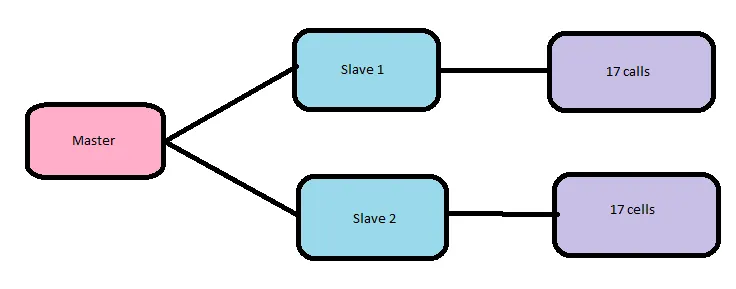
Total no.of cells is 34
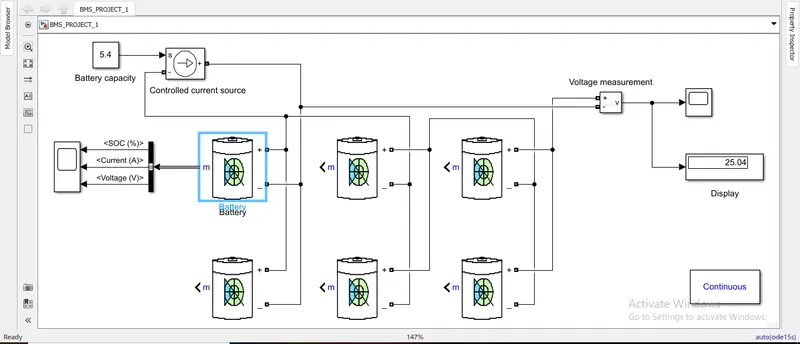
2. Build a 3S2P battery pack configuration with generic battery block using Matlab/Simulink.
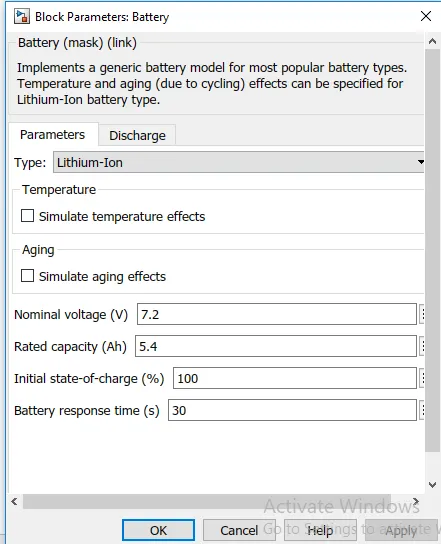
Parameters
Total no.of cells in battery pack = No.of cells in series*No. of cells in parallel
= 3*2 = 12 cells
Nominal voltage of a cell is 7.2v
Rated capacity of a cell is 5.4Ah
Maximum voltage of a cell is 8.3v
Nominal voltage of the battery pack = no. of cells in series * Nominal voltage of the cell
= 3*7.2
= 21.6v
Rated capacity of the battery pack = no.of cells in parallel * Rated capacity of a cell
= 2*5.4
= 10.8
Simulink model:
Battery:
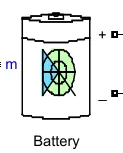
- Nominal voltage of a cell is 7.2v
- Rated capacity of a cell is 5.4Ah
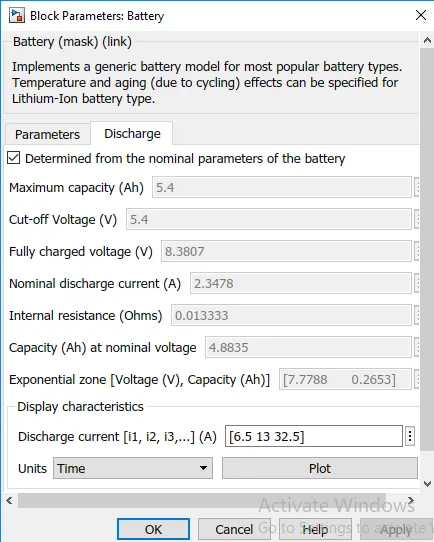
- Maximum voltage of a cell is 8.3v
Parameters of battery:
Discharge:
Output of the battery:
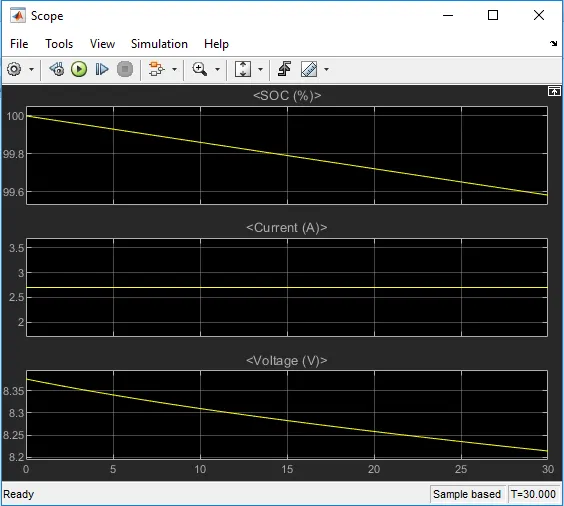
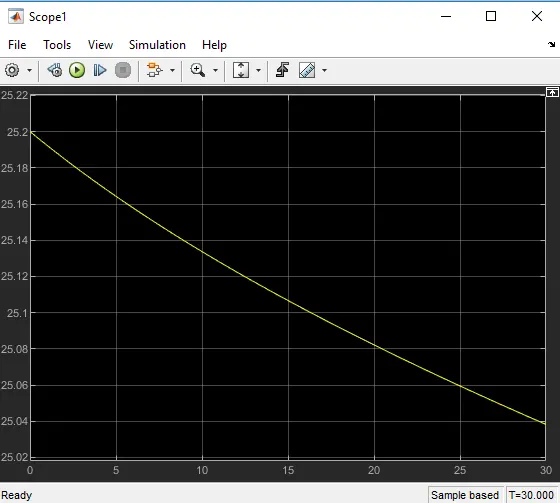
Over all output voltage:
Over all voltage of the battery pack = Max.voltage of the cell*No.of cells in series
= 8.3*3
= 25 v