Vehicle Dynamics - Anti-Characteristics
AIM: To calculate the required parameters for anti-characteristics and to ensure a zero pitch(theorotically).
OBJECTIVES:
1. Calculate the following parameters
- Front end deflection under load.
- Rear end deflection under load.
- Pitch angle.
- Pitch gradient.
2. Use the IC location information to calculate the following
- Front anti-lift angle.
- Rear anti-squat angle.
- Front swing arm angle for 100% anti-lift.
- Rear swing arm angle for 100% anti-squat.
- Front anti-lift %.
- Rear anti-lift %
3. To eliminate the pitch angle (theoretically), keep the rear swing arm height fixed at 16 inches from the contact patch. Calculate the following
- Front anti-lift % and rear anti-squat % for zero pitch angle.
- Front end deflection under load, accounting for the new anti characteristics.
- Rear end deflection under load, accounting for the new anti characteristics.
- Pitch angle, accounting for the new anti characteristics (verify that it is indeed zero)
GIVEN:
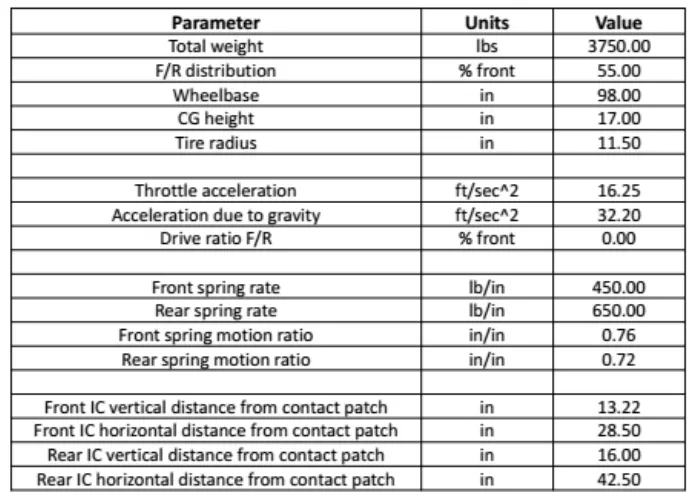
SOLUTION: An excel sheet is constructed that calculates all the required parameters baseed on the given data.
PROCEDURE: Following formulas are used stepwise-
1. Throttle acceleration per g = (throttle acc.)/(acc. due to gravity)
2. Load transfer = [(total weight)*(throttle accn)*(CG height)]/[(wheelbase)*g]
3. Front axle weight (after throttle) = (static front axle weight) - (load transfer)
4. Rear axle weight (after throttle) = (static rear axle weight) + (load tansfer)
5. Front wheel rate = (front spring rate)*(front motion ratio)^2
6. Rear wheel rate = (rear spring rate)*(rear motion ratio)^2
I. Without Compensation
1. Front end deflection = (load transfer)*0.5/(front wheel rate)
2. Rear end deflection = (load transfer)*0.5/(rear wheel rate)
3. Pitch angle = arctan{[(front defelction) + (rear deflection)]/wheelbase}*(180/pi)
4. Pitch gradient = (pitch angle)/(throttle acc.(g))
| Parameter | Units | Value |
| Front end deflection | in | 0.631512 |
| Rear end deflection | in | 0.487128 |
| Pitch angle | deg | 0.653986 |
| Pitch gradient | deg/g | 1.295898 |
II. With Compensation
1. Front anti-lift angle = arctan{[(FICV) - (tire radius)]/(FICH)}
2. Rear anti-squat angle = arctan{[(RICV) - (tire radius)]/(RICH)}
3. Front swing arm angle = arctan[(CG height)/wheelbase]
4. Rear swing arm angle = arctan[(CG height)/wheelbase]
5. Front anti-lift % = (front anti-lift angle)*(drive ratio)/(front swing arm angle)
6. Rear anti-squat % = (rear anti-squat angle)*[100 - (drive ratio)]/(rear swing arm angle)
| Parameter | Units | Value |
| Front anti-lift angle | deg | 4.454046 |
| Rear anti-squat angle | deg | 6.709837 |
| Front swing arm angle | deg | 9.841132 |
| Rear swing arm angle | deg | 9.841132 |
| Front anti-lift % | % | 0 |
| Rear anti-squat % | % | 68.18156 |
After compensation
1. Front end deflection = [front end deflection (w/o comp)]*[100 - (front anti-lift %)]/100
2. Rear end deflection = [rear end deflection (w/o comp)]*[100 - (front anti-squat %)]/100
3. Pitch angle = arctan{[(front defelction with comp) + (rear deflection with comp)]/wheelbase}*(180/pi)
4. Pitch gradient = (pitch angle)/(throttle acc.(g))
| Parameter | Units | Value |
| Front end deflection | in | 0.631512 |
| Rear end deflection | in | 0.154997 |
| Pitch angle | deg | 0.459823 |
| Pitch gradient | deg/g | 0.911158 |
| % compensation | % | 29.6891 |
III. Keeping the rear swing arm height fixed at 16 inches from the contact patch
The rear IC horizaontal distance is varied until the pitch angle is found to be zero or approximately zero.
The pitch angle is found to be minimised near zero at RICH = 12.02 inches
| Parameter | Units | Value |
| Front end deflection | in | 0.631512 |
| Rear end deflection | in | -0.63086 |
| Pitch angle | deg | 0.000381 |
| Pitch gradient | deg/g | 0.000754 |
| % compensation | % | 99.94179 |
Excel sheet (snapshot):
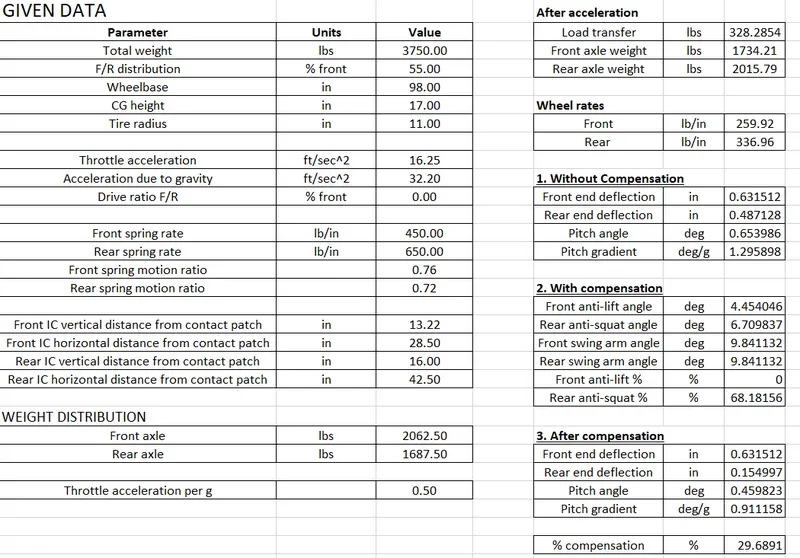
(drive link for excel sheet: https://drive.google.com/file/d/1p7n4N5SYiOdiJaQngbf7IzEHR6lZlIor/view?usp=sharing )
CONCLUSION:
1. All the parameters have been calculated by making an axcel sheet.
2. When the pitch angle is made zero, we can see that the %compensation is approximately equal to 100% which is not possible in practical. Hence we say that this value is theorotical.