Problem Set-1b Week 11Challenge : Basic Handling parameters
A car has a weight of 1900 lb front axle and 1552 lb on the rear with a wheelbase of 100.6 inches. The tires have the following cornering stiffness values
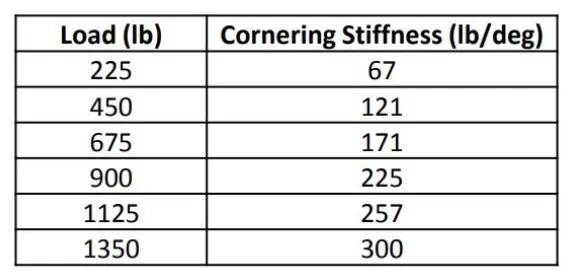
Determine the following
1. Ackermann steer angles for 500, 200 and 50 ft radius
2. Understeer gradient
3. Characteristic speed
4. Lateral acceleration gain at 60 mph
5. Yaw velocity gain at 60 mph
6. Slideslip angle at the CG on an 800 ft radius turn at 60 mph.
7. Why is the calculated understeer gradient quite low (usually it is around 3-4 deg/g)
Solution:-
Given data
Wf=1900lb
Wr=1552lb
L=100.6 inches=2.55 m
1. Ackermann steer angles for 500, 200 and 50 ft radius
r=500ft=152.5 m
r=200ft= 60.98 m
r=50ft= 15.24 m
steering angle=L/r
r=152.5m steering angle=2.55/152.5 =0.0167 rad =0.96 deg
r=60.96m steering angle=2.55/60.96=0.041 rad=4.24 deg
r=15.2m steering angle=2.55/15.2 =0.167 rad=9.56 deg
2. Understeer gradient
weight of each wheel
Load on front tyre =1901/2=950.5 ib =4228.034 N
Load on rear tyre=1552/2=776 ib=3451.819 N
from interpolation:
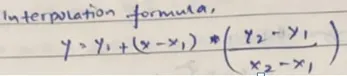
C_alpha_f= 225+(950-900)*((257-225)/1125-900))= 232.11(lb)/(deg)
C_alpha_r=171+(776-675)*((225-171)/(900-675))= 195.24 (lb)/(deg)
Understeer gradient,
K = (Wf/C_alpha_f)-(Wr/C_alpha_r)
K = 0.120(deg)/g
3) Characteristic speed
Vchar = sqrt((57.3*L*g)/K)
vchar=sqrt(57.3*2.55*9.81/0.11)=114 m/s
4) Lateral acceleration gain at 60 mph
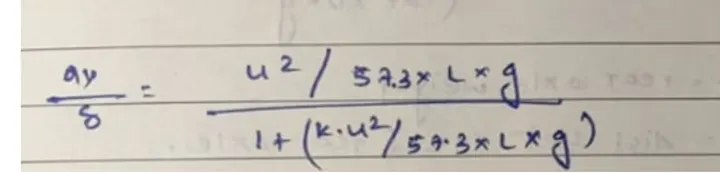
steering gain=((v)^2/57.3*l*g)/(1+(v/vchar)^2)=(26.8224)^2/57.3*2.55*9.81/1+(26.8224/114)^2=0.475g/deg
5) Yaw velocity gain at 60 mph
yaw gain=v/l/1+(v/vchar)^2=(26.8224)/2.55/1+(26.8224/114)^2=9.96 deg/sec/deg
6) Slideslip angle at the CG on an 800 ft radius turn at 60 mph.
side slip:
weight dist front=1901/1901+1552 =0.55,
b(dist. from cg to rear axle)=0.55*2.55=1.4025
rear axle cornering stiffness=rear tyre cornering stiffnes*2=867*2=1734 n/deg=1734*180/pi=99350 n/rad
ay=v^/r=(26.8824)^2/243.84=2.96 m/s^2
side slip=b/r - (mrear /c rear axle)*ay= 1.4025/243.84-((703.97/1734*180/pi)*2.96)= -0.015 rad
=-0.015 *180/pi= -0.86 deg
7) Why is the calculated understeer gradient quite low (usually it is around 3-4 deg/g)
Understeer gradient is small because of the front weight bias didn't counteract enough the low cornering stifness of the rear tyres compared to the front,it was just was able to prevent negative understeering gradient,so inorder to increase the understeering gradient,either increase the front weight bias ,or increase rear tyre cornering stiffness or reduce front tyre cornering stifness or a combination of these solutions