Prandtl Meyer Shock problem
AIM:To analyze Prandtl Meyer shock problem using converge studio.
Shock Flow Boundary Conditions: For solving the steady state flow appropriate boundary conditions are needed. It is one of the required components of the mathematical model. On the other hand, for solving transient flow, appropriate initial condition is also required. Boundary conditions are generally three types.
They are Dirichlet boundary condition, Neumann boundary condition and mixed boundary condition. When using a Dirichlet boundary condition, the value of variable is prescribed at the boundary.
Neumann boundary Conditions, When Neumann boundary Conditions imposed on an ordinary or a PDE, the condition specifies the values in which the derivative of a solution is applied within the boundary of the domain.
SHOCK WAVE: When the speed of the moving object in a medium becomes equal to the velocity of sound(340 m/s) in the medium, the wavefronts cannot escape from the source and pile up. This results in a large amplitude sound barrier. When the speed of the moving object or source exceeds the speed of sound in medium then the wavefronts lag behind the source forming a cone shaped region with a source at vertex. The edge of the cone forms a supersonic wave front with an unusually large amplitude called a shock wave. A sonic boom is heard when the shock waves reach an observer. The occurence of shock waves can be characterized by instantaneous change in pressure, velocity and temperature in a fluid flow. The region between the vehicle and the shock wave known as the shock layer will be a region of high pressure, density and temperature than the free-stream flow conditions. When a fluid streamline crosses the standing shock wave, abrupt increase in the pressure, temperature and density of the fluid flow occurs with a decrease in velocity of the flow.
Prandtl Meyer Shock Waves: In order to understand Prandtl Meyer shock wave, we first need to understand what oblique waves are. The normal shock waves are straight in which the flow before and after the wave is normal to the shock. It is considered as a special case in the general family of oblique shock waves that occur in supersonic flow. In general, oblique shock waves are straight but inclined at an angle to the upstream flow and produce a change in flow direction. An oblique shock generally occurs, when a supersonic flow is ‘turned into itself”.
Another class of two dimensional waves occurring in supersonic flow shows the opposite effects of oblique shock. Such types of waves are known as expansion waves . When the supersonic flow is “turned away from itself”, an expansion wave is formed. Here, the flow is allowed to pass over a surface which is inclined at an angle θ to the horizontal and all the flow streamlines are deflected downwards. The change in flow direction takes place across an expansion fan centered at point ‘A'. The flow streamlines are smoothly curved till the downstream flow becomes parallel to the wall surface behind the point ‘A'. Here, the flow properties change smoothly through the expansion fan except at point ‘A'. An infinitely strong oblique expansion wave may be called as a Mach wave . An expansion wave emanating from a sharp convex corner is known as a centered expansion which is commonly known as Prandtl-Meyer expansion wave.
Case Setup:
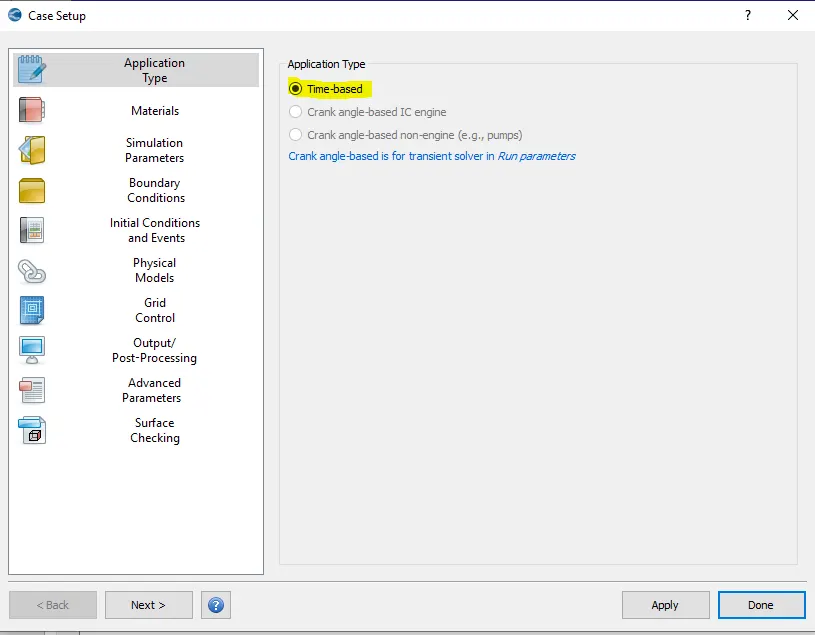
Application Type: Is selected as Time Based
Run Parameters
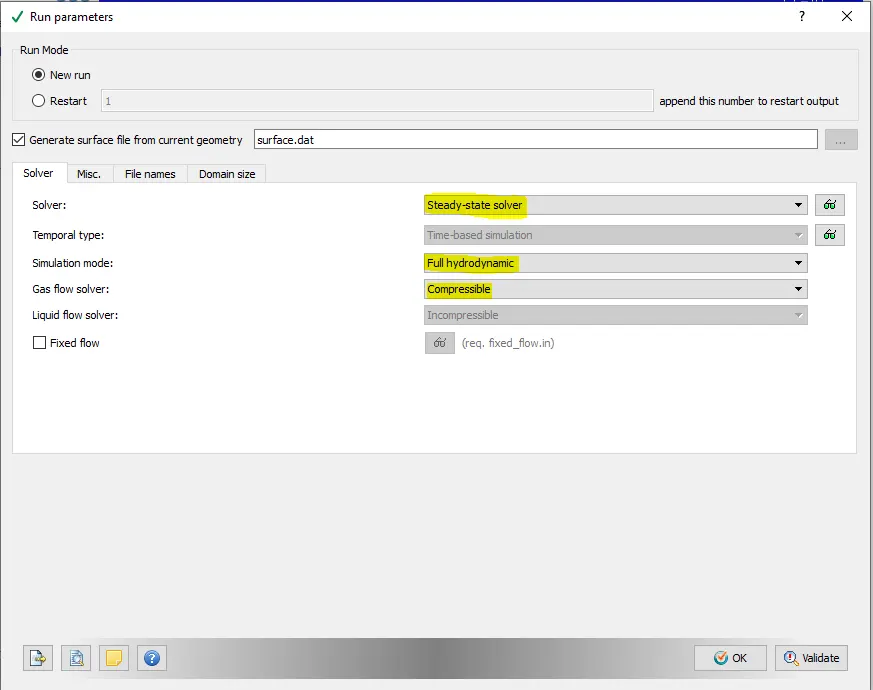
For the Solver the Steady state solver is selected, simulation mode is full hydrodynamic and Gas flow solver is Compressible.
Simulation Time Parameters
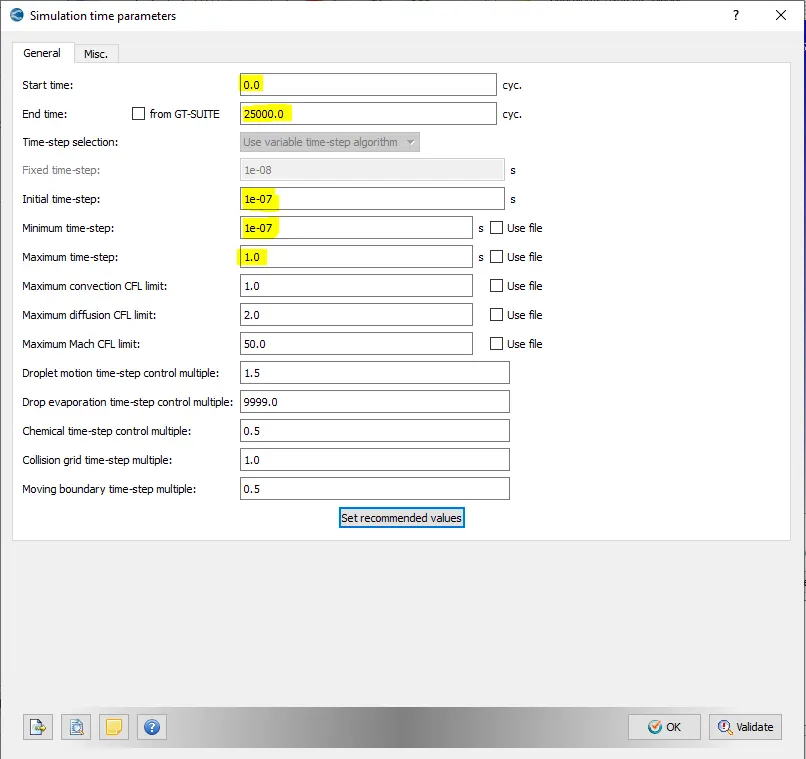
Start time is set to 0, end time is 25000 cycles, Initial and Minimum time step is set to 1e-7 seconds and maximum time step is set to 1 second. Rest all the values are default.
Solver Parameters
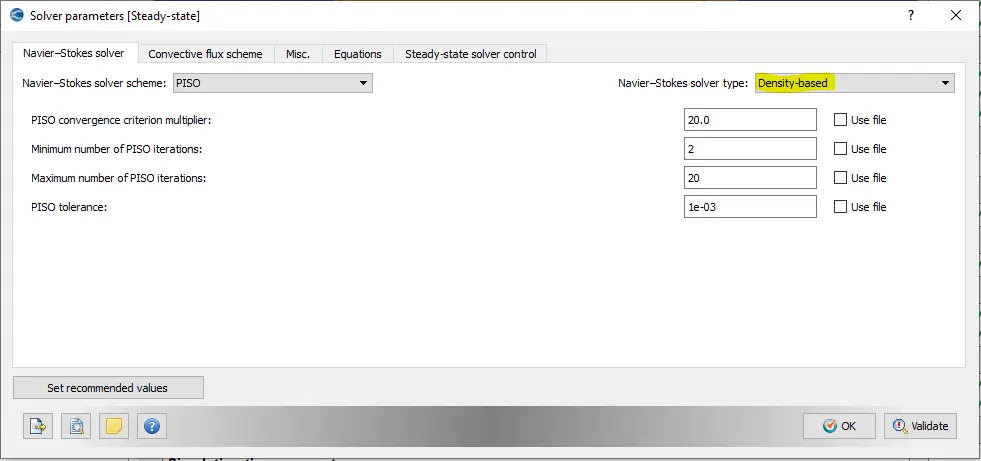
All the parameters are default.
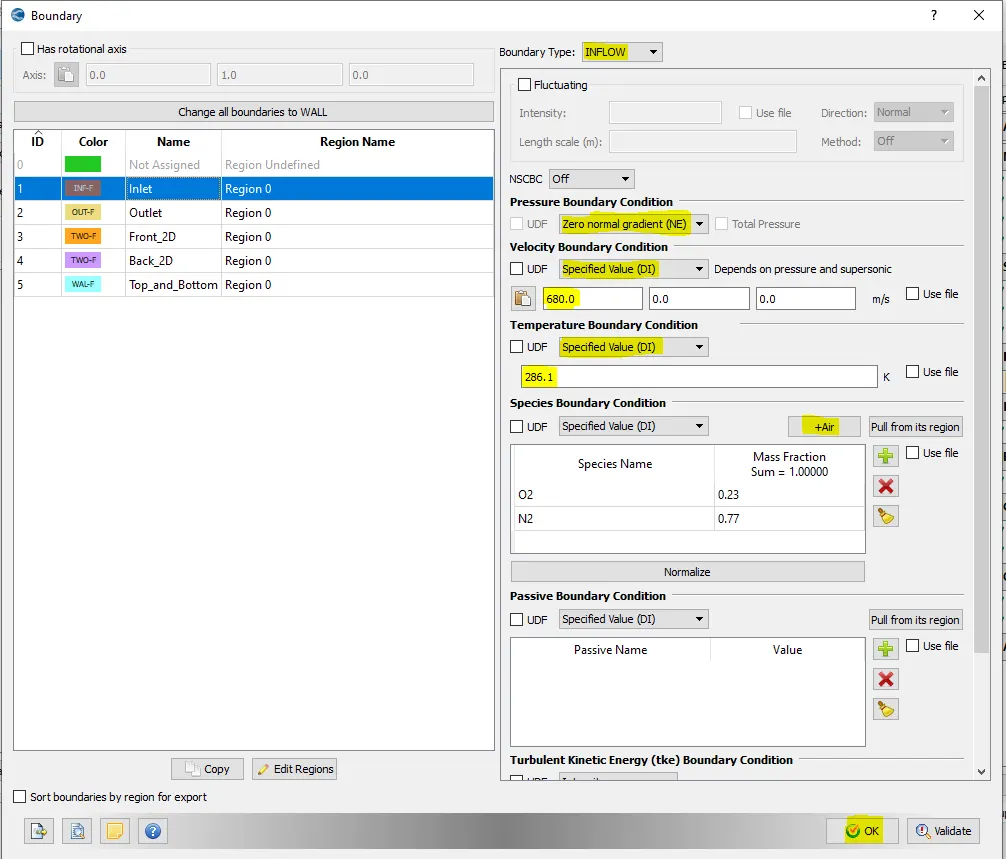
Inlet Boundary
Boundary Type is selected as INFLOW, Pressure Boundary Condition is set to Zero normal gradient (NE), velocity boundary condition is specified value of 680 m/s in X direction.
Temperature boundary condition is set to specified value of 286.1 K. Air is selected for species boundary condition.
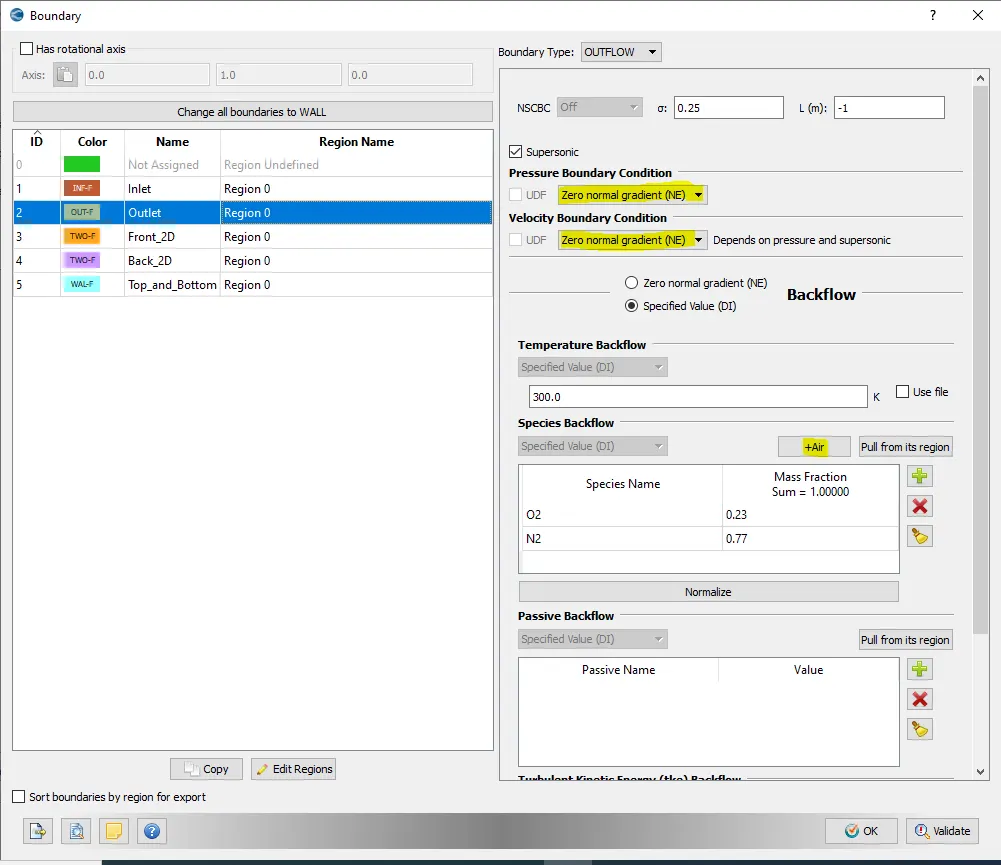
Outflow Boundary Condition
Boundary Type is selected as OUTFLOW, Pressure and velocity boundary conditions are specified as Zero Normal gradient. For Species Backflow Air is selected.
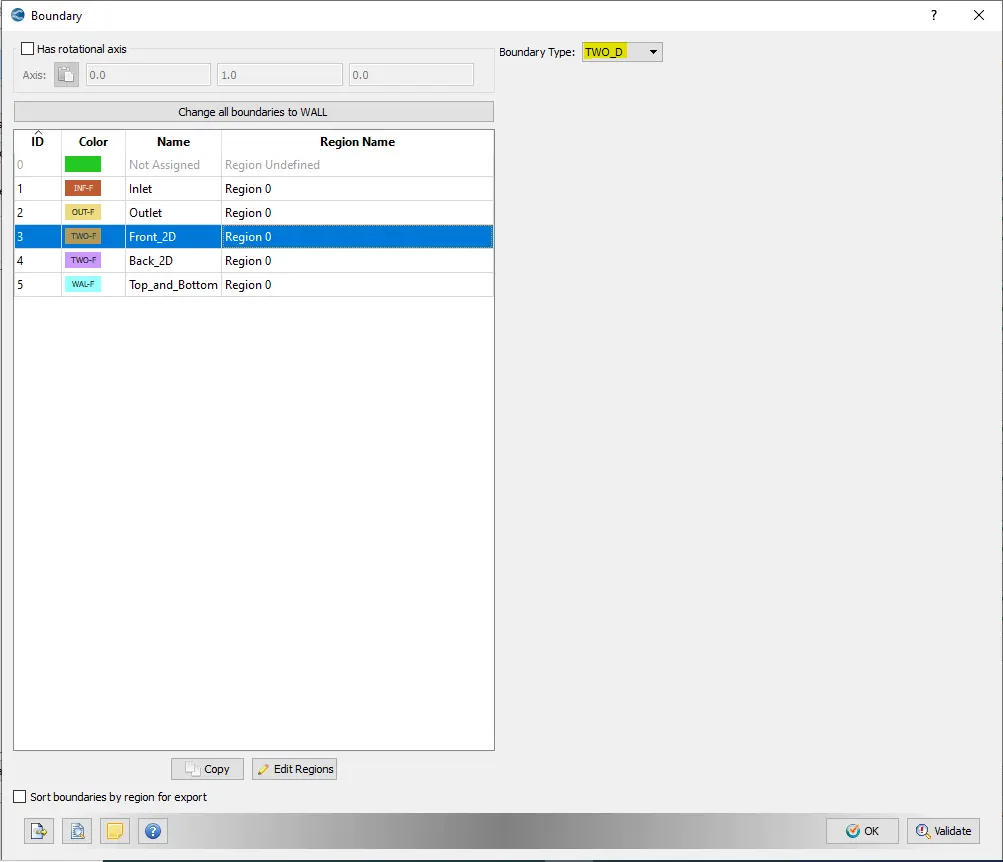
Front and Back Boundary condition
Since this is a 2D problem, the boundary type is specified as TWO_D
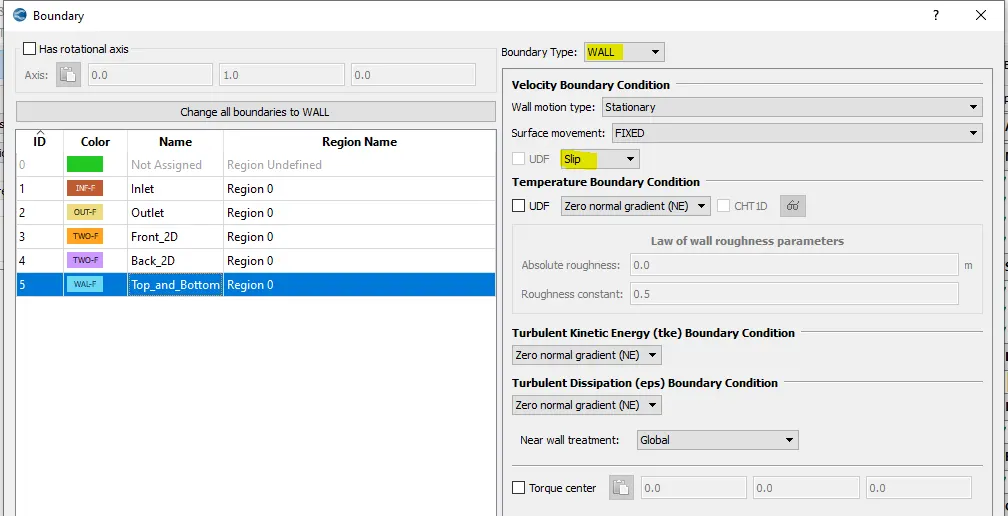
Top and Bottom walls
Boundary type is specified as WALL, Velocity boundary condition is Slip type, Temperature boundary condition as Zero normal gradient.
Regions and Initialization
Initial Conditions are velocity = 680 m/s in X direction, Temperature = 300 K, Pressure = 50000 Pa and Species as Air
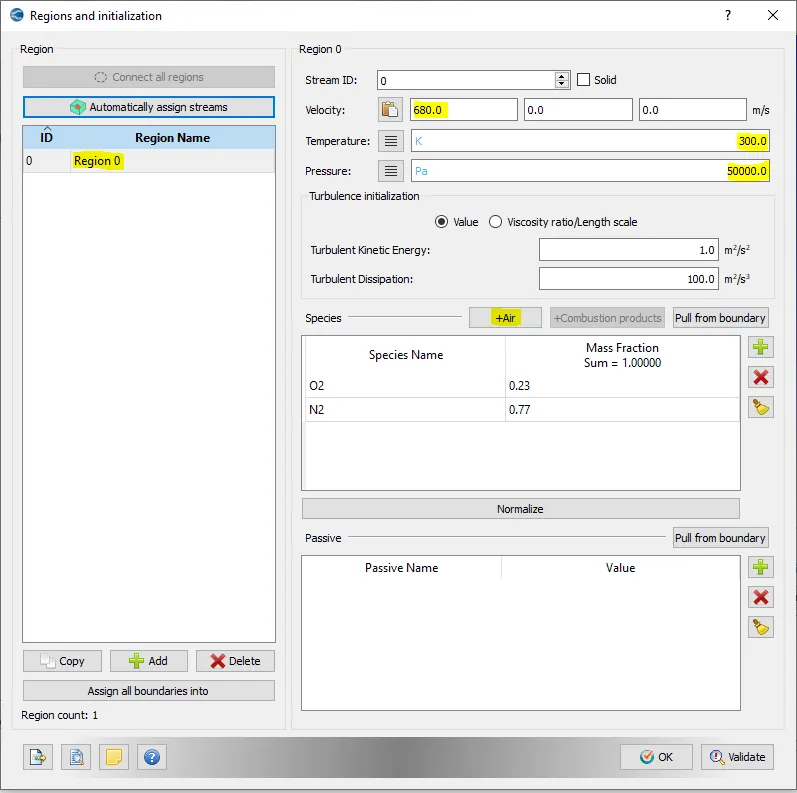
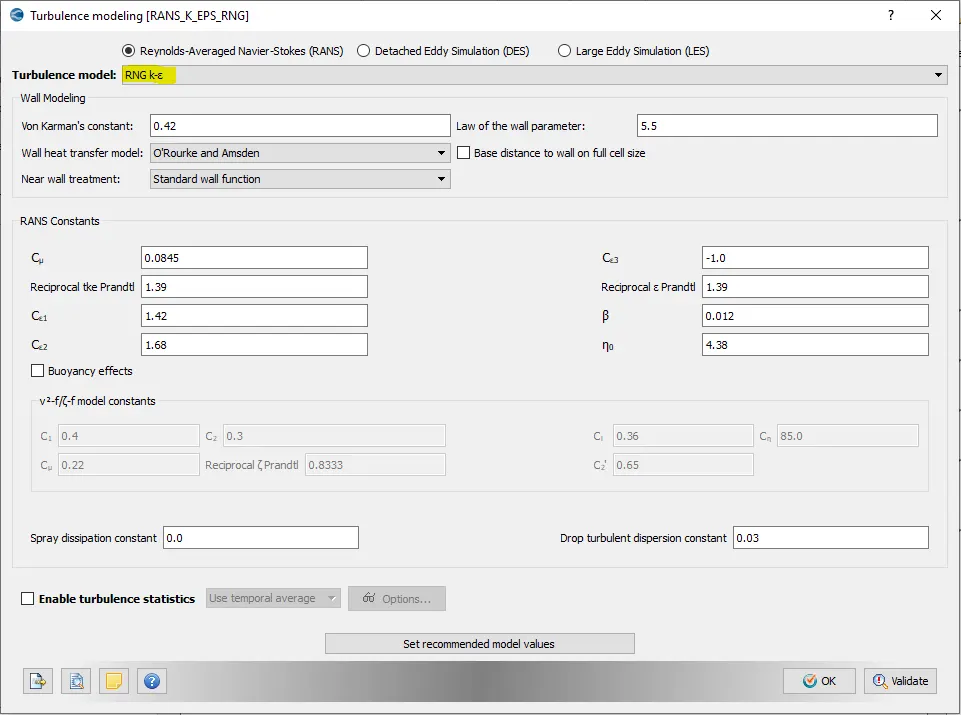
Turbulence Modeling
Turbulence model is RNG k-epsilon and all parameters are kept default.
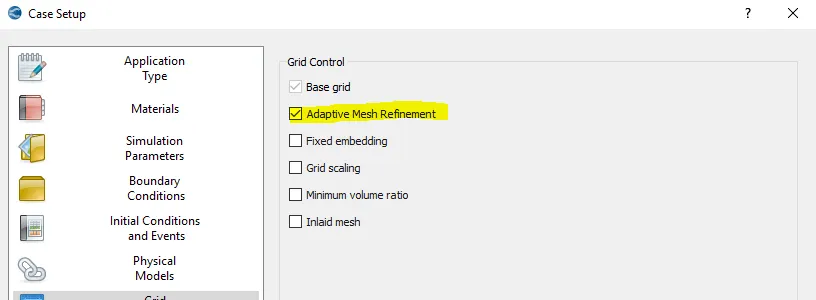
Grid Control
Adaptive Mesh Refinement enabled in Grid Control
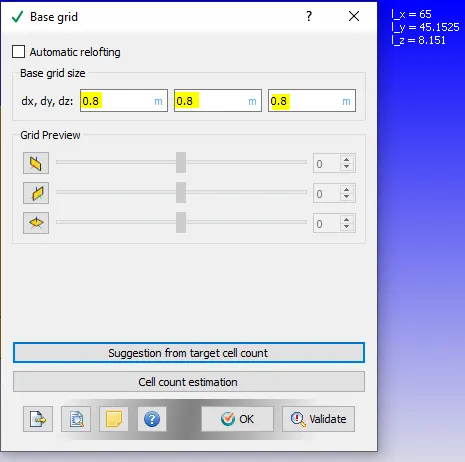
Base Grid Size
Base Grid size is set to 0.8 m for a bounding box dimensions of 65 x 45.15 x 8.15 m
Adaptive Mesh Refinement
Minimum cells set to 1 and Maximum cells set to 200000, Temperature scheme is used for AMR with Embed type as SGS (Sub Grid Scale), max embedding level as 2, Sub grid criterion is varied for every case.
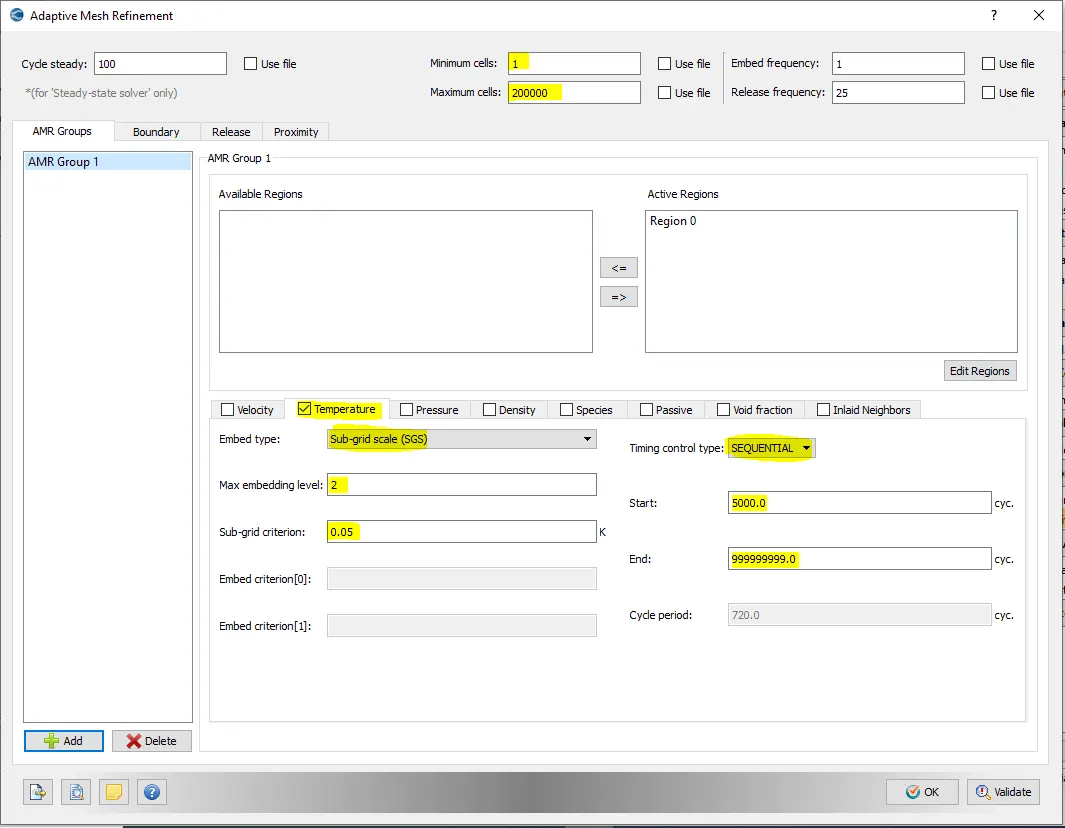
The simulation was run under three different conditions:
1) Sub-Grid Criterion(SGS)= 0.05 K
2) Sub-Grid Criterion (SGS)= 0.1 K
3)Sub-Grid Criterion (SGS)= 0.01 K
Temperature based Adaptive Mesh refienment is used, with three different values of Sub-grid scale. Density based steady state solver is used
1) Sub-Grid Criterion(SGS)= 0.05 K
MESH
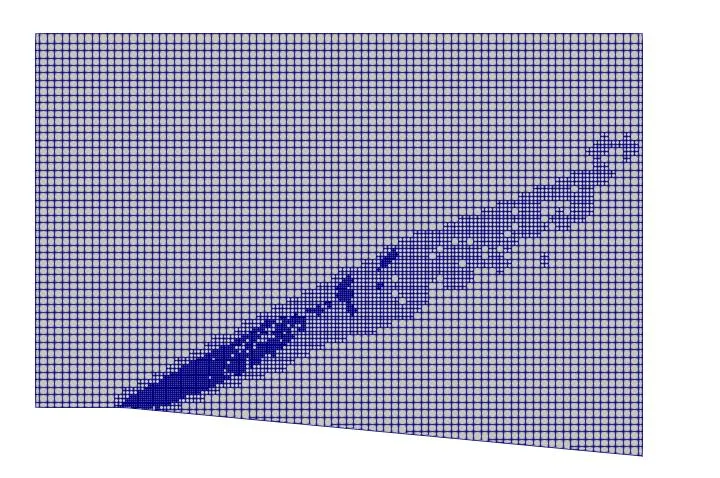
TEMPERATURE CONTOUR
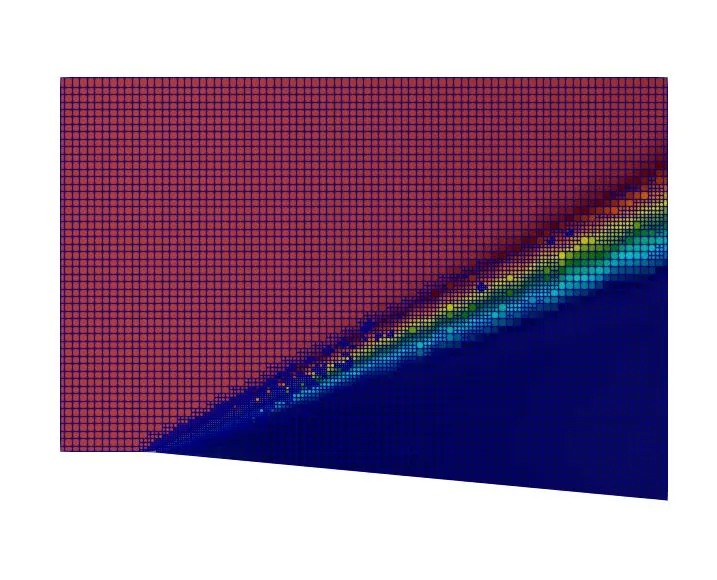
PRESSURE CONTOUR
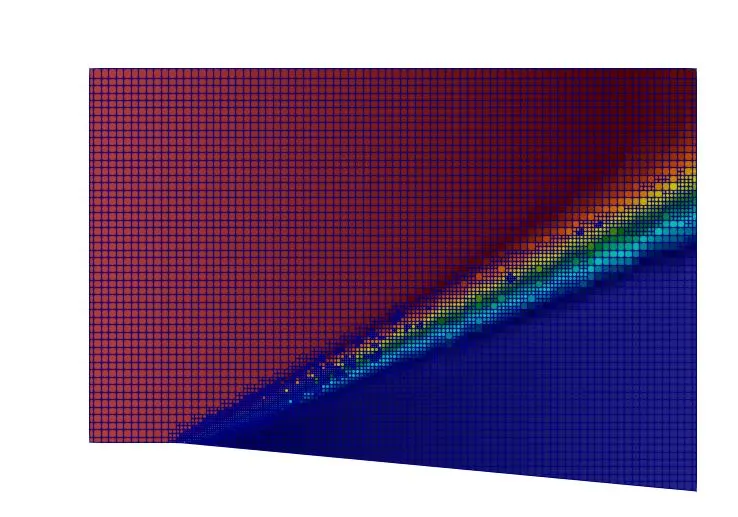
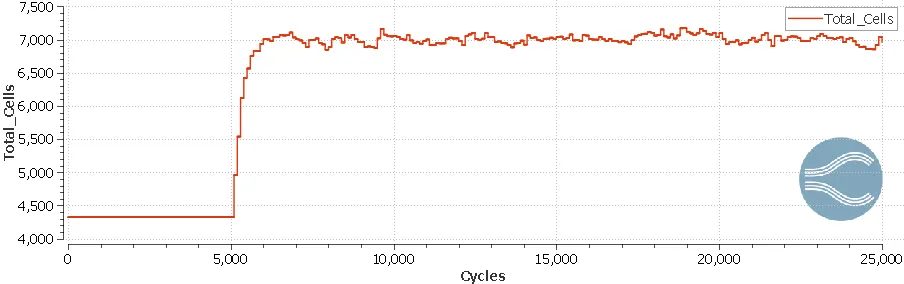
Plot 1.1:Cell count
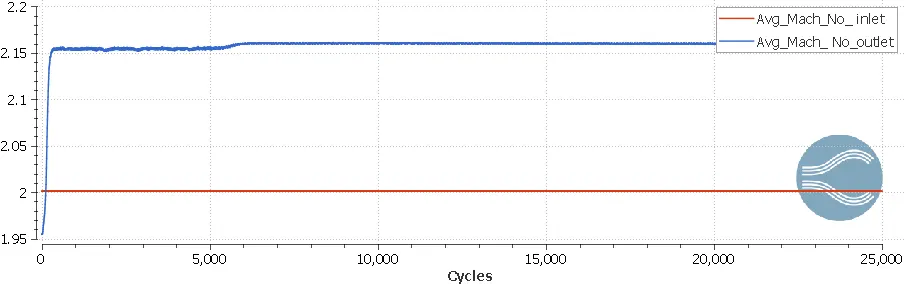
Plot 1.2:Mach number at inlet and outlet
Animation of how the steady state solution converges
1.Pressure Contour Plot:https://youtu.be/kF7usK1gqKs
2. Temperature Contour Plot:https://youtu.be/Hydwu_qpt8U
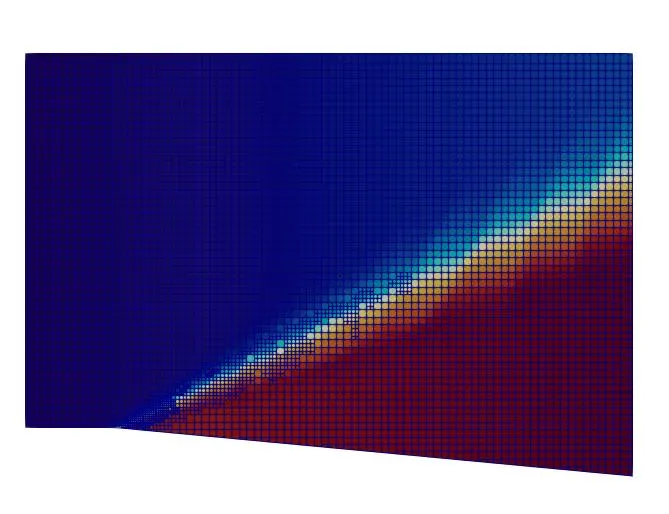
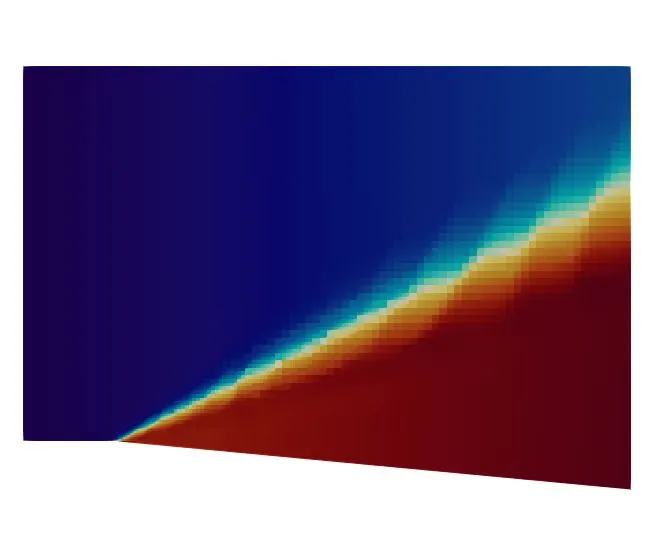
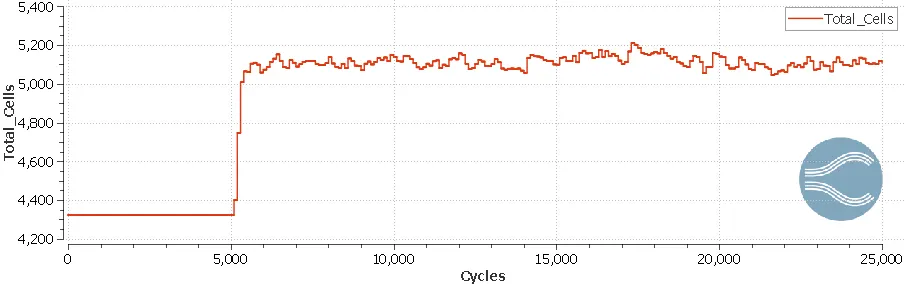
2) Sub-Grid Criterion (SGS)= 0.1 K
MESH
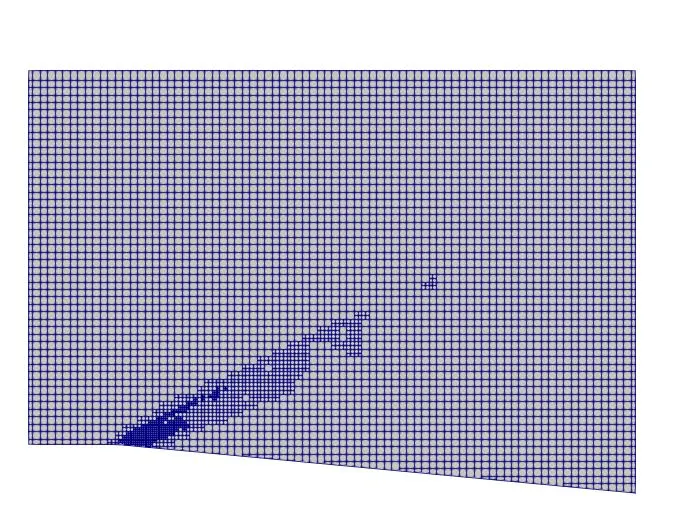
TEMPERATURE CONTOUR
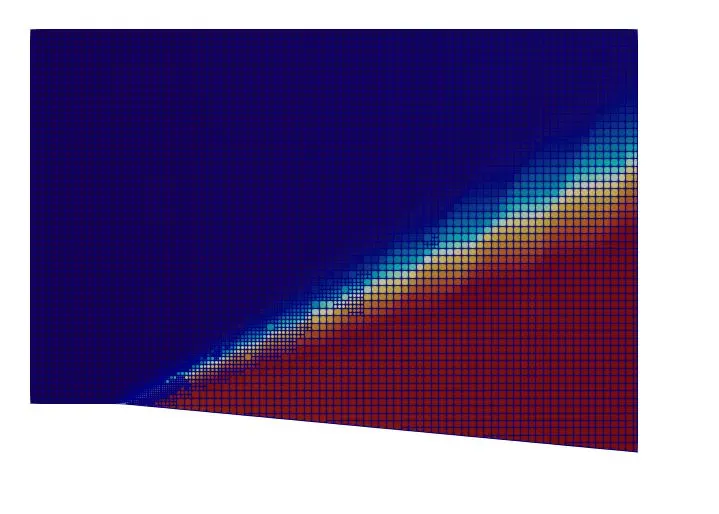
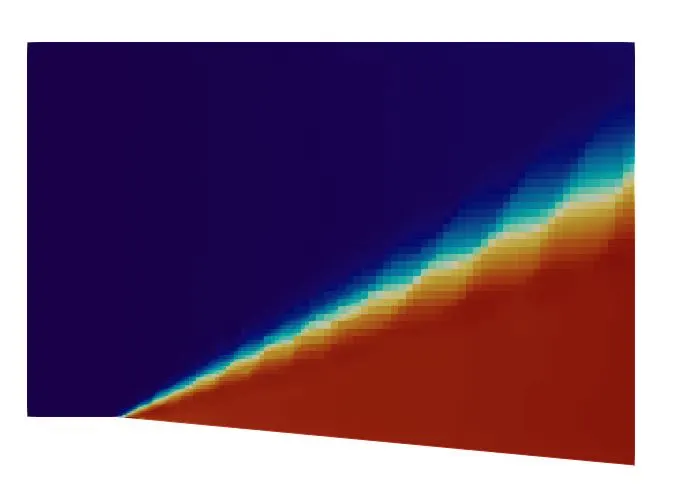
PRESSURE CONTOUR
Plot 2.1:Cell count
Plot 2.2:Mach number at inlet and outlet
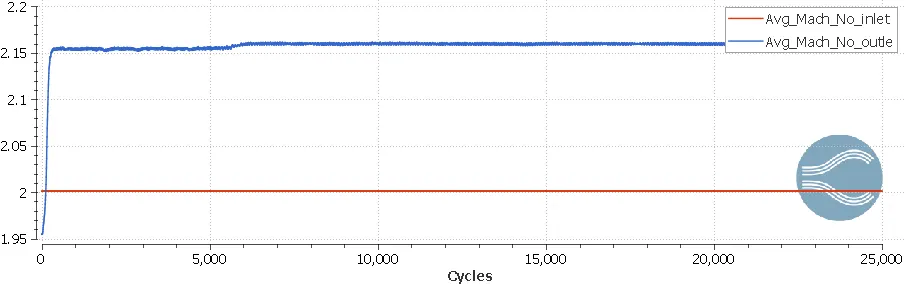
Animation of how the steady state solution converges
1.Pressure Contour Plot: https://youtu.be/Cy02p8E1RCQ
2. Temperature Contour Plot: https://youtu.be/C6b1-pB5IYk
3)Sub-Grid Criterion (SGS)= 0.01 K
MESH
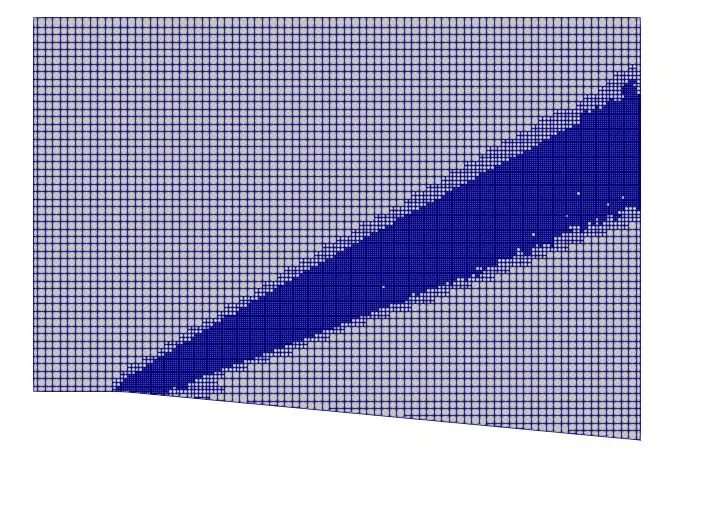
TEMPERATURE CONTOUR
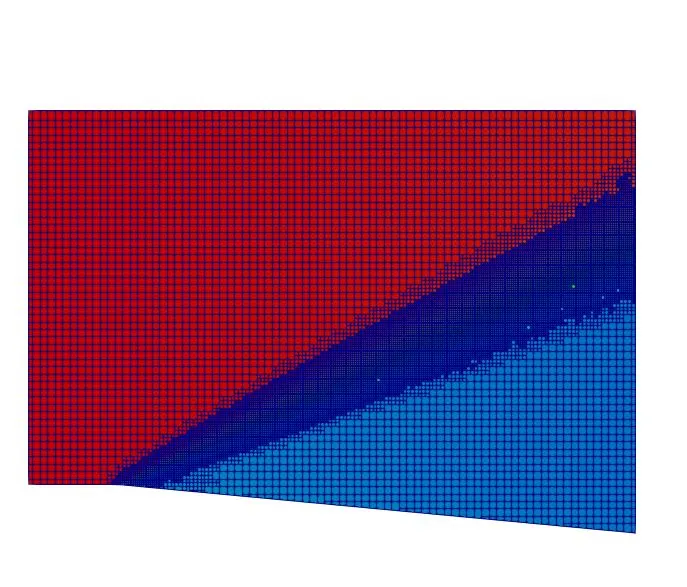
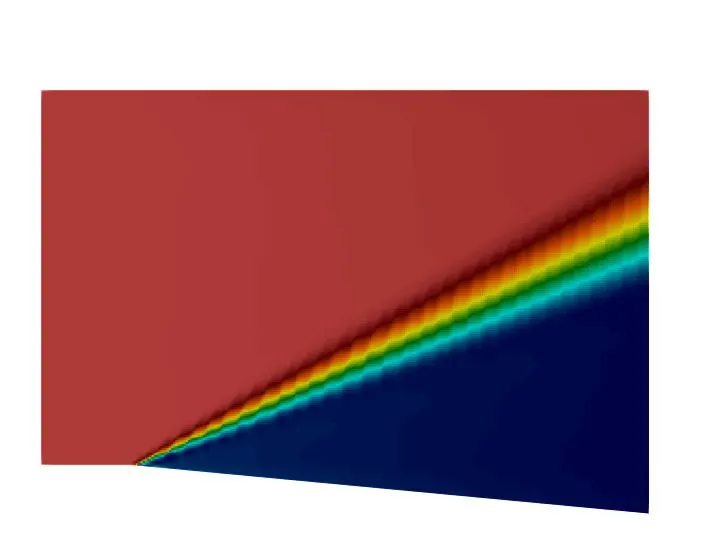
PRESSURE CONTOUR
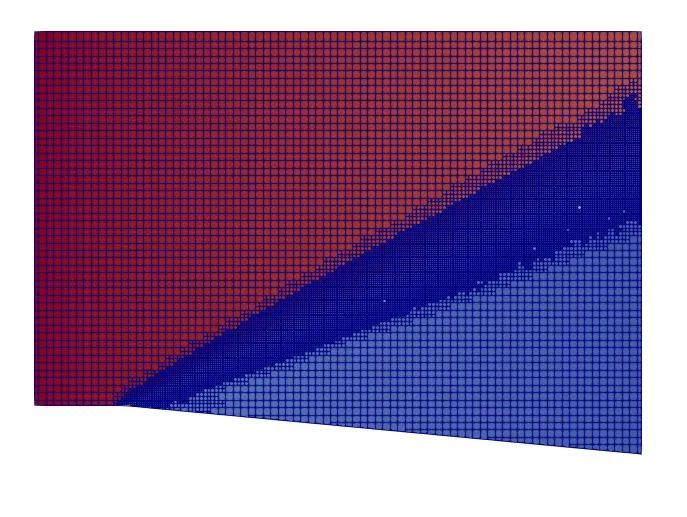
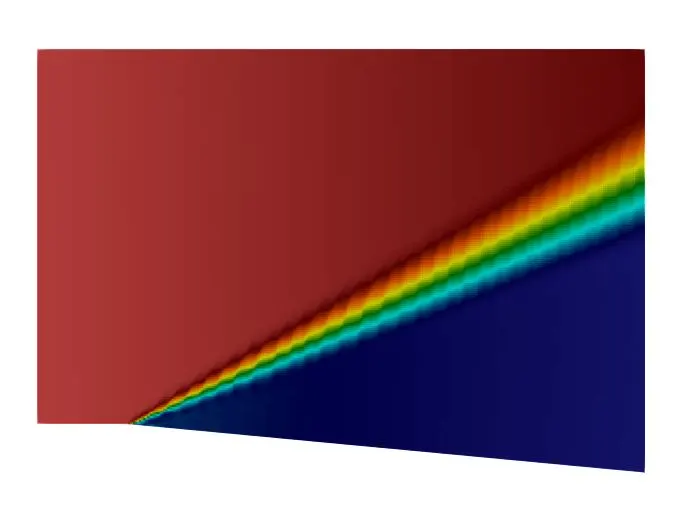
Plot 3.1:Cell count
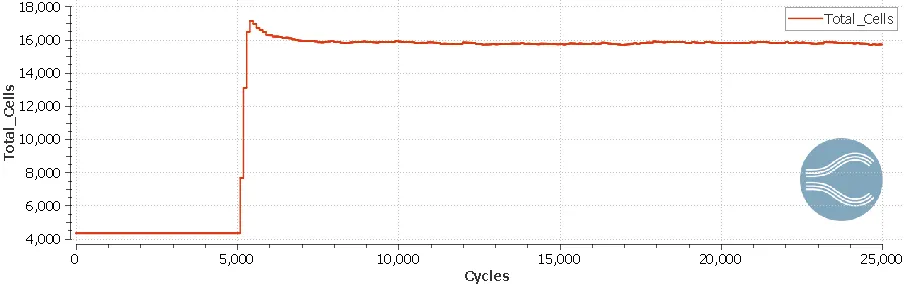
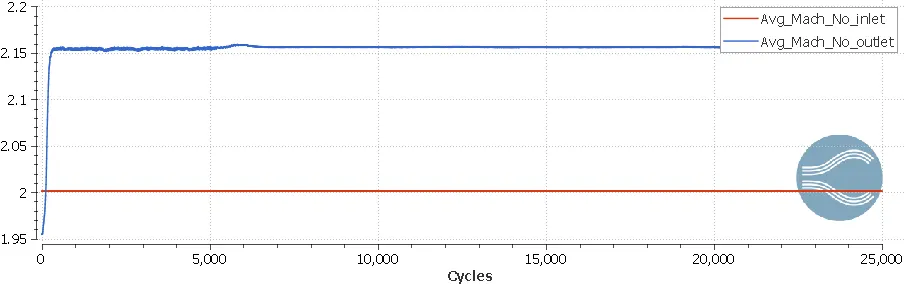
Plot 3.2:Mach number at inlet and outlet
Animation of how the steady state solution converges
1.Pressure Contour Plot:https://youtu.be/r_JIRjL79LU
2. Temperature Contour Plot:https://youtu.be/SUXHlFgwx5Q
Subsonic Vs Supersonic Flow Comparison
In supersonic flow, the prandtl-meyer expansion fan is clearly visible and the mesh refinement is also visible in the shock region
Whereas on the other hand, in case of a subsonic flow, the prandtl-meyer expansion fan is not at all visible and even the mesh refinement is not visible. This is because there are no sudden fluctuations in pressure, velocity, temperature or density or in other words shock.
Also the average Mach number increases from the inlet to the outlet in case of supersonic flow and decreases in case of subsonic flow.
Effect of SGS parameter on shock location and Total cell count
1. Cell count: As the SGS parameter decreases, the total cell count increases. In other words, for small SGS parameter, AMR refines the mesh for more number of cells in and around the shock waves.
2. Shock Location: For a high SGS parameter, the mesh refinement area (as seen on the mach fan) is very small like in Case 3 (SHS = 0.1) and for the a small SGS parameter, the mesh refinement area spans from the sharp edge till the outlet boundary.
Conclusion
A simulation of supersonic and subsonic flow through a duct having a sharp corner was setup and run in Converge CFD. Various contour plots of velocity, pressure, density and temperature were studied.
The formation of shock waves and effect of SGS parameter on the shock location and total cell count was studied.