MATLAB program to calculate Drag force on a cyclist.
AIM: To calculate the Drag force on a cyclist.
GOVERNING EQUATIONS:
Fd = `1/2×ρ×A×V^2×C_d`
Where,
Fd , Drag force
ρ ,Density of air
A , Frontal Area
V , Velocity of the object relative to the air
C_d , Drag coefficient
OBJECTIVES:
Objective 1 - To plot Velocity of cyclist vs Drag force experienced by it.
Objective 2 - To plot coefficient of drag vs Drag force.
BODY:
Drag is a type of fluid resistance experienced by an object acting opposite to the relative motion of the object moving through the fluid medium and the force is called Drag force. When a cyclist is riding, he or she experience a resistance offered by the surrounding air. This creates an opposing force which tries to slow down the rider and additional power must be applied to overcome it, hence very important characteristic to be calculated.
Case 1
When velocity of the cyclist is increasing relative to the surrounding and rest of the variables remain constant i.e. frontal area, coefficient of drag and density of surrounding air.
MATLAB code:

Plot obtained:
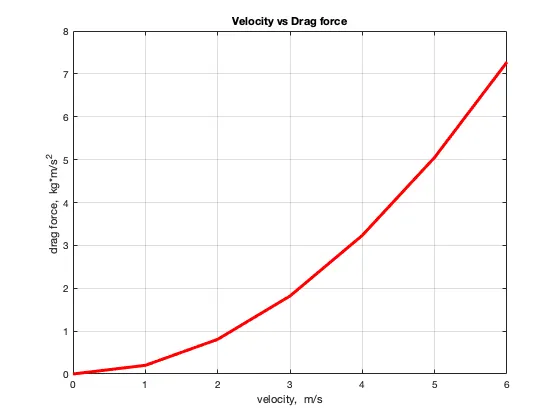
Figure 1
As we can see the drag force is increasing with the increase of velocity, this is because the drag force is related with velocity exponentially.
Case 2
For same frontal area and velocity, the drag coefficient is different for different surfaces. In general, the value of drag coefficient varies from
0.01 to 1.5 with stream line object lying in the lower spectrum and cube in upper spectrum.
The frontal area of the cyclist riding in an upright position is similar to a cube hence the drag coefficient is 1.1.
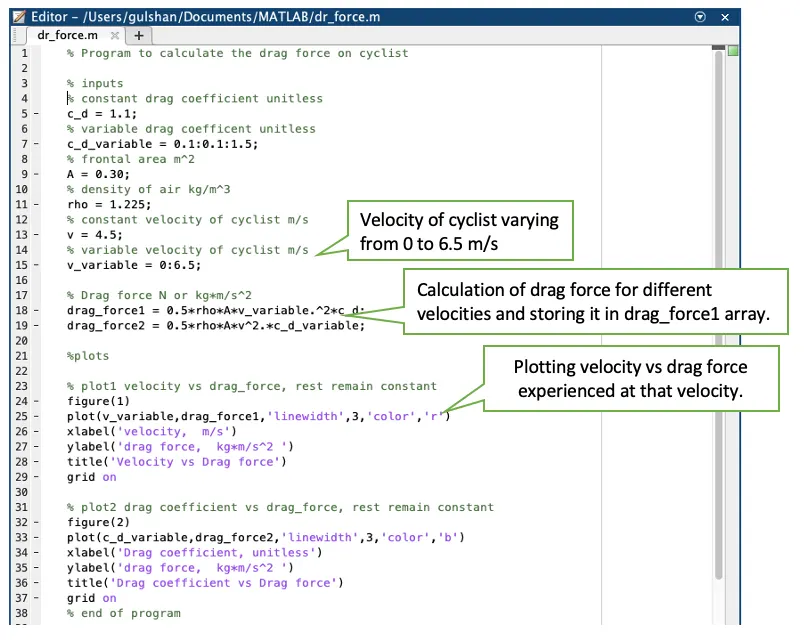
MATLAB code:
Plot obtained:
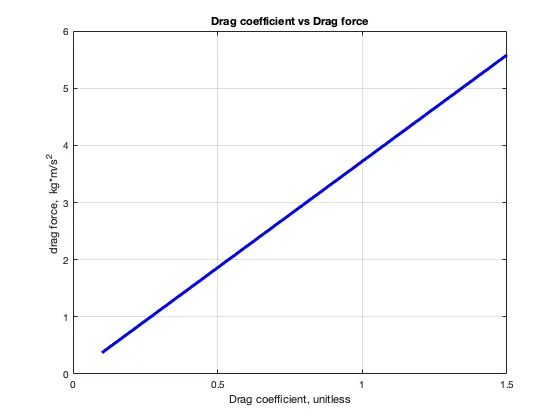
Figure 2
As we can see from the graph the drag force is increasing proportional relative to drag coefficient, which is true because of the drag is directly proportional to the drag coefficient.
CONCLUSION:
Case1
As we can see form the first graph the drag force experienced by the rider increases with the increase in speed of the cyclist and to overcome the resistance the rider has to pedal hard thereby require increase in input energy, this shortcoming can be overcome by reducing the frontal area of the rider i.e. if the rider’s head is closure to the handle and back parallel to the stem of the bike.
Case2
As we can see from the second graph the drag force increases with increase in drag coefficient. Since increase in drag force result in increase in input energy, the coefficient of drag should be kept low. Since we know different shapes have different drag coefficient with stream line vehicle having value around 0.05 and cubes with value around 1.1. While designing a more streamlined approach should be followed.