Literature review RANS derivation and analysis
Objective: To apply Reynold's decomposition to the NS equations to get the RANS equations.
1. Understanding of the terms Reynold's stress.
2. Understanding Turbulent and Molecular Viscosity.
Theory
Reynolds average Navier-Stokes equations(RANS)
In order to describe the behaviour of the turbulent flow Osborne Reynolds has came up with the concept of time averaging and decomposing the equations of the motion of the fliud flow. This method of decomposition is called Reynolds decomposition. Upon time averaging and decomposing we get 6 additional unknows along with the 4 variable unknows. These 6 unknows appear due to time averaging of momentum equations and because of this unknows we approach closure problem of turbulence. In order to get rid of these unknows there are certain models which can be used to model turbulence.
Reynolds decomposition
It is a process of separating the flow variables like velocity into mean component(time averaged) and a fluctuating component. Due to the fluctuating velocity component, the fluid layers experience additional turbulent shear stress, known as Reynolds stresses. There is momentum exchange due to convective transport by the eddies which cause the faster-moving fluid layers to be decelerated and slower-moving layers to be accelerated. And in presence of temperature or concentration gradients, the eddy motions will also generate turbulent heat or species concentration fluxes.
Solution:
In order to take the time average, the momentary value is decomposed into 2 parts, i.e, the mean value and the fluctuating value.
The momentary velocity component is u, the time-averaged value is named `¯u u¯` and the fluctuating velocity as u'. Hence the decomposition can mathematically be written as:
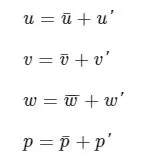
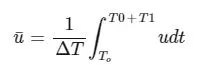
The chosen averaging method takes the mean values at a fixed place in space and averaged over a time span that is large enough for the mean values to be independent of it.
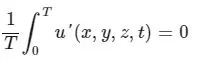
The integration of fluctuating velocity comes out to be zero, ie,
Reynold's decomposition:
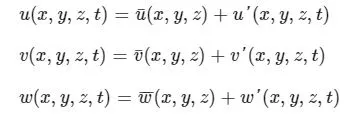
This decomposition is applied to Navier-Stokes equations to obtain the time-averaged form for:
1. Continuity equation:
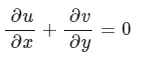
(2D continuity equation of Navier-Stokes equation)
Applying decoposition,
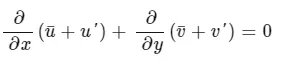
Applying time integration,

Since the time integral of fluctuating component is zero and the time averaged value is still an average function of time, we get
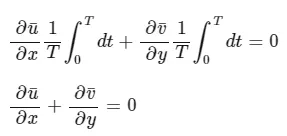
We obtain the continuity equation in terms of time averaged quantities.
2. Momentum equation:

Adding continuity equation,

Applying product rule,

Applying time integration and Reynold's decomposition,

The fluctuating terms are zero, hence, the equation reduces to,

The above equation is similar to the original momentum equation except it it is in time averaged form and we have two additional terms on the RHS.
The additional time-integration terms in the RHS are not equal to zero, however, to simplify the model, certain important assumptions are to be applied,
Assuming
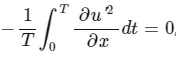
considering velocities in x-directin to be negligible gradient, we get,

On simplifying, RANS equation,

In the above equation,
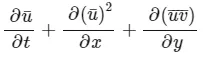
are the inertial terms,

is the pressure term,

is the molecular viscosity,
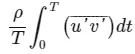
is the momentum diffusivity because of turbulence,

is the viscous stress term,
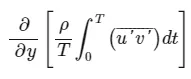
is the Reynold's stress term.
What is Reynold's stress:
Reynolds stress is the component of the total stress tensor in a fluid obtained from the averaging operation over the Navie-stokes equation to account for turbulent fluctuations in fluid momentum.
Turbulent viscosity:
In a turbulent fluid, a linear interface between two different fluids breaks apart to form small-scale structures, also known as eddies,s these eddies grow and diminish in size (by energy cascades), they effectively alter the surface area of the interface between the fluids with different properties, thus altering the net transfer of momentum and scalar properties through the interfaces. This effective viscosity is called turbulent viscosity.
The coefficient that relates the average shear stress and rate of velocity gradient in the turbulent flow is called turbulent viscosity. The turbulent transfer of momentum by eddies give rise to internal fluid friction on a large scale. It is also known as eddy viscosity. These are enormous in nature and to capture these to extreme details is near impossible, if done computationally, it is very costly. Thus we devise a way to capture net effective mixing of eddies using viscosity models. Turbulent viscosity increases the shear rate and affects the velocity and heat transfer.
Molecular viscosity:
It is a fluid property and is the same as viscosity. Its coefficient is the same as dynamic viscosity. Molecular viscosity is the transport of mass motion momentum solely by random motions of individual molecules not moving together in coherent groups. Molecular viscosity is analogous in laminar flow to eddy viscosity in a turbulent flow. It can also be constructed like some sort of internal friction between two layers of fluid developed while flowing.
*Turbulent viscosity is a turbulent transfer of momentum by eddies giving rise to internal fluid friction which is analogous to the action of molecular viscosity in laminar flow but takes place in much larger space.
*Molecular viscosity is the same as viscosity. The Coefficient of Molecular Viscosity is the same value as dynamic viscosity. Molecular viscosity is the transport of mass motion momentum solely by the random motions of individual molecules not moving together in coherent groups.