Independent Research Project
Engineering Significance
We want to utilize Ansys simulation software in the area of cutting tools.
We selected a drill model for the same. we want to analyse and check which cutting tool material has good strength by analysing the drill for different conditions.
Simulate the working condition of a Drill, assuming different workpiece material so that drill experience different axial force like 200N, 400N,500N,700N. Apply the 2 different material conditions for drill as HSS and Carbide. Analyze the total deformation and Equivalent stresses acting on the model.
Aim of the project:
To perform the Transient simulation for a drill penetrating into a workpiece model, Capture Total deformation, Equivalent stress, and strain.
Compare the results in varied condition of 3 different axial force like 200N,400N,500N,700N. And, with the 2 different material conditions for drill as HSS and Carbide.
Set Up
- In the Ansys workbench we chose Transient structural and in engineering data we added the material Carbide, HSS for drill.
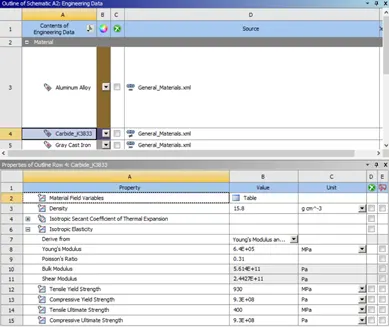
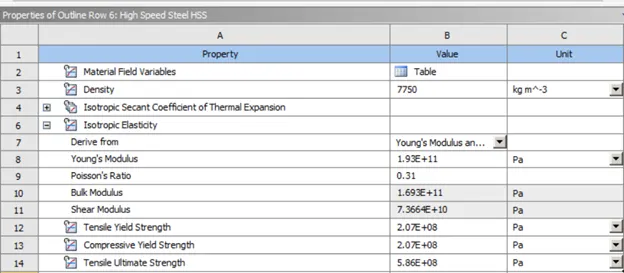
2. After Importing the Drill and workpiece model in the Geometry, we opened it in SpceClaim and checked for any abnormalities.
3. Once we opened the model in Mechanical module, we renamed it and assigned Carbide material to the drill for the case 1.
4. Under connections we have a Frictional contact between the tip edge and workpiece.
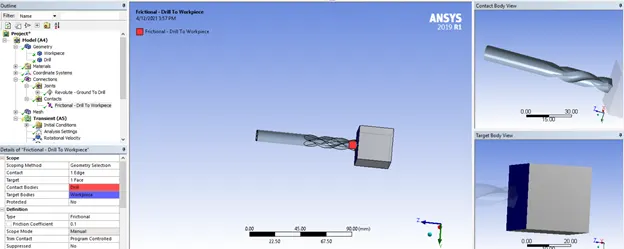
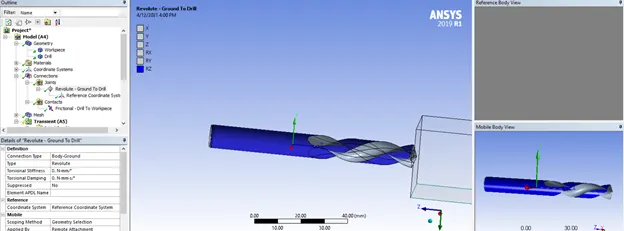
- Also, we added a revolute joint Ground to drill as shown below.
- In the meshing we used minimum possible 2.5mm element size under face sizing for drill and kept automatic method for workpiece.
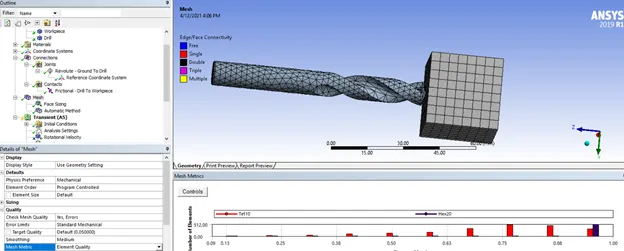
- In analysis settings we added 8 steps under step control and updated as shown below.
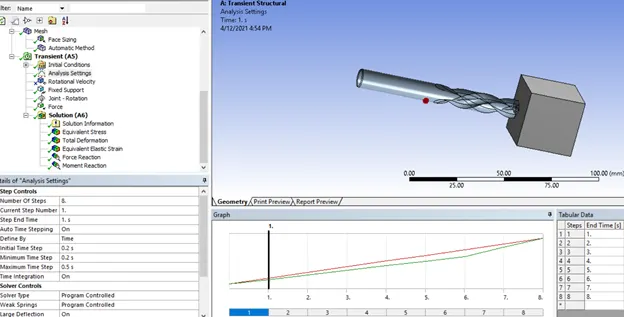
8. Added a fixed support to the back face of the workpiece.
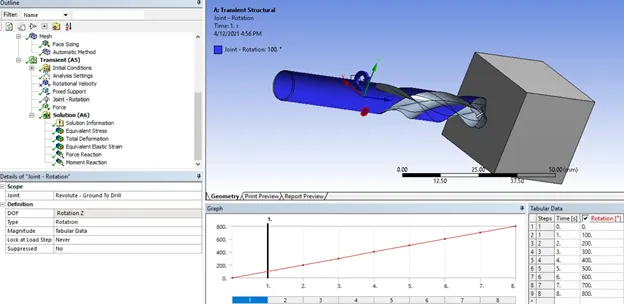
9. Added joint rotation for drill in 8 different steps so that drill rotates in the Z Direction as shown below.
10. Now we have added Force of 500N (in the first trial of case 1) to the Tip of drill towards the spindle.
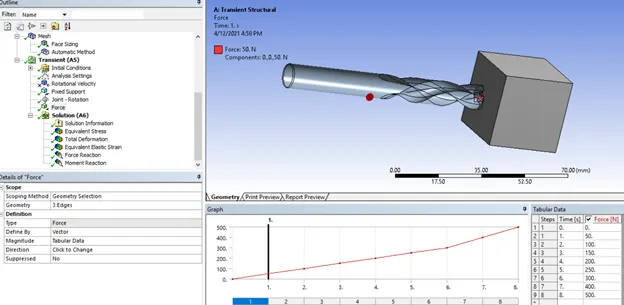
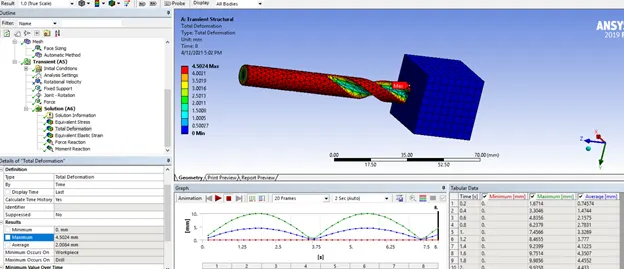
Finally, we requested for desired solutions and got the results as shown below for Axial force of 500N
Total deformation : - Maximum : 4.5024 mm
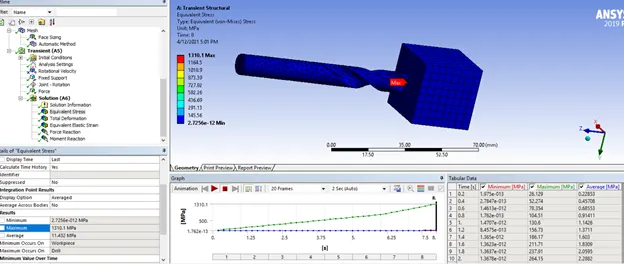
Von-mises Stress : - Maximum : 1310.1 MPa
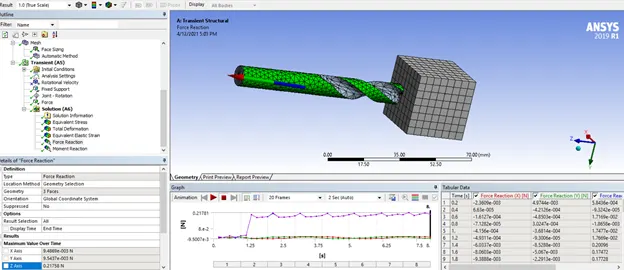
Force Reaction : 0.21758 N in Z axis
Increased Load in Case 1
Keeping the Drill material as Carbide only we changed the axial force on cutting tip of Drill to 700N
And found the results as shown below.
Total deformation : - Maximum : 4.5028 mm
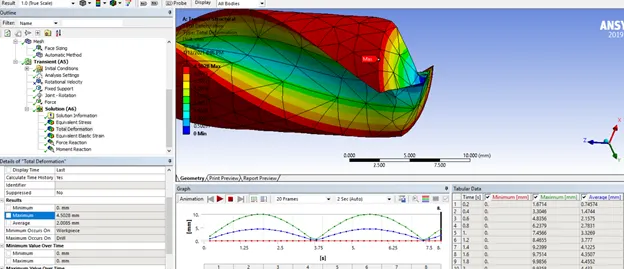
Von-mises Stress : - Maximum : 1833.3 MPa
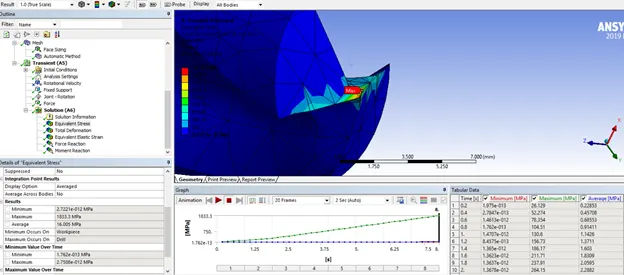
Case: 2
In case 2, we have changed the materials for the drill as HSS. And again, continued the analysis in different Force conditions.
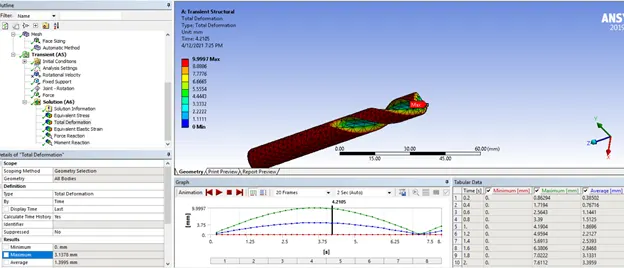
For higher force drill was drastically failed And found the results as shown below when we checked for Force 200N.
Total deformation : - Maximum : 3.1378 mm
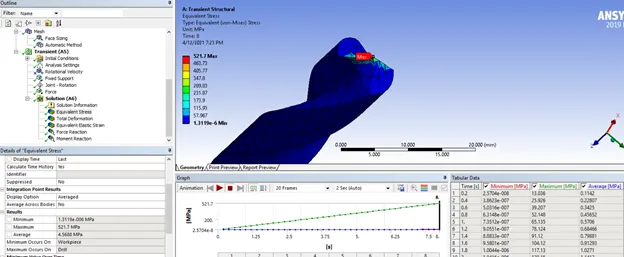
Von-mises Stress : - Maximum : 521.7 MPa
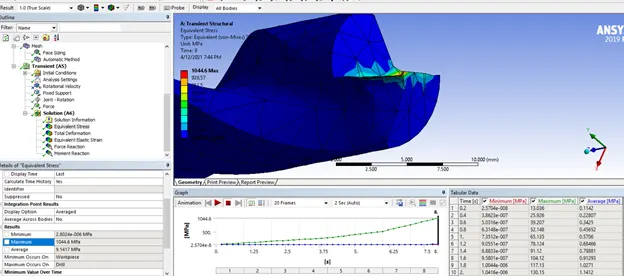
When we increased the Force and analyzed, found the results as shown below when we checked for Force of 400N.
Total deformation : - Maximum : 3.1344 mm
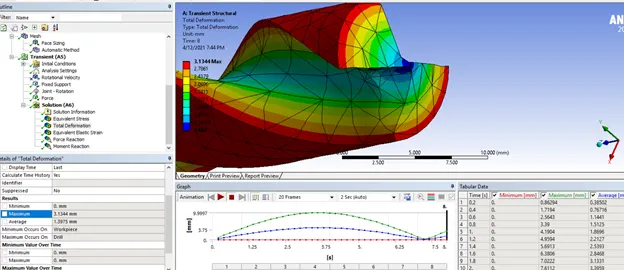
Von-mises Stress : - Maximum : 1044.6 MPa
Conclusion
|
Material of Drill |
Axial Force applied |
Directional Deformation (Max.) |
Max. Von-mises Stress (Mpa) |
|
Carbide |
500N |
4.5024 mm |
1310.1 MPa |
|
700N |
4.5028 mm |
1833.3 MPa |
|
|
High Speed Steel (HSS) |
200N |
1390. mm |
709.72 MPa |
|
400N |
3.1344 mm |
1044.6 MPa |
We found that Drill with Carbide material was able to withstand higher axial force and thus we can utilize the same for harder workpiece materials. HSS was able to sustain only upto 400N of axial force so it is recommended only to soft materials.