Implementation of DC machine torque speed characteristics equations of an EV in MATLAB script file.
Objective
> Implement DC machine torque speed characteristics equations in MATLAB script file.
> Distinguish between power cables and signal cables in wiring of an electric vehicle
> Define what voltage levels are considered as high & low for a battery pack of electric vehicle
DC machine torque speed characteristics equation in matlab script file
If supply voltage (V) of a DC motor is constant, with a motor constant (K) and resistance (R) in the motor windings is a constant then, torque (T) is inversely proportional to the rotational speed (`omega`) of the motor
The speed equation of a DC motor is
`omega`= (V/K) - (`tau`/K^2)*R
Where,
`omega`= Rotational speed of the motor in rad/sec
V = Voltage supply in volts
K = Motor constant
`tau` = Torque in N-m
R = Armature resistance in ohms
The motor constant equation is
K = (Eb*60)/(2`pi`Ns)
where,
K = motor constant
Eb = Back EMF
Ns = Constant speed
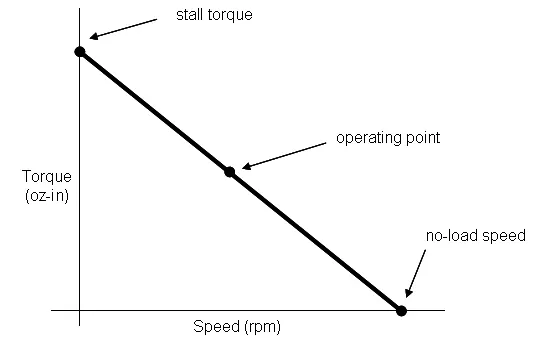
The torque vs speed curve of a dc motor has
> Stall torque
When rotational speed of the motor `omega`equal to zero then, the torque at that point is known as peak torque or stall torque.
The equation to find peak torque or stall torque
`tau`s = (V*K)/R
where,
`tau`s = Stall torque
V = Voltage supply in volts
K = Motor constant
R = Aramature resistance in ohms
> No-load speed
When the motor is running at maximum speed `omega`max then, the torque at that point will be zero. This maximum speed of the motor is also known as no-load speed.
The equation to find maximum speed or no-load speed of a motor is
`omega`max = (V/K)
where,
`omega`max = No-load speed in rad/s
V = Voltage supply in volts
K = Motor constant
> Operating torque
Any point in the curve except the stall torque and no-load speed, has an operating torque.
Although stall torque is considered to have the highest torque value in the speed vs torque curve, the motor does not operate, (i.e) speed of the motor = 0
MATLAB code to plot the Speed vs Torque curve using the above equations
%DC machine Speed vs Torque curve

clear all
close all
clc

% Inputs

% Voltage supply
V = input('Enter the voltage supply in Volts - ');
% Armature resistance
R = input('Enter the aramature resistance in ohms - ');
% Back EMF
Eb = 1;
% Speed constant
Ns = 15;


% Calculations

% Motor constant
Km = (Eb*60)/(2*3.14*Ns);
% Maximum speed (or) No-load speed
Nmax = (V/Km);
% Stall torque (or) peak torque
Ts = ((V*Km)/R);
% Torque values in N-m
T = linspace(0,Ts,20);
% Speed values in rad/s
N = ((V/Km) - ((T/(Km^2))*R));
% Speed values in rpm
N = (N*(60/(2*3.14)));
Nmax = (Nmax*(60/(2*3.14)));


% Plotting the speed vs torque curve

plot(N,T)
xlabel('Rotational speed in (rpm)')
ylabel('Torque in (N-m)')
legend('Speed vs Torque curve')
axis tight
grid on

% Stall torque and no-load speed of the motor
disp('Peak torque or stall torque of the motor is')
disp(Ts)
disp('No-load speed or maximum speed of the motor is')
disp(Nmax)
Code explanation
Inputs
>The voltage suppply (V) and armature resistance (R) are defined as inputs which are to be given by the user.
>Back EMF is assumed to be 1 .
>Constant speed of the motor Ns is assumed to 15.
Calculation
>The motor constant is calculated by using the equation K = (Eb*60)/2`pi`Ns.
>Then no-load speed is calculated by `omega`max = (V/K).
>The peak torque is calculated to determine the torque values of the motor.
>By using the linspace command the torque values of the motor is generated.
>Then the speed values of the motor `omega` is found using the torque values (T) by using the speed equation
>Since the no-load speed and the rotational speed values of the motor are in rad/s they are converted into rpm.
Ploting
>The speed vs torque is ploted using the plot command.
>Using xlabel and ylabel commands the plot is labeled and legend is used to define the curve in the plot.
>Axis tight command is used to fit the plot perfectly in the x and y axis of the plot.
>The peak torque and no-load speed is printed on the command window using the disp command.
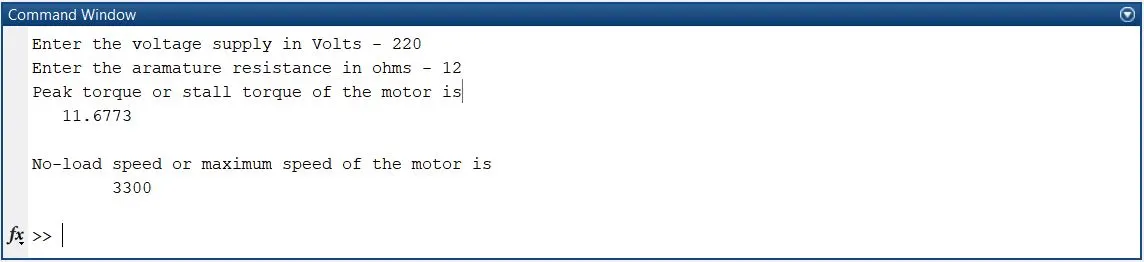
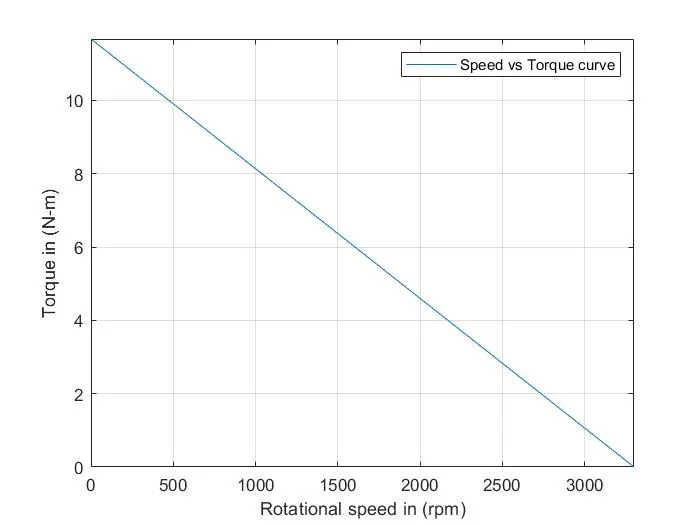
Results of the code
Results explanation
>The voltage supplied is given as 220 voltes.
>The resistance in the circuit is given as 12 ohms.
>Using the above user given inputs the peak torque and no-load speed are calculated.
>The calculated values are displayed in the command window.
>From the plot it is seen that the speed is inversely proportional to the torque of the motor.
>The curve in the plot represents a line equation
Diffrence between power cables and signal cables
Power cables
>The power cables are connected to the inverter of the pase of the alternating current (AC motor)
>They are larger in diameter when compared to the signal cables
>If power cabels are substituted with the signal cabel then, due to the resistance of wires, the signal maynot reach the required destination.
>Therefore power cables are not recommended to transmit signal
>Power cables are not only used for transmitting energy fro battery to motor but it is also use in recharging the battery if the vehicle is a plug-in electric vehicle
Signal cabel
>Signal cables are used to transfer the data from one place to another
>Signal cables are very thin compared to the power cables
>Since the cross sectional area of the wire is thin in the signal cables, the power capacity reqiured for an electic vehicle cannot be transmiited.
>The datas transmitted through the signal cables are processed accordingly in various subsytems of an electric vehicle
>The processed data such as vehicle speed, state of charge, estimated range of the vehicle, etc are digitaly displayed
What voltage levels are considered as high and low for a battery pack of electric vehicle
In automotive industry high voltages refer to voltages above 60V. Almost all the electric vehicle uses high voltage battry pack. The voltage requirment of the battery pack increases as the performance requirment increases.
The classification of voltages has its origins in plant and building services engineering, in this way lay persons can easily recogonize the increased risk associated with higher voltage
The classification of voltage level in automotive sector and passenger car vehicle is given below.
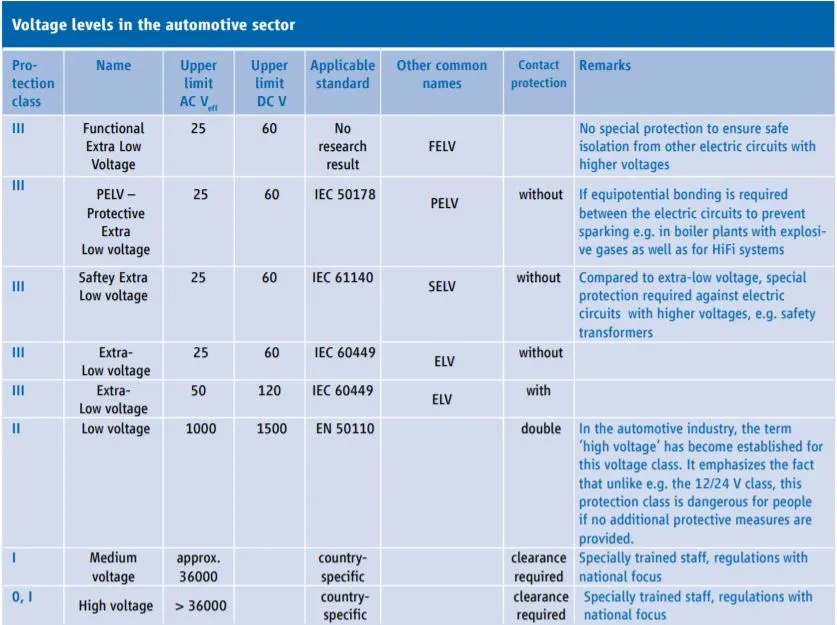
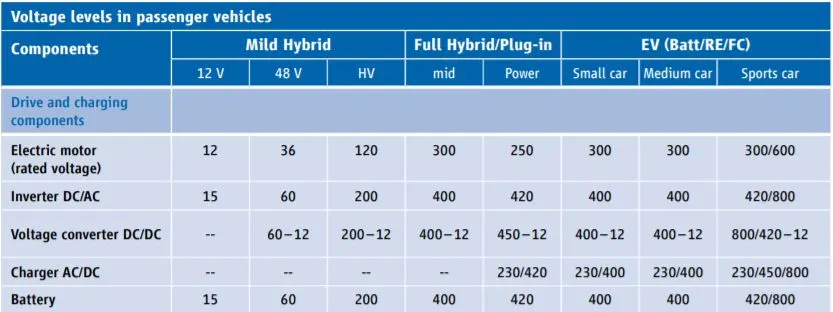
From the above table it is clearly seen that, fully hybrid vehicles and pure electric vehicles uses high voltage battery pack according to the automotive industry and some of the mild hybrid electric vehicles uses low voltage battery pack.