Identification of Cracks
1. What is the mode of failure or damage of the beams in the figure above? Are the damages repairable? Elaborate
a)
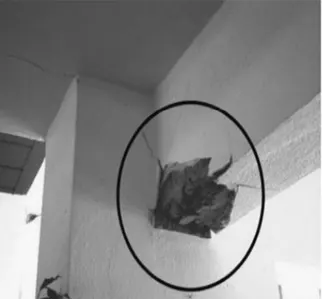
- This crack is formed due to the flexural failure of beam. The flexural strength represents the highest stress experienced within the material at its moment of rupture.To overcome this failure, main steel is provided at the bottom/top of the beam. The damages are repairable.Be sure to turn off the water, power, etc.Mount the angle iron on the jack and the temporary post. Get the angle iron in place and slowly raise the jack until the angle iron is wedged up against the damaged beam.Screw the angle iron into the beam and remove the temporary post.Slide any pipes or wires previously removed back through the beam and turn the water and power back on.
b)
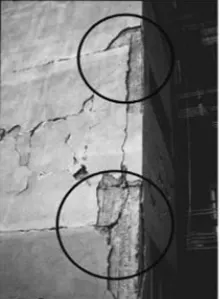
- This cracks are formed due to high slump concrete. Beams and columns carry heavy load. So ,first is to relieve part of its load. This is done by providing supports at beam column joints. Remove the damage concrete until steel reinforcement is visible
c)
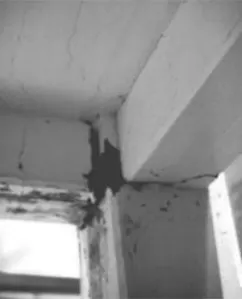
- This cracks is formed due to the beam-column joint failure.The high internal forces developed at plastic hinges cause critical bond conditions in the longitudinal reinforcing bars passing through the joint and also impose high shear demand in the joint core. The bond performance of the bars anchored in a joint affects the shear resisting mechanism to a significant extent.
*************
2. What is the mode of failure or damage of the beams in the figure above? Are the damages repairable? Elaborate
a)
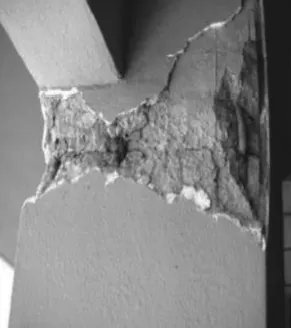
- This crack is formed due to the flexural failure of a column. Columns have the most important role in all structural members. According to the base civil concept, columns failure wants to be occurring after beams and the other components damages. Performance of existing buildings in earthquakes indicates that the beams are less vulnerable to damage during earthquakes and their damage appears to be less critical to performance as compared with that of columns and column-beam joints.
b)
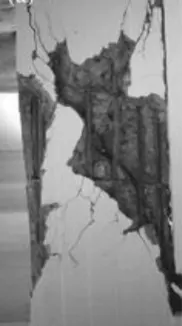
- This crack is formed due to the shear failure of a column.When there are no shear walls, columns carry these lateral loads. Lateral loads are generated by winds, earthquake loads, from retaining structures, etc. Further, the size of the columns is increased in the direction of shear to increase the shear capacity.
c)
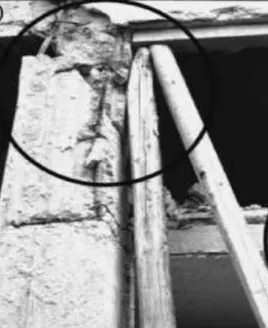
- This crack is formed due to the short column failure. In Short Columns, failure takes place due to yielding and it is defined as crushing. Short Columns are classified based upon Slenderness Ratio in which the ratio of the effective length and least lateral dimension of the column. Failure of column usually occurs due to anyone of the following stresses developed in the column.
*******************