Identification of Cracks
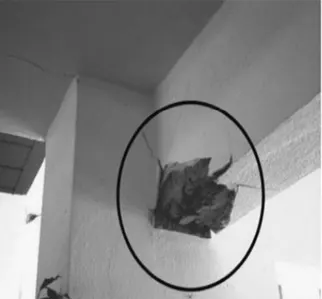
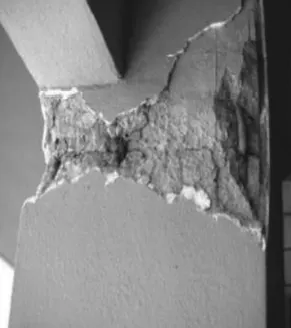

Q1)What is the mode of failure or damage of the beams in the figure above? Would you characterize the case as damage or as a failure? Are the damages repairable? Elaborate.
ans) In the above three figures, failure is due to beam to column connection.
this type of failure is the most common due to earthquake failures. joint where 4 members i.e beam and column join are subjected to very high loading. therefore any improper or negligiency during reinforcement can lead to this type of failure resulting in collapse. this is the case of plastic hinge formation. plastic hinge is defined as the ability of a member to sustain the loadings imposed on it,but when it crosses a specific value ,it results in failure.The functional requirement of a joint, which is the zone of intersection of beams and
columns, is to enable the adjoining members to develop and sustain their ultimate
capacity. The demand on this finite size element is always severe especially under
seismic loading. The joints should have adequate strength and stiffness to resist the
internal forces induced by the framing members. The flexural forces from the beams and columns cause tension or compression forces
in the longitudinal reinforcements passing through the joint. During plastic hinge
formation, relatively large tensile forces are transferred through bond. When the
longitudinal bars at the joint face are stressed beyond yield splitting cracks are
initiated along the bar at the joint face which is referred to as ‘yield penetration’.
Adequate development length for the longitudinal bar is to be ensured within the joint
taking yield penetration into consideration. Therefore, the bond requirement has a
direct implication on the sizes of the beams and columns framing into the joint.
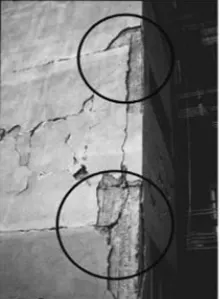

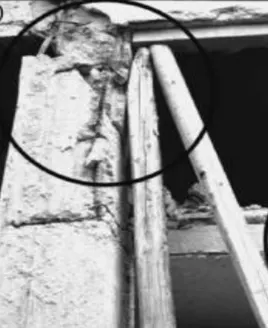
short column effect is observed in the above three figures ,which is explained below.
If an infill wall in a reinforced concrete frame is shorter than the column height and there is no initial gap between the column and the infill wall, the short column effect can occur during an earthquake shaking. This form of damage is frequently observed in many earthquake-damaged buildings all around the world . In this study, an effective method, which consists of placing additional infill wall segments surrounding the short column, to prevent this type of failure is examined. The influence of adding infill wall in the reduction of the shear force in the short column is also investigated. A parametric study is carried out for one-storey infilled frames with one to five bays using the percentage of the additional infill wall surrounding the short column and the number of spans as the parameters. Then the investigation is extended to a case of a multistorey building damaged due to short column effect during the 1998 Adana-Ceyhan earthquake in Turkey. The results show that the addition of the infill walls around the potential short columns is an effective way to significantly reduce the shear force.
suppose there are two columns,one of them is short. according to the calculations it is concluded that short columns are more stiffer compared to long columns,because of which they
attract more forces, which may lead to failure of structure. therefore in order to save the structure,short columns should be designed considering the desired force it should withstand.