Hood design-Week 2
Design and Development of Car engine HOOD
Aim :
Design Hood Outer Panel, Inner Panel and the necessary reinforcements by following the Master Section mentioned with the Design parameters
Contents :
- Introduction and Theory about HOOD
- Important Parts of HOOD
- Design requirements of Car HOOD
- Design Procedure
- Conclusion
1. Introduction and Theory about HOOD
- Hood Definition
The HOOD is simply defined as the movable covering for an automobile engine.
- Introduction
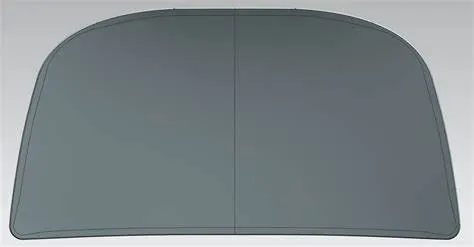
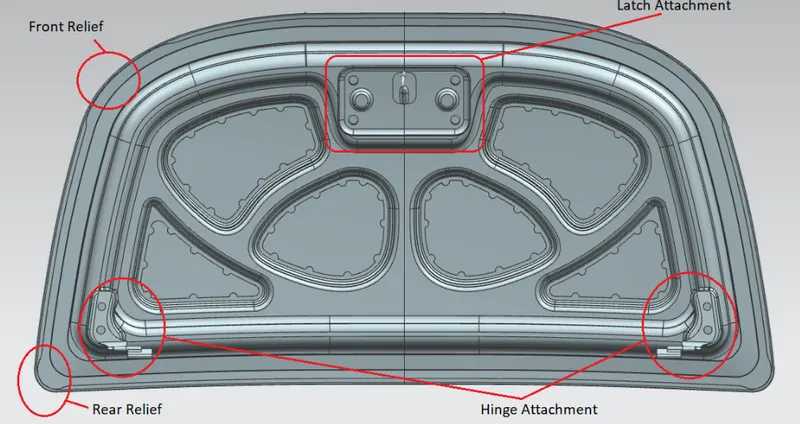
On front-engined cars, the hood may be hinged at either the front or the rear edge, or in earlier models. it may be split into two sections, one each side, each hinged along the centre line. A further variant combines the bonnet and wheelarches into one section and allows the entire front bodywork to tilt forwards around a pivot near the front of the vehicle.
The hood release system is common on most vehicles and usually consists of an interior hood latch handle, hood release cable and hood latch assembly. The hood latch handle is usually located below the steering wheel, beside the driver's seat or set into the door frame. On race cars or cars with aftermarket hoods (that do not use the factory latch system) the hood may be held down by hood pins. Some aftermarket hoods that have a latch system are still equipped with hood pins to hold the hood buttoned down if the latch fails.
2. Some Important Parts of HOOD
- Outer Pannel
- Inner Pannel
- Striker
- Hinge
- Hood Stay
Image of Car Engine Hood and Assembly for better understanding
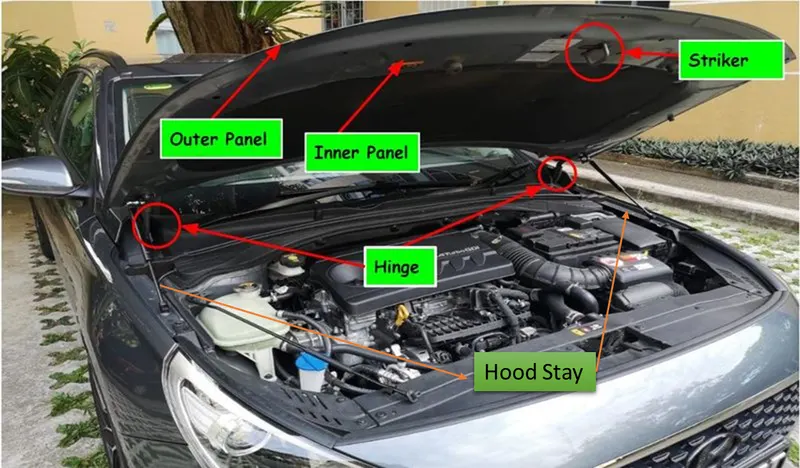
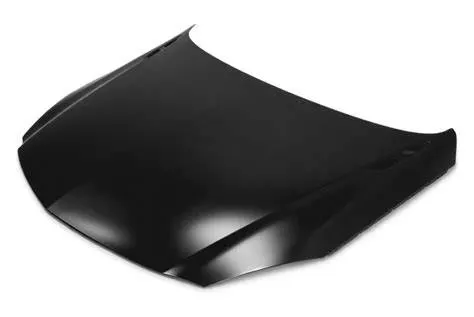
- Outer Pannel:
- Inner Pannel :
A hood panel consists of two panels that are hemmed together to form the automotive hood assembly. The inner panel of the hood is not visible to the customer but this is the engineering feature of the outer panel. The outer panel has the aesthetic look to it but on its own is very weak and not capable of handling force during impact.
A hood inner panel includes an inner panel main body forming part of a hood of a vehicle, a front bead provided on the inner panel main body and extending along a vehicle width direction, and a rear bead provided on the inner panel main body, located on the rear side of the front bead toward a back of the vehicle and extending along the vehicle width direction.
- Striker :
Meaning of hood striker : It bolts to the underside of the hood at the front. It engages the hood latch when closed. Material: Steel. This premium hood latch striker is in a league of its own when it comes to quality replacement of a damaged or cracked component.
- Hinge :
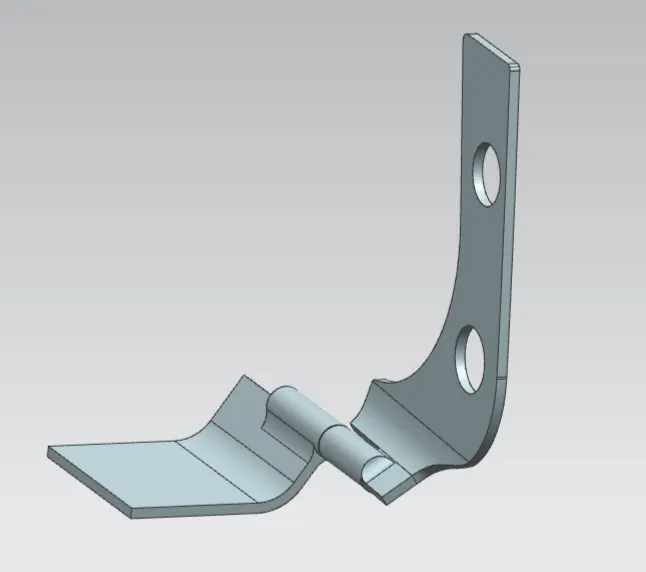
The hood hinge is a pivot and bracket mechanism that makes it possible for you to open and close your hood. Each car typically has a pair of hood hinges installed in the front of the vehicle.
Keeping in mind variegated needs and demands of our esteemed patrons; we are able to offer an elite array of Car Bonnet Hinges. A crew of experienced personnel fabricates this array by employing superior-grade raw material and with the aid of sophisticated machines. Apart from this, we offer this array to our esteemed patrons at budget friendly rates in modified as well as standard forms within specified frame of time.
- HOOD Stay :
A hood stay is an apparatus for an engine room of a car, which can safely keep an engine hood in an open state even if an external force is abruptly generated due to vibration, wind, and can felicitate an opening/closing operation of the engine hood.
There are mainly two types of the Hood stay that is a) Support Rod and b) Gas Stay.
a) Support Rod:
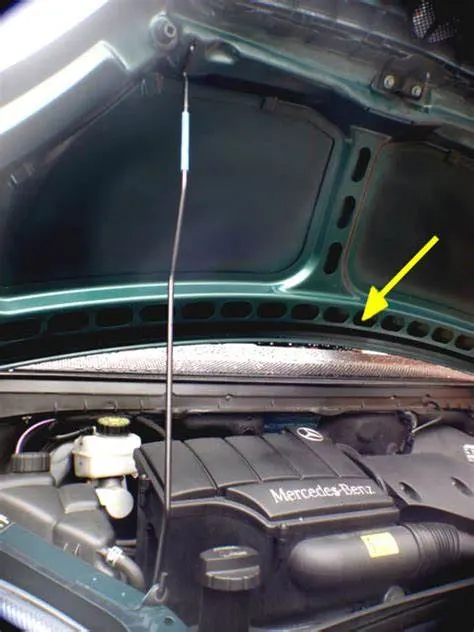
Support Rod can be mounted with grommet side on the engine compartment of Body and rod locking hole on the hood or vice versa.
The car bonnet support is made of high quality carbon fiber material, durable and wearresistant. A car front bonnet hood engine cover lift support is durable and resistant to corrosion.
b) Gas Stay :
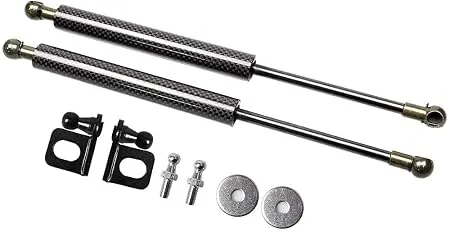
Bonnet struts are small, usually gas-charged cylinders that are used to support the hood of your car while it’s open so that you can get to work on all the important stuff.
The gas stay will assist in opening and holding the hood in position.
Basically, used for high-performance cars where the length of the engine compartment will be more.
In such cases, bonnet length and its weight will be more.
Bend is provided to improve strength. The bend should be within 35mm. Above 35 mm won’t serve the purpose as the rod start to bend more due to hood weight.
3. Design requirements of Car HOOD
- HOOD opening angle and head clearance :
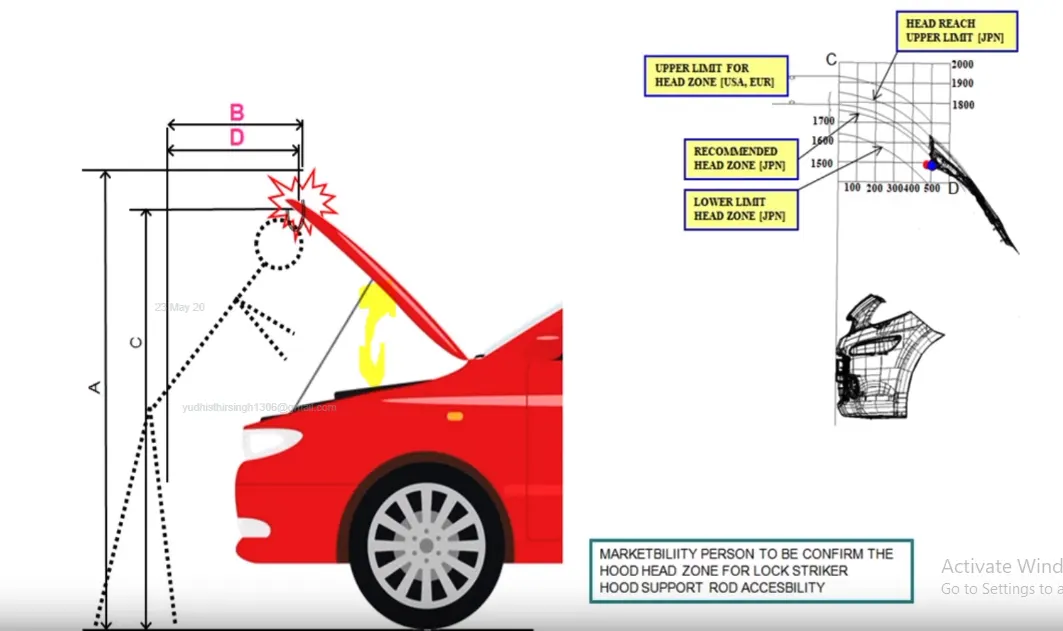
Opening angle varies from region to region depending on average human height. Depending on the standards we are deciding the angle. So from the angle data, Support rod or Gas stay is designed. The position of Support rod is on the other side of the battery which is shown in the fig. below.
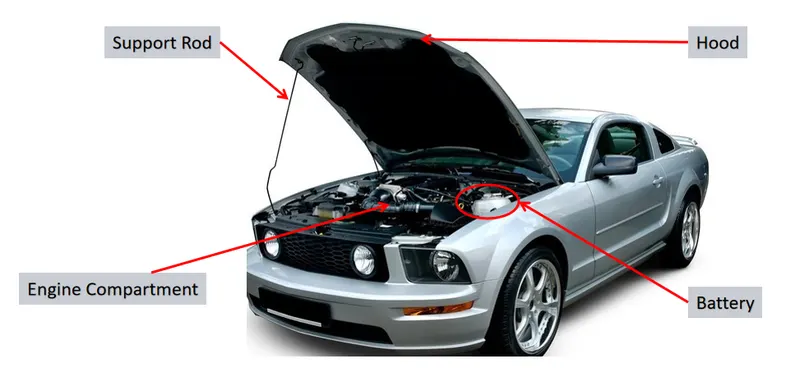
The average height of the human in India is 5.5 ft and also in other countries like US and Japan the average height is approximate 6 ft thats why the opening angle and head clearance is decided by considering the human height. There are some standards are decided to the calculations of the opening angle of hood.
Head clearance is decided upon the zone or country. So same car if it is made for a different country will have different opening angles depending on the country or region.
- Adding Latches and Stiffner pad :
A system for releasing and lifting an automobile hood includes a sensor located proximate a front location of an automobile that detects impact with an object. Also included is a hood having a striker pin operably connected to the hood for engaging a rotatable latch, wherein such engagement places the hood in the secured position.
Material: Steel. This premium hood latch striker is in a league of its own when it comes to quality replacement of a damaged or cracked component.
Latches are added where and all the weight is added. On the inner panel we have Hinges and striker, which are attached to the inner panel so due to this attachment the strength of the inner panel is going weak. In order to strengthen the inner panel Latches will play a very important role. Stiffener pad is the sponge-like material place b/w Inner and outer panel to reduce vibrations.
- Mastic Seals in the HOOD :
Mastic seals are the most important factor in the design of the hood because the mastic seals are applied to hood for reduces and stop the vibrations, noise and harshness in the hood and comparatively in the car.
Mastic seals are placed in between the outer pannel and inner pannel of the hood, because of this the gap between the two pannels are 2-5 mm and the region covered by the mastic seal points is around 80 mm as shown in the fig above, The circles are shown that this is the area of single mastic point is 80mm.
- Embossing in the HOOD:
Embosses are placed or forming on the inner pannel of the hood also emboss provided the strength to the hood and reduction in weight of the hood. Creating embosses so as to dissipate the crash force towards the hinge. Whenever the car is crashed because of the emboss the force is diverted because of this the embossing is done on the Hood inner pannel.
- Hemming of Sheet Metal:
Hemming is a sheet metal forming process in which sheets are joined by bending it usually to 180°. Automotive body panels and automotive parts such as deck-lids, trunk-lids, doors, hoods and tailgates are formed by hemming process. This paper present a systematic review of sheet metal hemming process based on materials used in hemming process
Hemming is a forming operation in which the edges of the sheet are folded or folded over another part in order to achieve a tight fit. Normally hemming operations are used to connect parts together, to improve the appearance of a part and to reinforce part edges.
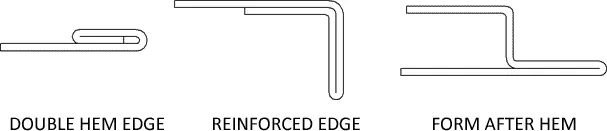
The term hemming has its origins in fabric making where the edge of cloth is folded back on itself and then stitched shut. In sheet metal hemming means to fold the metal back on itself. When working with a Brake Press hems are always created in a two step process.
- Wrap Around Distance :
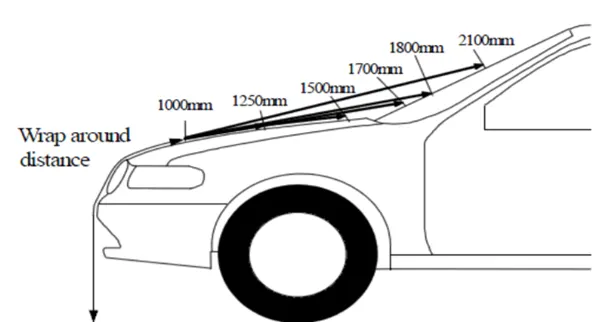
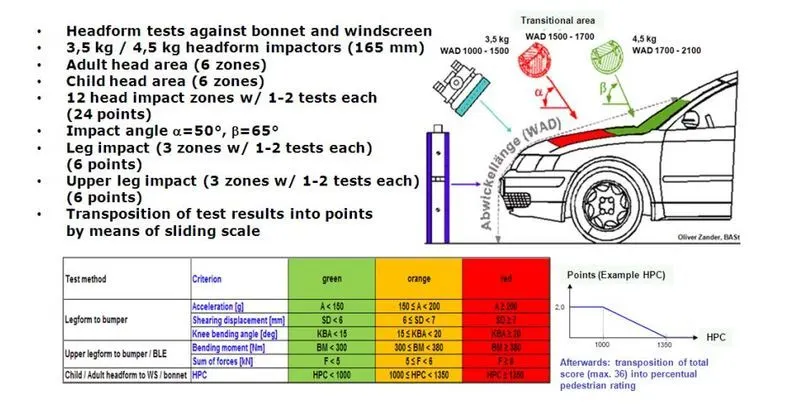
Wrap Around Distance (WAD) means the geometric trace described on the outer surface of the vehicle front structure by one end of a flexible tape, when it is held in a vertical longitudinal plane of the vehicle and traversed across the front structure. The tape is held taut throughout the operation with one end held at the same level as the ground reference plane, vertically below the front face of the bumper and the other end held in contact with the front structure (see Figure 11). The vehicle is positioned in the normal ride attitude.
4. Design Procedure
- Inner Pannel Design :
Take a file from download section which is outer pannel and process on it for the design of inner pannel, the dimensions and the drawing of inner pannel are shown in the question and referance video.
The drawing for design of inner pannel are as follows :
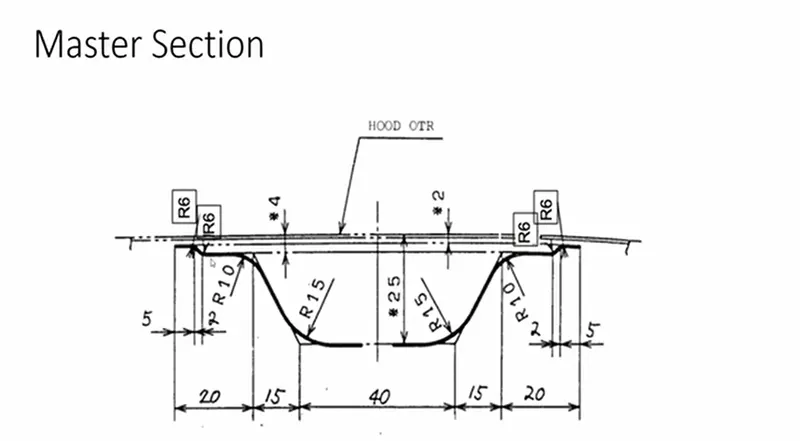
by follow the above drawing we have to produce inner pannel
- Command used for inner pannel design :
- Offset Surface
- Offset Curve on Surface
- Trim Sheet
- Through Curves
- Law Extension
- Emboss
- Edge Blend
- Face Blend
- Datum
- Sketch
- Saw
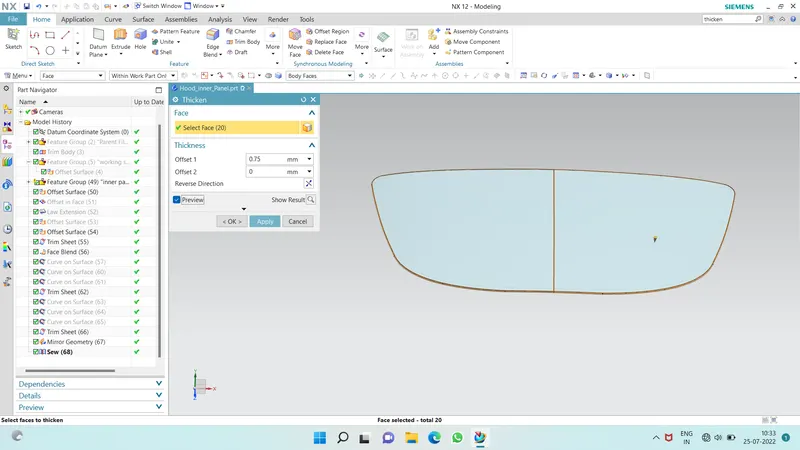
- Thicken
- Curve on Surface
- Mirror Geometry etc......
By using above command we have to design the inner pannel,
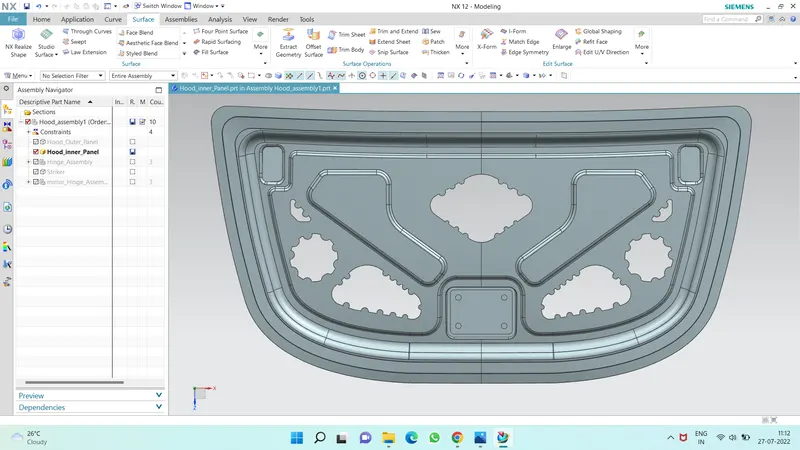
- Inner Panel Thickness = 0.75mm
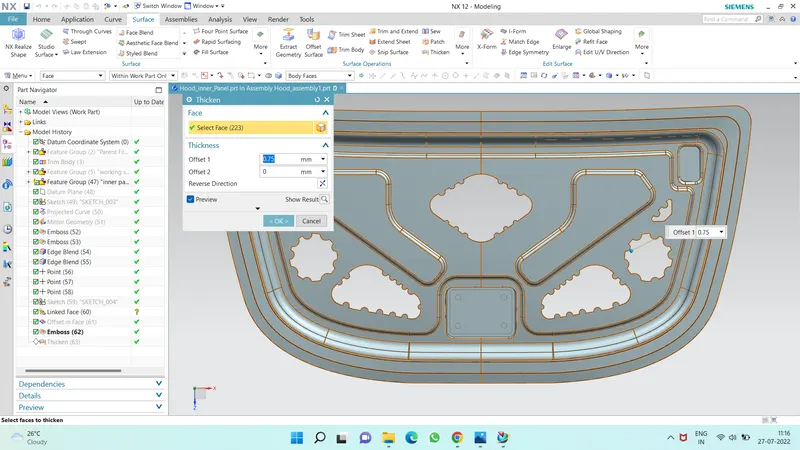
This is the ready design of Hood Inner Pannel.
- Outer Pannel Design :
Requirements :
Hemming Data:
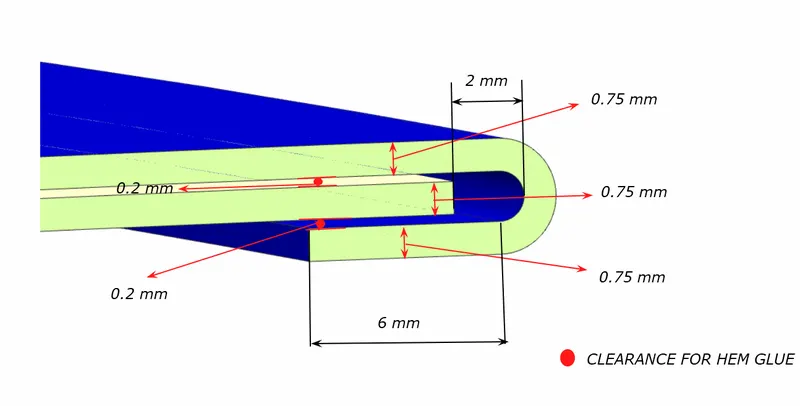
Relief rear section:
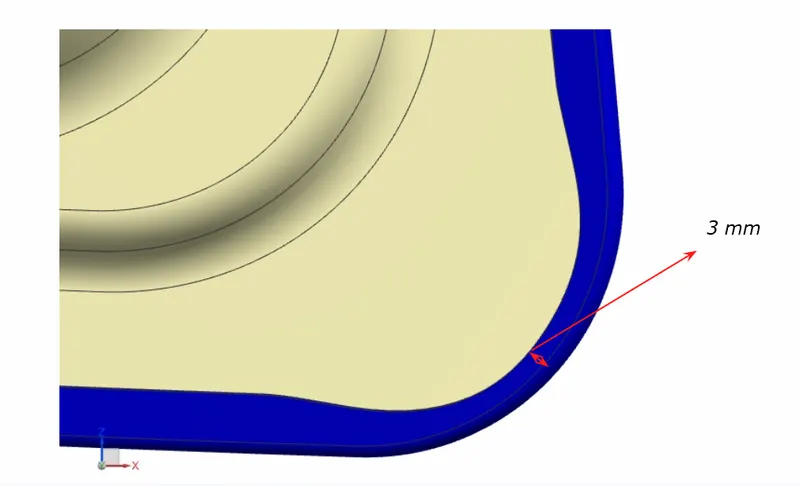
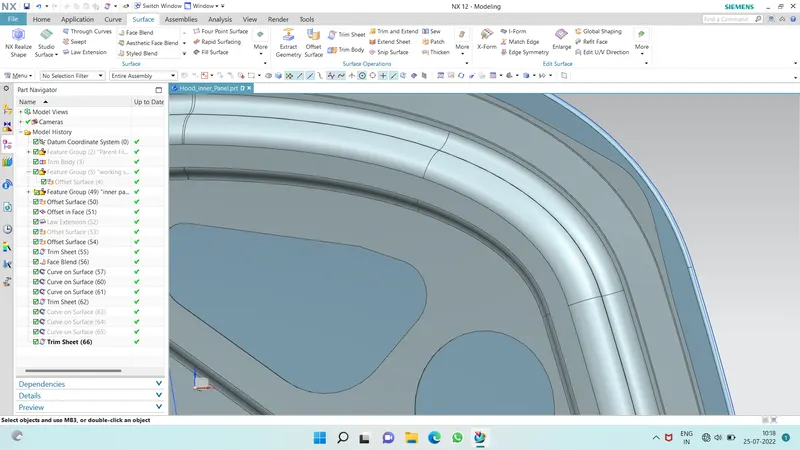
Front relief:
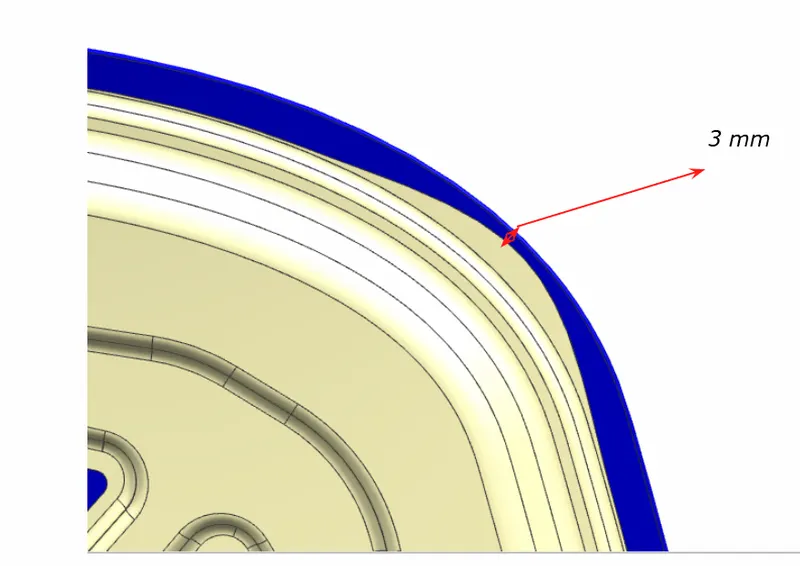
By using above information we have to modify the outer pannel of HOOD
Hemming :
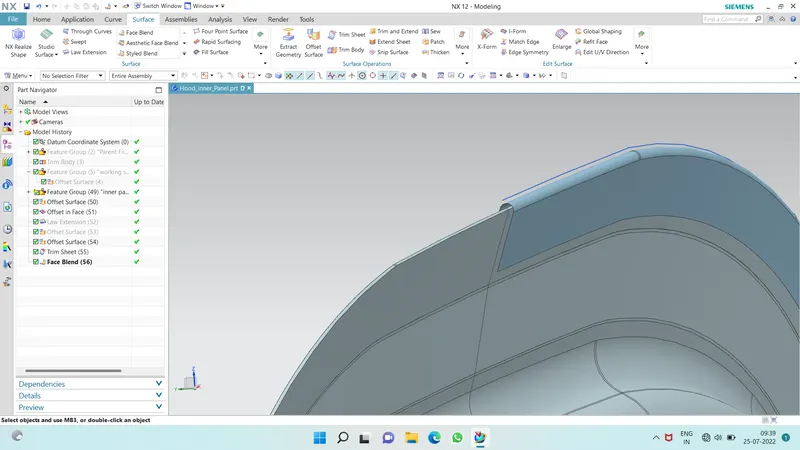
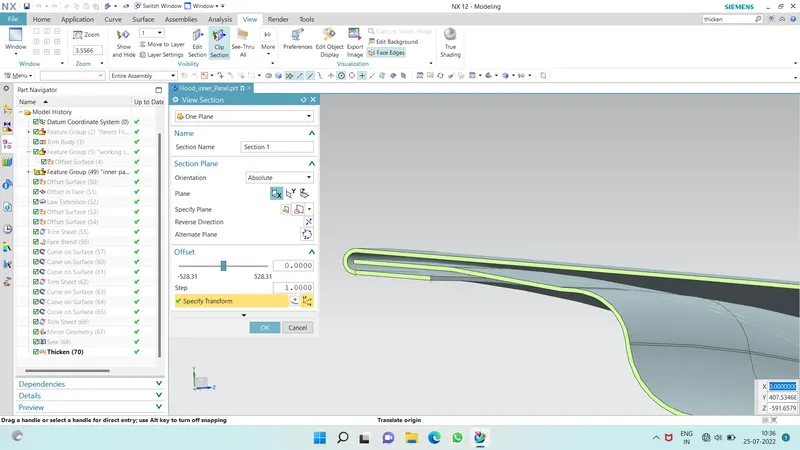
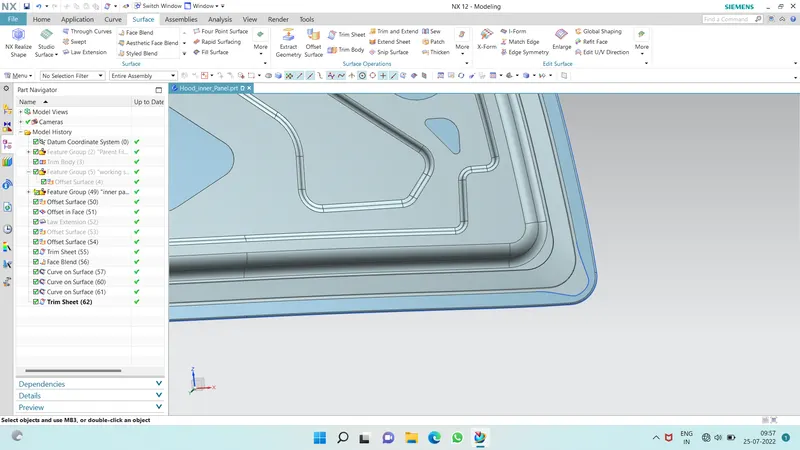
Relief rear section:
by using curve on surface command the relief is created
Front relief:
- Outer Panel Thickness = 0.75mm
- Hinge Assembly Placement :
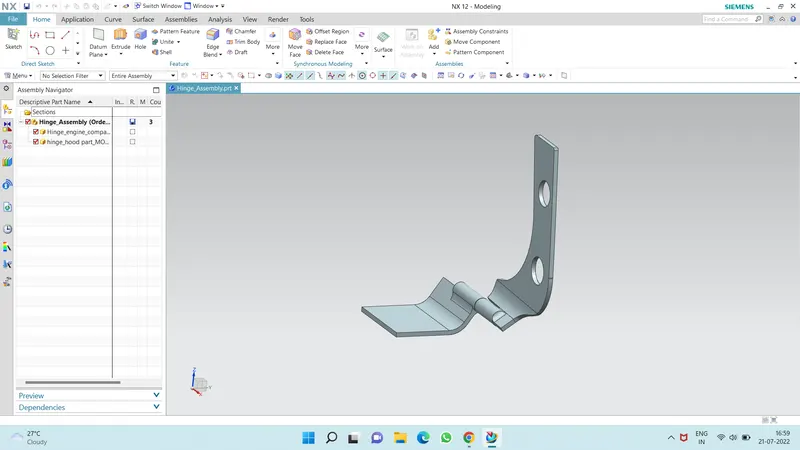
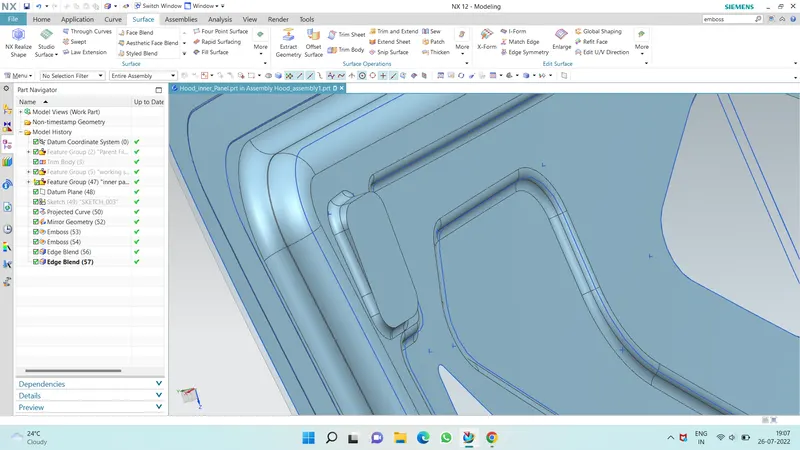
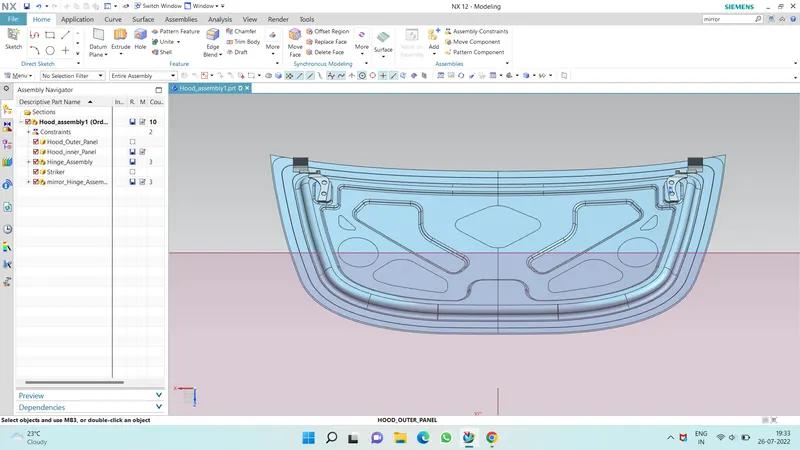
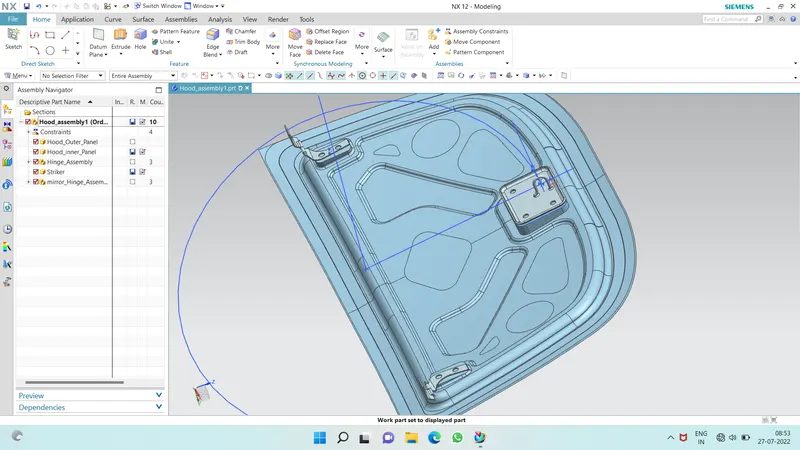
For the placement of hinge assembly we have to create emboss on the inner pannel for rest the hinge for that we generate the Datum plane and draw sketch for emboss.
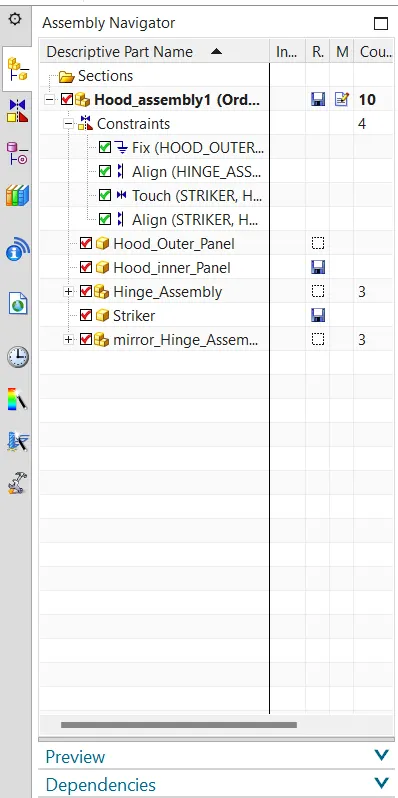
After doing the emboss the command Move Component and Assembly Constraints are used to proper fix and rest the hinge on that emboss on inner pannel.
- Stricker Placement :
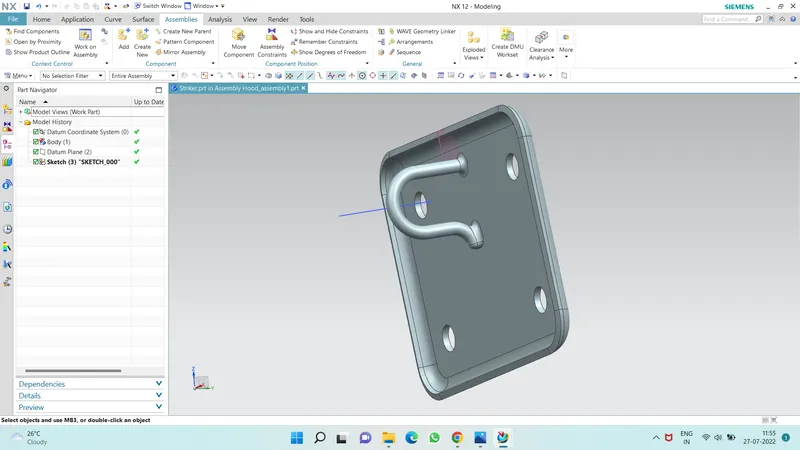
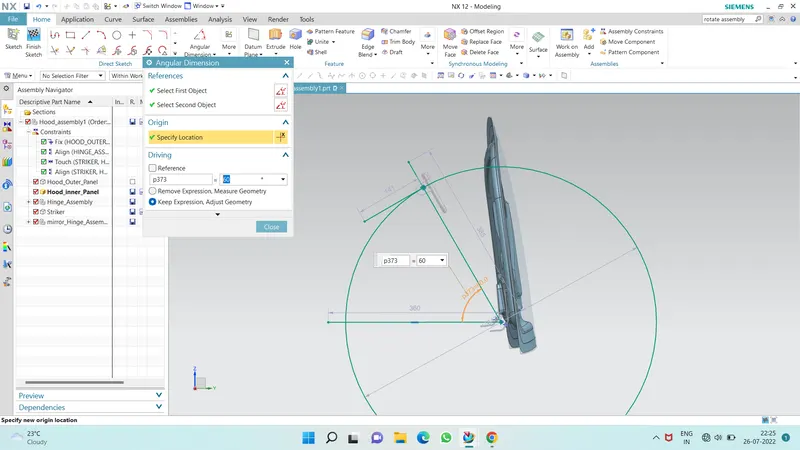
For the placement of stricker we have to sketch the circle which is perpandicular to the inner pannel, then draw the horizontal and vertical line in centre point, give some angle to the lines for proper placement of the stricker.
Using the Touch Allign and Parallel Allign for the proper placement.
HOOD ASSEMBLY PART
Top view :
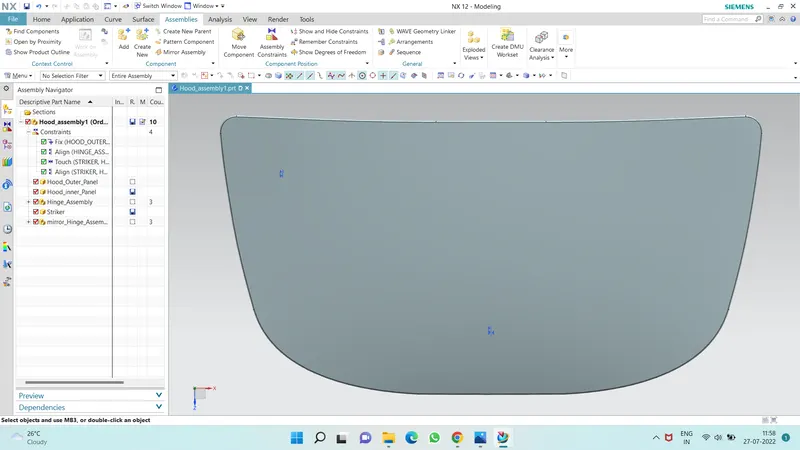
Bottom view :
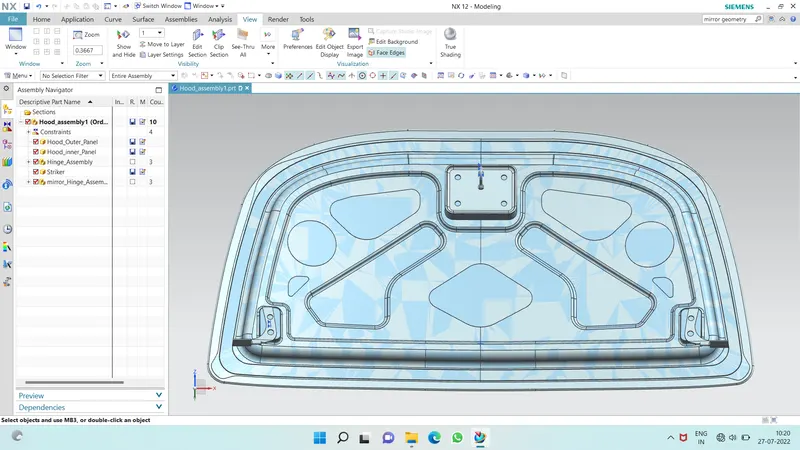
Assembly Navigator :
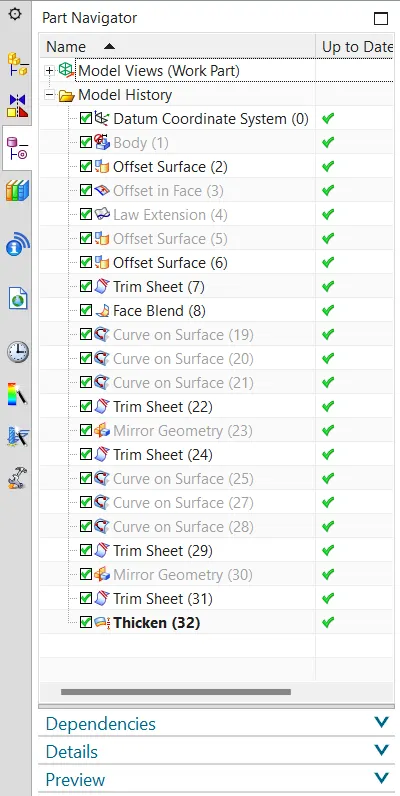
Outer Pannel Navigator :
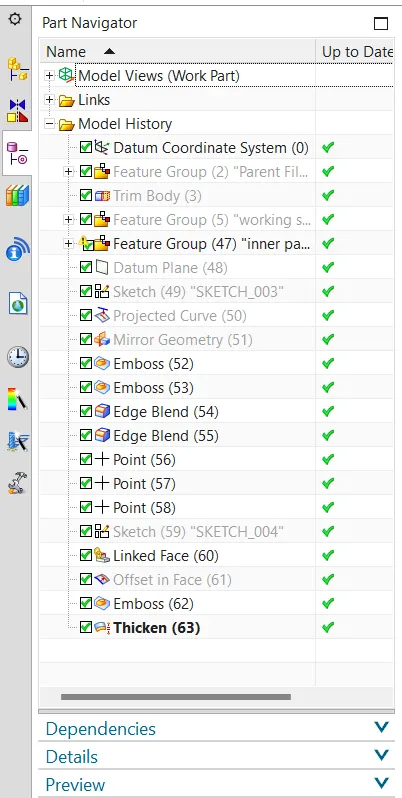
Inner Pannel Navigator :
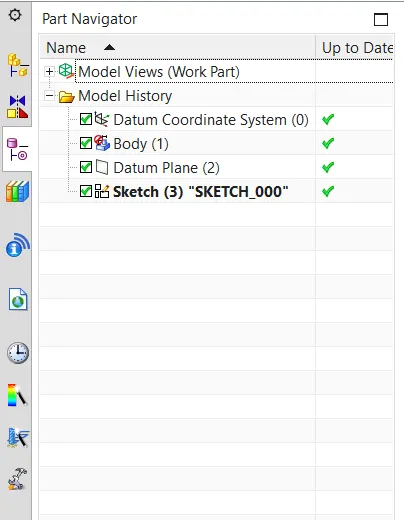
Stricker Navigator :
5. Conclusion :
We have designed a hood that falls under the rules & regulations of the manufacturer's standards.
- The design parameters of the inner panel including master sections are followed.
- The inner panel is designed with a thickness of 0.75mm.
- The outer panel is designed with a thickness of 0.75mm.
- The outer panel is developed with a hemming flange.
- The reinforcements parts of the required places are created.
- The hood is assembled with hinges and a striker.