Hood design-Week 2
Aim:
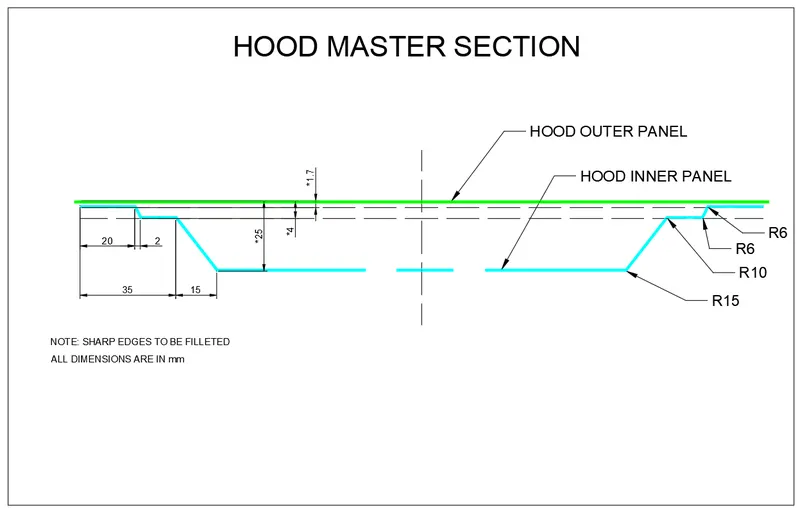
To Design Hood Outer Panel, Inner Panel and the necessary reinforcements by following the Master Section mentioned with the folowing Design parameters.
Hood Thickness Information
- Outer Panel Thickness = 0.75mm
- Inner Panel Thickness = 0.75mm
- Reinforcement Thickness = 1.5mm
Master Section:
Parts in front hood assy:
- Gas stay/ stay rod.
- Hinges
- Inner panel
- Outer Panel
- Reinforcements
Gas stay/ stay rod :
It's an part of hood which keeps the hood in open state, even when there is some external force due to vibration, wind and even self weight, facilitates open and close function, is fixed in either on the hood and free end which will locate in engine cabin or vice versa. this rod is designed with curve ro withstand load rather than a straight rod. The deflection of the rod is deviated at max 35mm from the axis, though its not fixed dimension and varies vehicle to vehicle. Another one basic design requirement which is linked with Stay rod is the opening angle of hood mainly depends on the dimension of the stay rod.
The opening angle varies vehicle to vehicle and region to region ,as the person in different regions would be of different height.This is decided based on the region percentile group classification and this will be positioned mainly on the opposite side of the battery unit for ease of fixing and this is fixed in reinforced hinge area and its free end is fixed in grommet to avoid vibration in closed condition.
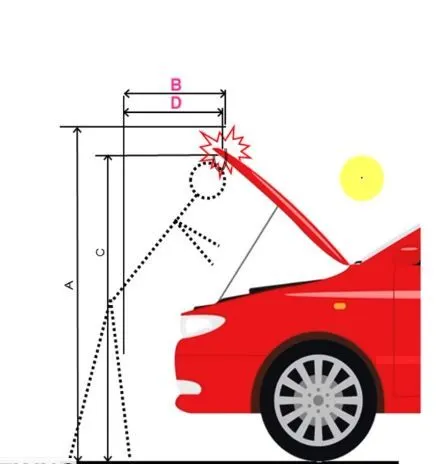
The above pic shows the opening angle and head hitting region.
Hinge assembly:
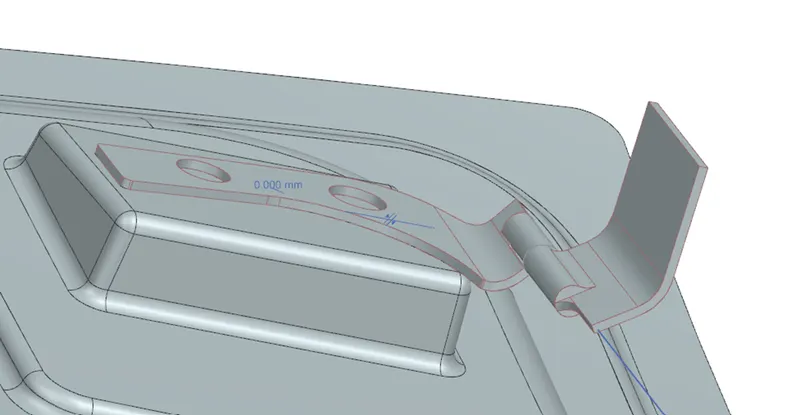
Hinge assembly is a part which facilitates the open and close function of hood. its one end is fixed in engine cabin and the other in hood.
the fixing of hinge assembly is considered important as its operating function reflects the quality, this fixing axis is inter related with striker.
Outer panel:
outer panel is the part which is visible from outside in the hood assembly, and very important aesthetically.the outer panel is designed based on the styling data.spot welds are not used in outer panel,as it affects appearence.so only hemming and pasting is used to fix it with inner panel.the thickness of panel would be approx 0.75mm
Pedestrian safety: Designing of outer panel has a major criteria in considering the pedestrian safety, as whenever there car crashes pedestrian, the pedestrians head would hit the outer panel, so it has to absorb the impact energy rather than opposing it, mainly because of this the inner panel region would be hollow or easily deformable in some sections. this sections are defined based on the wrap around distance from base.
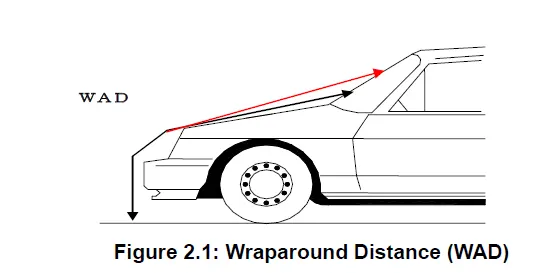
wrap around distance: In pedestrian safety, the WAD is the distance from ground ,covering bumper region and hood and cowl region.
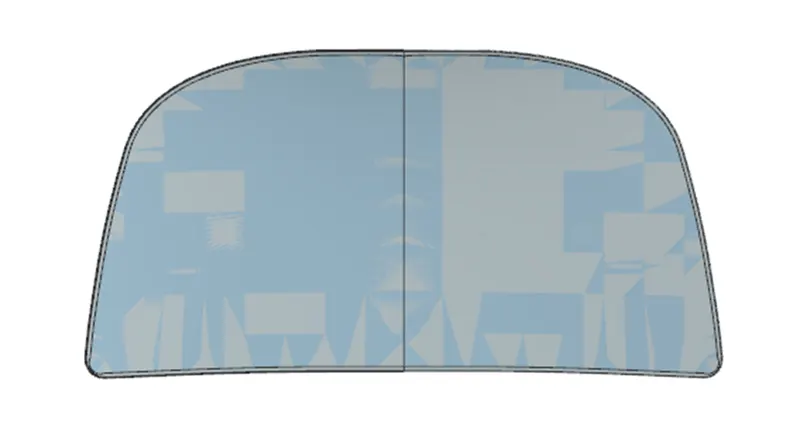
the region which commonly would hit for adult and child are classified. based on that front hood are designed and its tested with grid points divided in hood with green and red based on severity if affected. lesser the injury if it hits green and vice versa.
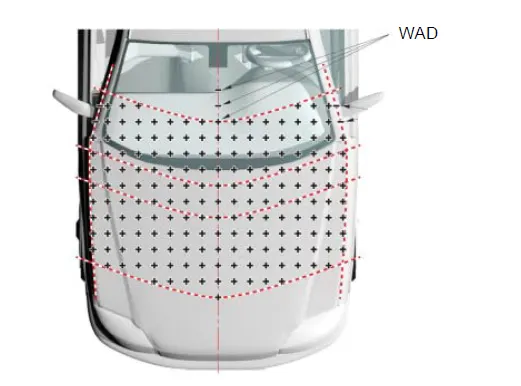
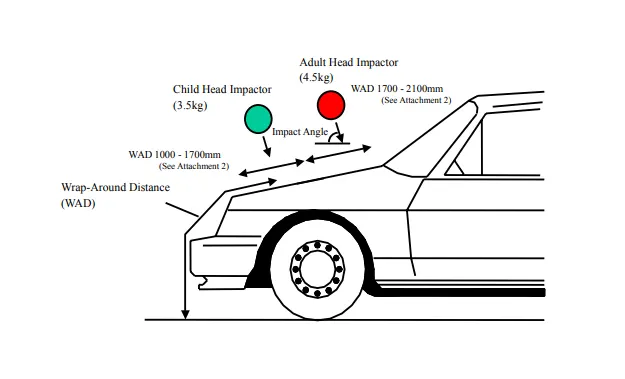
The above example is from pedestrian safety of Japan, it varies slightly from region to region depending on various factor.
Side reference line:
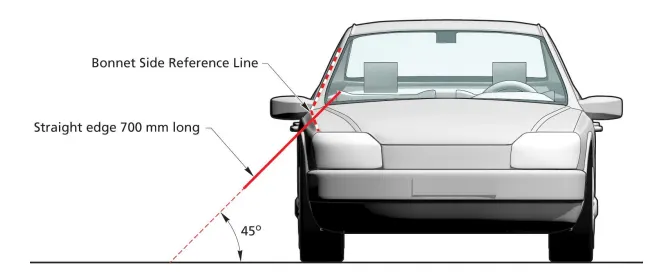
A line is drawn at 45deg from the ground such that it touches the end of the hood. This type of hood is called the inlaid hood. If the end of the point of the side reference line is at A-pillar then it is called the wrap-around hood
Inner panel:
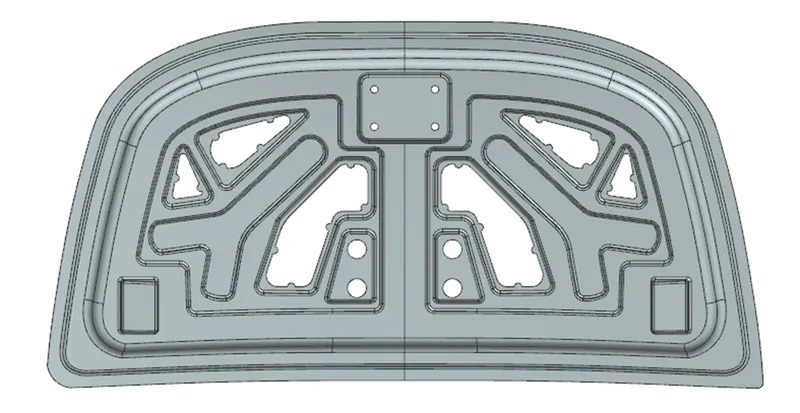
Inner panel is a part which is the major and important part in the hood assembly ,as it acts a reinforcement to the outer panel, embossing is created in inner panel in such a way when there is an impact the load is distributed to the side of the body, so the passenger would be safe. normally it would be of in Y Shape or the U shape,the thickness of panel wo6uld be approx 0.75mm.
Striker:
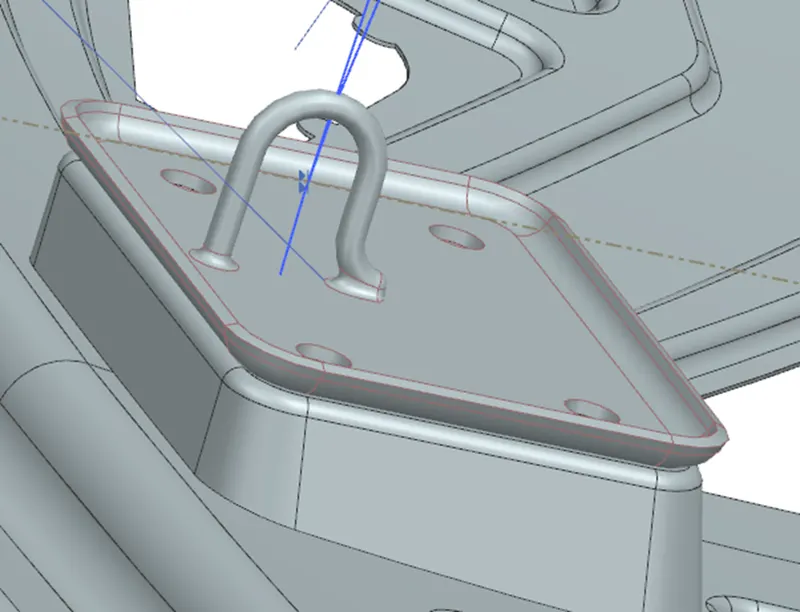
Striker is the part which helps to lock the front hood when not in use, in mating with latch fixed in engine cabin.the design of striker and its position is considered important as the opening and closing of hood is also depends on striker postion/axis.other than that it has to withstand huge load,as it have an impact force continously whenever its opened and closed.
Renforcement:
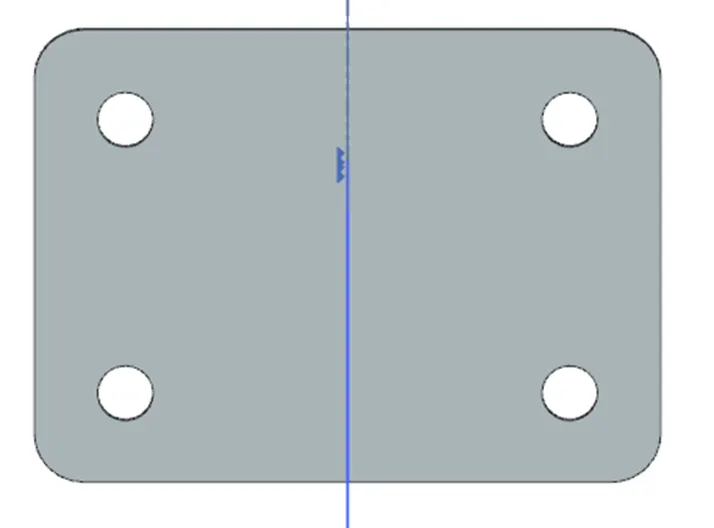
whenever we are adding load , it loses its strength locally, inorder to improve the strength, an additional support is provided to improve strength.this provison of additional strength is called reinforcement
Mastic sealant:
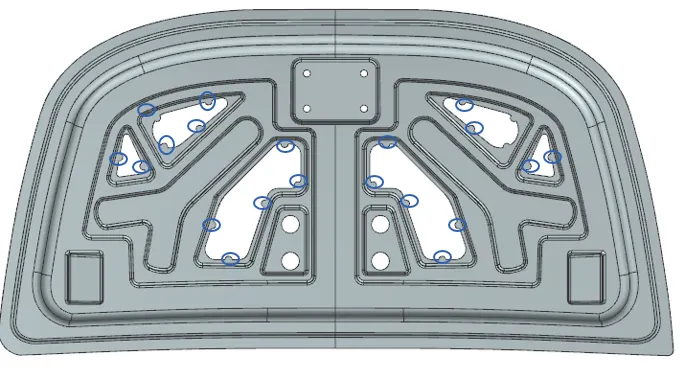
Its a rubber product which is filled in the gap of outer panel and inner panel and upon heating its formed in solid rubber which acts as insulation for vibration which is caused because of gap between inner panel and outer panel. its filled in equidistantly mainly in center regions as the reinforcement is there in coreners like hemming in outer panel or reinforcments.sealant provided in one spot will cover upto 80mm radially.
Grommet- HOOD STAY:
grommet is a part used to hold the stayrod in fixed place.
Latch Trajectory:
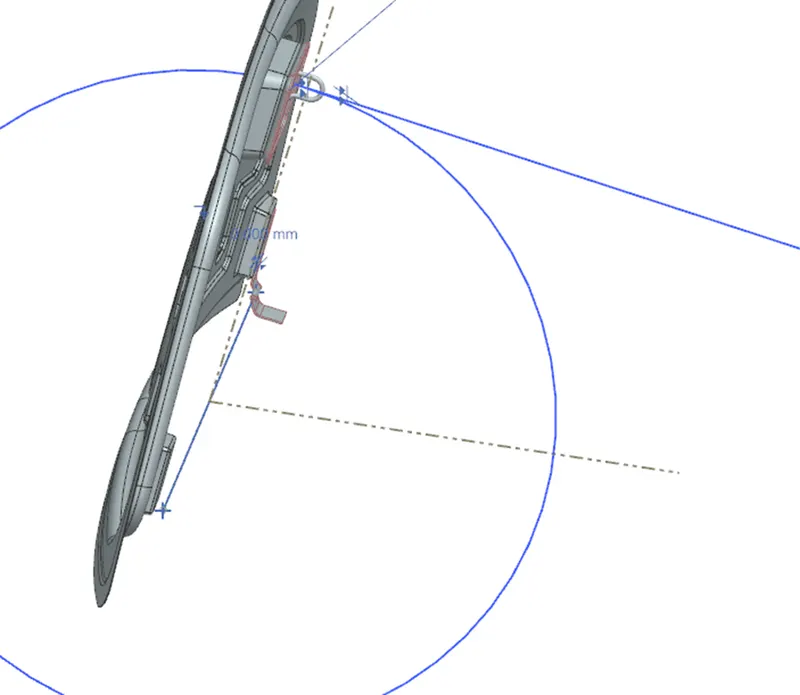
whenever we open /close the hood ,it operates on the hinge axis, radially. the striker follows this radius and it has to be perpendicular. this helps in smooth operation, any offset in it would lead to hard operation.
Emboss function:
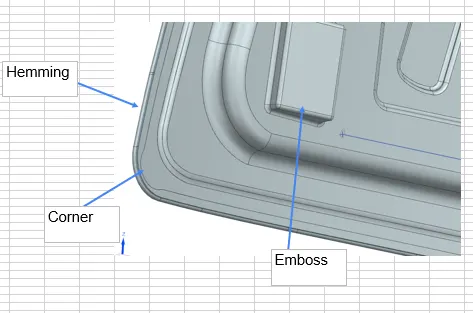
Embossing is the stamping process to produce a raised or sunked design in sheet metal.The metal sheet embossing operation is commonly accomplished with a combination of heat and pressure on the sheet metal, depending on what type of embossing is required. Theoretically, with any of these procedures, the metal thickness is changed in its composition.
Hemming :
Hemming is a forming operation in which the edges of the sheet are folded or folded over another part in order to achieve a tight fit. hemming operations are used to connect parts together, to improve the appearance of a part and to reinforce part edges.
Corner Reliefs:
Relief are removing of small material from part in the region where its meeting the secondary part and making space for the material to bend.
Deep drawing:
its the process of sheet metal radially drawn into die by action of punch.when depth of drawn part crosses diameter of it, called as deep drawing.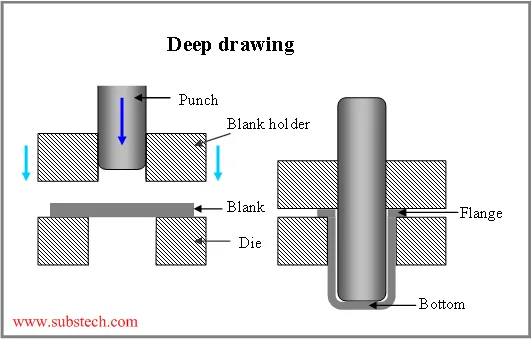
Commands used in designing of this hood panel:
Offset face: its used to create a parallel face at a specified distance.
offset curve: Its used to creat a curve on same face at a specified distance.
Trim sheet: this tool is used to cut the unwanted material based ob boundary we selected.
Through curves: its used to create a flange like structure between two curves
Edge blend: its used to blend two faces of specified radius based on the common edge selected.
face blend: its used to blend two or three face of specified radius based based on the faces selected.
law extension: its used to extend a virtual face to the length specified.
sketch : used to draw on a plane of different shapes
Project curve : Its a tool which helps to project the sketch from one plane to another specified.
Emboss: Emboss is a tool used to create protruded or sunken design.
trim and extend: used to extend or trim any unwanted parts.
mirror: used to create a duplicate on opposite side of axis/ curve with exact mirror dimensions.
These are few tools used while creating this Hood assy
Design approach of Hood assembly in Siemens NX:
- The outer panel of Class A surface was provided.
- Based on the outer panel surface, the inner panel offset has been created.
- The basic dimension of inner panel has been take from the master section provided.
- The emboss of hinge bracket and latch region is created.
- The inner panel is designed in such a way that transfers the impact force to side body instead hitting directylt to cabin region.
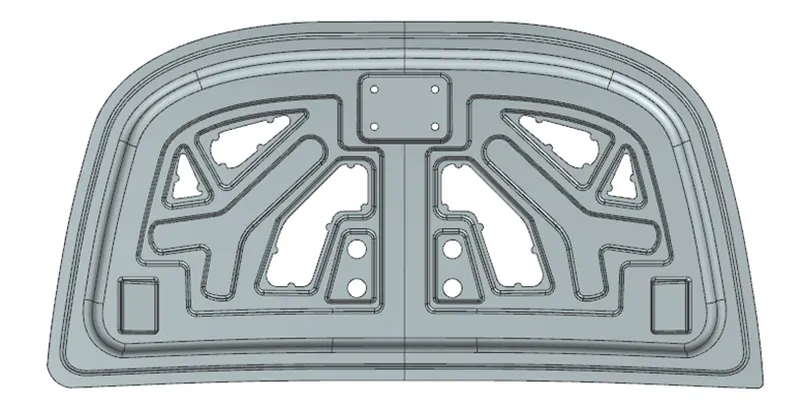
- The hinge assembly is fixed and the corresponding axis is the main criteria for smooth operation of hood.
- The striker is fixed in such a way that the stiker sits on the radius of the hinge axis and the latch and striker are perpendicular to trajectory.
- The inner panel is assembled with outer panel and the hemming is created in corners with necessary relief in corner with proper gap of 2 mm between inner panel and outer panel near hemming region.
Draft analysis:
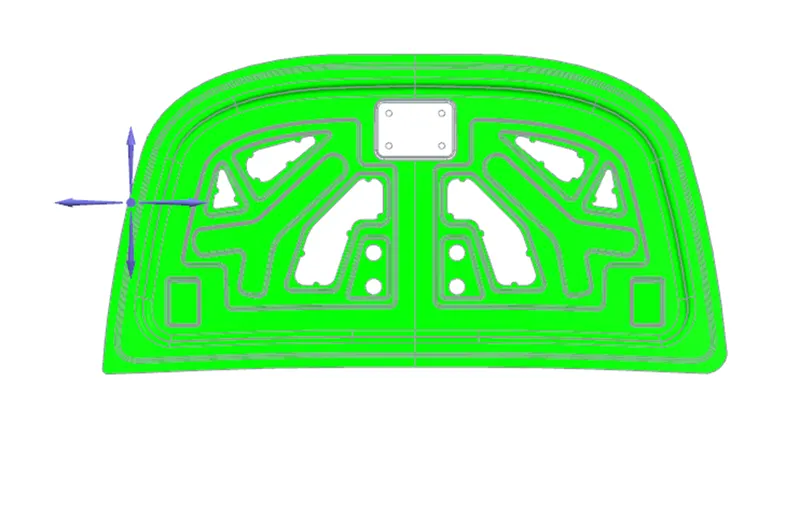
The designed part were checked for feasibillity for production, and it could be seen that the parts were producable.
Conclusion:
The design approach of hood design has been explained in it with the components like hinge, striker, latch trajectory application has been done and few process like hemming, deep drawing , embossing etc ,and also the pedestrian safety with respect to hood assembly and testing with pedestrian of adult and child and finally the draft analysis done to check on feasibility.