Hood design-Week 2
HOOD DESIGN
OBJECTIVES:-
- Design hood outer panel, inner panel and the necessary reinforcements by following the master section.
- Submit an assembly of hood inner panel,outer panel, latch, hinge and the reinforcements.
INTRODUCTION
Bonnet/hood is main component of a car at the front portion. It is used to decorate the car and add luxurious look. The shape of the bonnet is made aerodynamic in order to minimize the air effect. Bonnet is generally used to access the parts easily such as radiator, engine and many other parts.
On front-engine cars, the hood may be hinged at either the front or the rear edge, or in earlier models it may be split into two sections, one each side, each hinged along the centre line. A further variant combines the bonnet and wheel arches into one section and allows the entire front bodywork to tilt forwards around a pivot near the front of the vehicle.
Hoods are typically made out of the same material as the rest of the body work. This may include steel, aluminium, fiberglass or carbon fibre. However, some aftermarket companies produce replacements for steel hoods in fiberglass or carbon fibres to make the vehicle lighter.

Parts
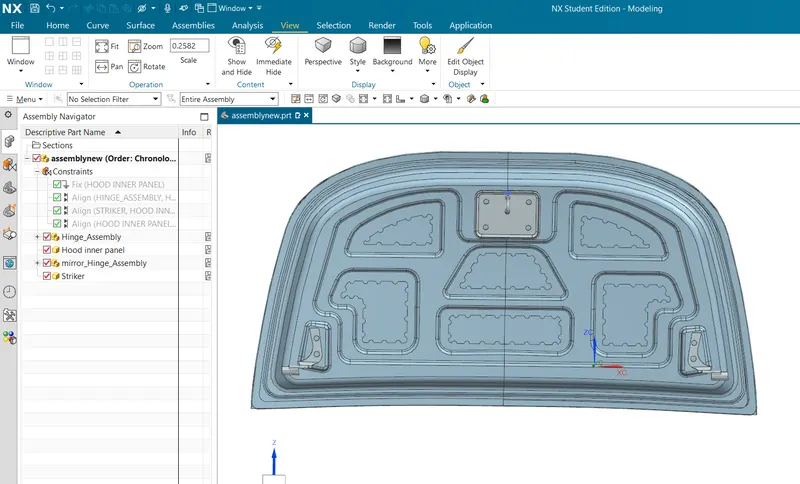
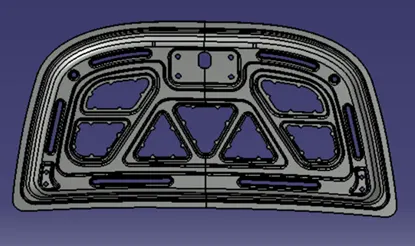
- Hood inner panel: The main part of the hood which gives support to the outer panel with its embossing shapes dissipates the force in different directions when the vehicle takes crashes.
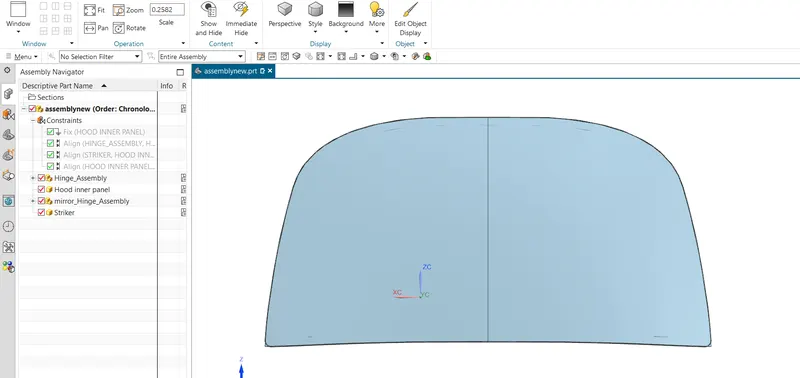
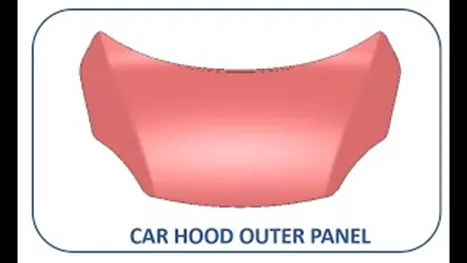
2.Hood outer panel: it is actually called as the skin of the vehicle which covers the inner parts of the hood. The mastic process is used to mount the outer panel to the inner panel. This acts as a styling part of the vehicle front.
- Latch and striker: It is the part of hood that helps locking the hood with the strikerwhich is mounted on the engine block and plays a major role in opening and closing the hood for maintenance.
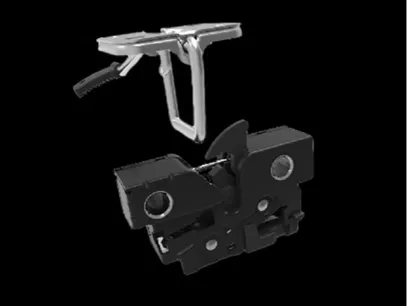
Latch Trajectory: Latch trajectory is the path which the striker will follow in opening while pivoting it on the hinge axis. It can be considered as a circle with the hinge axis. The striker is placed 90 degree as it will be tangent to the circle.
- Hinges: this coupling allows the hood to open and close as well as makes contacts between the engine block to the hood. It also controls the lifting of the hood.
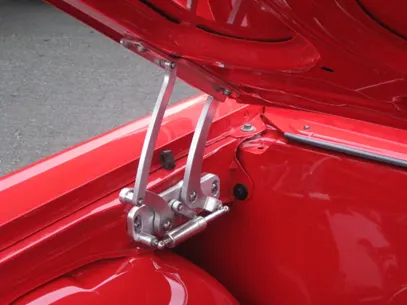
Design Criteria’s of hood
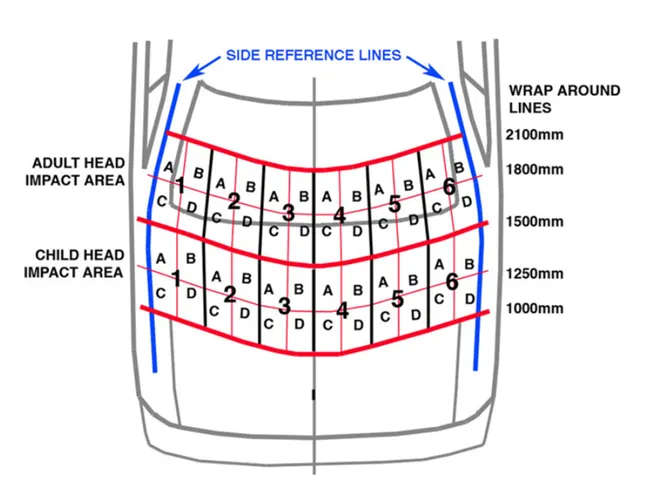
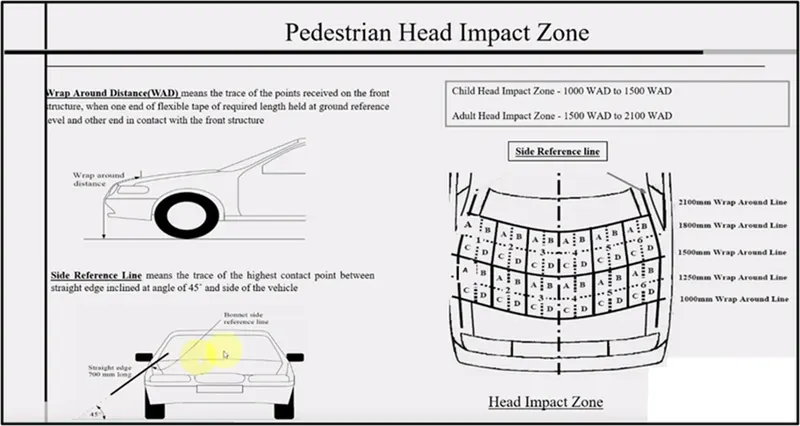
1. Hood Head zone: Hood opening angle is one of the main factor for the hood design. While opening the hood the person’s head can’t collide with the hood. This can be managed by the hood head criteria. It is different for different country zones as shown in the figure.
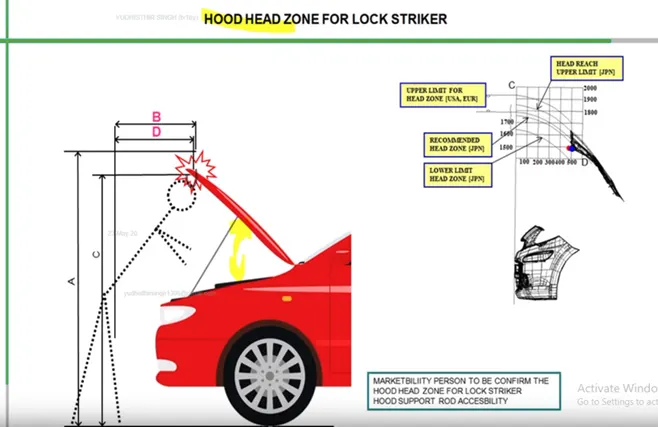
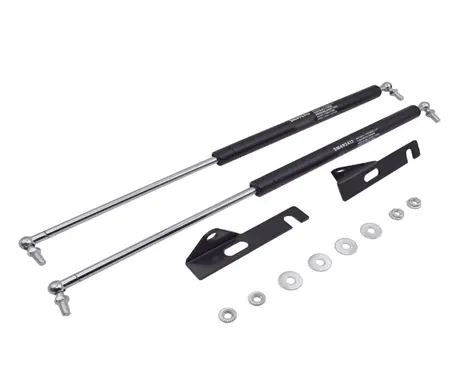
There are two ways adopted for the hood to stay.
- Support rod.
It can be used to keep the hood in open state safely if any external forces like wind or vibrations are abruptly generated. It is fixed manually on the hood. The support rod can be designed with some bends than straight to withstand more force. The support rod must be at the opposite side of the battery and it should not collide with other parts to avoid NVH factors.
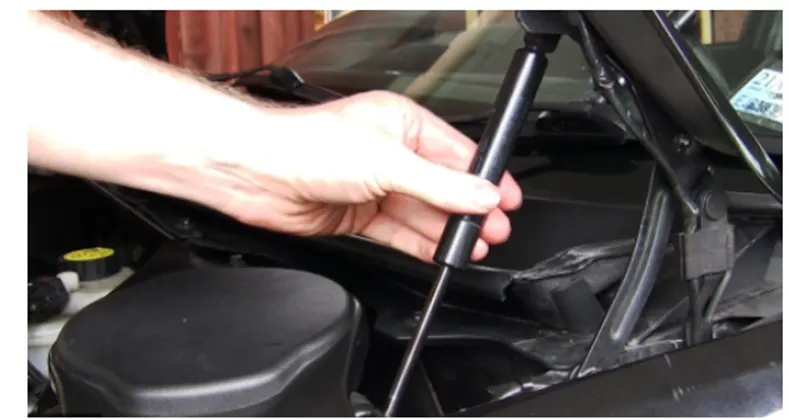
- Gas Stay.
This provides an automatic opening and closing with the help of the actuator in the cylinder. It is mainly used for the high end cars.
- Pedestrian safety.
Vehicle safety factors should simultaneously consider occupant and pedestrian safety, given that pedestrians are the third largest category of traffic fatalities. Most pedestrian deaths occur due to traumatic brain injury, resulting from the hard impact of the human head against the vehicle's stiff hood or windshield. Therefore, how to design a pedestrian-friendly vehicle and propose a new hood structure is a matter of urgency for minimising pedestrian head injuries. In this study, three kinds of sandwich hood structures are proposed for reducing pedestrian head injuries, including carbon fibre-reinforced polycarbonate, carbon fibre-reinforced foam and aluminium-reinforced polycarbonate. In assessing the friendliness of vehicle hoods, this study adopts the EEVC/WG17 regulations on headforms for hood tests. The finite element method is used to simulate the impact between the vehicle's hood and the head form impactor. The software used in simulation is LS-DYNA. The results predicted by the head form-hood tests show that the hood structure with aluminium-reinforced polycarbonate material provides enough absorption capability to protect pedestrians from the impacts of accidents. It is also stiff enough to keep pedestrians' heads away from the inner parts of the engine cavity.
- Direction of force dissipation
This is one of the main factor for designing the hood to dissipate the force towards the outside to reduce the impact to the passengers inside the cabin when the car collides.
The embosses are meant to dissipate the force while collides.
- NVH Level.
Noise vibration and harshness is the study for reducing the noice and vibrations in the car.
The NVH can be reduced by the use of stiffner pad between the hood inner and outer panel. The noise made by the wind also can be reduced by the stiffner pads.
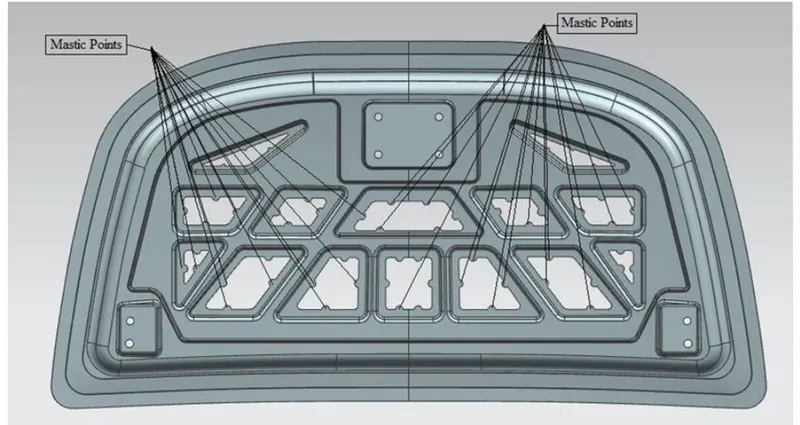
Mastic Data
Mastic sealant is used between the outer and inner panel to give a bond to the two panels and also provides strength to the hood panel. This can be either a glue or a rubber.
Manufacturing Processes
- Blanking and piercing:
Blanking is a steel manufacturing process in which a flat, geometric shape (or “blank”) is created by feeding a coil of sheet metal into a press and die. In this process the blank is punched out from large metal sheet.
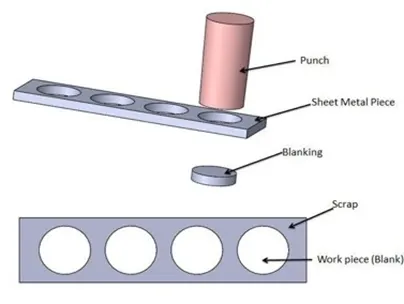
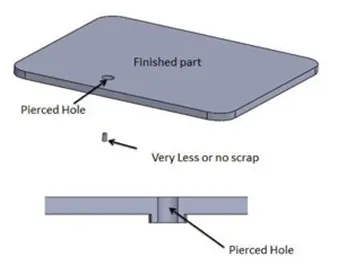
Another similar process is piercing, in which a punch operation cuts a hole by tearing operation from a final piece of sheet metal. This is process is considered a blanking operation.
Steel Blanking Advantages
Steel blanking produces economical metal pieces that are customized to fit specific customer needs. In the blanking process the material is continually fed into the machine which leads to less setup and parts management. Simply, steel blanking allows you to make more with less.
This reduces waste significantly because the tools are typically designed to nest parts as close together as possible. Also, shipping costs are reduced by only sending the net weight and leaving the rest behind.
- Deep Drawing:
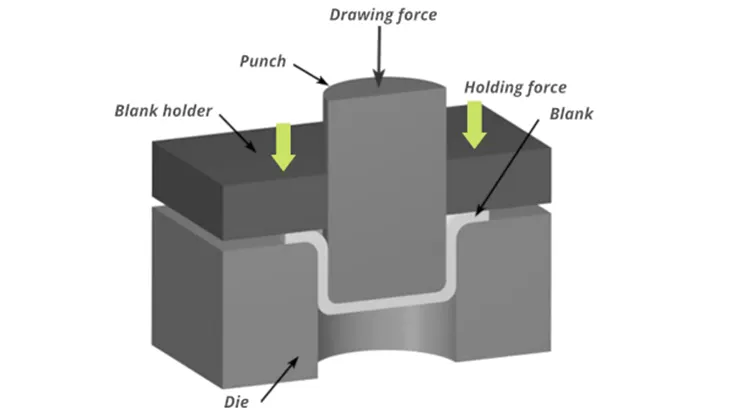
Deep drawing is a sheet metal forming process by which a sheet metal blank is slightly clamped along its perimeter by a blank holder and radially drawn into a forming die by use of a punch.
Deep drawing is perhaps most useful for creating cylindrical objects: a circular metal blank can easily be drawn down into a 3D circular object with a single draw ratio, minimizing both production time and cost. Production of aluminum cans is one example of a popular use of this method
- Hemming:
Hemming is a sheet metal forming process in which sheets are joined by bending it usually to 180°. Automotive body panels and automotive parts such as deck-lids, trunk-lids, doors, hoods and tailgates are formed by hemming process. Vehicle body parts, such as engine hoods, doors, trunk lids and fenders. In contrast to the conventional press hemming the roller hemming is completed incrementally by an industrial robot driven hemming roller. The advantages of roller hemming against the conventional process are based on technological and economic criteria.
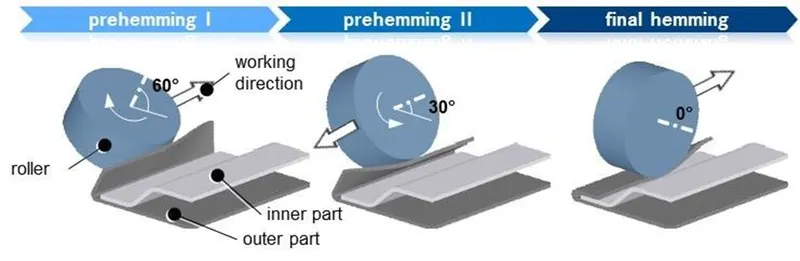
DESIGNING OF HOOD
Master sketch provided:
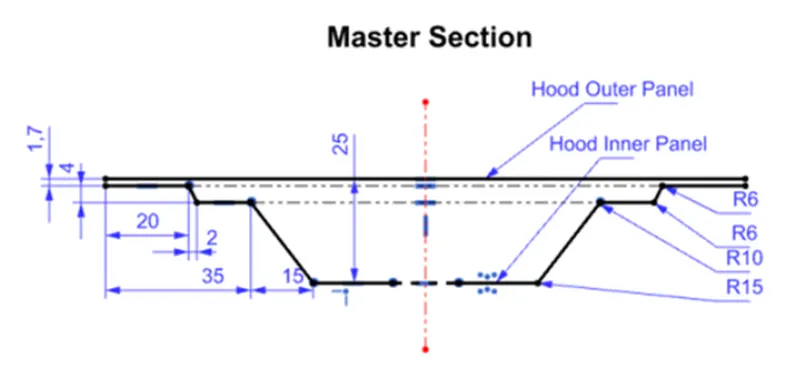
Sheet Data Provided:
- Outer Panel Thickness = 0.75mm
- Inner Panel Thickness = 0.75mm
- Reinforcement Thickness = 1.5mm
NX CAD WORK FLOW
Step 1 : Offseting the curve on face (15 mm) to trim the sheets as per the given dimensions.
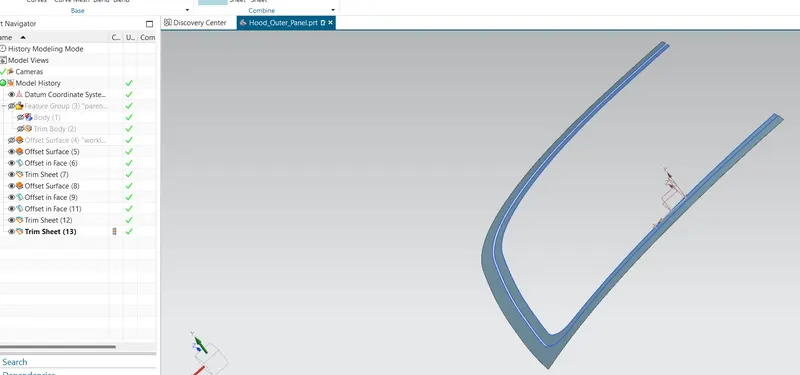
Step 2: Joining the sheets with through curve option.
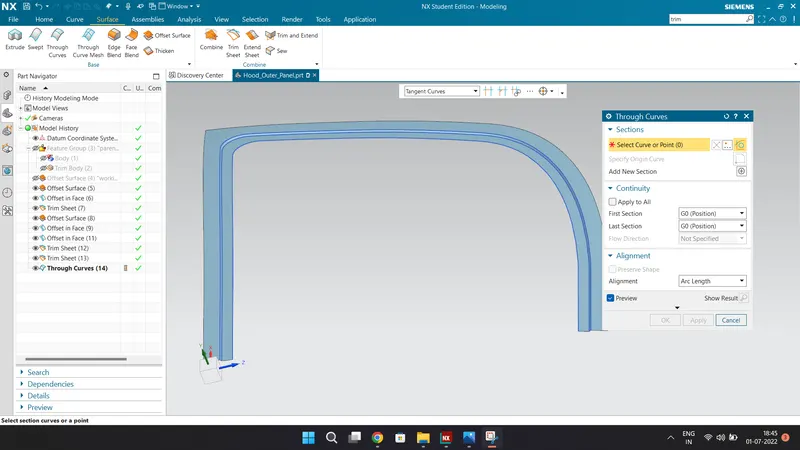
Step 3 : Offset the final area (25 mm) from the parent surface and trim the sheet.
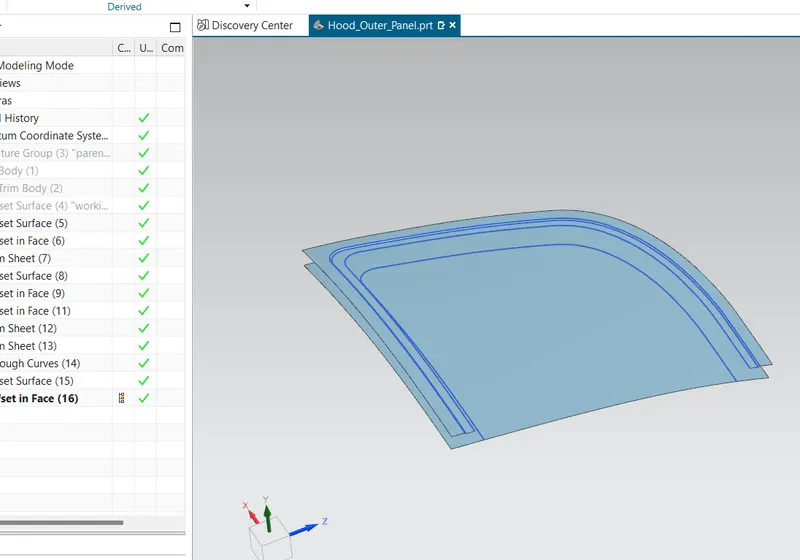
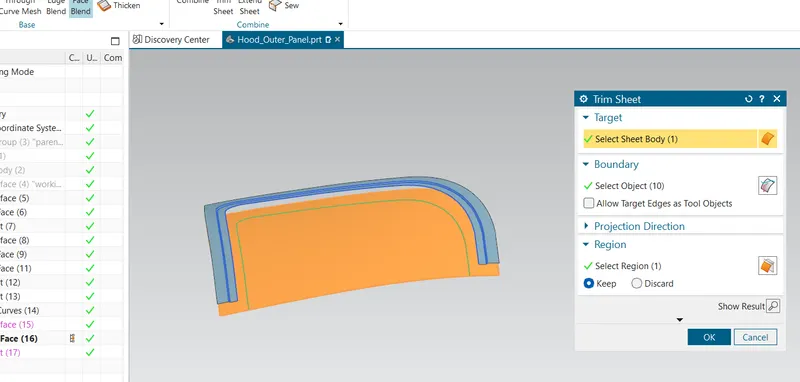
Step 4: Joining the sheets which is at an offset distance of 4 mm and 25 mm with through curves option an blend all the edges.
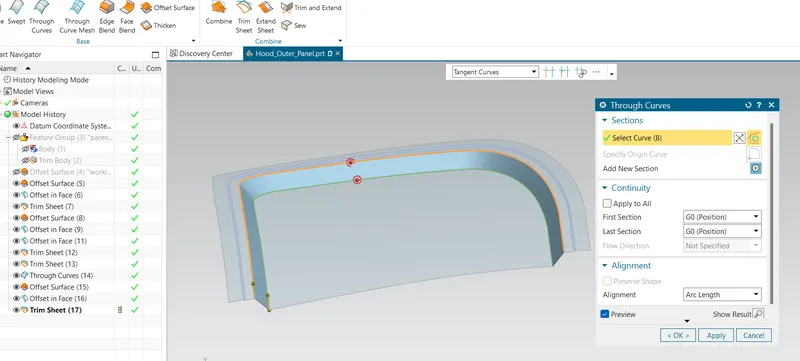
Step 5: Creating the sketches and embossing it through project curve,law extension, trim and extend options respectively.
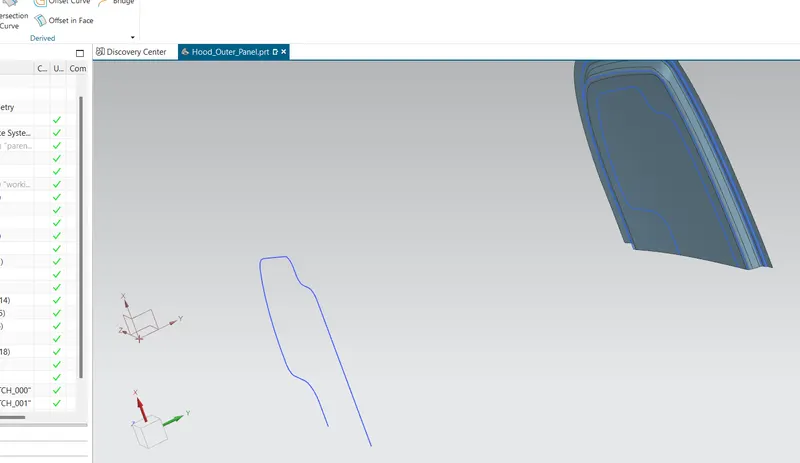
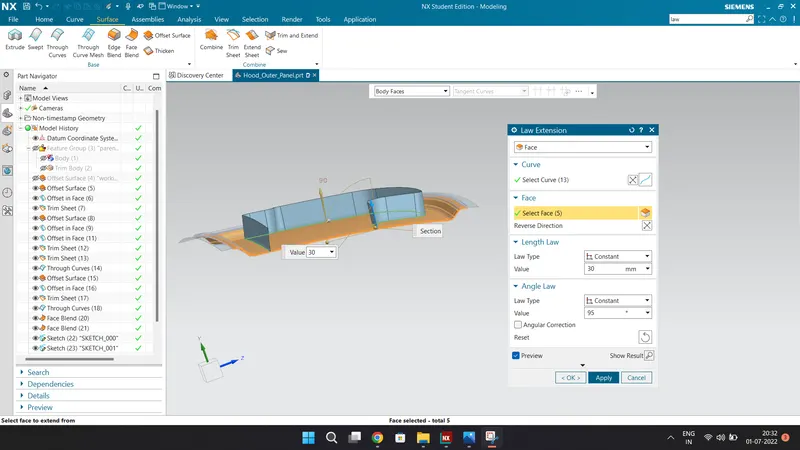
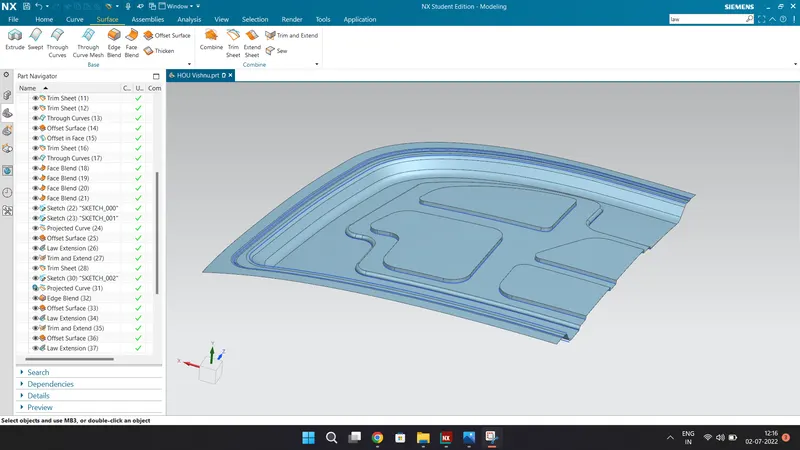
Step 6: Sketching the mastic points and trimming it in the shape.
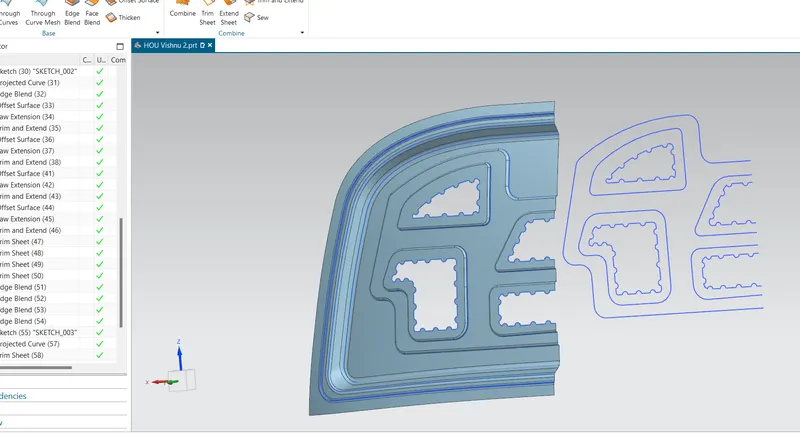
Step 7: Creating a new datum plane which is almost parallel to the center of the inner panel for the sketching of emboss for the hinge mount.
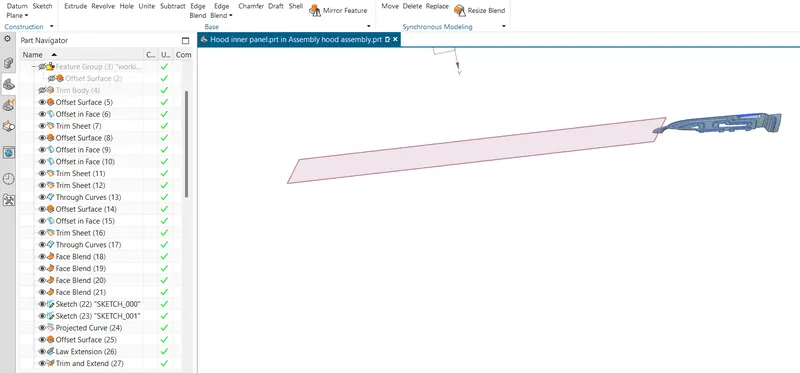
Step 8: Sketch the hinge mount and project it to the inner panel and emboss it. Add the hinge assembly to the model and give touch constraints with referance to the hinge mount.
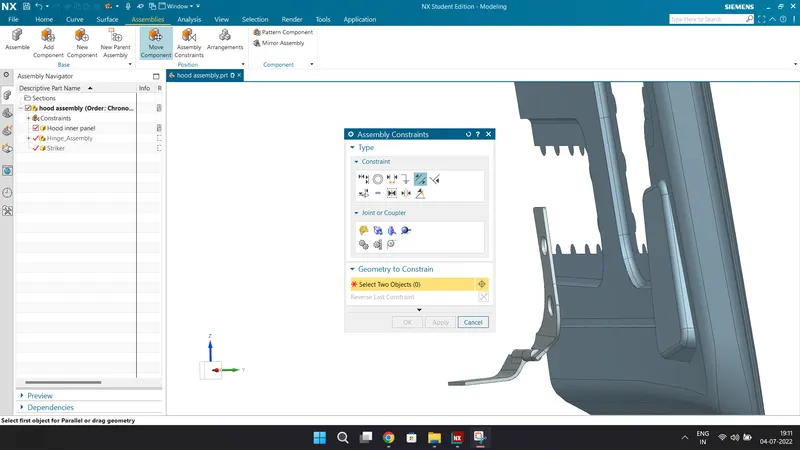
Step 9 : Mirror the entire hinge assembly by use of mirror geometry associative mirroring option.
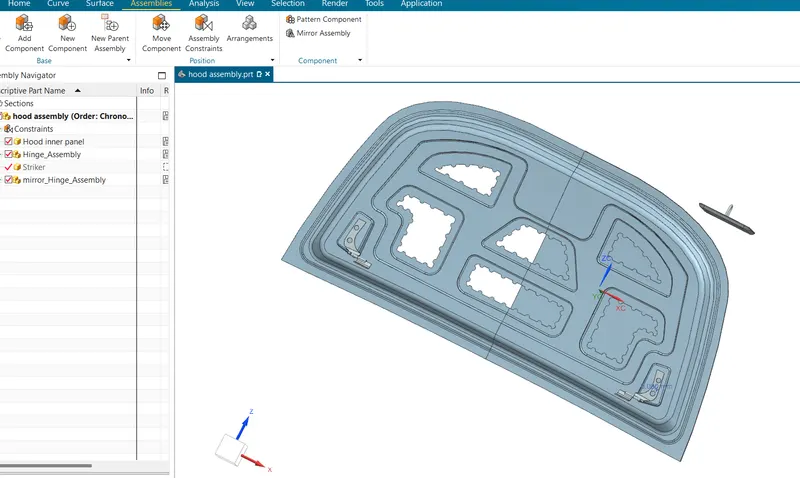
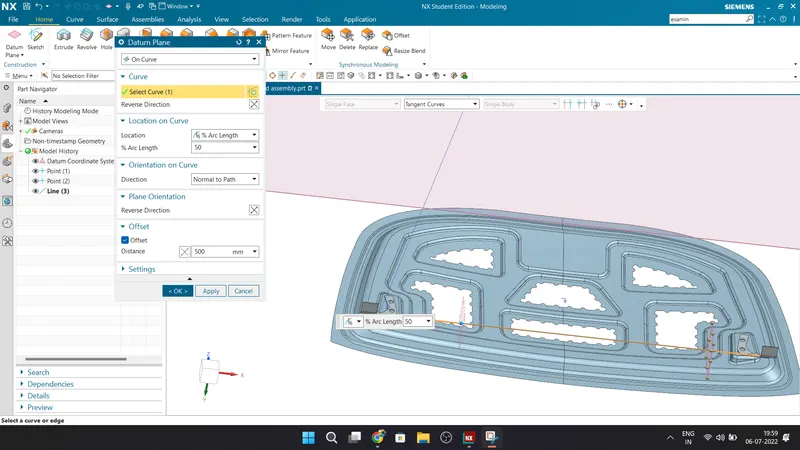
Step 10 : Draw the hinge axis by marking center points for both the hinges and placing a new datum plane exactly at the center of the axis.
Step 11 : Sketch the circle and tangential line for constraining the striker part.
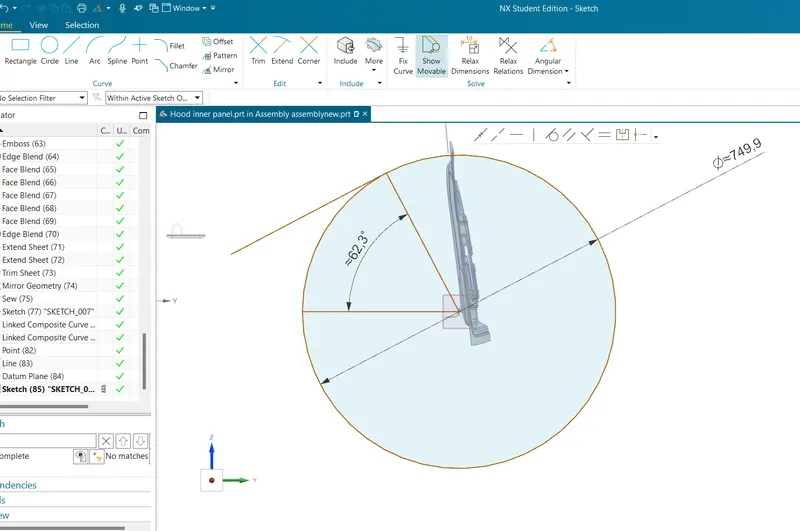
Step 12 : Constraining the striker with the help of tangential line, circle intersection point etc.
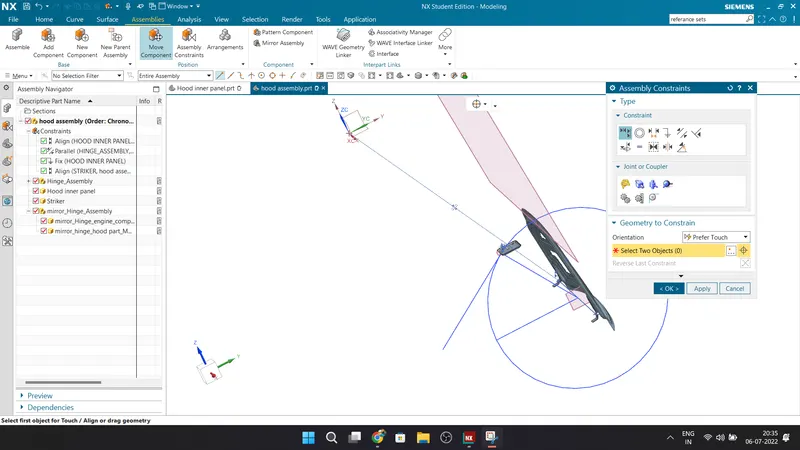
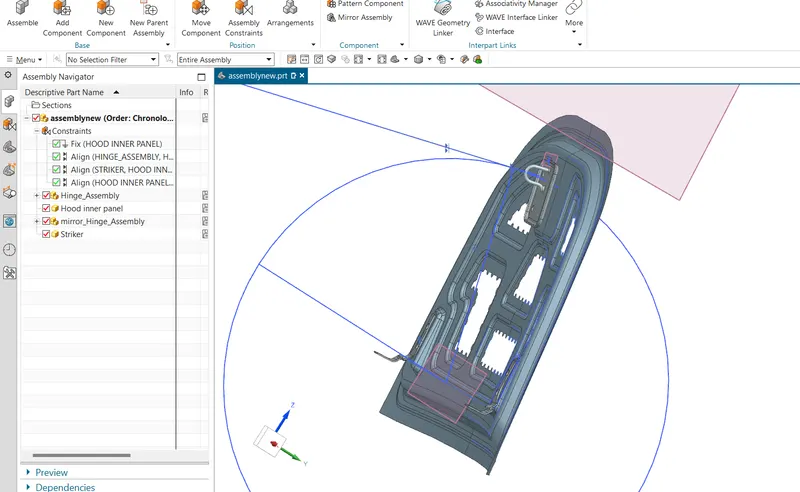
Step 13: Construct the mounting part for striker with the help of wave geometry tool,extend sheet command and law extension command.
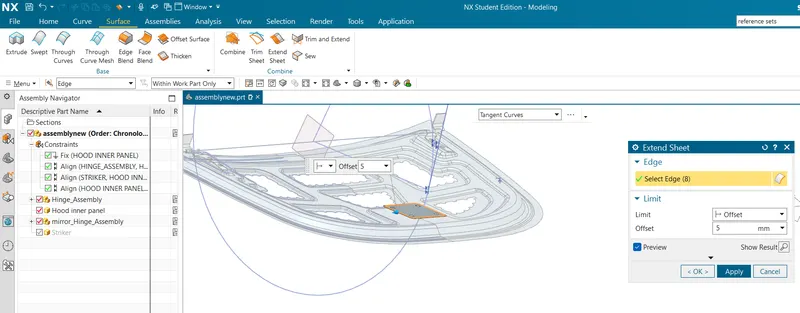
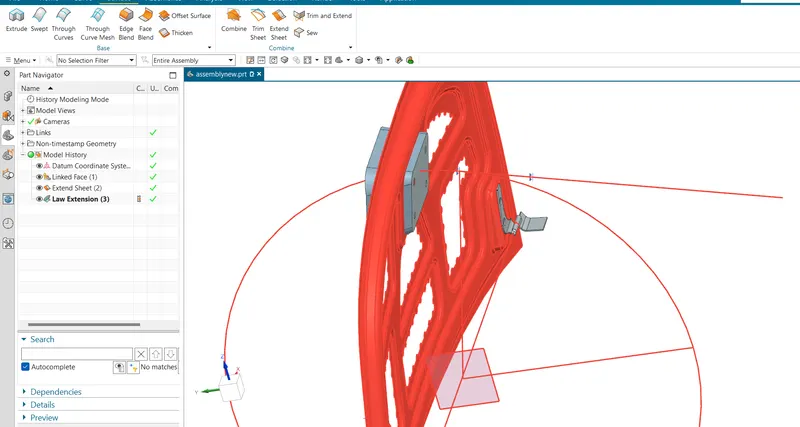
step 14: Sew the parts together and trim the extra area with trim and extend.
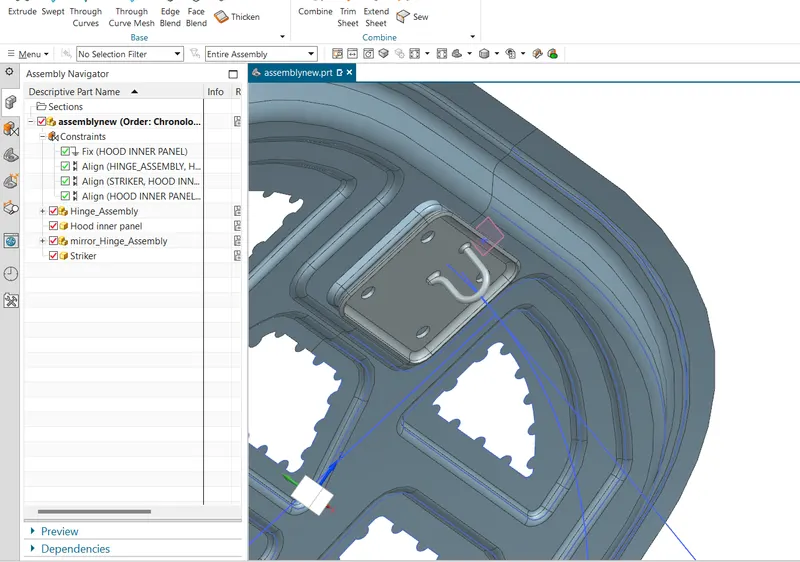
Step 15 : Offset the parent surface again and make the hemming parts.
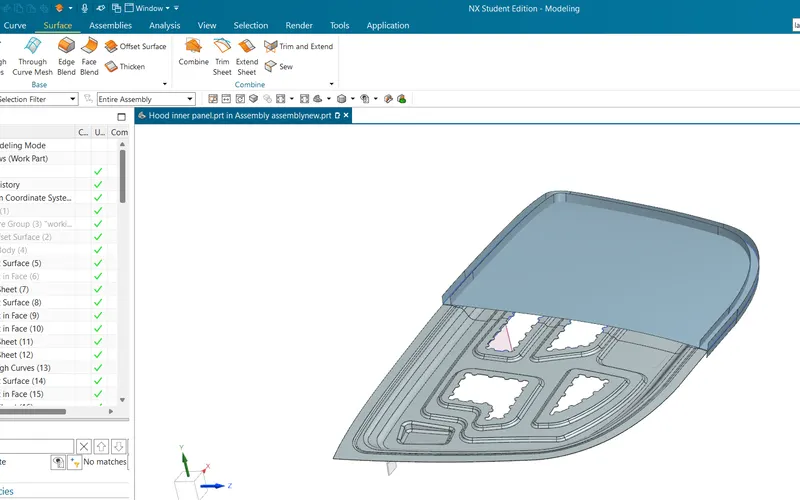
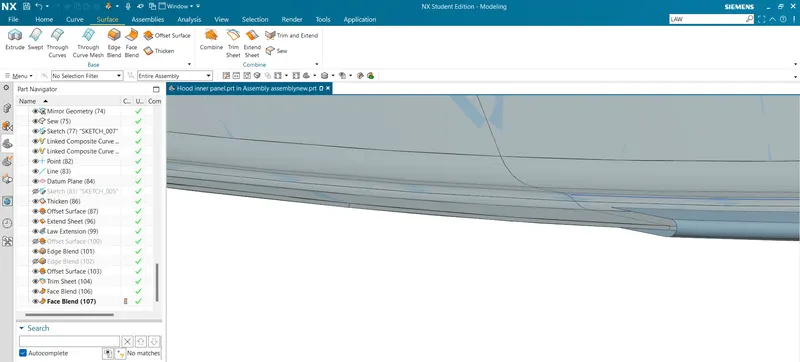
Step 16: Mirror the geometry and make sure there is no intersection of parts.
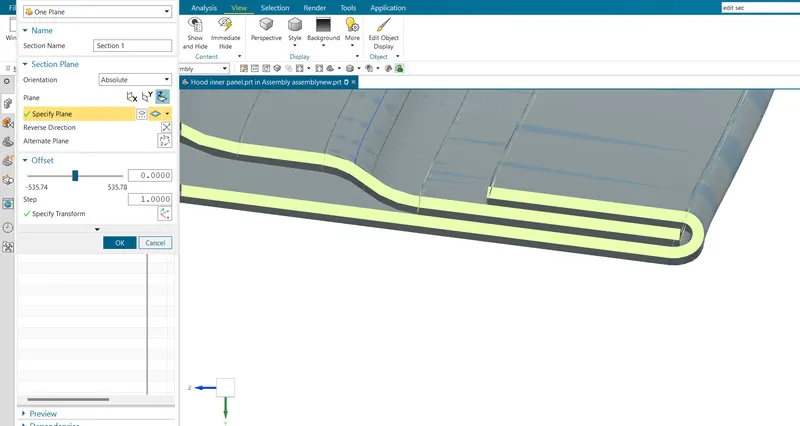
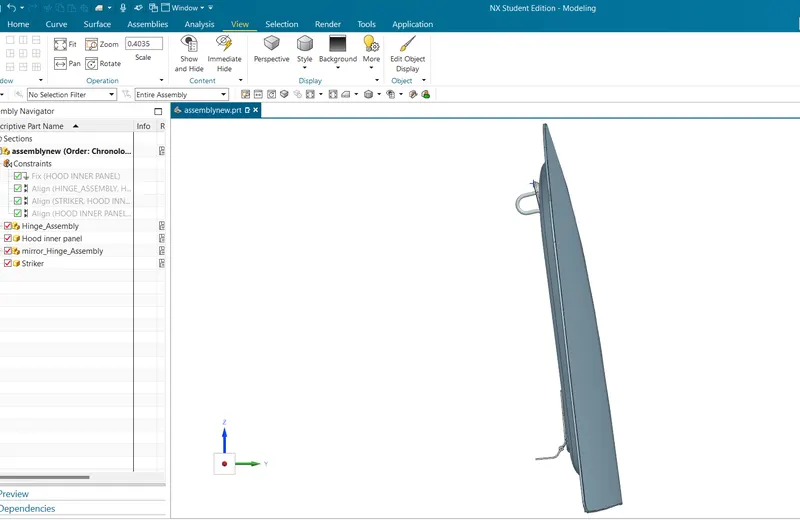
Views After Assembly Of Parts.