Hood design-Week 2
Aim:
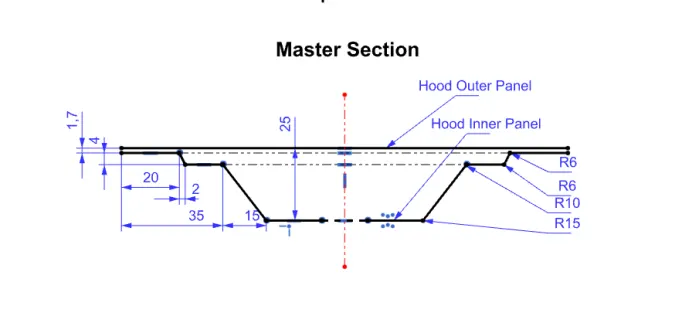
To Design Hood Outer Panel, Inner Panel and the necessary reinforcements by following the Master Section mentioned with the Design parameters.
Objective:
To submit a detailed report about the Hood Design which includes a detailed explanation about hood and its components, Latch Trajectory, Mastic Data, Emboss Definitions, Manufacturing process like Deep-Drawing and Hemming, and all the parameters followed in the design.
Hood Design:
Hood:
The hood or bonnet is the hinged cover over the engine of motor vehicles. Hoods can open to allow access to the engine compartment, or trunk on rear-engine and some mid-engine vehicles) for maintenance and repair.A car hood also referred to as a bonnet in some other countries. Car hoods are typically constructed from steel and sometimes from aluminum. On front-engined cars, the hood may be hinged at either the front or the rear edge, or in earlier models (e.g. the Ford Model T) it may be split into two sections, one on each side, each hinged along the centerline. A further variant combines the bonnet and wheel arches into one section and allows the entire front bodywork to tilt forwards around a pivot near the front of the vehicle.
On newer models, the hood release is often located inside the vehicle, somewhere near the steering column, or on the floor next to the driver’s seat. (Typically, you’ll see the word “hood” or a picture of a car with the hood open.) On older models, the hood release is behind the grill or bumper.
With the hood released inside the vehicle, press, push, or pull until the hood pops open. With the hood release in the front, look around and through the grille and feel under the grille and behind the bumper to find a handle, lever, arm, or button. Then push, press, or pull from front to back and side to side until it releases the hood.
The hood opens a little but is likely to be stopped by the safety lock of a metal lever that, when pushed in one direction or the other, releases the hood so it can be fully opened.
Hood Materials
Because the hood is usually detachable from the rest of the frame with relatively minimal effort, vehicles may sport hoods made from different materials than the rest of the body.
1. Steel
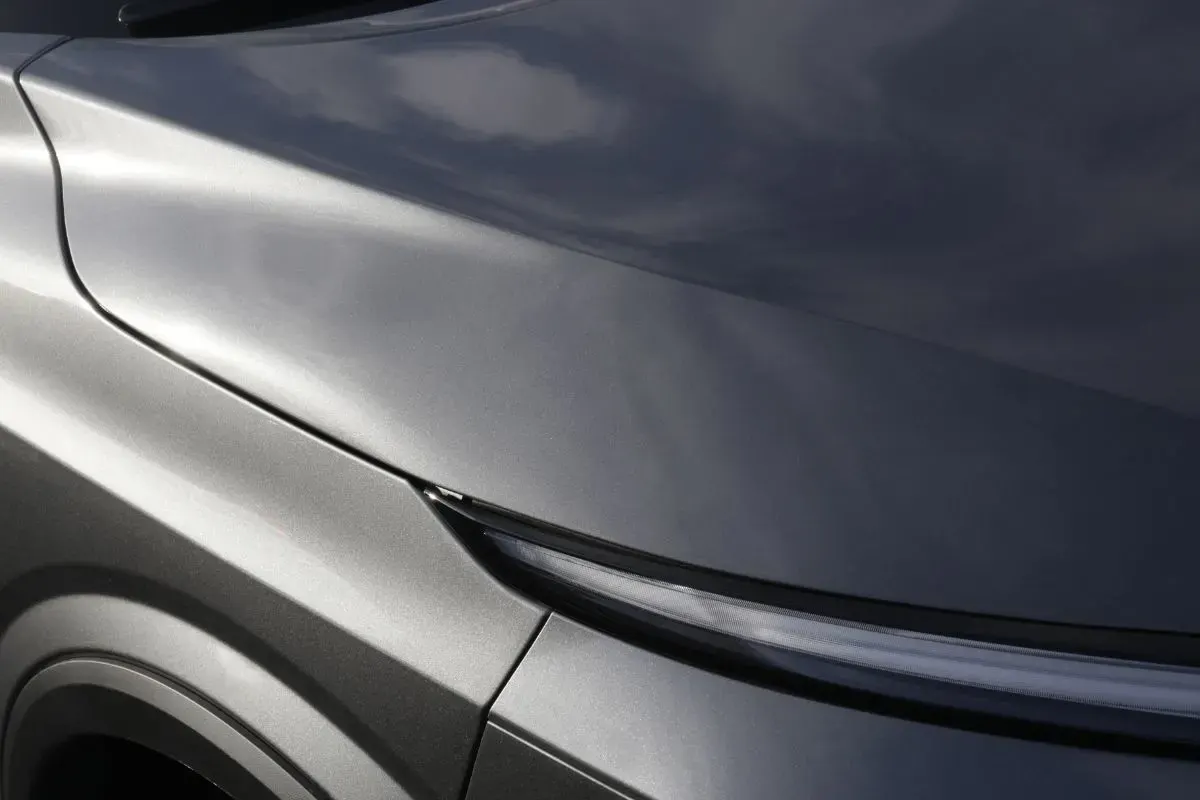
Steel is synonymous with strength and durability. It has been the go-to metal for engineering needs, including automobiles.
The varying formulas for steel have a large impact on its performance, so the standard form of steel used for cars has a higher weight than the alternative hood materials. Its low price is still a major reason for its continued usage as the standard hood material.
2. Aluminum
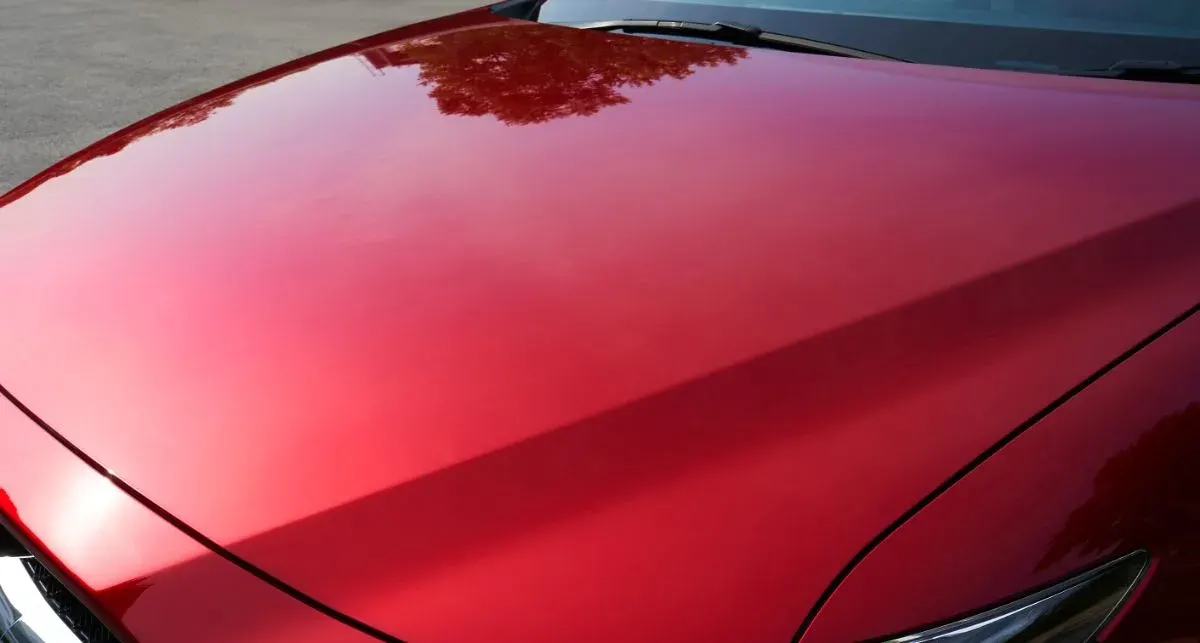
Although most people interact with aluminum as a lightweight foil, thick aluminum is a durable metal that’s resistant to rust while weighing less than heavier elements.
Aluminum isn’t quite as strong as steel, so these hoods can be dinged and dented more easily. The durability isn’t as significant in a crash where the vehicle will be reliant on crumple zones and other safety features more than the strength of the hood.
3. Fiberglass
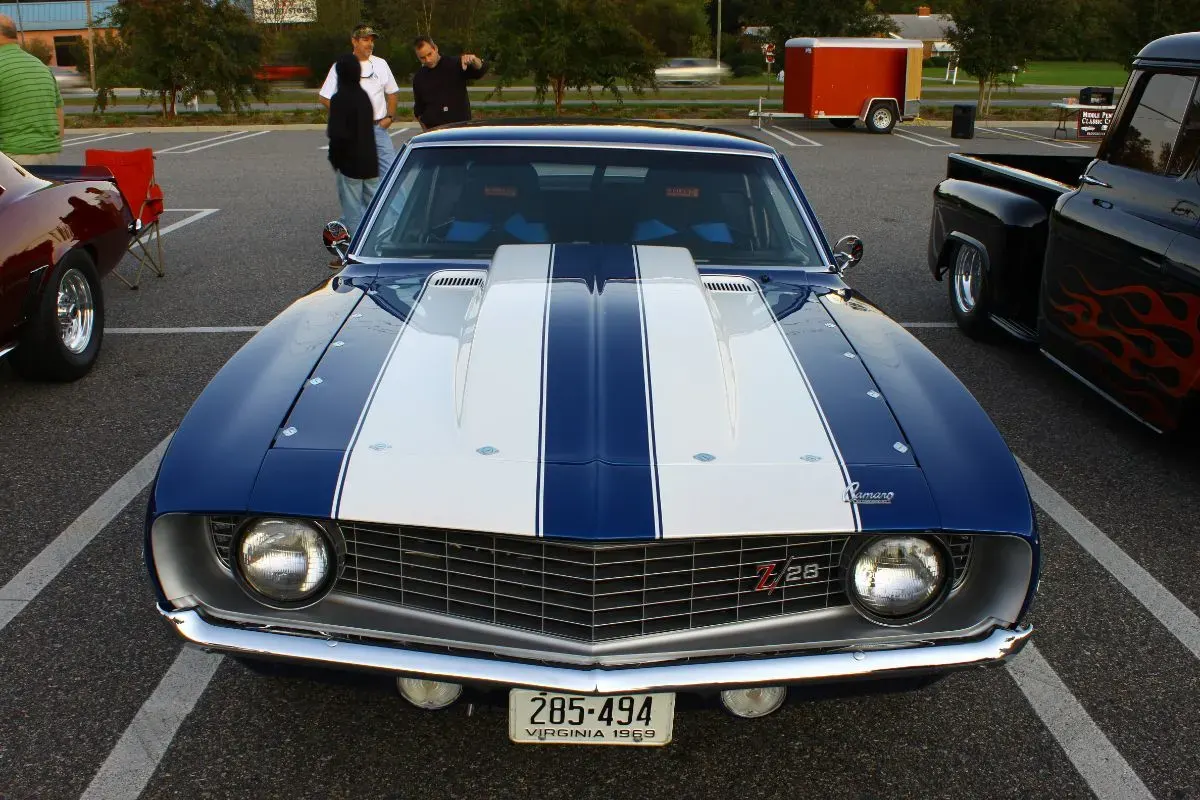
That offsets some of the price reduction, but a good fiberglass hood will cut vehicle weight without sacrificing much safety or durability.
4. Carbon Fiber
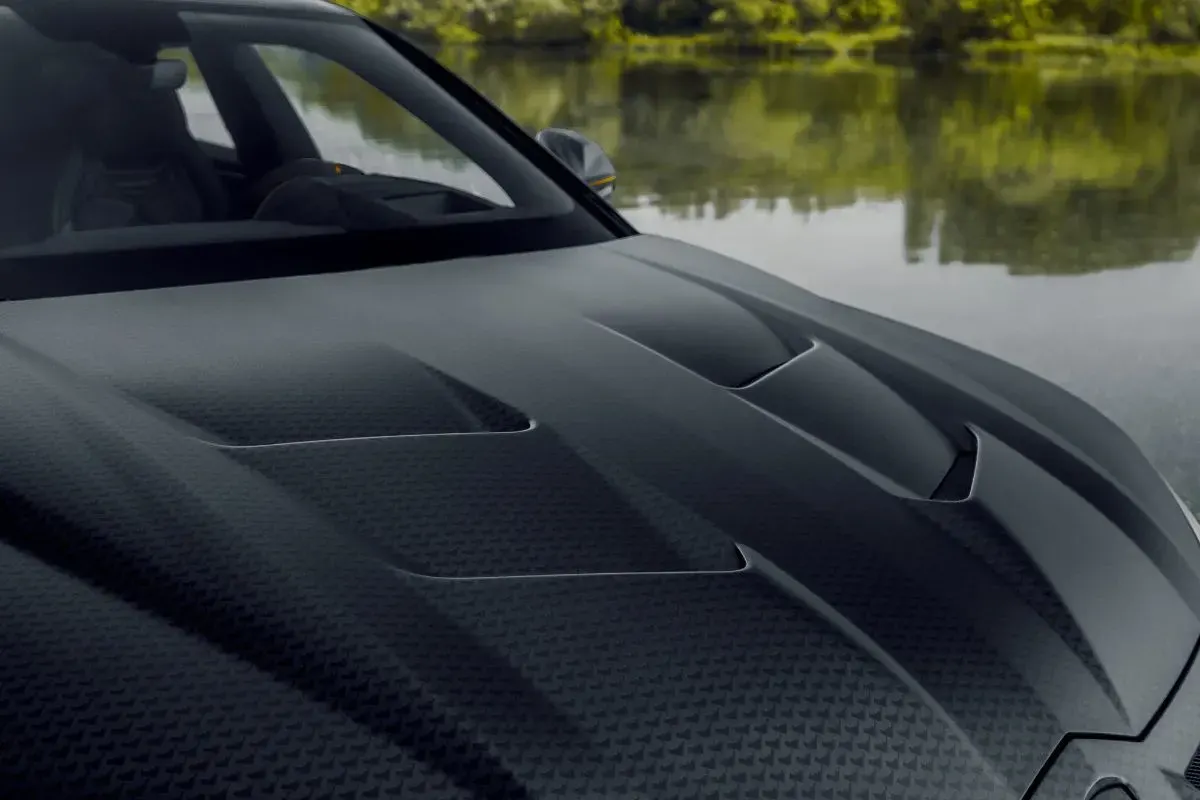
Specially engineered strands of carbon can be turned into a light yet incredibly durable material. The extra chemical and mechanical processing does make it the most expensive option, but using it can easily shave up to half of the hood’s weight.
It’s not a major cut off of the overall weight, but it can add up with other weight reduction measures when trying to maximize performance.
Fiberglass weighs about the same while being cheaper, but you can make the majority of a car out of carbon fiber without sacrificing structural integrity or safety.
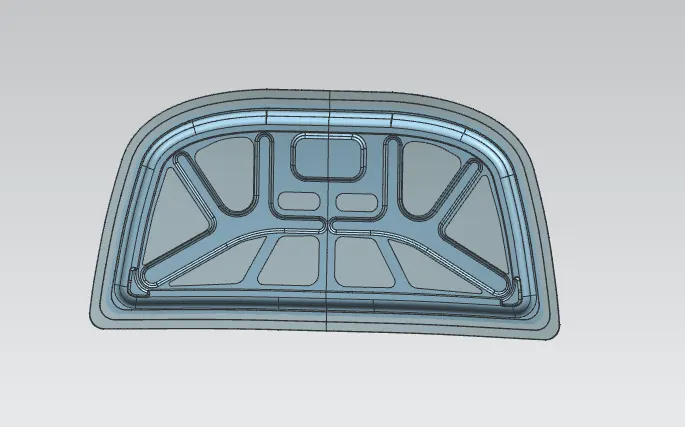
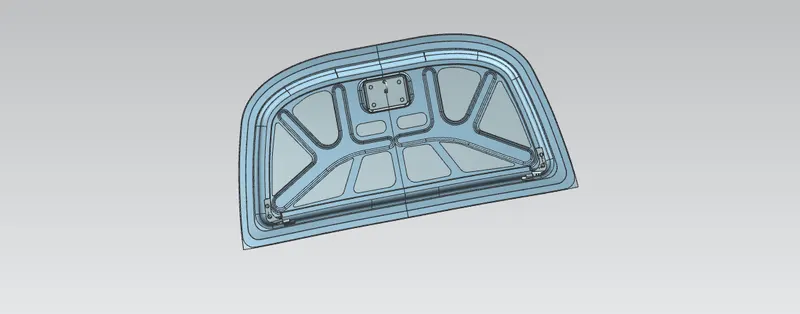
Hood which is also called ENCON, serves as an access panel to ENGINE COMPARTMENT of an automobile. It is an assembly made of OUTER and INNER PANELS to meet various safety & design requirements. Following are the design considerations involved to design hood,
1. PEDESTRIAN SAFETY.
2. VEHICLE QUALITY.
3. OCCUPANT SAFETY.
4. STYLING
5. MANUFACTURABILITY.
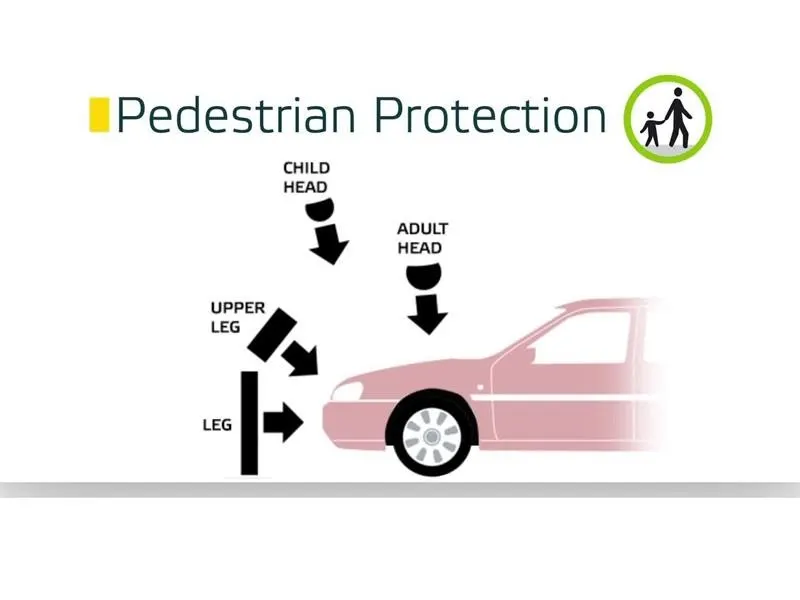
1. PEDESTRIAN SAFETY: Pedestrian safety is always a factor involved in the design of the hood. This is achieved by proper selection of material that can readily deform avoiding risk during impact, providing emboss to inner panels, etc. This is one of the major factors for a vehicle to have better safety ratings.
2. VEHICLE QUALITY: This involves how best the hood can be designed to have better quality in terms of torsional stiffness, dentb resistance (Hailstone and stone chippings), corrosion resistance, better weight distribution, and noise attenuation.
3. OCCUPANT SAFETY: The design consideration must include the impact caused due to FRONTAL CRASH COLLAPSE. Under such a scenario it is expected that the HOOD maintains its integrity with hinges and also retains any of the loosed components from engine compartments.
4. STYLING: Better surface quality (A-class surface finishing), Tight radii on hemmed panel edges & low strain between curved regions of the inner and outer panel.
5. MANUFACTURABILITY: The design should be always considered for Manufacturability e.g. embossing on the inner panel should have sufficient draft angles provided for the punching tool to flow in and flow out.
Wrap Around Distances
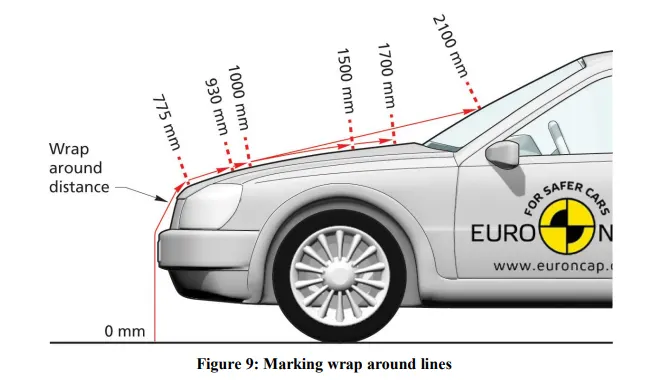
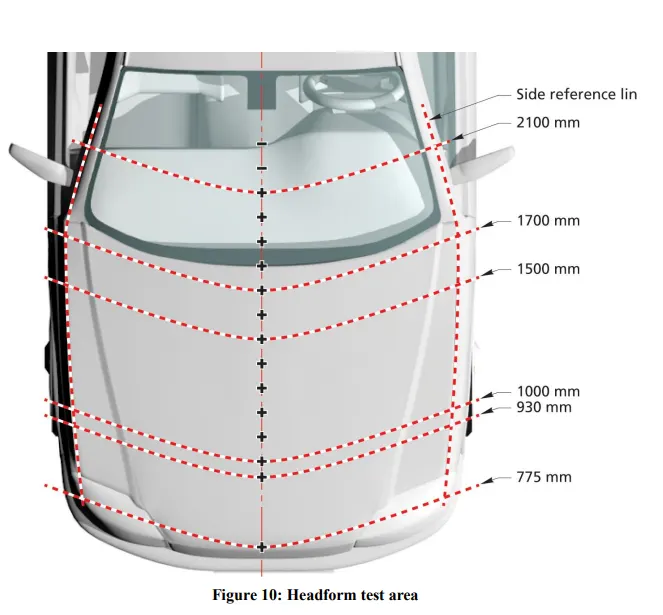
The headform test area is defined as the outer structure that includes the upper surface of all outer structures. It includes, but is not limited to, the bonnet, wings, windscreen scuttle, wiper arms/spindles, windscreen frame, A-pillars, and roof. It is bounded by the geometric trace of the 1000mm wrap-around line in the front, the Bonnet Side Reference Lines, and the 2100mm wrap-around distance (WAD).
1. Begin at the vehicle centreline. Place the end of a flexible tape measure or graduated wire on the floor vertically below the front face of the bumper.
2. Wrap the tape or wire over the bumper, bonnet windscreen, and roof ensuring that it is maintained in a vertical longitudinal (X, Z) plane and that its end is still in contact with the ground.
3. The tape should be held taut throughout the operation, vertically below the front face of the bumper, see Figure
4. Mark on the bumper/grille, bonnet top, windscreen, A-pillars, and/or roof the wrap-around distances of 775mm, 930mm, 1000mm, 1500mm, 1700mm, and 2100mm. These are the geometric traces described on the outer surface of the vehicle by the end of the flexible tape or wire 775mm, 930mm, 1000mm, 1500mm, 1700mm, or 2100mm long, when it is held in a vertical fore/aft plane of the car and traversed across the front of the bonnet and bumper.
Impact-absorption bonnet and bumpers:
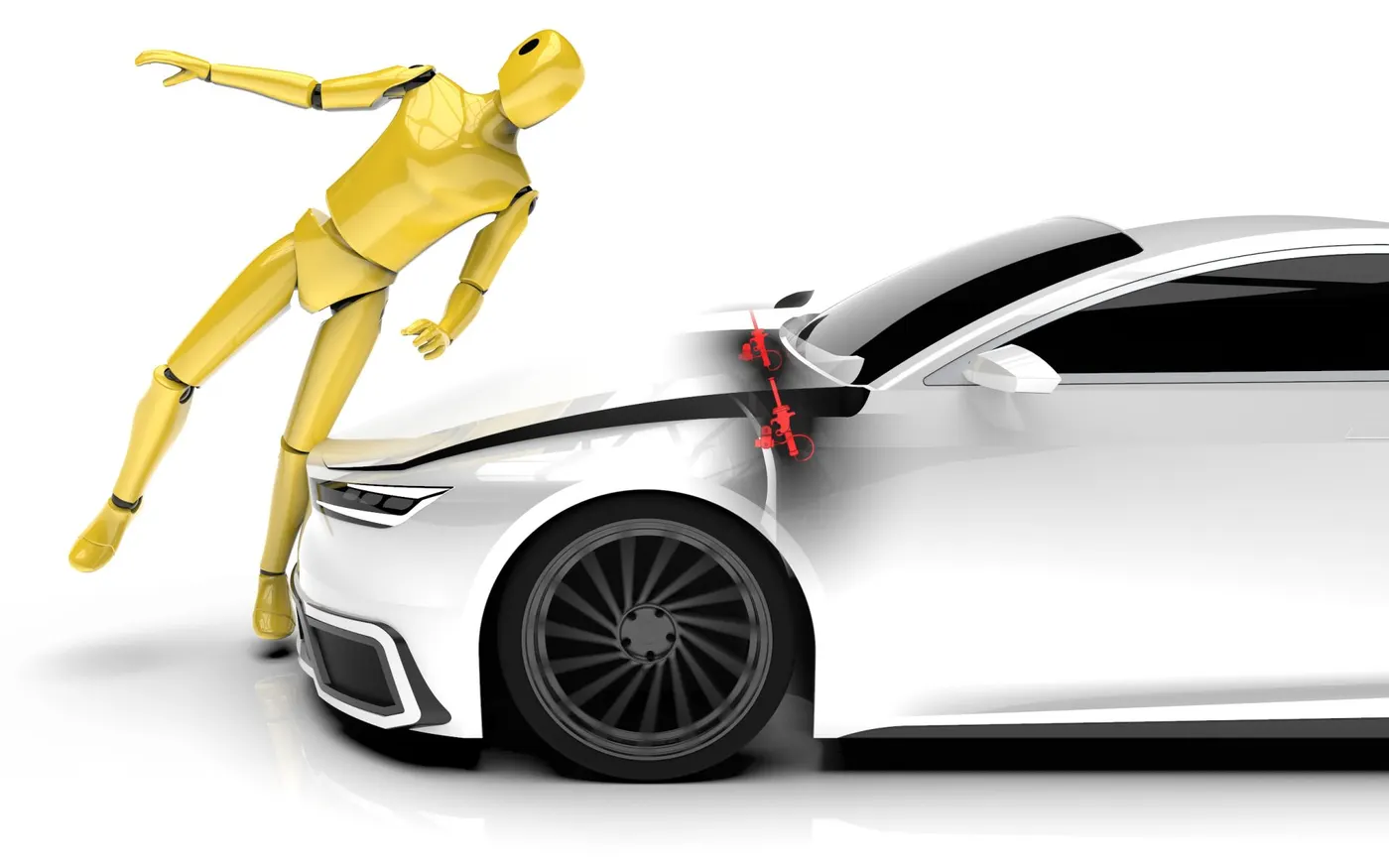
Mazda uses various methods to reduce injury to pedestrians in the event of a collision. The Impact Absorption Bonnet mitigates the impact to a pedestrian's head in a pedestrian accident.
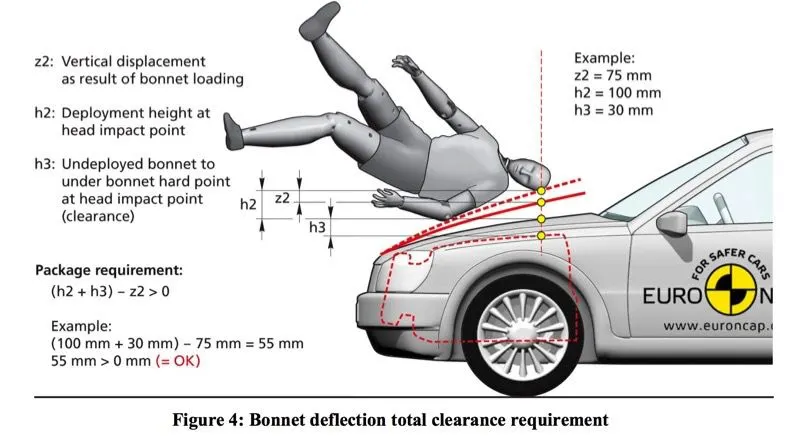
Active Bonnet is designed to mitigate the shock to the head in the event the vehicle collides with a pedestrian. Designed to activate with a defined speed range, the system causes the rear end of the bonnet to pop up when an impact exceeding a certain threshold is detected, creating a shock-absorbing space between the bonnet and the engine.
Energy absorption materials are used in the front part of the vehicle which hits pedestrians' knees to mitigate the severity of pedestrian's knee injuries. Also, stiffening reinforcement is placed at the bottom of the bumper to better prevent pedestrian's legs from going under the vehicle. In anticipation of an accident, the shape of the bonnet is carefully designed to reduce the damage to the pedestrians' knees, which are an important part of the body for walking.
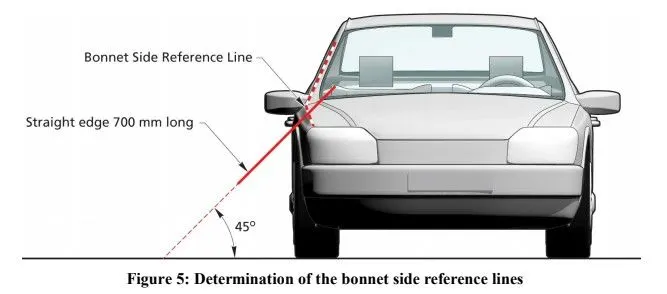
Bonnet Side Reference
The Bonnet Side Reference Line is defined as the geometric trace of the highest points of contact between a straight edge 700mm long and the side of a bonnet, as defined in Section 3.3.1 and A-Pillar, when the straight edge, held parallel to the lateral vertical plane of the car and inclined inwards by 458is traversed down the side of the bonnet top and A-Pillar, while remaining in contact with the surface of the body shell, any contact with door mirrors is ignored. See Figure 5. Where multiple or continuous contacts occur the most outboard contact shall form the bonnet side reference line.
Figure: Determination of the bonnet side reference lines
Fix a straight edge that is 700mm long at 45to the vertical. With this edge in a plane parallel to the lateral vertical plane of the car, position the straight edge at the front of the front wing and in contact with, the bonnet.
1. Mark the uppermost point of contact of the straight edge and wing.
2. Pull the straight edge away from the wing, move it towards the other end of the vehicle by not more than 100mm, and then back into contact with the wing.
3. Mark the uppermost point of contact of the straight edge and wing
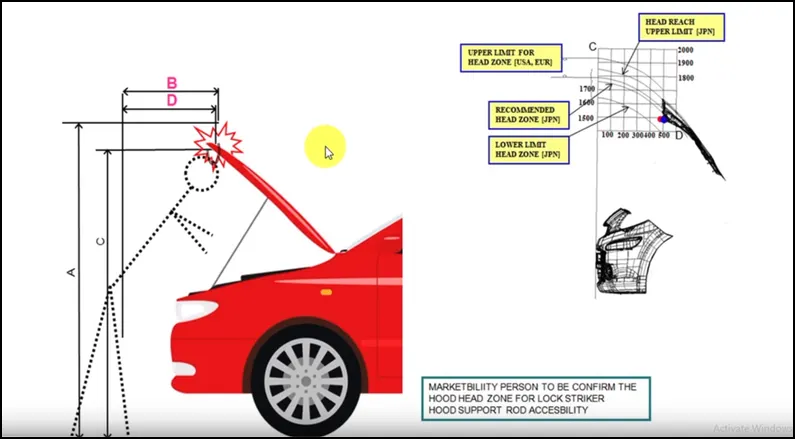
Pedestrian Protection Test Features:
Head Zone for Lock Striker:
Data to be used:
Hood Thickness Information
- Outer Panel Thickness = 0.75mm
- Inner Panel Thickness = 0.75mm
- Reinforcement Thickness = 1.5mm
Master Sketch:
Embossing:
The metal sheet embossing operation is commonly accomplished with a combination of heat and pressure on the sheet metal, depending on what type of embossing is required. Theoretically, with any of these procedures, the metal thickness is changed in its composition.
The metal sheet is drawn through the male and female roller dies, producing a pattern or design on the metal sheet. Depending on the roller dies used, different patterns can be produced on the metal sheet. The pressure and a combination of heat actually "irons" while raising the level of the image higher than the substrate to make it smooth. The term "impressing" refers to an image lowered into the surface of a material, in distinction to an image raised out of the surface of a material.
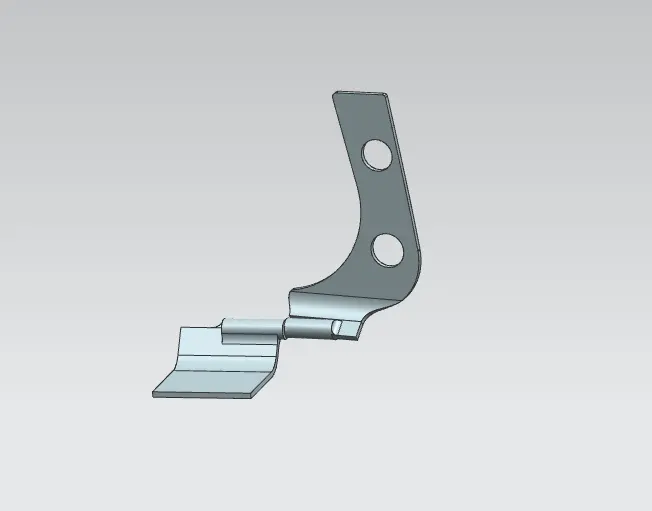
Hinges are used to join two parts together while allowing them to rotate relative to each other. They typically have two flat faces, known as leaves. One leaf is attached to each of the parts being joined.
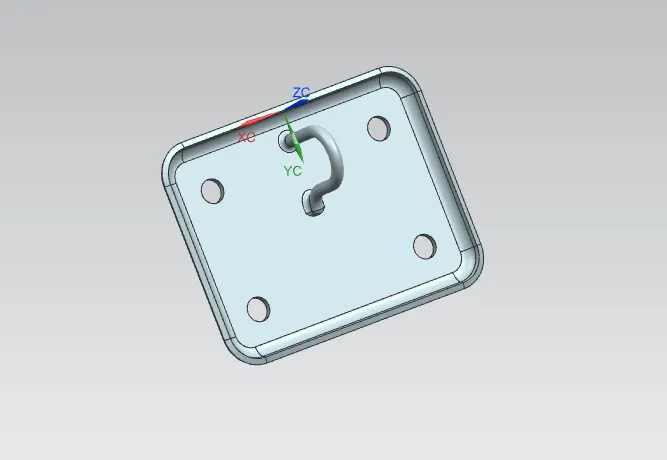
Hood striker it bolts to the underside of the hood at the front. It engages the hood latch when closed. For the term hood striker may also exist other definitions and meanings, the meaning and definition indicated above are indicative not be used for medical and legal or special purposes.
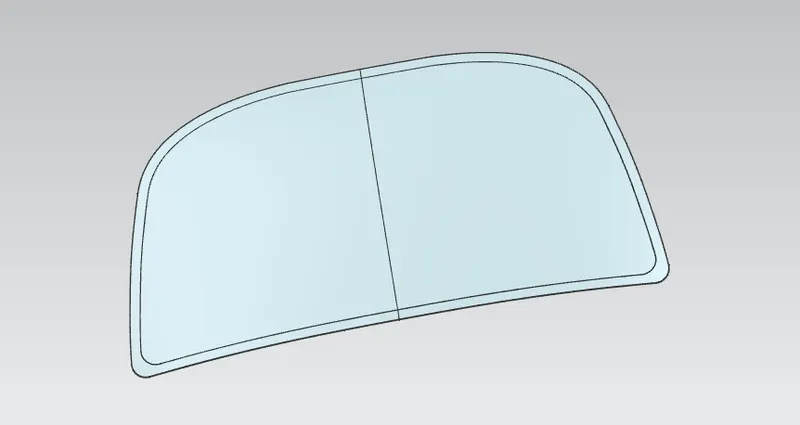
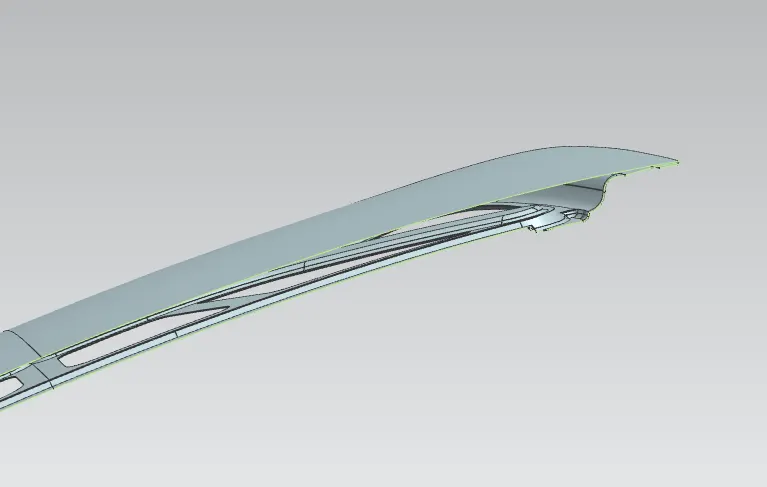
External Skin or Outer Panel of Car Hood to cover the Engine and Protect the Engine as well as Aesthetic of a car
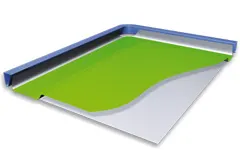
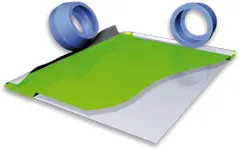
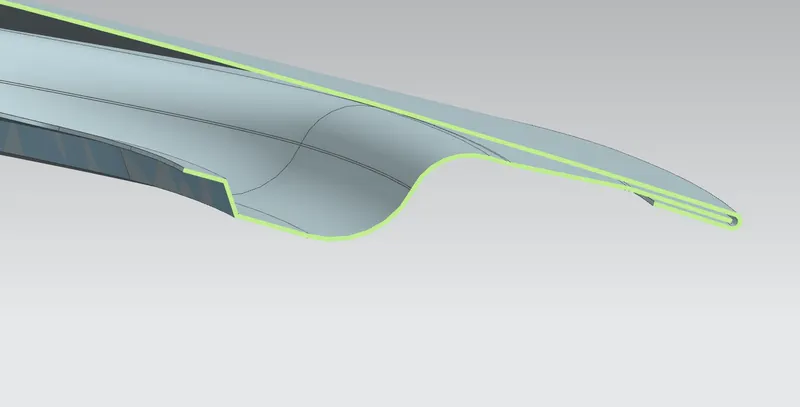
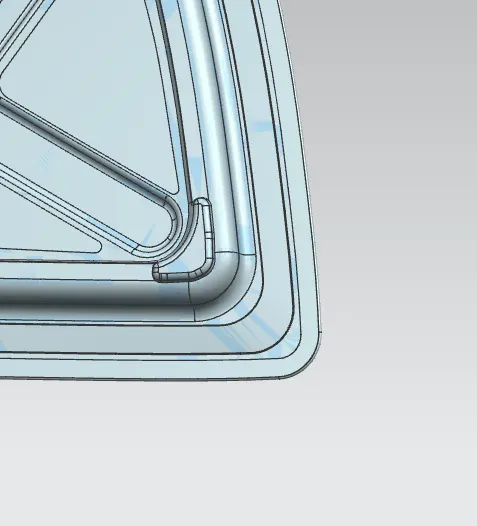
Hemming
Hemming is a forming operation in which the edges of the sheet are folded or folded over another part in order to achieve a tight fit. Normally hemming operations are used to connect parts together, to improve the appearance of a part and to reinforce part edges. In car part production, hemming is used in assembly as a secondary operation after deep drawing, trimming and flanging operations to join two sheet metal parts (outer and inner) together. Typical parts for this type of assembly are hoods, doors, trunk lids and fenders. The accuracy of the hemming operation is very important since it affects the appearance of the surface and surface quality. Material deformations, which occur during the hemming process, can lead to dimensional variations and other defects in parts. Typical hemming defects are splits or wrinkles in the flange, material overlaps in the corner areas or material roll-in. This is why it is important to use simulation tools in order to, on the one hand, better understand the hemming process and, on the other hand, significantly reduce the number of "trial and error" loops during tryout und production.
There are various types of hemming operations:
• Conventional die hemming
• Roll hemming
Outer panel of the Hood:
Assembly of the Hood:
Body Sealer
Body sealers that provide manufacturers with truly waterproof, dustproof, and corrosionproof solutions for automotive body joints that are susceptible to environmental threats. These one-component PVC sol/acryl sol sealing materials accommodate multiple weton-wet coating applications without requiring the time and expense of oven curing between coats. These sealers are tough on the elements, yet easy on your team-and your bottom line.
Distinct Benefits
Protection at its best. Body Sealer keeps dust and moisture out, preserving the integrity of steel panels inside and outside of the automobile cabin. It puts a durable, rustproof coating on vulnerable steel plate edges, virtually eliminating corrosion.
Ultimate application flexibility. Body Sealer can be applied manually or robotically during the paint process, then cured in the paint shop's baking oven.
Excellent adhesion. Our body sealer is engineered to provide exceptional adhesion, including bonding securely to electrodeposition coatings.
Tailored to your needs. Sunstar's flexible design allows for the material's properties and performance characteristics to be optimized for each working environment, application, coating, and working condition. Custom specifications can be set to further fine-tune coating properties and assure exceptional paint finishing for your shop.
Excellent compatibility. Our Body Sealer systems are highly compatible with virtually all adherents and paints and are cured in conventional OEM paint shop baking ovens one time (no need for curing between each applied coating). Achieving excellent results is easy when everything works together.
Google Drive Link:
https://drive.google.com/file/d/1LbfrzrN25pqEOdzywX5vl2mREyiFdAbC/view
Conclusion:
Designing of the Hood Outer Panel, Inner Panel and the necessary reinforcements by following the Master Section mentioned with the Design parameter has been acheived.