Hood design-Week 2
AIM :
- Design Hood Outer Panel, Inner Panel and the necessary reinforcements by following the Master Section mentioned with the Design parameters.
- A detailed explanation about hood and its components, Latch Trajectory, Mastic Data, Emboss Definitions, Manufacturing process like Deep-Drawing and Hemming, and all the parameters followed in the design.
INTRODUCTION
The hood is a hinged covers that lies on the engine in the front-engine vehicles. It purposes to provide access to the engine for repair and maintenance. It is joined with the help of hinge and a latch is used to lock or unlock the hood. There is also a stay rod to hold the hood in open condition at definite height. Its inner panel provide strength while outer panel as a metal cover. Hemming operation is used to join the outer and lower panel metal sheet. Mastic sealants is used to join the both panel and provide no direct contact between the both panels.
DESIGN CONSIDERATION FOR CAR HOOD
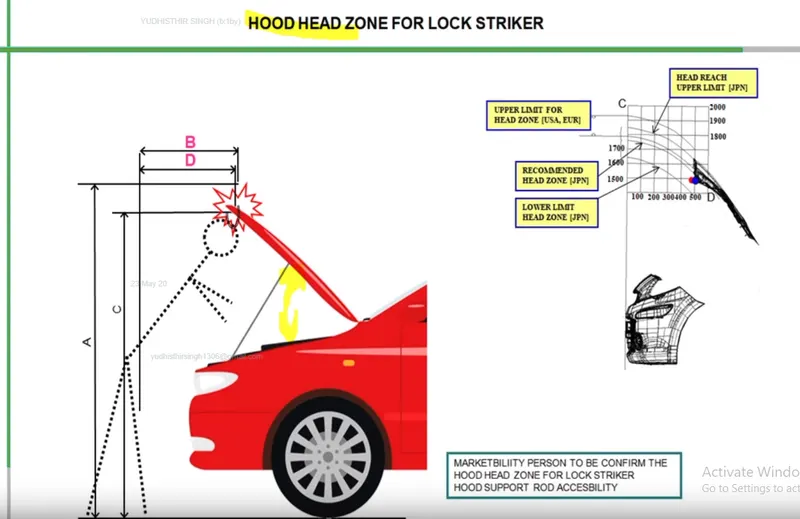
Head clearance zone The hood opened is such angle that the tip of the striker not touched the head of the person that is standing next to the hood that space is called head clearance zone.
Pedestrian safety
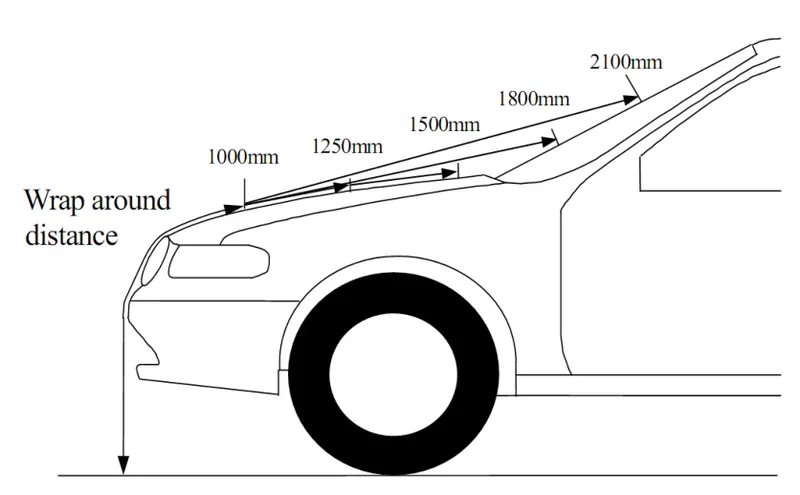
Pedestrian safety is important aspects while designing a hood. Hood is design to consider the wrap around distance WAD and pedestrian head impact zone on the hood. The area on the hood where the head of the pedestrian impact during accidents is called red zones. The red zones area on hood is made softer to reduce the impact force during accidents for making pedestrian friendly hood.
Wrap around diatance (WAD) is the geometrically traced distance from the contact point with the Ground Reference Plane, vertically below the front face of the bumper, to any point on the vehicle front structure. For adults 1700 to 2100 and for child 1000 to 1700.
Reduce NVH NVH is an acronym of Noise, vibration and hardness. Noise and vibration in the hood should be minimised. Mastic sealants is used between two panel to reduce noise and vibration.
Impact Force Distribution in Hood Design
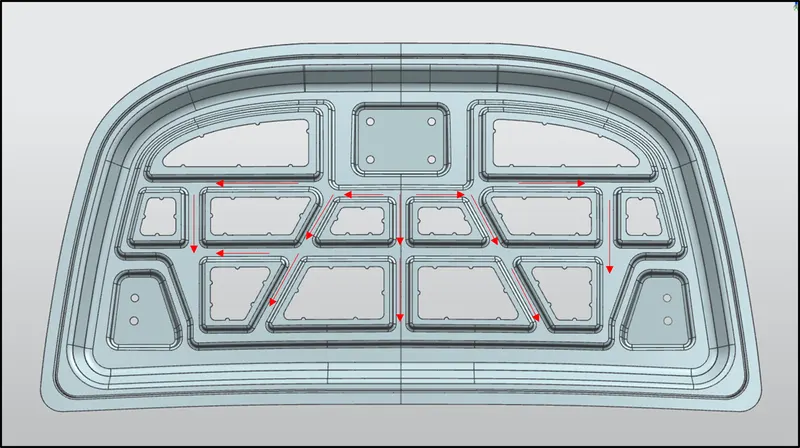
A hood design must be made in such a way that when an impact force is on the front of the hood, all the force must be directed outwards the hinge and the impact of force to be minimised. To achieve this, we create shape of emboss in inner panel such a way that impact force directs toward hinges.
DESIGN PARAMETER
Hood Thickness Information
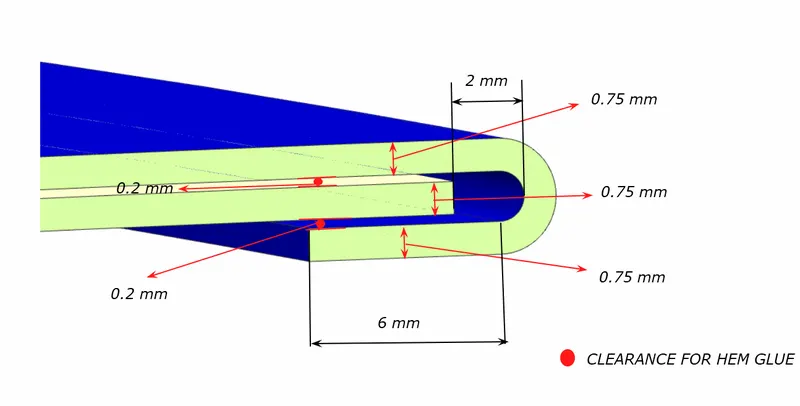
- Outer Panel Thickness = 0.75mm
- Inner Panel Thickness = 0.75mm
- Reinforcement Thickness = 1.5mm
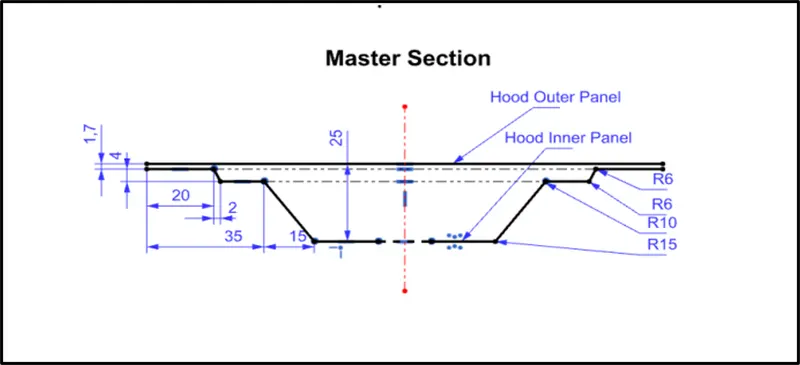
Master section
Hemming Data
COMPONENTS OF HOOD
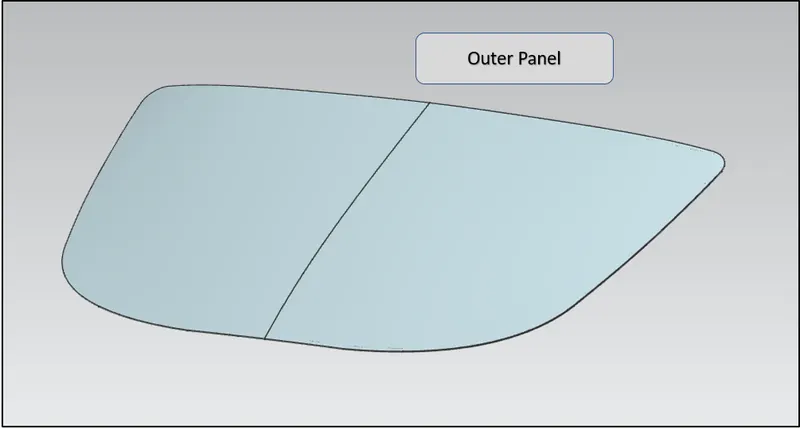
Outer panel
Outer panel is the exterior surface of the hood. it is an aesthetic element of a car. The outer panel is attached with lower panel by hemming operation.
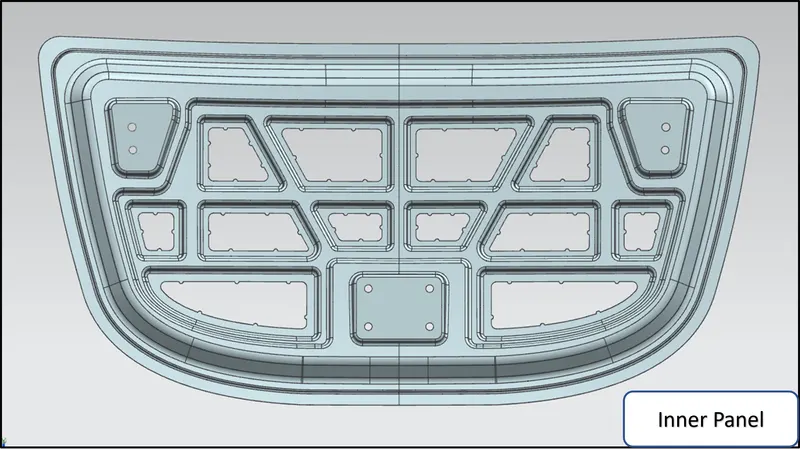
Inner panel
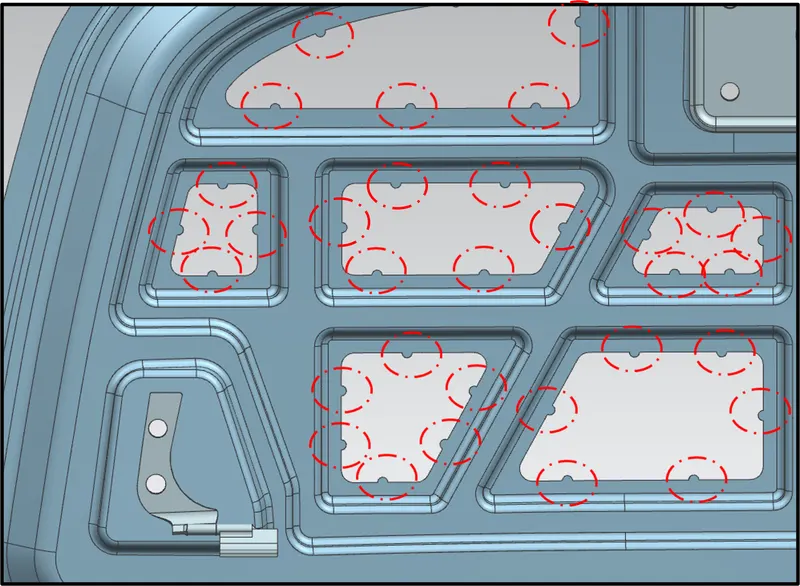
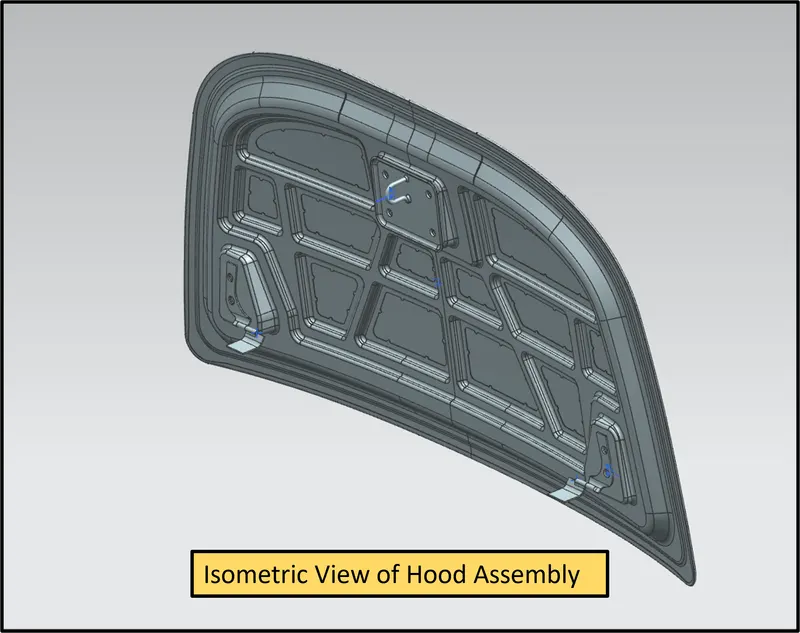
Inner panel give strength to the hood. It has emboss or deep drawing surface and to reduce the weight of the inner panel some surface are trimmed. There is also emboss for striker and hinge latch assembly.
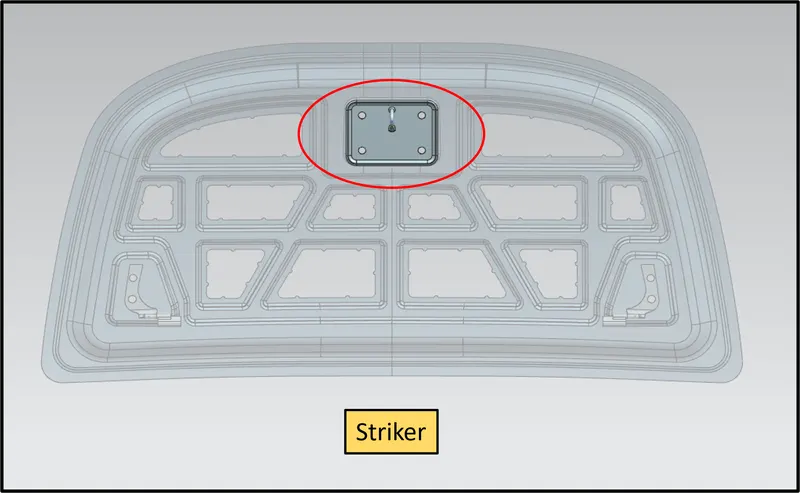
Latch and Striker
The latch and Striker mechanism provided to lock the hood. Latch is fixed on the engine compartment and the striker is attached to the embossed surface of inner panel.
Hinge
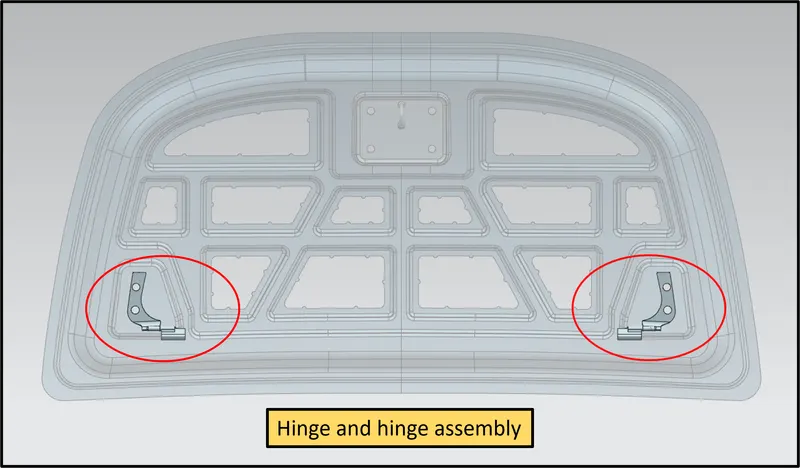
Hinge is a mechanical bearing that connect the two solid objects and allowing a limited rotation movement between them. One part of hinge is fixed with the engine compartment while other part is connected to hood.
Reinforcement
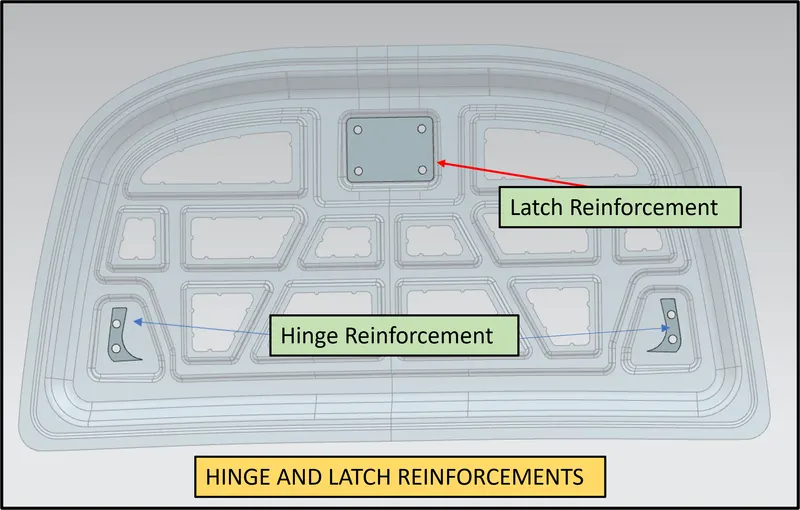
Reinforcement is provided according to the design requirements. We add reinforcement at hinge and latch regions to improve the strength of that region. Here the thickness of the reinforcements is 1.5mm which is twice in comparison with thickness of the panel.
Mastic data
Mastic seals are used as a bond between outer and lower panels. It improves the stiffness of the area. It also plays vital role to reduce the NVH. Mastic sealants are elastic compound that behave like rubber. The mastic points are arranged in such a way that covers the area away from the hemming which are more vulnerable to vibrate. Every mastic sealant point has tendency to provide local strength in around 80 mm in diameter.
Latch trajectory
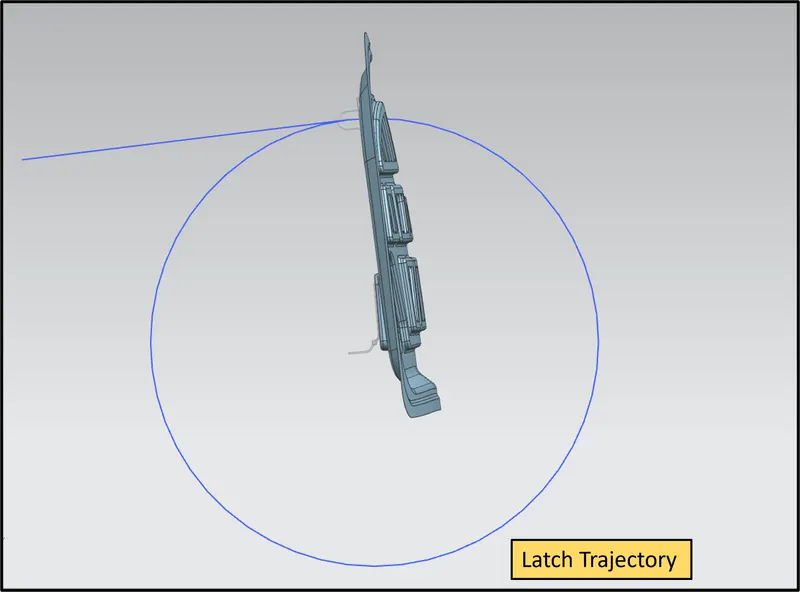
During opening and closing of hood at hinge axis, a circular path of the latch is traced, this path is called latch trajectory and for proper locking and unlocking operation the latch is located directly perpendicular to the trajectory.
Emboss
Sheet metal embossing is a metal forming operation in which the sheet metal is stretched into a shallow depression.
Three things to controls during the embossing of sheet metal
- Pressure: Pressure applied to the sheet metal should be controlled during embossing.
- Heat: Heat level should be maintained consistently during the embossing to get the perfect impressions.
- Die depth: The depth of the die should be adjusted such that the extreme thinning or failure of sheet metal does not occur.
Deep drawing
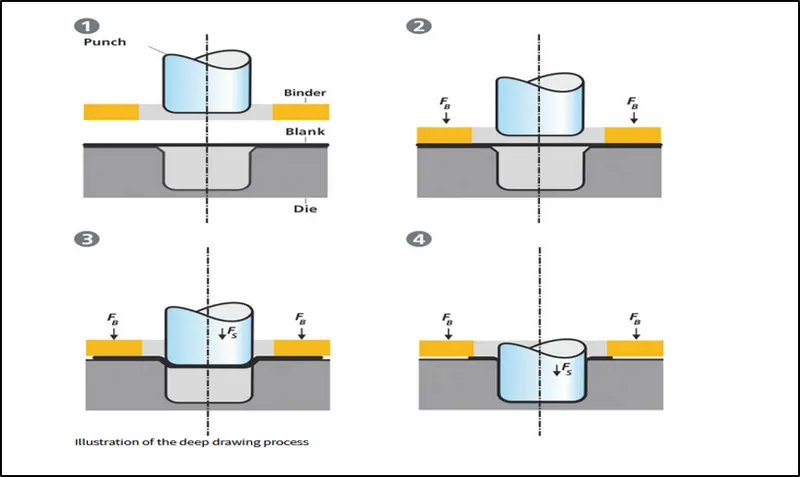
The deep drawing process is a forming process which occurs under a combination of tensile and compressive conditions. A flat sheet metal blank is formed into a hollow body open on one side or a hollow body is formed into a hollow body with a smaller cross-section. is also a forming process which is used in sheet metal.
Hemming
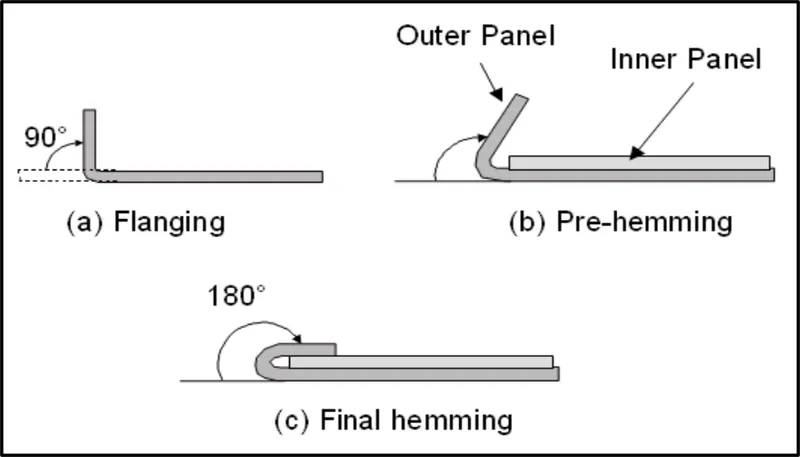
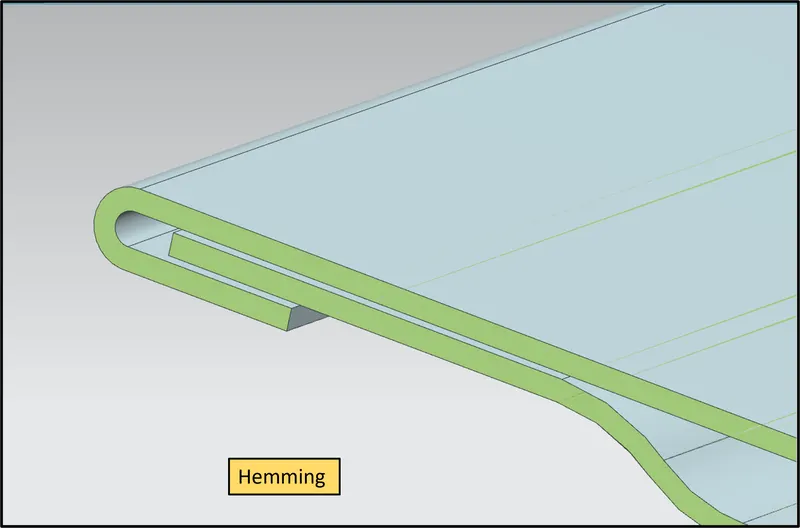
Hemming is a forming operation in which edge of the metal sheet folded over same sheet or other sheet to joining the two or more sheets and it increase the strength at the edge of the sheet.
Corner reliefs
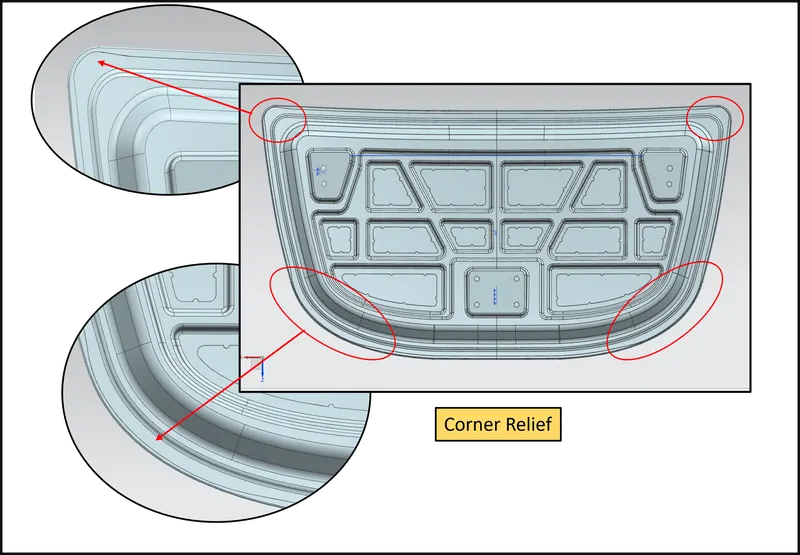
Corner relief help to control the sheet metal material behaviour and to prevent unwanted deformation during unbend operation.
Isometric view of Hood
IMPORTANT FEATURES USED IN HOOD DESIGNING
Curve Commands
- Offset curve in face – It is used to offset the edge curve on selected face.
- Curve on surface – It is used to create curve on surface with option of one and two DOF.
- Bridge Curve – It is also used to curve between two points.
Surface Commands
- Trim body – It is used to trim the body by using face and plane. Also specify which part is to retain or which part to discard.
- Offset Surface - It is used to copy and paste the surface to parallel distance from the surface.
- Trim Sheet – It is used to trim off the unrequired portion in the surface of the sheet by selecting the edge, curves, face and planes in the surface.
- Through Curve – It is used to create surface between the edge of two separated body. Only condition is distance between them is less.
- Law Extension - It is used to create the surface through curve and edge at desired angle to the body surface.
- Trim and Extend – It is used to trim the extended surface which is intersect to another surface.
- Face blend – It is used to give fillets between two or more face of surface.
- Edge Blend – It is used to give fillets on the edges of the two or more surface.
- Extended Sheet – It is used to extend the existing surface to the required surface length.
- Emboss – It is used to create the embossing surface of the existing surface by giving some draft angle.
- Projected Curves – It is used to projected the curve, edge of the surface to another planes or surface.
- Sew – It is used to join the two different bodies.
- Thicken - It is used to provide thickness the body surface and become solid body.
Assembly Commands
- Mirror geometry – It is used to mirror the geometries at planes or surface.
- Wave Geometry Linker – It is used to create copy of any entity of the body to other body. Any changes on the original entity of the body reflect on the copied.
- Assembly Constraint – It is used to provide constraint between two body such as perpendicularly, parallel, align, angle, fix, and others.
CONCLUSIONS
The hood is design by using NX cad software by understanding the concept of passenger and pedestrian safety, NVH, Impatcs force distribution.