Hood design-Week 2
AIM
Design Hood outer panel, inner panel and the necessary reinforcements by following the Master section mentioned with the design parameter explained in the videos. Submit an assembly of Hood inner panel, outer panel, latch, hinge and the reinforcements
A detailed report about the Hood Design which includes a detailed explanation about hood and its components, Latch trajectory, Mastic data, Emboss definitions, manufacturing process like deep drawing and hemming, and all the parameters followed in the design.
The report should be well-formatted and should have a good flow of content. Add all the relevant images
Data to be used:
Hood Thickness Information
- Outer Panel Thickness = 0.75mm
- Inner Panel Thickness = 0.75mm
- Reinforcement Thickness = 1.5mm
Software Used
CATIA V5
Introduction
The Hood is an opening body panel which is the frontal BIW enclosure component in a front engine vehicle.
It consists of an outer and inner panel. The inner panel provides strength while the outer panel functions as metal cover. It is a very critical component because of the frontal crash requirements and pedestrian and passenger safety requirements. The design of the hood is vital since it affects the aerodynamic flow around the car.
Major parts of a Hood
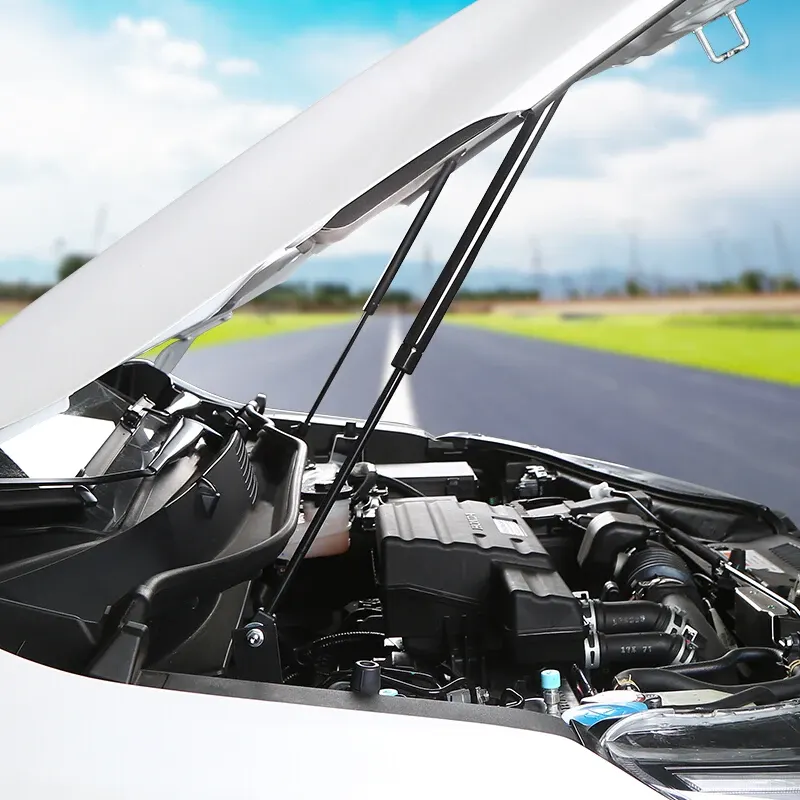
Support Rod/Gas Stay
It is a device used for supporting the engine hood in its open position.
This component plays the primary role in determining the opening angle of the hood. Its length varies for different regions depending upon the average human height.
European regions require a larger opening angle compared to Asian regions. Gas stay requires no man power and is engaged into support position
automatically as the hood opens, unlike the Support Rod.
It can be kept unmounted on the Grommet in the hood or in the engine compartment. The Support Rod can be given curvatures for increased strength, not exceeding 35mm which is the industry standard limit.
Inner and Outer Panel
The inner panel provides strength while the outer panel functions as metal cover. They are of 0.65-0.75 millimetres (mm) thick.
To improve NVH (Noise, Vibration and Harshness) i.e to reduce these levels, Mastic Sealants are used.
Mastic Sealants improves the strength locally at around 80mm diameter.
They are positioned between the inner and outer panel of the hood in such a way that it covers most of the hood region.
They are made of hard Rubber and are introduced as a paste thereby joining the inner and outer panel with a thickness of 5mm.
What is a mastic sealant
A mastic sealant is a type of liquid sealant that cures in an elastic state, thus making it flexible while holding the bond of the surfaces that has attached together.
It adheres to just about any material making an all-purpose type of sealant.
EMBOSS FOR HOOD
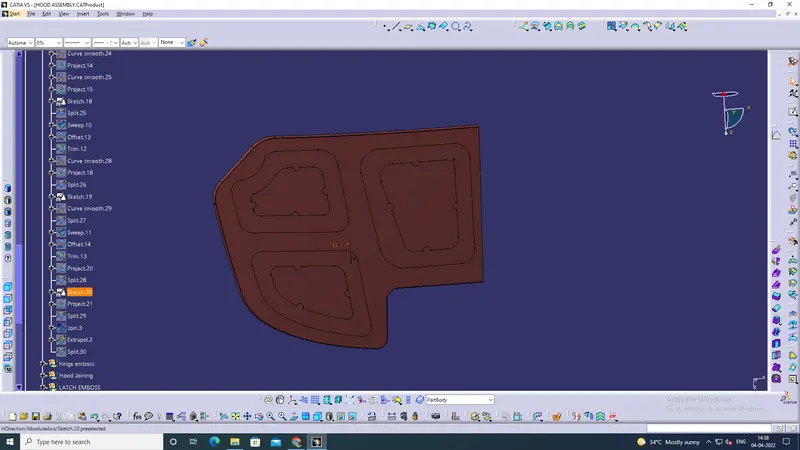
Embosses are added to the inner panel to improve the stiffness of the part. The embossing are done in such a way as to
perform the Deep Drawing direction smoothly.
embossings.
The geometry is created based on the master section that was designed above. After performing the initial stages of design, we will provide local embosses to strengthen the component. The component will be strengthened based on the master section.
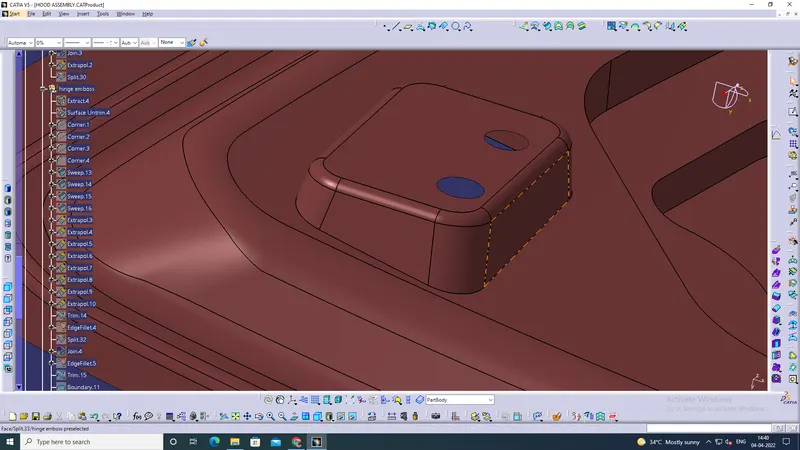
The design and direction of the embosses should be the guide for the force to travel in case of a collision, dissipating the
force away from the passengers to the outside of the vehicle (towards the Hinge) and thereby reducing the impact force
drastically. Fig. Shows the force moving towards outside.
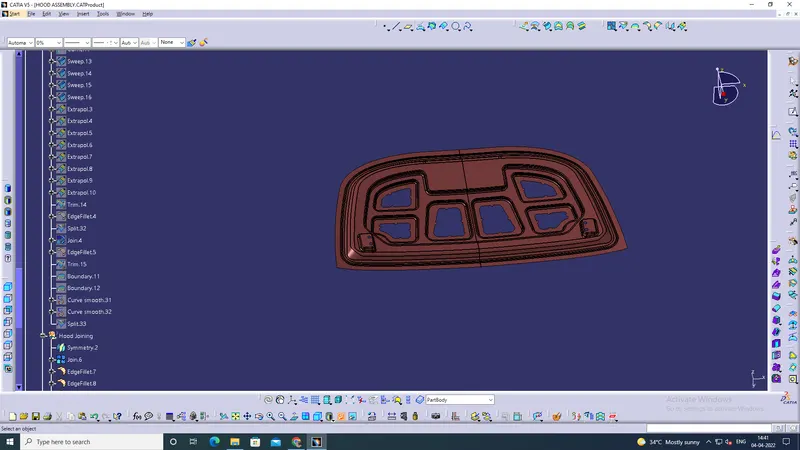
When a force impacts the hood from the front, it travels in an upward direction.
The component is designed to divert the force away from the passengers into the hinges, as shown in the image belowThe embosses in the inner panel are made according
to the diversion of the load path.
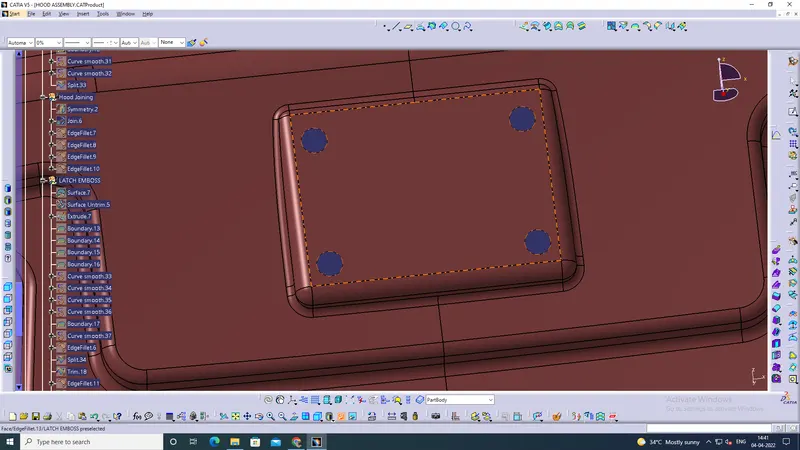
The emboss depth is kept at a maximum of 5mm to be on the safer side so that the part is manufacturable.
HEMMING
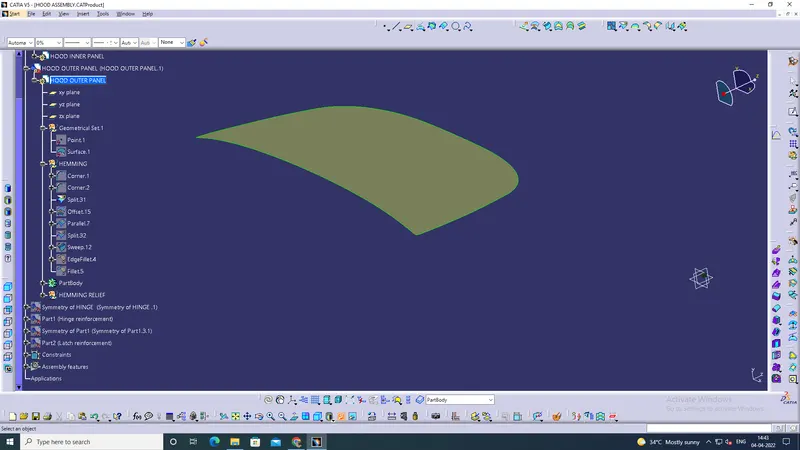
Hemming :
Hemming is a forming operation in which the edges of the sheet are folded or folded over another part in order to achieve a
tight fit.
Normally hemming operations are used to connect parts together, to improve the appearance of a part and to reinforce part
edges.
In car part production, hemming is used in assembly as a secondary operation after deep drawing, trimming and flanging
operations to join two sheet metal parts (outer and inner) together. Typical parts for this type of assembly are hoods, doors, trunk lids
and fenders.
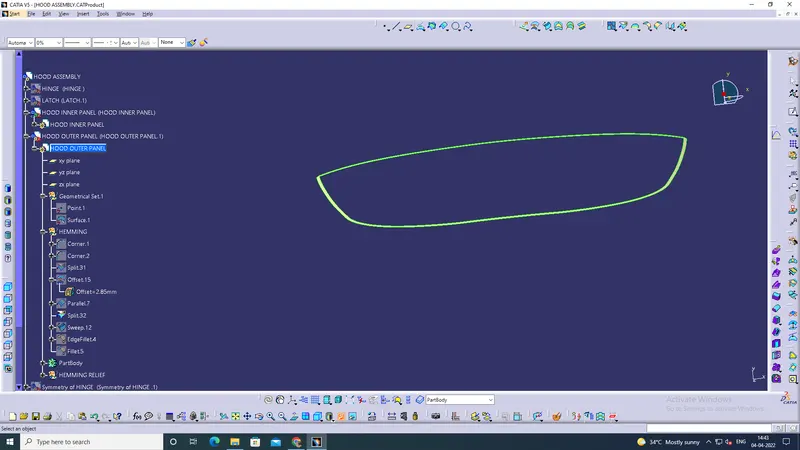
In this case Hemming is done to assemble the inner panel with the outer panel.
Here there are predefined nomenclatures to follow w.r.t gap (0.2mm) between the outer and inner panels on both sides where sealants are applied to achieve water
tightness
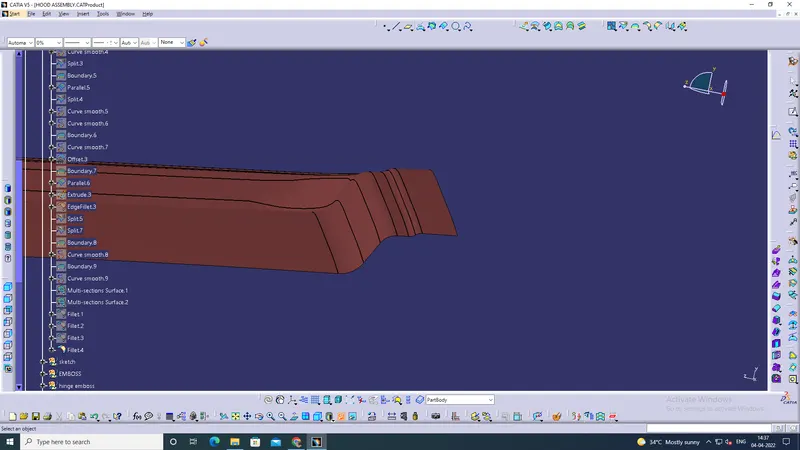
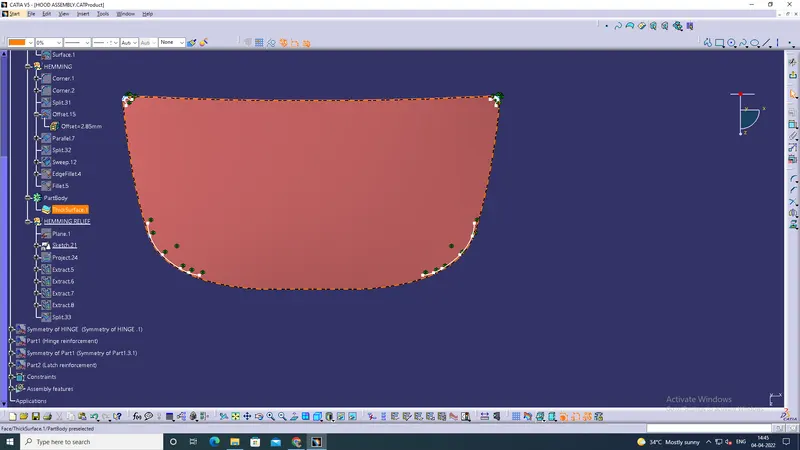
Hemming is preferred over Spot Welding given its superior aesthetic finishing.Relief is provided on the hood corners to avoid
intolerance issues arising from the rolling process in Hemming operation
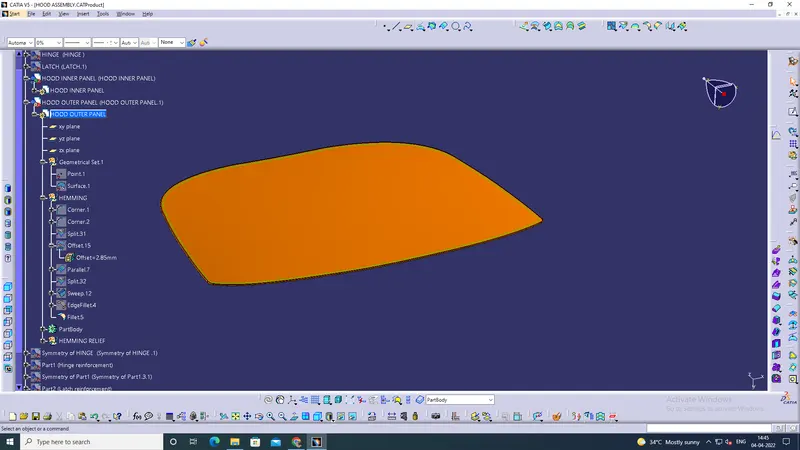
HEMMING CORNER RELIEFS
Corner reliefs are given therefore when we create hemming it wont creates a problem
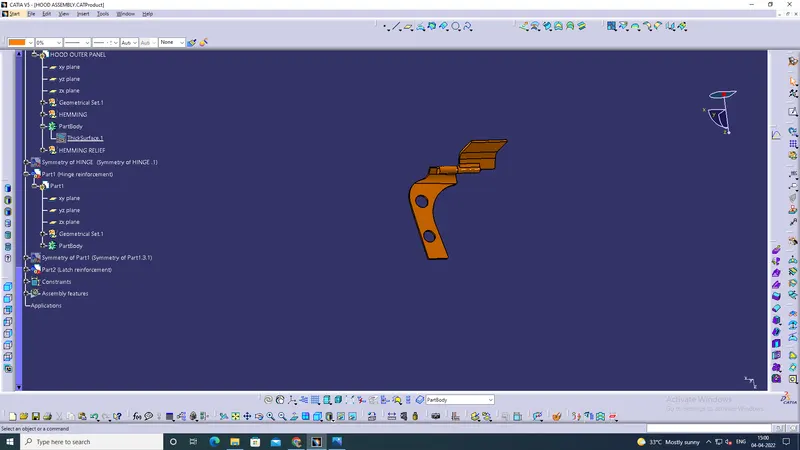
HINGE , LATCH AND STRIKER :
Hinges enable the opening and closing of the Hood. The Latch & Striker forms the locking mechanism of the hood with the engine compartment.
One part of the Hinge is mounted to the engine compartment and the other to the inner panel of the Hood, on both sides
Position Of Hinge and Striker :
For postioning hinge and striker,we have to place hinge tantatively and take hine axis point and place position from
data taken from the parent car or our own.
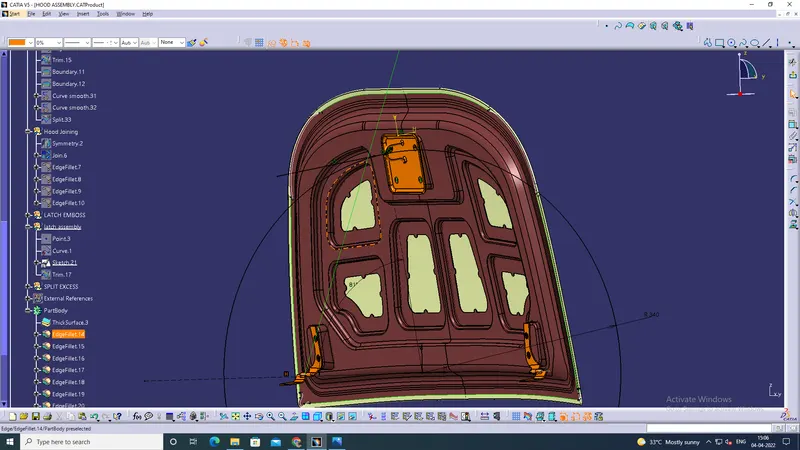
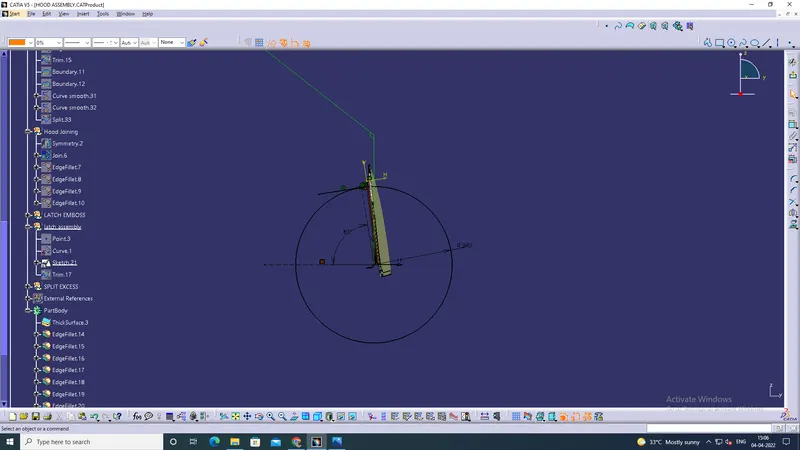
The other major functional of the hood is the opening and closing of the hood. This is done with the help of the latch and striker. To position the latch and striker effectively, we position the hinge and draw the hinge axis.
Now, using the hinge axis as the center we draw a big circle to the position where we need the latch to be placed. Then, we draw a tangent line to the circle at that point and place the latch in that region.
REINFORCEMENT
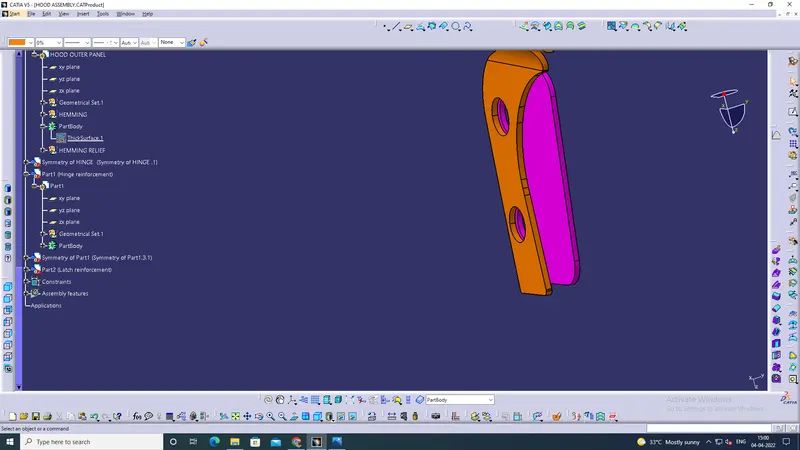
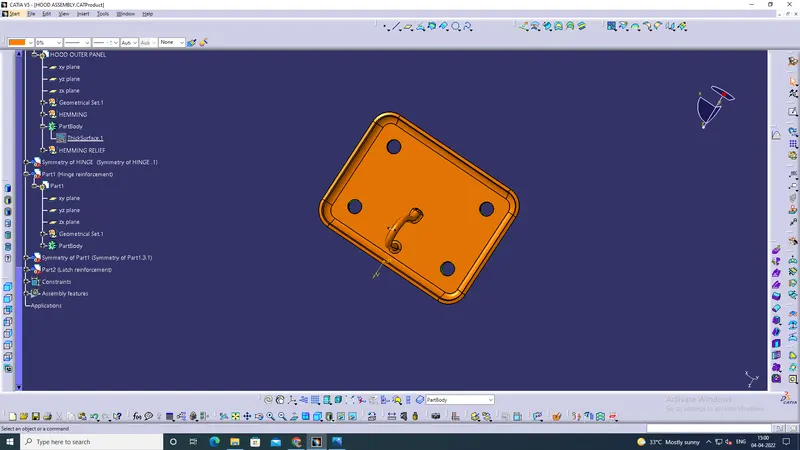
Reinforcements are created to reduce the NVH factor in the car hood
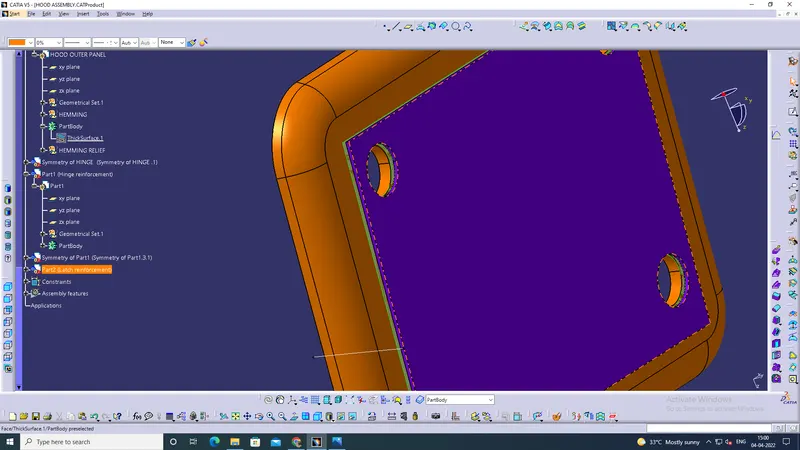
A 1.5 mm thick hinge reinforcement has been created and is shown below
.