Week 4.1 - Genetic Algorithm
A GENETRIC ALGORITHM
A GENETRIC ALGORITHM IS A METHOD TO SLOVE THE BOTH CONSTRAINED AND UNCONSTRAINED
OPTIMIZATION PROBLEM BASED ON A NATURAL SELECTION PROCESS THAT MIMICS BIOLOGICAL EVOLUTION .AND ALSOIS SEACH HEURISTIC THAT IS INSPIRED BY THE CHARLES DARWIN'S THEORY OF NATURAL EVOLUTION
In genetic algorithm id done in three step are considered in genetic algorith
they are,
(1)selection
(2)crossover
(3)mutation
slection
The ideal of selection phase is to select the fittness individual and let them pass their genes to the next generation.
Two pairs of individuals(parents) are selected basond on their fitness scores individual with high fitness have more chance to be selected for reproduction
crossover
cross over is the most significant phase in a genetic algorithm .for each pair of parents tobe mated, acrossover point is chosen atrandom from with in the genes
mutation
In a certain new oofspring formed some of theirgenes can be subjected to a mutation with a low random probability .this implies that some of the bits in the spring can be flipped
syntax;
x=ga(fun,nvars)
x=ga(fun.nvars) find a local un constrained minimum,x,to the object functionfun.nvars is the number of design variables of the function , fun .
stopping criteria
- Generation
The algorithm stop when the number of generation reaches the value of generation
- Time limit
The algorithm stop after running for an amount of time in second is equal to the time limit
- Fitnes limit
the algorithm stop when the value of fitness function for the best piont in the current population is less than the equal to fitness limit
clear all
close all
clc


%inputs
x=linspace(0,0.6,100)
y=linspace(0,0.6,100)
num_cases=40;

%for 2d mesh
[xx yy]=meshgrid(x,y)

%evaluating the stalagmite function
for i=1:length(xx);

    for j=1:length(yy);

        input_vector(1) = xx(i,j);

        input_vector(2) = yy(i,j);

        f(i,j)=stalagmite(input_vector);
    end
end

tic
%study 1-satistical behavior
for i=1:num_cases
    [inputs,fopt(i)]=ga(@stalagmite,2);
    xopt(i)=inputs(1);
    yopt(i)=inputs(2);
end
study1_time=toc


%plotting
figure(1);
subplot(2,1,1);
hold on
surfc(xx,yy,f);
shading interp
plot3(xopt,yopt,fopt,'o')
subplot(2,1,2)
plot(fopt)
xlabel('iteration');
ylabel('function minimum');

tic
%study2
for i=1:num_cases
    [inputs,fopt(i)]=ga(@stalagmite,2,[],[],[],[],[0;0],[1;1]);

    xopt(i)=inputs(1);
    yopt(i)=inputs(2);
end
study2_time=toc

%studing 3 increasing ga iteration

options=optimoptions('ga')
options=optimoptions(options,'populationsize',170);


%plotting
figure(2)
subplot(2,1,1);
hold on
surfc(xx,yy,f);
shading interp;
plot3(xopt,yopt,fopt,'o');
title('bounded  input');
subplot(2,1,2);
plot(fopt)
xlabel('iteration');
ylabel('function minimum');


%study3
for i=1:num_cases
    [inputs,fopt(i)]=ga(@stalagmite,2,[],[],[],[],[0;0],[1;1],[],[],options);

    xopt(i)=inputs(1);
    yopt(i)=inputs(2);
end
study3_time=toc


%plotting
figure(3)
subplot(2,1,1);
hold on
surfc(xx,yy,f);
shading interp;
plot3(xopt,yopt,fopt,'o');
title('bounded  input');
subplot(2,1,2);
plot(fopt)
xlabel('iteration');
ylabel('function minimum');

------------------------------------------------------------------


function [f]=stalagmite(input_vector)
x=input_vector(1);

y=input_vector(2);

f1=(sin(5.1*pi*x+0.5))^6;

f2=(sin(5.1*pi*y+0.5))^6;

f3=exp(-4*log(2)*((x-0.0667)^2/0.64));

f4=exp(-4*log(2)*((y-0.0667)^2/0.64));


f=-(f1*f2*f3*f4);
end
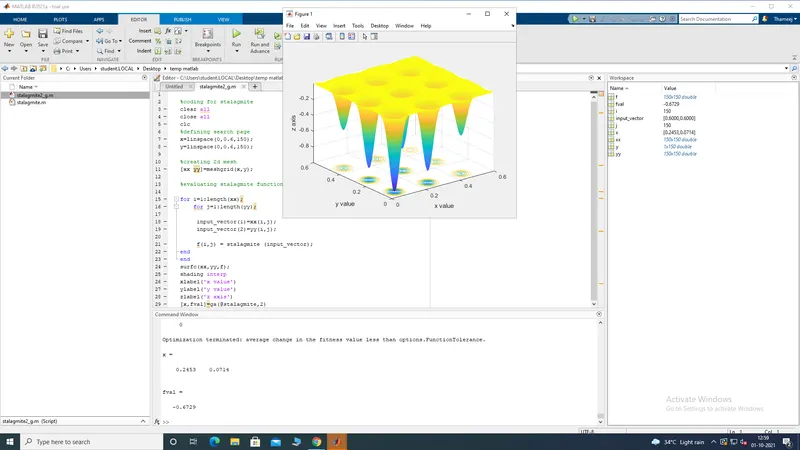
figure (1)
in this digram the basic digram for the global maxima. by using the code and generated the global maxima
figure(2)
to determining the minimum point of the global minima with genetic algorithm
in this figure we analysis the so much point is consider of the requiment of the point in this stage (1)
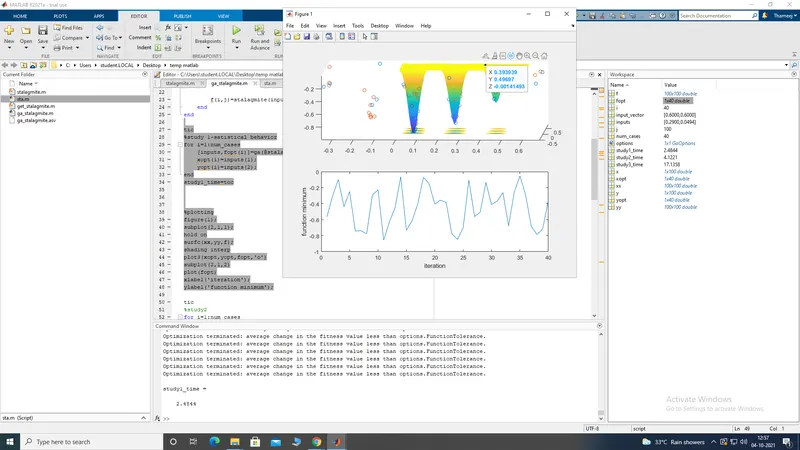
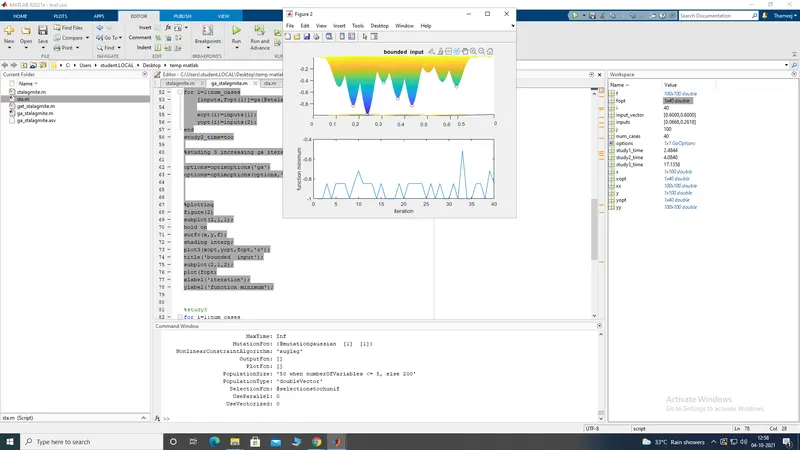
figure (3)
in figure(3) we analysis the less point the in showed in the figure
when we compare with figure (2) the point are reduced with reqirment of the spot of stage (2)
with genenitic algorithm
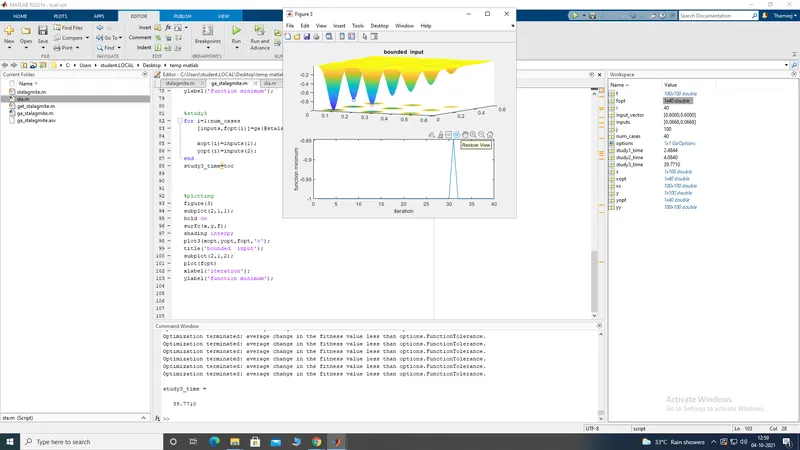
figure(4)
in the final stage the point are reduced when we comapre with stage 1 and 2
this is the final genetric algorithm because the point are are less than three
so that the final output for ga global minimum og stage (3)
result
- *The code as be upload fot the global maxima and stalagmite fuction are completed
- *And then the genetric algorith and syntax is completed
- *The graph for three studies of gobal minima are plotted and attached