Hood design-Week 2
Design of the Hood
Objective:
To understand the design approach and its consideration that follows the designing and developing an automobile hood to ensure the pedestrian for inner and around the vehicle.
About the Hood:
A car hood also referred to as a bonnet in some other countries is the hinged cover that rests over the engine of a front-engine vehicle. A car hood is meant to protect the performance parts of your vehicle, including the engine, while also providing easy access for repairs and maintenance. A concealed latch is typically used to hold down the hood. Car hoods are typically constructed from steel and sometimes from aluminum.
Concerns regarding the severity of a potential pedestrian head injury during a collision with a motor vehicle have led to advanced hood designs on many models. Such designs may include a multi-cone inner hood panel design.
A car hood panel is one of the most important components of the BIW (body in white), it is considered as the closure sheet-metal component. A hood panel consists of two panels namely outer and inner panels that are hemmed together to form the automotive hood assembly.
The inner panel of the hood is not visible to the customer but this is the engineering feature of the outer panel and also serves as the structure to dissipate and channel shock waves in the event of the crash. The outer panel has the aesthetic look to make the automobile a complete presentation. The initial design goes through iterative design modification based on the crash and structure analysis.
Once the design of two components is done and finalized, then the manufacturing process begins. The inner panel is generally manufactured by the deep drawing process and the outer panel of the hood mainly includes blanking, deep drawing, and trimming. Among them, deep drawing is a key process to ensure quality.
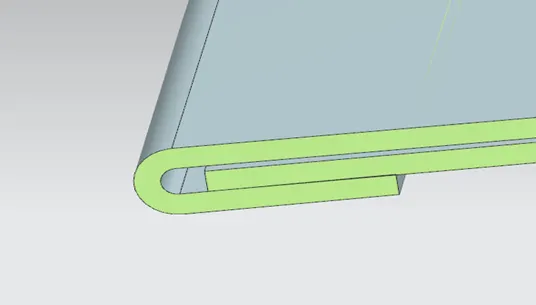
After the manufacturing, the outer panel and inner panel are united to form one unit by several joining methods such as Hemming, Riveting, gluing, and spot welding. In this project, Hemming is used to joining these two components and involves the folding of the outer panel overlap around the inner panel and pressed using hemming rollers.
Master Sections:
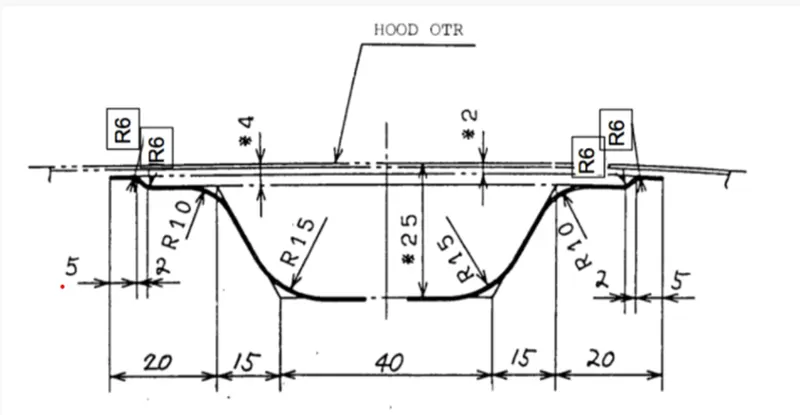
Data to be used:
Hood thickness information
- Outer Panel Thickness = 0.75mm
- Inner Panel Thickness = 0.75
- Reinforcement Thickness = 1.5 mm.
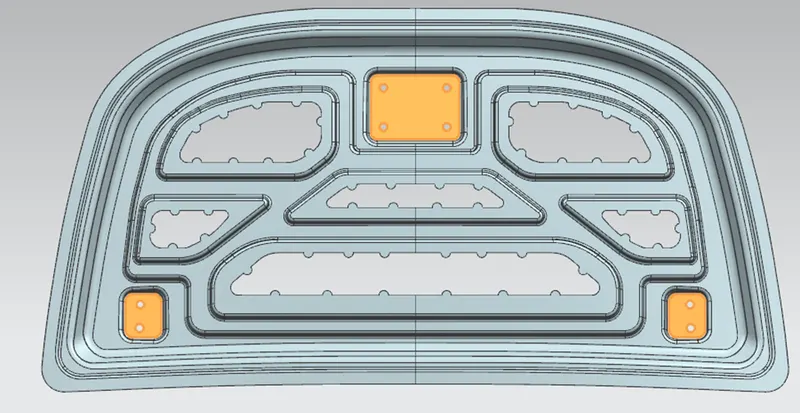
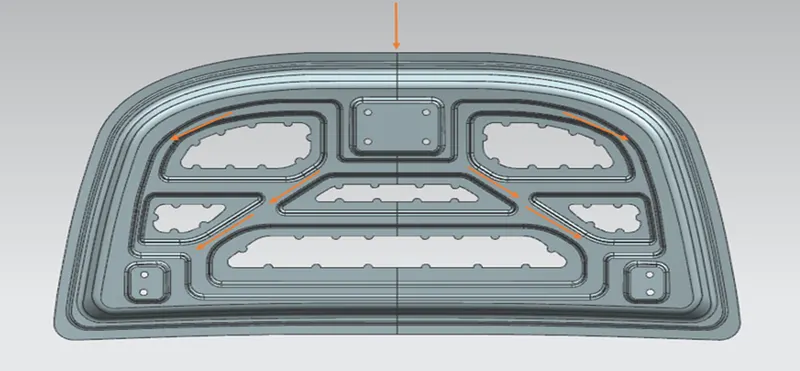
With the help of the above-mentioned master section, we generate the initial structure design, and embosses were created to strengthen the structure as well as to accommodate the channel to direct shock flow and dissipate the maximum energy away from the cabin. Once the design the designing is done, reinforcement is provided at the portion of the hinge and latch position to compensate for the strength drop that occurred.
The NVH team also contributes their work at this stage to implementing design changes to reduce vehicle noise and vibration.
The center region of the inner panel is kept in contact with the outer panel using the mastic sealants and rubberized components. In the presence of the sealants and the absence of the rivet, spot weld makes the outer panel aesthetically pleasing.
Manufacturing process:
- Deep drawing
Deep drawing is a sheet metal forming process in which a sheet metal blank is radially drawn into a forming die by the mechanical action of a punch. The process is considered "deep" drawing when the depth of the drawn part exceeds its diameter of the initial blank. This is achieved by redrawing the part through a series of dies.
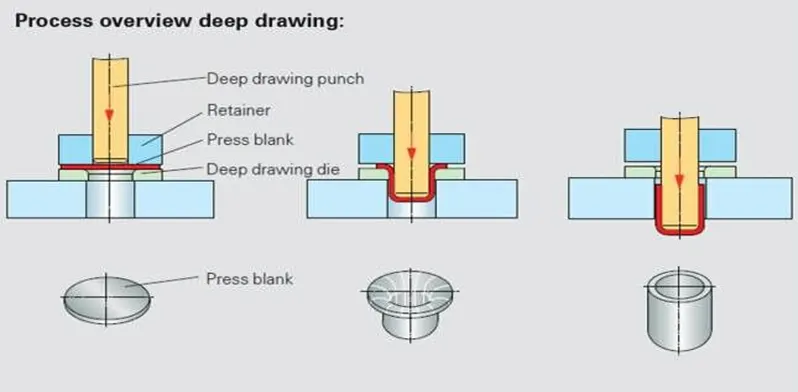
- Hemming
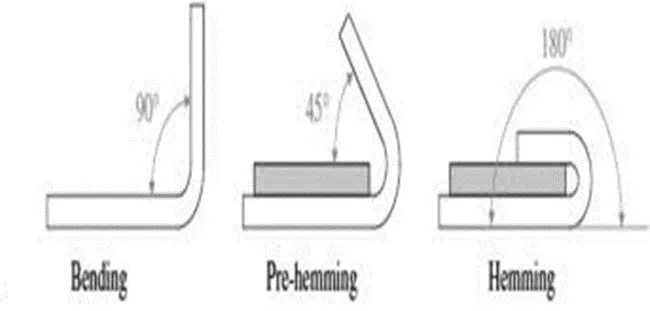
Hemming is a sheet metal forming process in which sheets are joined by bending it to 180°. Automotive body panels and automotive parts such as deck-lids, trunk-lids, doors, hoods, and tailgates are formed by the hemming process. In this process, usually, a sheet is bent with the help of an inner sheet in three different stages.
Embossing:
Embossing is a metal forming process for producing raised or sunken designs or relief in sheet material utilizing matched male and female roller dies, theoretically with no change in metal thickness, or by passing sheet or a strip of metal between rolls of the desired pattern. The metal sheet is drawn through the male and female roller dies producing a pattern or design on the metal sheet. Depending on the roller dies used, different patterns can be produced on the metal sheet.
Embossed metals are used in industry for two reasons:
(1) Aesthetic, and (2) Functional.
Aesthetic applications also include appliance panels, building products, elevator panels, garage door panels, automotive trim, metal office furniture, and others.
Functional applications are those in which a performance characteristic is enhanced. This reduction friction, and increase a metal panel’s stiffness and rigidity, increase a metal surface area for acoustic or heat transfer applications and improve traction.
In this project, we can observe the emboss is designed which is placed at the hinge and latch placement.
Design consideration:
As discussed earlier in the section, the Hood plays a significant role in the safety of an automobile not only for the vehicle occupants and pedestrians.
For this, it goes with a lot of things to consider with approved standards. In this project, the European New Car Assessment Program, popularly known as the Euro N-CAP. It was followed to be considered in designing a hood. A series of test replicate impacts involving the child and adult pedestrians where impact occurs at 40kmph. Impact sites are then assessed and the protection is offered as rating as fair, marginal, and poor.
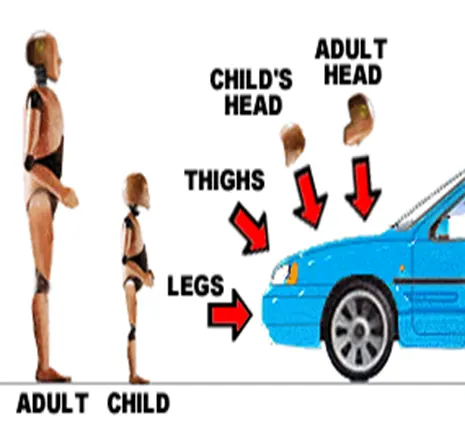
Dummy placement in Pedestrian crash test
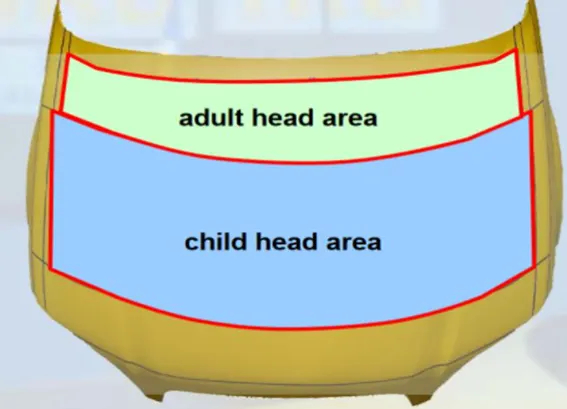
Impact area of child and adult in Bonnet (Hood)
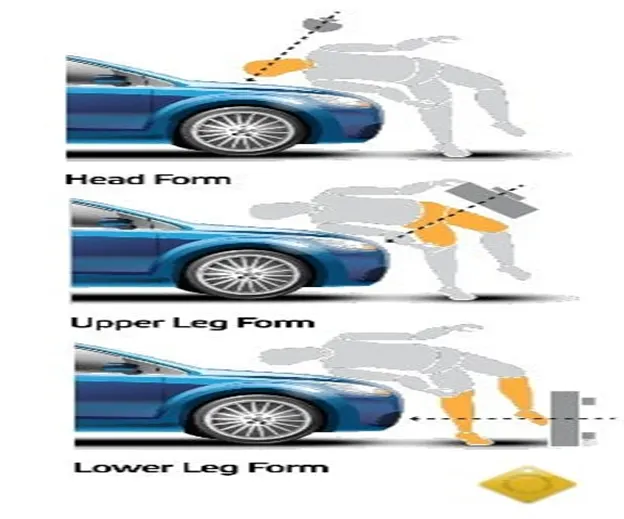
Body- Bonnet Interaction
Based on the impact zones as shown in the above picture, the thickness of the hood at those zones is reduced to allow the low impact for the pedestrian.
At the same time, the impact on the vehicle should minimize by having a channel section channeled outside to safeguard the occupants from severe injuries.
With this understanding, the below-providing design is carried out in NX-Cad.
Inner panel:
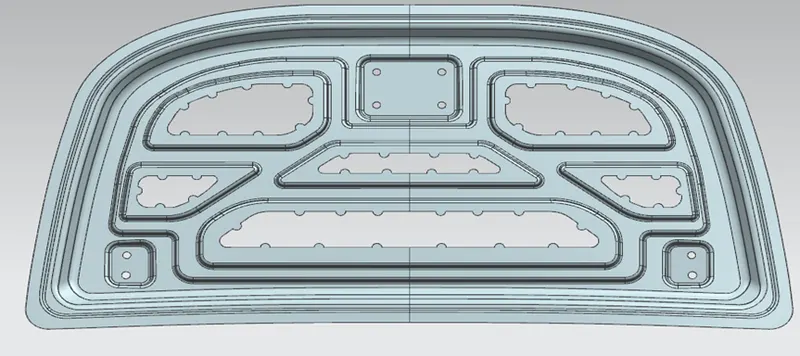
Outer panel:
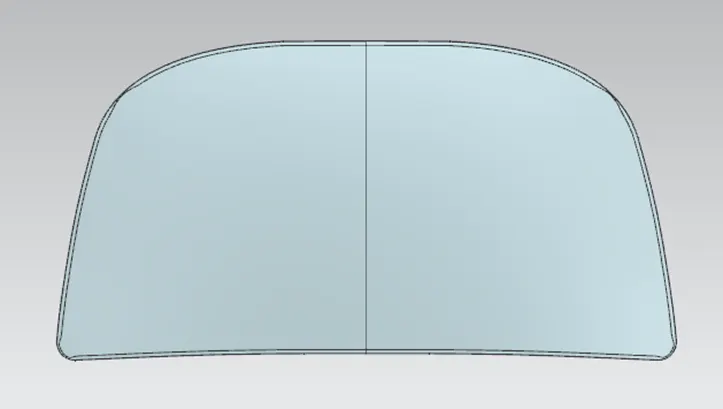
Hem:
Relief:
Striker:
Hood opening and closing trajectory:
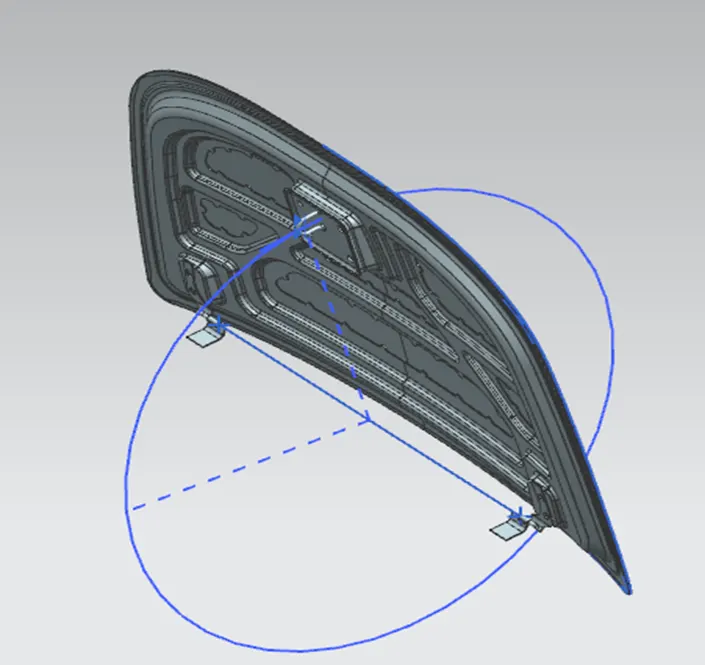
The trajectory of the hood is to be considered for the proper opening and closing of the hood. First, we have to position the hinge axis and the trajectory of the hood is drawn. The trajectory helps to validate the positioning of the hinge and latch and to find whether the latch is correctly aligned with an engine compartment. This can be achieved by having a perpendicularity between the trajectory and the axis of the latch. In this way, hinge and striker point correlate with each other.
Reinforcement:
Shock flow:
Draft analysis:
Conclusion:
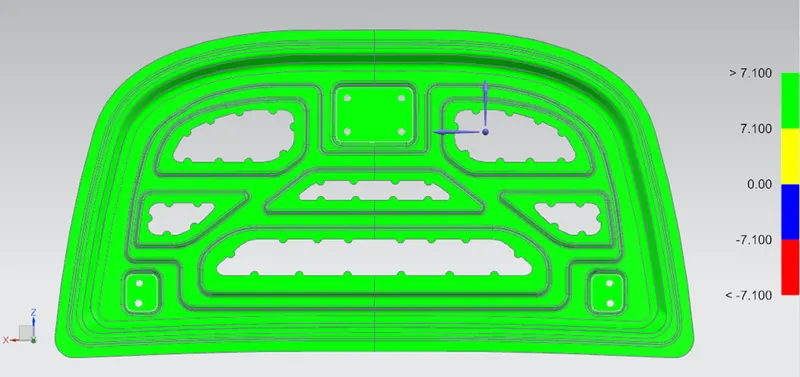
With consideration and standards of the Euro N-Cap, the design of the automobile hood is executed with help of the NX Cad and perform the draft analysis to ensure manufacturability