Hood design-Week 2
Hood
Hood also know as bonnet is a hinged cover that are sometimes held by struts to keep the engine bay from external elements that may ruin the same. Usually it is easily able to open the hood for Engine inspection or oil check, In the open condition the hood is supported by a support rod which is a rigid structure which holds the hood in place at open condition.
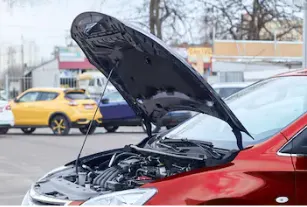
Hood Stay is very essential and it varies with respect to the type of automobiles.
there are mainly two types of stay
1. Support rod: Commonyl used support as show in the above fig
2. Gas Stay: Used when the hood is very heavy. commy used i nhigh performance super cars. Even though is bit more costly not external man power is required.
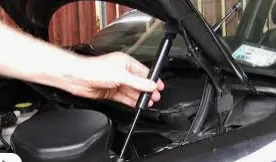
The hood is opened and closed by means of a latch and striker mechanism which in turn actuates the same. While designing a hood important factor is the opening angle , they must be designed according to the customer requiremnts in each region. human height varies in Europe and Asia this difference in height will be taken into consideration while designing the hood for each region respectively this also enable better marketing of customers in each region.
Hood Sections
The hood consists of inner panel and outer panel.
Hoods are typically made out of the same material as the rest of the body work. This may include steel, aluminium, fiberglass or crabon fibre. However, some aftermarket companies produce replacements for steel hoods in fiberglass or carbon fiber to make the vehicle lighter but the former is bit more costly.
Designing the inner panel of the hood is very important beacuse during the time of impact force dissipation will occur through embosses provided in the sheet metal. Since there are metal lost in variuos section innorder to mitigate the loss in strength of the sheet metal reinforcements are introduced.
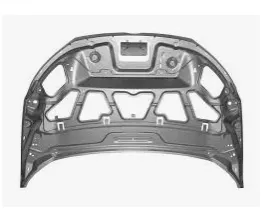
There is a Provision for the Latch and striker in the iiner panel. The strength of the hood will help in good NVH(Noise,Vibration and hardness) while assmebling the inner and outer panels it is made sure that they are fixed firmly innorder to prevent any kinds of vibration or wobbling at the ruuning condition. While placing the inner and outer panels are placed together together it is made sure that mastic sealants are applied as shown below
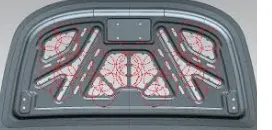
Mastic seals are positioned in such a way that most of hhod regions are covered and also improves the strength locally at a diameter of 80mm.
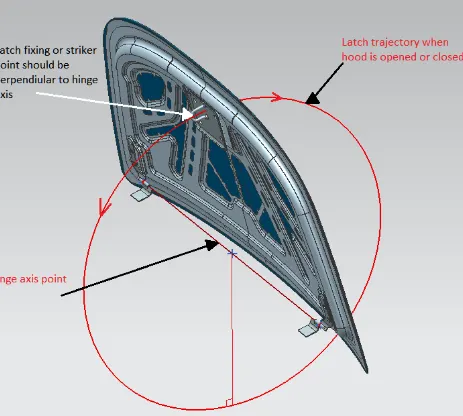
Latch Trajectory of Hood
While designing the latch reinforcement on a hood it should be made sure that they are tracing the circle shown in the below fig.The reinforcement should be placed in such a way that a circle can be traced from midpoint of the line drawn from the two hinges, Designing in this way will keep the latch reinforcement tangent to the traced circle which inturn enables in succesful latch-striker mechanism.
Hemming Process
Hemming is done on the outer panel sheets for effective binding of the outer sheet to the inner panel section of the hood by means of rollers. Each rollers will roll over the edges of the outer pannel to close and bind with the inner panel.
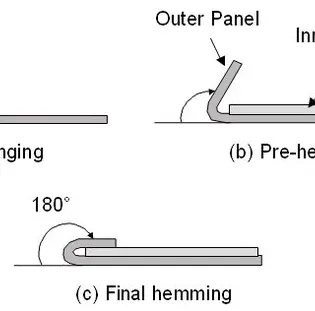
A releif is given at the corners of the panel beacause even after the hemming process the corners are red zone area for spring back which means tha chances of the outer sheet to return to the original position to avoid this releif is provide at the red zones which are the corners of the outer panel region.
Design Specification of hood for pedestrian safety
In many regions regulations have come into effect that place a limit on the severity of pedestrian head injury when struck by a motor vehicle.This is leading to more advanced hood designs, as evidenced by multicone hood inner panel designs as found on various cars.Other changes are being made to use the hood as an active structure and push its surface several centimeters away from the hard motor components during a pedestrian crash. This may be achieved by mechanical (spring force) or Pyrotchnic devices. Many Pedestrian Injuries are caused by collision of head with the hood region which causes brain hemmorage. By making the hood lighter or with better desing for effective force dissipation during the time of impact the head region will not be Susceptible to severe damage.