Hood design-Week 2
Aim :
To Design and Assemble the Hood outer panel, Inner panel and the necessary reinforcements by following the Master section.
Introduction :
The hood or bonnet is the hinged cover over the engine of car. Hoods can open to allow access to the engine compartment, or trunk on rear-engine and some mid-engine vehicles for maintenance and repair. It generally covers the engine and other essential accessories like battery, Radiator, electrical components, etc of the car which are exposed outside. The Hood consists of an outer panel and an inner panel. The inner panel provides strength and support, where the outer panel is a metal cover that has styling factors.
Sheet metal operations :
- Blanking and piercing
- Deep drawing
- Embossing
- Hemming
Blanking and piercing :
Blanking and piercing are shearing processes in which a punch and die are used to produce parts from coil or sheet stock. Blanking produces the outside features of the component, while piercing produces internal holes or shapes. The web is created after multiple components have been produced and is considered scrap material. The "slugs" produced by piercing internal features are also considered scrap. The terms "piercing" and "punching" can be used interchangeably.
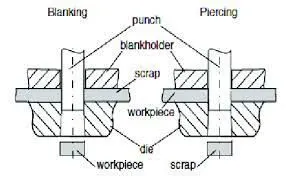
Deep drawing :
Deep drawing is a sheet metal forming process in which a sheet metal blank is radially drawn into a forming die by the mechanical action of a punch. It is thus a shape transformation process with material retention. The process is considered "deep" drawing when the depth of the drawn part exceeds its diameter.
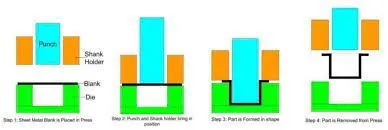
Embossing :
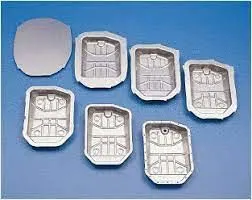
The metal sheet embossing operation is commonly accomplished with a combination of heat and pressure on the sheet metal, depending on what type of embossing is required. Theoretically, with any of these procedures, the metal thickness is changed in its composition.
Metal sheet is drawn through the male and female roller dies, producing a pattern or design on the metal sheet. Depending on the roller dies used, different patterns can be produced on the metal sheet. The pressure and a combination of heat actually "irons" while raising the level of the image higher than the substrate to make it smooth. The term "impressing" refers to an image lowered into the surface of a material, in distinction to an image raised out of the surface of a material.
In most of the pressure embossing operation machines, the upper roll blocks are stationary, while the bottom roll blocks are movable. The pressure with which the bottom roll is raised is referred to as the tonnage capacity.
Embossing machines are generally sized to give 2 inches (5 cm) of strip clearance on each side of an engraved embossing roll. Many embossing machines are custom-manufactured, so there are no industry-standard widths. It is not uncommon to find embossing machines in operation producing patterns less than 6 inches (15 cm) wide all the way up to machines producing patterns 70 inches (180 cm) wide or more.
Hemming :
Hemming is a sheet metal forming process in which sheets are joined by bending it to 180°. Automotive body panels and automotive parts such as deck-lids, trunk-lids, doors, hoods and tailgates are formed by hemming process. In this process, usually a sheet is bent with the help of inner sheet in three different stages.
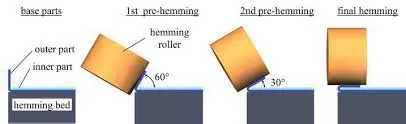
Automobile hood consists of the following components :
- Hood Inner panel
- Hood outer panel
- Reinforcements
- Hinge assembly
- Latch and striker assembly
Hood Inner panel :
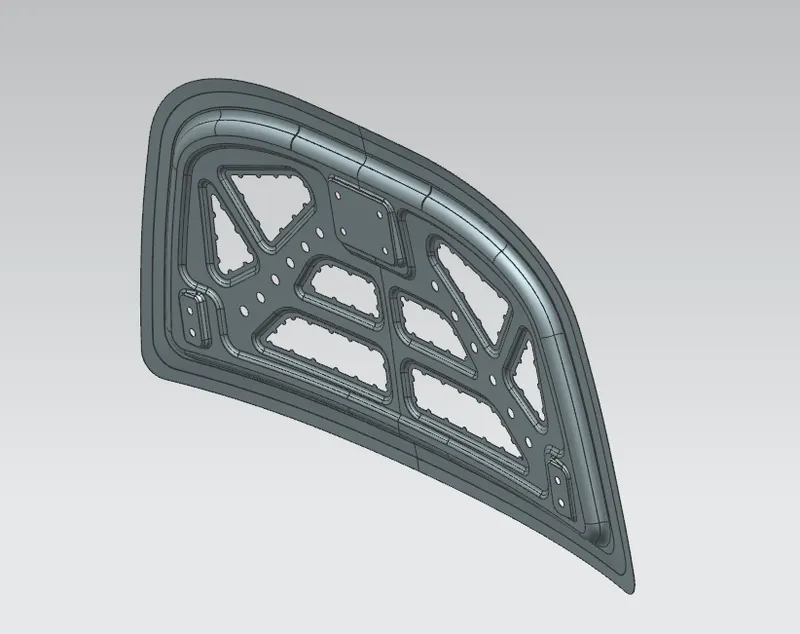
Hood inner panel is the skeleton of the hood and it provides proper strength to the hood. Hood inner panel for a vehicle is provided to improve rigidity, durability, and pedestrian protecting performance by comprising a composite structure in which a multi-cone structure and a frame structure are individually arranged on the front and the rear. It accomodates all the other components of the hood assembly based on functional requirements.
Hood outer panel :
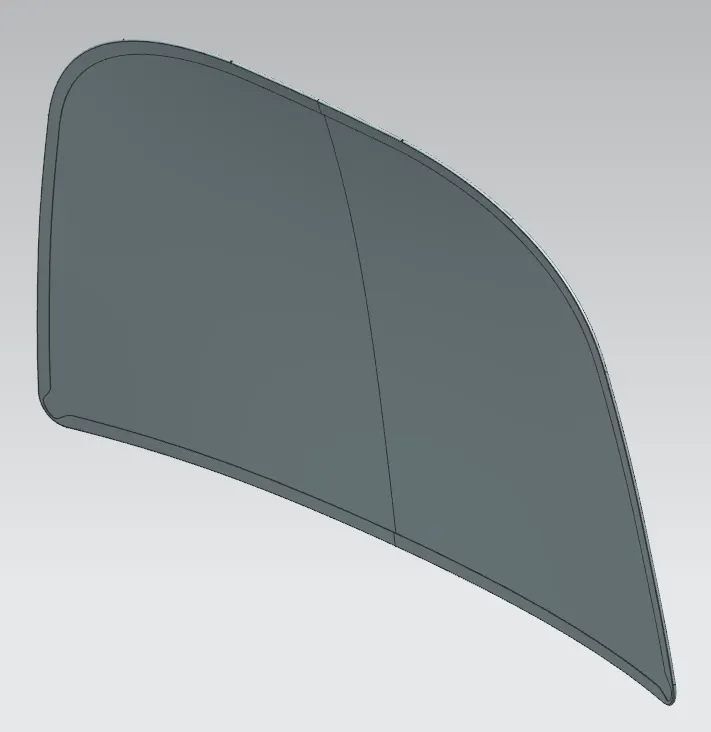
Hood outer panel is the outer most skin of the hood, covers the automobile's engine compartment and other components. It enhances the overall look of the automobile and provides protection from external corrosive conditions.
Reinforcements :
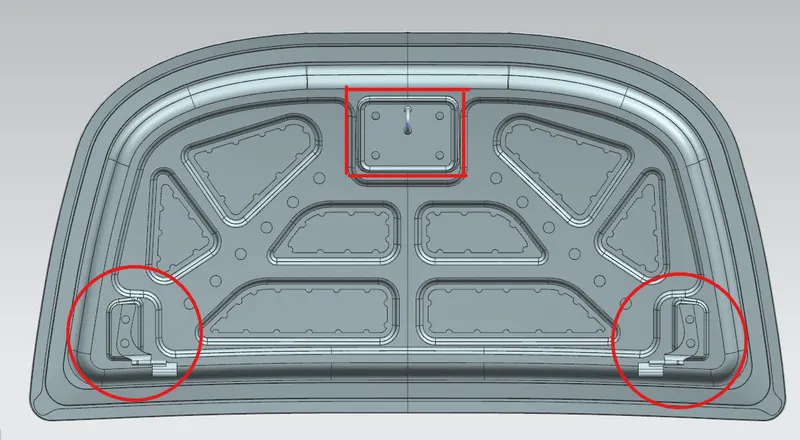
Hood reinforcement are used to reduce the impact in collisions to passangers.Inorder to improve the strength of the hood the reinforcements are used.The area where the strength is low on hood at that place we add reinforcements.
Hinge assembly :
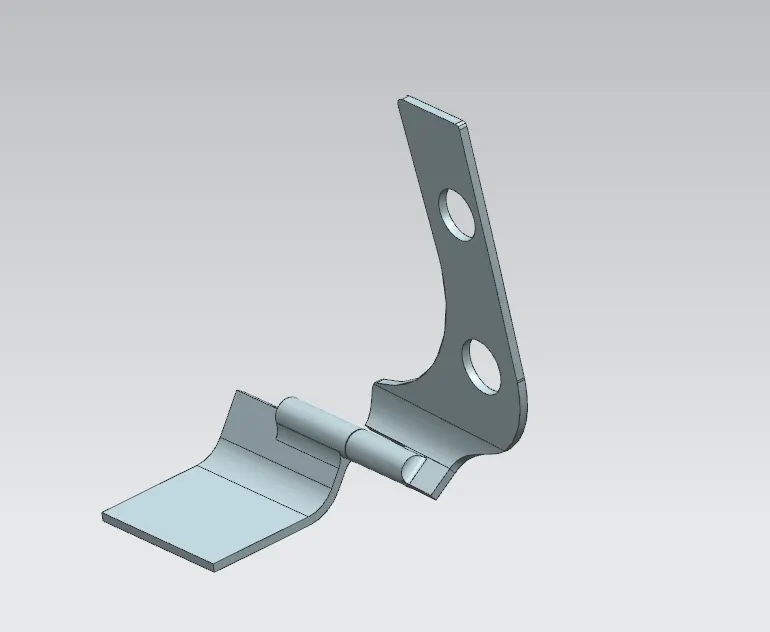
It provides the rotational degree of freedom to the hood about the hinge axis in order to access the engine compartment of the automobile.
Latch and striker assembly :
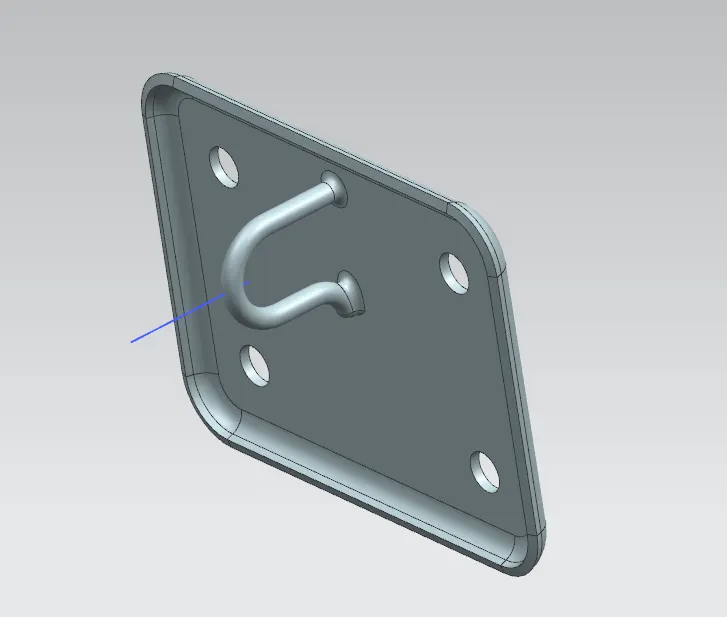
A striker assembly for a door latch comprises a U-shaped bracket and a striker pin. The U-shaped bracket comprises a base plate of substantial width and height and a narrow generally L-shaped strap that is integrally attached to the side of the base plate and that has an end portion spaced from the base plate.
Points to be considered while designing hood :
- Opening angle of hood
- Wrap Around Distance (WAD)
- pedestrain safety
- Mastic Data NVH
Opening angle of hood :
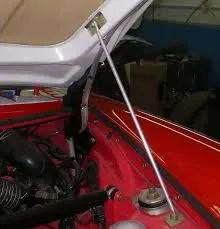
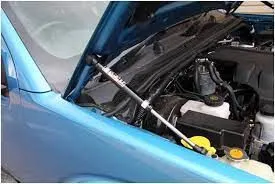
The opening angle of the hood is varies from region to region it depends on the average height of a person at that region or country.The opening angle is considered important criteria because when the opening angle is less there is a chance of head injury to the human. The hood need supports to set an open angle according to the countries. There are two types of supports were there to hold hood. They are
- Support rod
- Gas stay
Wrap Around Distance (WAD) :
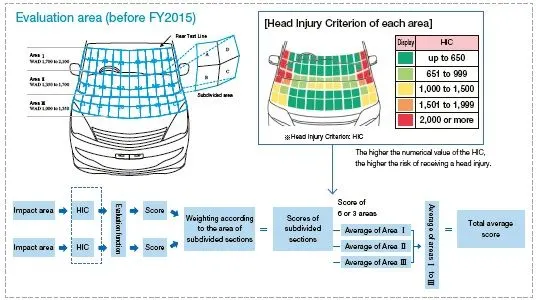
When a car crashes on the pedestrian, the whole human body wraps around the front shape of the car, and the head impacts on the bonnet or the windscreen. The distance at which the head impacts on the car from the ground is mentioned as wrap around distance. To be specific the Wrap Around Distance is a measurement of the distance from the ground to the head impact zone over the outer surface of the car. The wrap around distance is measured longitudinally in the centre of the vehicle from the ground. The severity of the injury caused by the frontal crash depends on the type and shape of the vehicle, the speed of the vehicle, and the movement of the pedestrian relative to the vehicle. In addition to these parameters, the wrap around distance plays a major role in the safety measures of a pedestrian.
pedestrian safety :
When it comes to safety both the driver and the pedestrian safety is important. Driver has got safety within car (Airbags) but when the car hits a pedestrian the whole-body wraps around the front shape of the car and the head impacts on the hood to reduce the head injuries the hood should be designed according to the norms given by the NCAP. They set a range where the adult or child head may receive minimal injuries after an heat impact on the hood.
Mastic Data NVH :
Noise, vibration, and harshness (NVH), also referred to as noise and vibration (N&V), is the study and adjustment of noise and vibration characteristics in vehicles, particularly cars or trucks. While noise and vibration can be readily measured, harshness is a subjective quality.To improve NVH, mastic sealants were provided on the inner panel to attach with outer panel. Here mastic points on the inner panel plays a major role to avoid Noise and Vibration into the cabin.
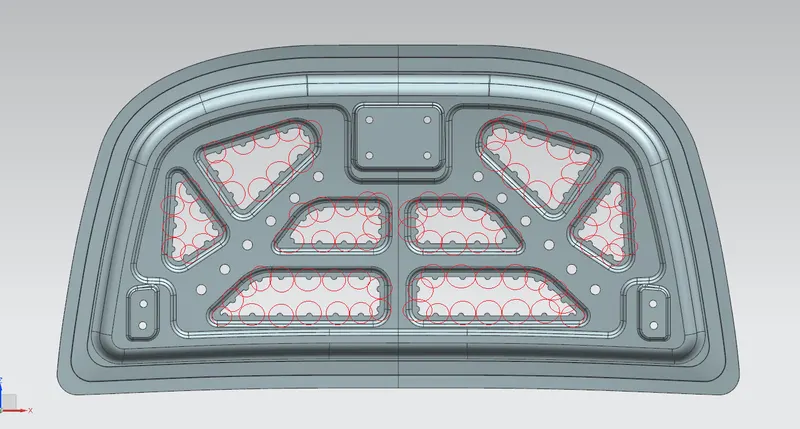
The Final Assembly of the Hood Design :
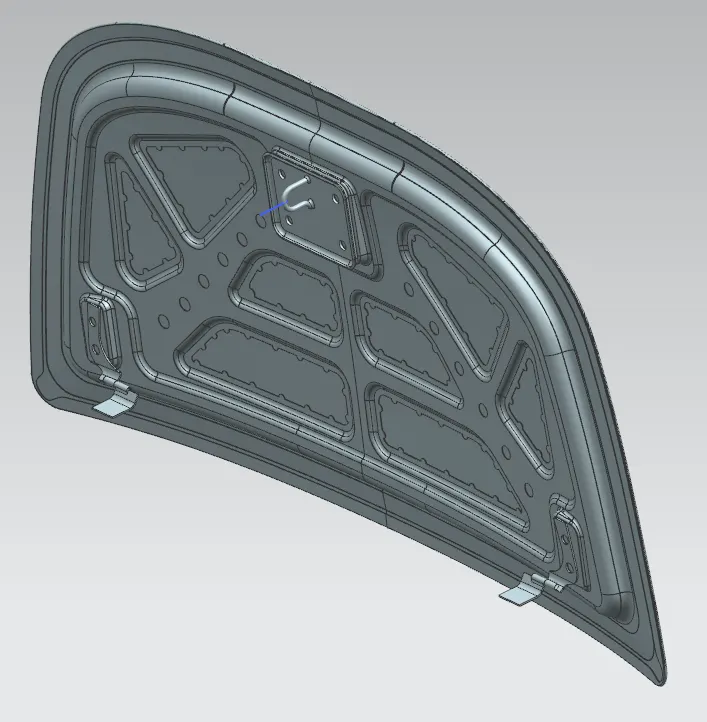
Isometric view
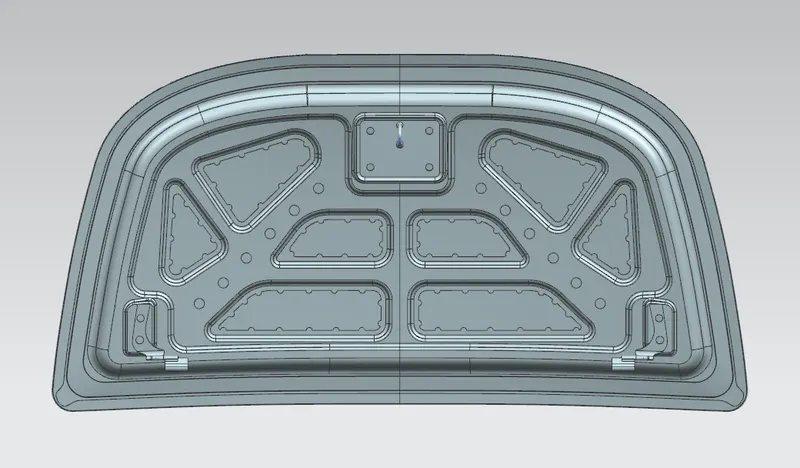
Front View
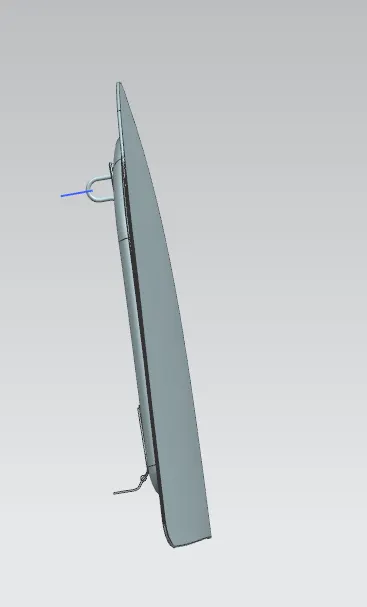
Side view
Conclusion:
Hood inner and outer panel are developed according to the master section using NX CAD.Reinforcement plates are fixed.
Hinge axis and striker trajectory are defined.